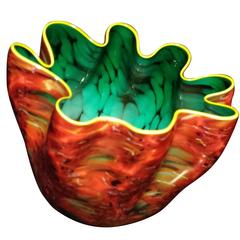
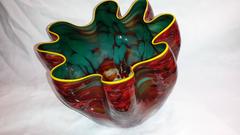
With his sculptural works that fuse naturalistic forms with vibrant colors, Dale Chihuly has established himself as one of the world’s preeminent contemporary makers of art glass. The Tacoma, Washington, native’s experimental techniques — manifest in large-scale glass sculptures, installations and environmental artworks alongside smaller table-top pieces — combine fine art, design, architecture and craft.
Chihuly’s inspired creative energy has brought glass blowing to a place at the forefront of the arts in the United States. His prolific body of work is coupled with a dedication to artistic instruction, education and community. Trained in interior design at the University of Washington, he pursued graduate work with Harvey Littleton, who built the first academic art glass program in the U.S. at the University of Wisconsin-Madison. After further studies at the Rhode Island School of Design, Chihuly was awarded a 1968 Fulbright Fellowship to study glass blowing at the Venini glass factory on the island of Murano in Venice, where he was first introduced to group collaboration in glass making. Not only has Chihuly been committed to his own improvement as an artist, but he has also devoted much of his career to sharing his knowledge. He returned to RISD as an instructor, and after working there for more than a decade and he cofounded the Pilchuck Glass School in Washington State in 1971. An automobile accident in 1976 left Chihuly blind in one eye; a subsequent injury while bodysurfing weakened one shoulder, leaving him reliant on assistant glassblowers to execute his designs.
Chihuly’s skills and technical innovations have allowed him to make pieces in an astonishing array of patterns, textures and hues — yet his work can be recognized immediately. He has created several notable extended series of artworks. These include his “Seaforms,” which evoke shells, starfish and other marine animals; “Blankets,” which are composed of cylindrical units in patterns suggested by Native American textiles; and, most famously, his grand chandeliers made up of scores of curling, curving, pepper-shaped elements. Whether large or small, as you will see on 1stDibs, the works of Dale Chihuly blend practical flair and bravura artistry. They are a highlight of any contemporary art and design collection.
Organic modern furniture is characterized by clean lines, an overall uncomplicated aesthetic and a prioritizing of natural, sustainable materials, such as wood and stone. There are lots of earth tones and natural-world textures rather than bright color palettes or fabrics embellished with busy patterns.
Organic furniture is minimalist and, owing to the ideas of venerable architect Frank Lloyd Wright, designed for warm spaces that promote harmony between human habitation and the great outdoors. Organic modern design, including in furniture and architecture, emerged in the 1930s.
Designers such as Andrianna Shamaris, Alguacil & Perkoff and Jörg Pietschmann — all known for organic modern design — have created furniture that brings dynamic and unpredictable energy to home interiors while emphasizing the importance of a relationship with the natural world.
Striking an appealing balance between our living spaces and nature doesn't have to be an arduous task — the broad selection of original organic modern furniture on 1stDibs includes solid wood tables, bamboo seating options, hand-knotted wall tapestries and more.
Whether you’re seeking glass dinner plates, centerpieces, platters and serveware or other items to elevate the dining experience or brighten the corners of your living room, bedroom or other spaces by displaying decorative pieces, find an extraordinary range of antique, new and vintage glass on 1stDibs.
Glassmaking is more than 4,000 years old. It is believed to have originated in Northern Mesopotamia, where carved glass objects were the result of a series of experiments led by potters or metalworkers. From there, the production of glass vases, bottles and other objects proliferated in Egypt under the reign of Thutmose III. Later, new glassmaking techniques took shape during the Hellenistic era, and glassblowing was invented in contemporary Israel. Then, on the island of Murano in Venice, Italy, modern art glass as we know it came to be.
Over the years, collectors of glass decorative objects or serveware have sought out distinctive antique and vintage pieces of the mid-century modern, Art Deco and Art Nouveau eras, with artisans such as Archimede Seguso, René Lalique and Émile Gallé of particular interest for the pioneering contributions they made to the respective styles in which they worked. Today, long-standing glassworks such as Barovier&Toso carry on the Venetian glasswork tradition, while modern furniture designers and sculptors such as Christophe Côme and Jeff Zimmerman elsewhere test the limits of the radical art form that is glassmaking.
From chandeliers to Luminarc stemware, find a collection of antique, new and vintage glass on 1stDibs.