
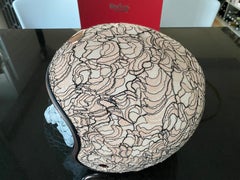
"Ruby" Helmet for Christian Dior
By Christian Dior
Located in Saint-Didier, Provence-Alpes-Côte d'Azur
Extremely rare Christian Dior / ruby Ruby helmet for Christian Dior. Helmet designed for the
Category
2010s French Masks
Materials
Steel
"Ruby" Helmet for Christian Dior
By Christian Dior
Located in Saint-Didier, Provence-Alpes-Côte d'Azur
Extremely rare Christian Dior / ruby Ruby helmet for Christian Dior. Helmet designed for the
Steel
When Christian Dior launched his couture house, in 1946, he wanted nothing less than to make “an elegant woman more beautiful and a beautiful woman more elegant.” He succeeded, and in doing so the visionary designer altered the landscape of 20th century fashion. Vintage Dior bags, shoes, evening dresses, shirts and other garments and accessories are known today for their feminine and sophisticated sensibility.
Dior was born in Granville, on the Normandy coast, in 1905. His prosperous haute bourgeois parents wanted him to become a diplomat despite his interest in art and architecture. However, they agreed to bankroll an art gallery, which Dior opened in 1928 in Paris with a friend.
This was the start of Dior’s rise in the city’s creative milieu, where he befriended Pablo Picasso and Jean Cocteau. After seven years as an art dealer, Dior retrained as a fashion illustrator, eventually landing a job as a fashion designer for Robert Piguet, and in 1941, following a year of military service, he joined the house of Lucien Lelong. Just five years later, with the backing of industrialist Marcel Boussac, the ascendant Dior established his own fashion house, at 30 avenue Montaigne in Paris.
Just two years after the end of World War II, the fashion crowd and the moribund haute couture industry were yearning, comme tout Paris, for security and prosperity, desperate to discard the drab, sexless, utilitarian garb imposed by wartime deprivation. They needed to dream anew.
And Dior delivered: He designed a collection for a bright, optimistic future. “It’s quite a revolution, dear Christian!” exclaimed Carmel Snow, the prescient American editor-in-chief of Harper’s Bazaar, famously proclaiming, “Your dresses have such a new look.” The press ran with the description, christening Dior’s debut Spring/Summer haute couture collection the New Look. “God help those who bought before they saw Dior,” said Snow. “This changes everything.”
Dior’s collection definitively declared that opulence, luxury and femininity were in. His skirts could have 40-meter-circumference hems, and outfits could weigh up to 60 pounds. They were cut and shaped like architecture, on strong foundations that molded women and “freed them from nature,” Dior said. Rather than rationing, his ladies wanted reams of fabric and 19-inch waists enforced by wire corsets, and the fashion world concurred. The debut got a standing ovation.
In the subsequent decade, Paris ruled as the undisputed fashion capital of the world, and Christian Dior reigned as its king. With the luxuriously full skirts of his New Look, suits and his drop-dead gorgeous couture dresses and ball gowns worthy of any princess, Dior gave women the gift of glamour they’d lost in the miserable years of war.
On 1stDibs, find an exquisite range of vintage Christian Dior clothing, jewelry, handbags and other items.
Today, art enthusiasts and venturesome interior designers find a lot to love and appreciate about antique and vintage masks, particularly as they have earned a distinct place amid a collection of folk art and other collectibles and curiosities in contemporary homes.
Folk art refers to art that people, not classically trained, created for either utilitarian or decorative purposes. With respect to visual art in folk art, it is typically reflective of a community’s culture and usually handmade by craftspeople working within a popular tradition. Masks, as part of this history, have been used in carnivals, theater, medicine, therapy, religion and more. The use of masks in rituals and sacred ceremonies goes back thousands of years, and masks in general are believed to be much older. And all kinds of other uses have been found for masks and face coverings over time. We have enlisted these accessories for protection, to signal modesty, facilitate flirtation, enable licentiousness or simply to look cool.
Archaeologists found a mask in Palestine that is believed to be 9,000 years old, a Neolithic-era stone mask that may have been part of rituals associated with the worship of ancestors. Some tribal masks are worn as an offering to the gods. Masks are among the most important African art forms, for example, and traditional African masks can be used to lend a concrete form to an invisible spirit. Dancers donning wooden tribal masks celebrate important events to honor their deceased ancestors. These masks are also very important devices for storytelling and sharing the oral history of a community.
For Asian artists, specific colors are used in masks to convey different values and ideas. In Japan, a red Oni mask worn by performers during a festival might signify anger, while in China’s Peking Opera, a mask that has been hand-painted gold would be worn by an immortal.
Mexican craftspeople make masks for traditional celebrations and ceremonial dances. Mexican masks are part of the country’s folk-art traditions that go back thousands of years and play a role in festivals and theater. A common symbol of the Mexican holiday Day of the Dead is a skull, which is widely represented in masks (although the innumerable activities associated with the holiday are by no means universal).
We’re inviting you to explore and pay respect to the long folk-art traditions that underpin mask-making by introducing antique and vintage masks to your space. Find an exciting collection on 1stDibs today.