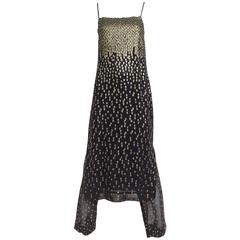
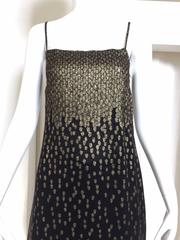
1970s CHRISTIAN DIOR Gold and Black Metallic Indian Inspired Tunic Pant Set
By Christian Dior
Located in Beverly Hills, CA
70s Christian Dior Metallic gold and black silk tunic top and pant ensemble. spaghetti strap and
Category
1970s CHRISTIAN DIOR Gold and Black Metallic Indian Inspired Tunic Pant Set
By Christian Dior
Located in Beverly Hills, CA
70s Christian Dior Metallic gold and black silk tunic top and pant ensemble. spaghetti strap and
When Christian Dior launched his couture house, in 1946, he wanted nothing less than to make “an elegant woman more beautiful and a beautiful woman more elegant.” He succeeded, and in doing so the visionary designer altered the landscape of 20th century fashion. Vintage Dior bags, shoes, evening dresses, shirts and other garments and accessories are known today for their feminine and sophisticated sensibility.
Dior was born in Granville, on the Normandy coast, in 1905. His prosperous haute bourgeois parents wanted him to become a diplomat despite his interest in art and architecture. However, they agreed to bankroll an art gallery, which Dior opened in 1928 in Paris with a friend.
This was the start of Dior’s rise in the city’s creative milieu, where he befriended Pablo Picasso and Jean Cocteau. After seven years as an art dealer, Dior retrained as a fashion illustrator, eventually landing a job as a fashion designer for Robert Piguet, and in 1941, following a year of military service, he joined the house of Lucien Lelong. Just five years later, with the backing of industrialist Marcel Boussac, the ascendant Dior established his own fashion house, at 30 avenue Montaigne in Paris.
Just two years after the end of World War II, the fashion crowd and the moribund haute couture industry were yearning, comme tout Paris, for security and prosperity, desperate to discard the drab, sexless, utilitarian garb imposed by wartime deprivation. They needed to dream anew.
And Dior delivered: He designed a collection for a bright, optimistic future. “It’s quite a revolution, dear Christian!” exclaimed Carmel Snow, the prescient American editor-in-chief of Harper’s Bazaar, famously proclaiming, “Your dresses have such a new look.” The press ran with the description, christening Dior’s debut Spring/Summer haute couture collection the New Look. “God help those who bought before they saw Dior,” said Snow. “This changes everything.”
Dior’s collection definitively declared that opulence, luxury and femininity were in. His skirts could have 40-meter-circumference hems, and outfits could weigh up to 60 pounds. They were cut and shaped like architecture, on strong foundations that molded women and “freed them from nature,” Dior said. Rather than rationing, his ladies wanted reams of fabric and 19-inch waists enforced by wire corsets, and the fashion world concurred. The debut got a standing ovation.
In the subsequent decade, Paris ruled as the undisputed fashion capital of the world, and Christian Dior reigned as its king. With the luxuriously full skirts of his New Look, suits and his drop-dead gorgeous couture dresses and ball gowns worthy of any princess, Dior gave women the gift of glamour they’d lost in the miserable years of war.
On 1stDibs, find an exquisite range of vintage Christian Dior clothing, jewelry, handbags and other items.
Luxurious and versatile, designer day dresses are as well suited to tea at an upscale hotel as they are to your next garden or rooftop party.
Today’s featherlight unisex day dresses — as well as the vibrant vintage day dresses of the 1950s and ’60s — look quite different from the heavy, fabric-rich de rigueur garments of the Victorian era. In the late 19th century, a woman of a certain standing might have multiple dresses to wear throughout the day: specifically, one or two for the daytime and one for the evening. For example, a long-sleeve silk dress with a prominently flared back and a round collar of gold beaded lace that hugs the neck would be suitable for stepping out during the day, while a velvet gown trimmed in silk embroidery but overall comparatively informal in appearance would be worn for afternoon tea at home. At night, a silk velvet evening dress could feature natural world motifs such as butterflies (a characteristic of Art Nouveau design) and have short sleeves adorned with lace and ruffles and a scooped neckline — the perfect attire for the theater.
During the 1920s, after all the chores were done, a woman would change from her housework clothing into a more fashionable day dress to run her errands or socialize. Some 1920s day dresses were brightly colored and featured bold patterns — a cotton dress with a dazzling floral print, perhaps, or, in the case of the more venturesome Art Deco apparel sold in high-end couture fashion boutiques of the era, semi-sheer silk garments embellished with three-dimensional beadwork or rich metallic gold lamé.
Today, a closet full of casual vintage day dresses is a must-have. Whether you opt for black, crimson or beige, day dresses bring an element of glamour to your next appointment, and in the summer, who doesn’t love a wonderfully simple, lightweight day dress cut in cotton and linen?
Because different fashion designers of every decade have offered their own take on the widely loved day dress, you’ll be able to find a variety of vintage and designer day dresses on 1stDibs. Search by creator to find enduring designs by the likes of Emilio Pucci, Pierre Cardin, Yves Saint Laurent and Christian Dior, or browse by period to uncover a scintillating collection of cotton and satin patterned dresses of the 1950s and ’60s.