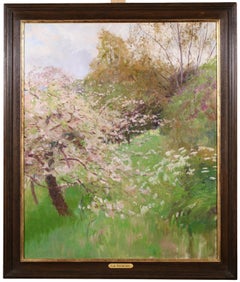
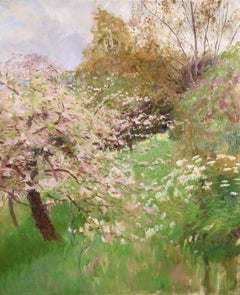
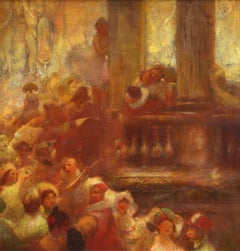
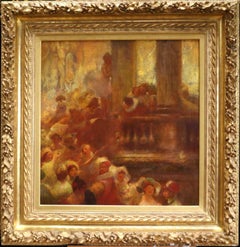
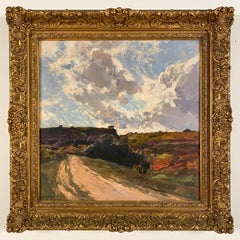
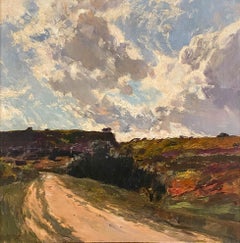
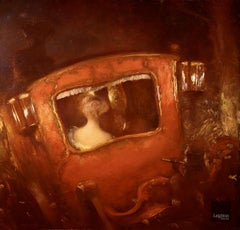
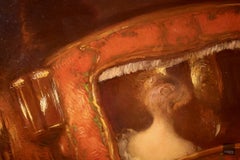
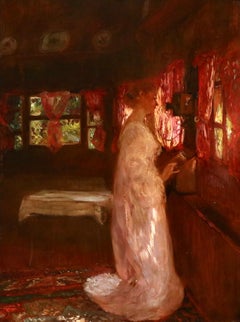
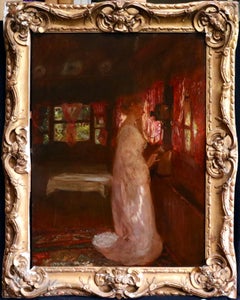
Gaston La Touche, artiste majeur de la fin du XIXe siècle et du début du XXe siècle, a débuté sa carrière dans un style naturaliste inspiré par Manet et Zola, avant d'évoluer vers une esthétique plus joyeuse et personnelle à partir des années 1890. Il s’illustre notamment par des scènes de fêtes, des portraits et des paysages bucoliques, dans lesquels la lumière et la couleur jouent un rôle central. Cette transformation stylistique lui vaut d'être comparé aux peintres rococo du XVIIIe siècle et surnommé "le fils de Watteau". Au cours de sa carrière, Gaston La Touche a exposé très fréquemment ses oeuvres, avec la Société des artistes français de 1874 à 1889, puis à la Société nationale des beaux-arts à partir de 1890, ainsi qu'avec la Société Nouvelle, les Aquarellistes et les Pastellistes. Célébré de son vivant comme l'un des acteurs majeurs de la peinture décorative, son talent lui a permis d'être décoré chevalier de la Légion d’honneur en 1900, puis officier en 1909.
Ses oeuvres sont présentes dans de nombreux musées en France et dans le monde entier.
Painting is an art form that has spanned innumerable cultures, with artists using the medium to tell stories, explore and communicate ideas and express themselves. To bring abstract paintings, landscape paintings, still-life paintings and other original paintings into your home is to celebrate and share in the long tradition of this discipline.
When we look at paintings, particularly those that originated in the past, we learn about history, other cultures and countries of the world. Like every other work of art, paintings — whether they are contemporary creations or works that were made during the 19th century — can often help us clearly see and understand the world around us in a meaningful and interesting way.
Cave walls were the canvases for what were arguably the world’s first landscape paintings, which depict natural scenery through art. Portrait paintings and drawings, which, along with sculpture, were how someone’s appearance was recorded prior to the advent of photography, are at least as old as Ancient Egypt. In the Netherlands, landscapes were a major theme for painters as early as the 1500s. Later, artists in Greece, Rome and elsewhere created vast wall paintings to decorate stately homes, churches and tombs.
Today, creating a wall of art is a wonderful way to enhance your space, showcase beautiful pieces and tie an interior design together.
No matter your preference, whether you favor Post-Impressionist paintings, animal paintings, Surrealism, Pop art or another movement or specific period, arranging art on a blank wall allows you to evoke emotions in a room while also showing off your tastes and interests. A symmetrical wall arrangement may comprise a grid of four to six pieces or, for an odd number of works, a horizontal row. Asymmetrical arrangements, which may be small clusters of art or large, salon-style gallery walls, have a more collected and eclectic feel.
Download the 1stDibs app, which includes a handy “View on Wall” feature that allows you to see how a particular artwork will look on a particular wall, and read about how to arrange wall art. And if you’re searching for the perfect palette for your interior design project, what better place to turn than to the art world’s masters of color?
On 1stDibs, you’ll find an expansive collection of paintings and other fine art for your home or office. Browse abstract paintings, portrait paintings, paintings by emerging artists and more today.