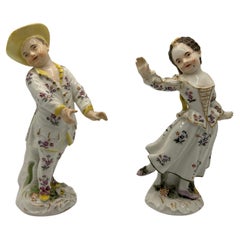
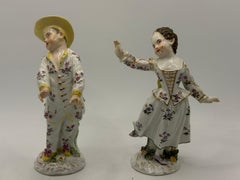
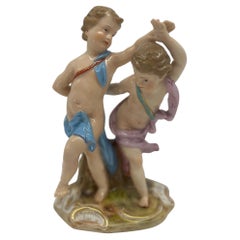
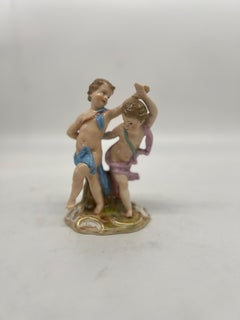
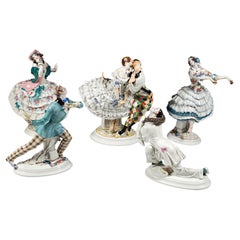
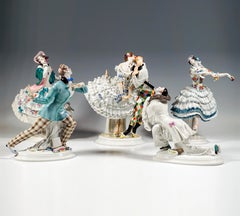
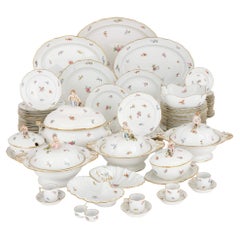
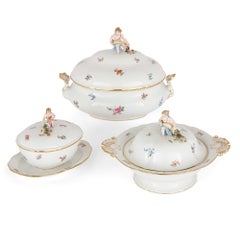
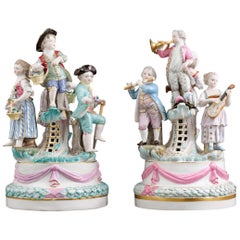
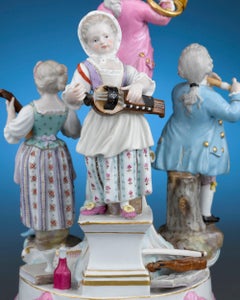
An assortment of meissen figures dancers is available at 1stDibs. Frequently made of
ceramic,
porcelain and
bronze, all meissen figures dancers available were constructed with great care. Meissen figures dancers have been made for many years, and versions that date back to the 19th Century alongside those produced as recently as the 20th Century.
Rococo,
Art Deco and
Art Nouveau meissen figures dancers are consistently popular styles. Many meissen figures dancers are appealing in their simplicity, but
Meissen Porcelain,
Paul Scheurich and
Johann Joachim Kändler produced popular meissen figures dancers that are worth a look.
Meissen Porcelain (Staatliche Porzellan-Manufaktur Meissen) is one of the preeminent porcelain factories in Europe and was the first to produce true porcelain outside of Asia. It was established in 1710 under the auspices of King Augustus II “the Strong” of Saxony-Poland (1670–1733), a keen collector of Asian ceramics, particularly Ming porcelain.
In pursuing his passion, which he termed his “maladie de porcelaine,” Augustus spent vast sums, amassing some 20,000 pieces of Japanese and Chinese ceramics. These, along with examples of early Meissen, comprise the Porzellansammlung, or porcelain collection, of the Zwinger Palace, in Dresden.
The king was determined, however, to free the European market from its dependence on Asian imports and to give European artisans the freedom to create their own porcelain designs. To this end, he charged the scientist Ehrenfried Walther von Tschirnhaus and aspiring alchemist Johann Friedrich Böttger with the task of using local materials to produce true, hard-paste porcelain (as opposed to the soft-paste variety European ceramists in the Netherlands, Germany, France, Italy and Spain had been producing since the late Renaissance). In 1709, the pair succeeded in doing just that, employing kaolin, or “china clay.” A year later, the Meissen factory was born.
In its first decades, Meissen mostly looked to Asian models, producing wares based on Japanese Kakiemon ceramics and pieces with Chinese-inflected decorations called chinoiserie. During the 1720s its painters drew inspiration from the works of Watteau, and the scenes of courtly life, fruits and flowers that adorned fashionable textiles and wallpaper. It was in this period that Meissen introduced its famous cobalt-blue crossed swords logo — derived from the arms of the Elector of Saxony as Arch-Marshal of the Holy Roman Empire — to distinguish its products from those of competing factories that were beginning to spring up around Europe.
By the 1730s, Meissen’s modelers and decorators had mastered the style of Asian ceramics, and Augustus encouraged them to develop a new, original aesthetic. The factory’s director, Count Heinrich von Brühl, used Johann Wilhelm Weinmann’s botanical drawings as the basis for a new line of wares with European-style surface decoration. The Blue Onion pattern (Zwiebelmuster), first produced in 1739, melded Asian and European influences, closely following patterns used in Chinese underglaze-blue porcelain, but replacing exotic flora and fruits with Western varieties (likely peaches and pomegranates, not onions) along with peonies and asters.
During the same period, head modeler Joachim Kändler (1706–75) began crafting delicate porcelain figures derived from the Italian commedia dell’arte. Often used as centerpieces on banquet tables and decorated to reflect the latest fashions in courtly dress for men and women, these figurines were popular in their day, and are still considered among Meissen’s most iconic creations. Kändler also created the Swan Service, which, with its complex low-relief surface design and minimal decoration is considered a masterpiece of Baroque ceramics.
The rise of Neoclassicism in the latter half of the 18th century forced Meissen to change artistic direction and begin producing monumental vases, clocks, chandeliers and candelabra. In the 20th century, Meissen added to its 18th-century repertoire decidedly modern designs, including ones in the Art Nouveau style. The 1920s saw the introduction of numerous animal figures, such as the popular sea otter (Fischotter), which graced an East German postage stamp in the 1960s. Starting in 1933, artistic freedom was limited at the factory under the Nazi regime, and after World War II, when the region became part of East Germany, it struggled to reconcile its elite past with the values of the Communist government. In 1969, however, new artistic director Karl Petermann reintroduced the early designs and fostered a new degree of artistic license. Meissen became one of the few companies to prosper in East Germany.
Owned by the State of Saxony since reunification, in 1990, Meissen continues to produce its classic designs together with new ones developed collaboratively with artists from all over the world. In addition, through its artCAMPUS program, the factory has invited distinguished ceramic artists, such as Chris Antemann and Arlene Shechet, to work in its studios in collaboration with its skilled modelers and painters. The resulting works of contemporary sculpture are inspired by Meissen’s rich and complex legacy.
Find a collection of authentic Meissen Porcelain on 1stDibs.
Figurative sculpture is a modern art form in which artists create work that is typically representative of the visible world. However, sculptures that are considered to be figurative in style can definitely be inclusive of abstract elements. A wide range of antique, new and vintage figurative sculptures has been made over the years by both well-known and emerging artists, and these pieces can prove striking and provocative as part of your home decor.
Realistic representation in visual art has a very long history. And while figurative artists, whether figurative painters or sculptors, find inspiration in humans, animals and real-life objects, good figurative sculptures can make us think differently about how the real world should look. Just as figurative paintings might include Photorealistic human likenesses, they can also include elements of Surrealism and can suggest a creative and alternative reality. Figurative sculptures aren’t always realistic impressions of our world — depictions of the human form in classical Greek sculpture, for example, might emphasize beauty and physical perfection.
There are a variety of figurative sculptures on 1stDibs created by artists working in a number of styles, including Art Deco, Art Nouveau, mid-century modern and more. A large figurative sculpture can introduce an excellent focal point in a guest bedroom, while smaller works might draw the eye to spaces such as wall shelving or a bookcase that people may otherwise overlook.
When decorating your living room, dining room, home office and study areas with figurative sculptures, don’t be afraid to choose bold colors to inject brightness into neutral spaces. Texture is another factor to consider when purchasing figurative sculptures. A highly textural work of ceramics or wood will catch the eye in a sleek modern space, whereas a smooth, flat glass sculpture can offer an often much-needed contrast in a room that already has many textures.
On 1stDibs, find antique, new or vintage figurative sculpture or other kinds of sculpture for your home decor today.