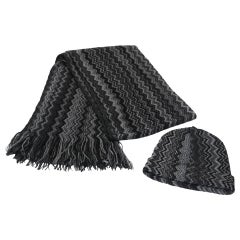
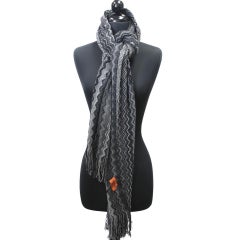
Missoni Wool and Acrylic Striped Fringe Shawl and Beanie Hat Set Scarf
By Missoni
Located in Downey, CA
Missoni Wool and Acrylic Striped Fringe Shawl and Beanie Hat Set Scarf Be fashionable and warm
Category
Missoni Wool and Acrylic Striped Fringe Shawl and Beanie Hat Set Scarf
By Missoni
Located in Downey, CA
Missoni Wool and Acrylic Striped Fringe Shawl and Beanie Hat Set Scarf Be fashionable and warm
In 1953, Ottavio “Tai” Missoni (1921–2013) and Rosita Missoni (b. 1931) opened a small knitwear shop in Gallarate, Italy, paving the way for what would become an iconic style of colorful chevron knit.
Missoni began with a tracksuit, which featured zippers down the legs because, as Rosita recalls it, “Tai was too lazy to take off his shoes when putting them on.” The couple’s fashion really took off, though, once they discovered the Raschel knitting machine on a trip to a shawl factory. The machine enabled the Missonis to knit multiple colors in a zigzag pattern, a motif that would go on to become synonymous with the Missoni brand across everything from its alluring vintage day dresses and sweaters to its purses, seating and rugs.
Missoni held its first fashion show in Florence in 1967 and caused a bit of a sensation when the models’ Lurex dresses proved translucent under the lights at the Pitti Palace. Scandal aside, the show went down in history as a hit, and the Missonis soon made their debut in the United States with the help of legendary fashion editor Diana Vreeland, who gave the variegated Missoni stripe the Vogue seal of approval, saying, “Who says a rainbow has seven colors? It has many shades.” (It was also Vreeland who reportedly introduced the Missonis to Neiman Marcus president Stanley Marcus, effectively shepherding the brand to the American market.)
Missoni’s many-shaded rainbow would soon become an emblem of the 1970s fashion scene, earning the brand a permanent place in the fashion canon. In 1973, the New York Times proclaimed: “Missoni’s weaved garments have ended up universal materialistic trifles, as Vuitton sacks and Gucci shoes.”
The brand branched into the home market in 1983, with Rosita overseeing this new venture, Missoni Home, which included furniture, textiles and accessories. Daughter Angela succeeded her mother at the helm of the brand, where she served as creative director until 2021 and is currently president; her brother Luca is CEO, while her daughter Margherita was creative director of M Missoni, a modestly priced offshoot that was discontinued in 2021.
Find vintage Missoni clothing and accessories today on 1stDibs.
We’ve long had a love affair with vintage and designer scarves. Every glamorous go-to ensemble deserves the lightweight finishing touch that can be added with this stylish, versatile accessory.
Scarves have held a distinctive place in the evolution of formal and casual wear for centuries. And although now firmly entrenched in western culture, the origins of this neckwear are global.
Egyptian Queen Nefertiti is known to have worn a finely woven scarf with a headdress, and Emperor Cheng of the Chinese Han dynasty presided over an army of warriors whose scarves denoted their rank. The idea of scarves as status symbols still persists; for example, silk scarves, which were favored by the upper class during the reign of Queen Victoria, are an out-of-reach luxury item, cost prohibitive for many consumers. However, the increasing diversity of available materials over the years has rendered this adornment more accessible since their early days.
Luxury houses and various designers helped elevate scarves and long, flowing wraps as a desirable fashion accessory during the 20th century.
Visionary Italian designer Emilio Pucci — the first fashion designer to enter the lifestyle market — introduced abstractions and dazzling psychedelic elements to scarves, while mid-century era multidisciplinary American artist Vera Neumann drew on Japanese techniques to create exuberant textile designs based on her paintings and drawings.
Established in Paris in 1837, Hermès didn’t start creating their famously decorative scarves until 100 years later, in 1937. Before long, the Hermès scarf, then crafted from strong imported Chinese silk, became an iconic work favored by actresses such as Audrey Hepburn and Grace Kelly, a lifetime enthusiast of the family-owned brand. Hermès has produced over 2,000 different scarf designs in the decades since Robert Dumas, Émile-Maurice Hermès’s son-in-law, crafted the first one.
On 1stDibs, find a broad selection of vintage scarves that includes flamboyant and colorful accessories designed by Chanel, Yves Saint Laurent and more.