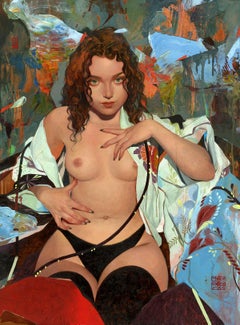
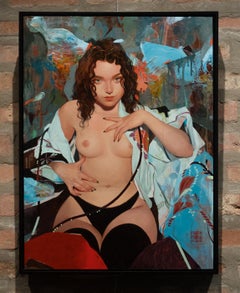
The Hours of Light
Located in Palm Beach, FL
"Soey Milk crafts beautiful portraits of women that contain elements of calm alongside calamity
Category
21st Century and Contemporary Contemporary Figurative Paintings
Materials
Copper
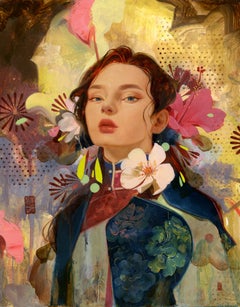
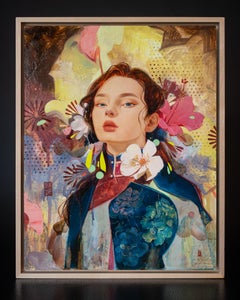
The Hours of Light
Located in Palm Beach, FL
"Soey Milk crafts beautiful portraits of women that contain elements of calm alongside calamity
Copper
$882Sale Price|61% Off
H 24.02 in W 18.12 in D 0.79 in
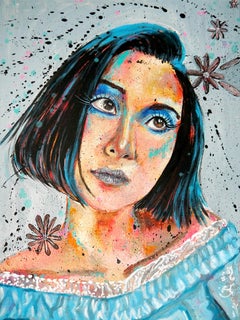
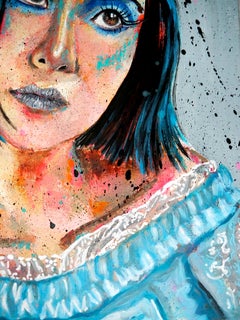
Portrait Blue Soey Artist French School 127 READY TO HANG Chut les Barbizons!
Located in Zofingen, AG
Portrait PS 127 Blue Soey Portrait of the artist Soey Milk wearing a blue dress ⭐Structural
Oil, Acrylic, Gesso, Canvas, Stretcher Bars
Phlox
Located in Palm Beach, FL
"Soey Milk crafts beautiful portraits of women that contain elements of calm alongside calamity
Oil
$11,000
H 24 in W 18 in
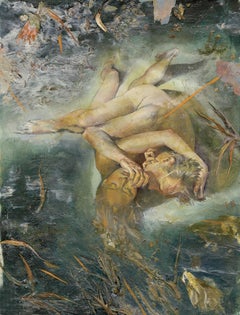
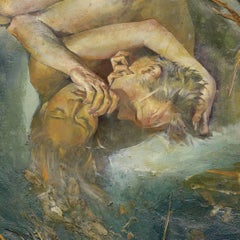
"Entanglement" Mixed media painting w/earth and plant matter.
By Kent Williams
Located in Palm Beach, FL
Kent Williams’ work melds the rigor of technical prowess with the iconoclast’s impulse to disrupt. Juxtaposing beautifully rendered classical forms with elements of abstraction and s...
Organic Material, Oil


$4,119
H 40.56 in W 29.53 in D 0.08 in
Zarina - Limited edition fine art nude print, Oversize photo, Contemporary
By Ian Sanderson
Located in Sant Cugat del Vallès, Barcelona
Zarina - Limited edition archival pigment print, 1987 - Edition of 5 This image was captured on film. The negative was scanned creating a digital file which is then printe...
Photographic Film, Archival Paper, Black and White, Pigment, Archival Pi...
Figurative art, as opposed to abstract art, retains features from the observable world in its representational depictions of subject matter. Most commonly, figurative paintings reference and explore the human body, but they can also include landscapes, architecture, plants and animals — all portrayed with realism.
While the oldest figurative art dates back tens of thousands of years to cave wall paintings, figurative works made from observation became especially prominent in the early Renaissance. Artists like Michelangelo, Leonardo da Vinci and other Renaissance masters created naturalistic representations of their subjects.
Pablo Picasso is lauded for laying the foundation for modern figurative art in the 1920s. Although abstracted, this work held a strong connection to representing people and other subjects. Other famous figurative artists include Francis Bacon and Lucian Freud. Figurative art in the 20th century would span such diverse genres as Expressionism, Pop art and Surrealism.
Today, a number of figural artists — such as Sedrick Huckaby, Daisy Patton and Eileen Cooper — are making art that uses the human body as its subject.
Because figurative art represents subjects from the real world, natural colors are common in these paintings. A piece of figurative art can be an exciting starting point for setting a tone and creating a color palette in a room.
Browse an extensive collection of figurative paintings on 1stDibs.
A 2001 canvas turns forest into color and line — a confident gesture from a fiercely independent artist.
In Denver, a major new retrospective reveals how the painter’s devotion to ordinary life — and his fearless shifts in style — shaped modern art.
Only the best painter could suit the calculatedly extravagant Bertha Russell.
With a solo show at the Denver Art Museum and a commission from the Met, the Cree Canadian painter has become an international sensation.
After a two-year closure, they Yale Center for British Art opens its doors again, with all sorts of changes to its building and programming.
The Italian-American’s 2020 abstract painting “The Hoe” personifies his “art of not knowing.”
Get to know the key movements and artists who have influenced visual culture for more than a century.
The nonspeaking California artist is having a moment, with vivacious paintings that play on art-magazine covers as well as more mysterious abstractions.