Albertolli Giacondo Art

to
4
Overall Width
to
Overall Height
to
4
4
4
2
2
1
1
1
1
1
1
4
4
11,311
2,858
2,497
1,459
4
Artist: Albertolli Giacondo
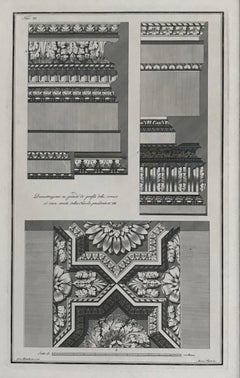
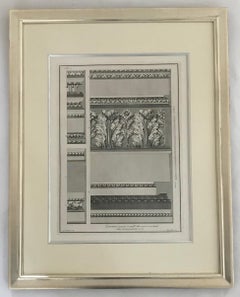
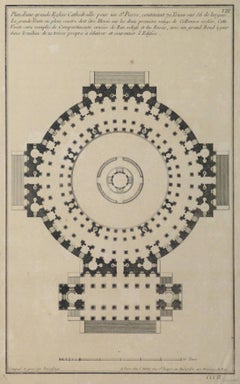
Architectural designs. A set of nine architectural engravings.

Architectural designs. A set of nine architectural engravings.

By Albertolli Giacondo

Located in Paris, FR

Architectural designs. A set of nine architectural engravings. These engravings are framed in white gold covered french frames. From the publication published in Milan in 1782. "Diff...

Category

1780s Albertolli Giacondo Art

Materials

Engraving

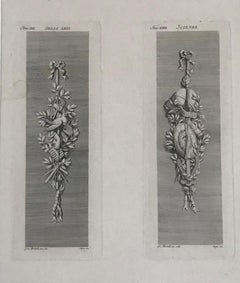
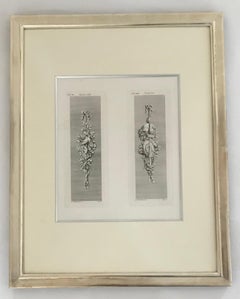
Allegory of the four seasons. Four engravings on two framed sheets.

Allegory of the four seasons. Four engravings on two framed sheets.

By Albertolli Giacondo

Located in Paris, FR

Allegory of the four seasons. A pair of engravings. These engravings are framed in white gold covered french frames. From the publication published in Milan in 1782. "Different ornam...

Category

1780s Albertolli Giacondo Art

Materials

Engraving

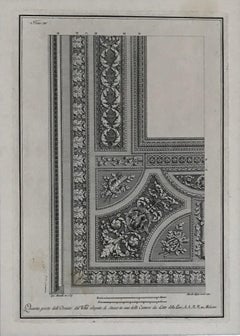
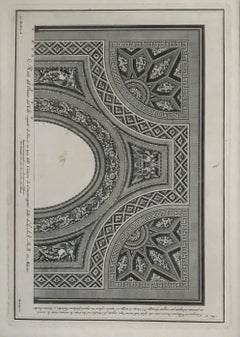
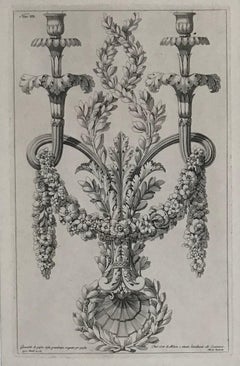
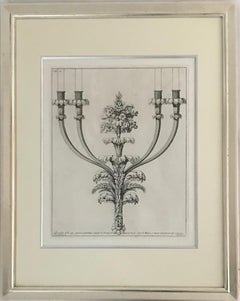
Chandelier designs. A pair of engravings

Chandelier designs. A pair of engravings

By Albertolli Giacondo

Located in Paris, FR

Chandelier designs. A pair of architectural engravings. These engravings are framed in white gold covered french frames. From the publication published in Milan in 1782. "Different o...

Category

1780s Albertolli Giacondo Art

Materials

Engraving

Related Items
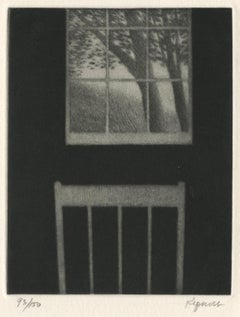
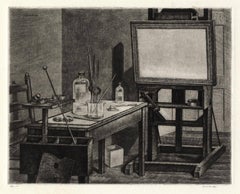
Landscape with Window and Chair

Landscape with Window and Chair

By Robert Kipniss

Located in Fairlawn, OH

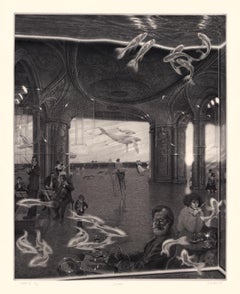
Landscape with Window and Chair Mezzotint on wove paper, 2000 Signed in pencil lower right (see photo) Edition: 150 (93/150) (see photo) Special Presentation Print for the Print Club...

Category

Early 2000s Contemporary Albertolli Giacondo Art

Materials

Mezzotint

Four 19th Century Hand Colored Engravings Depicting English Royal Residences

Four 19th Century Hand Colored Engravings Depicting English Royal Residences

By Charles Wild

Located in Alamo, CA

Four hand colored etchings and aquatints depicting interiors within English royal residences, including "The Blue Velvet Room at Carlton House", "The Queen's Library at Frogmore", "T...

Category

1810s Academic Albertolli Giacondo Art

Materials

Engraving

Before It Happened (A mysterious staircase offers no clues as to what happened)

Before It Happened (A mysterious staircase offers no clues as to what happened)

By Jukka Vanttinen

Located in New Orleans, LA

This Finnish artist creates a mezzotint in black and white. This impression is #44 of 100 and is signed, dated and titled in pencil. Jukka Vanttinen (Finn, b. 1954) Jukka Vanttinen...

Category

Early 2000s Modern Albertolli Giacondo Art

Materials

Mezzotint

"King of the Friendly Islands" (Tonga); Engraving from Captain Cook's 3rd Voyage

"King of the Friendly Islands" (Tonga); Engraving from Captain Cook's 3rd Voyage

By John Webber

Located in Alamo, CA

"Poulaho, King of the Friendly Islands, Drinking Kava" is an engraving created by William Sharp (1749-1824), from a drawing by John Webber (1752-1793), who was the artist on Captain James Cook's 3rd and final voyage of discovery. It was published in the atlas of "A Voyage to the Pacific Ocean Undertaken by the Command of His Majesty, for Making Discoveries in the Northern Hemisphere", the official British Admirality sanctioned journal published upon completion of the voyage in London in 1784 by Strahan & Cadell. Captain Cook visited Tonga on his 3rd voyage, which he named The Friendly Islands because of the warm welcome he and his crew received, unlike some of the other more hostile Pacific islands. The engraving depicts Cook and his men observed a kava ceremony at the village of Mu’a on Tongatapu. King Paulaho sits in the centre foreground, his back to the spectator with a man kneeling before him. The ceremonial mat depicted behind Paulaho indicates that nobody was allowed to sit behind him. The figure in the centre holds a single cup, referring to the Tongan custom of offering the cup to the king first. Kava is native to the islands of the South Pacific and was first described for English readers in 1768 by Captain James Cook. The kava root has been used for centuries as a central feature of ceremonies and celebrations because it was able to bring about a calming and pleasant social atmosphere. The root was crushed and processed into coconut milk to become the focal ceremonial beverage, simply referred to as kava. This engraving is presented in a Koa wood frame and a white mat. Koa wood is legendary in Hawaii. There are occasional faint spots, but the print is otherwise in very good condition. This amazing Koa wood is native to Hawaii and it is known for the deep rich colors and varied grain pattern. Koa has an honored heritage in Hawaii and is highly revered and sacred. The word “koa” means “warrior” in Hawaiian. The warriors of King Kamehameha the Great, created canoes and weapons from a wood plentiful on the Big Island of Hawaii. This wood became synonymous with the warriors themselves, and it became known as koa. There are three other engravings listed from the official journal of Captain Cook's 3rd voyage available that are presented in identical Koa wood frames and mats (LU117324682422, LU117324684052, LU117324684032). They would make a wonderful grouping for a display of 2, 3 or 4 prints. A discount is available for a grouping depending on the number of items included. Captain Cook is remembered as one of the greatest explorers and navigators in history. His explorations included Australia, New Zealand and islands of the South Pacific and the northwest coast of North America. Hawaii was discovered by Captain Cook during this voyage. Hawaii was originally called The Sandwich Islands in honor of The Earl of Sandwich...

Category

1780s Realist Albertolli Giacondo Art

Materials

Engraving

Four Koa Wood Framed 18th C. Engravings from Captain Cook's 3rd Voyage Journal

Four Koa Wood Framed 18th C. Engravings from Captain Cook's 3rd Voyage Journal

By John Webber

Located in Alamo, CA

A grouping of four framed engravings of Hawaii, Tahiti, Tonga and Vancouver Island from the atlas of the official British Admiralty sanctioned journal of Captain Cook's 3rd Voyage entitled "A Voyage to the Pacific Ocean Undertaken by the Command of His Majesty, for Making Discoveries in the Northern Hemisphere", published upon completion of the voyage in London in 1784 by Strahan & Cadell. These engravings were made from drawings by John Webber (1752-1793), who was the artist on Captain James Cook's 3rd and final voyage of discovery. The set of engravings includes: "A Canoe of the Sandwich Islands, the Rowers Masked", Plate 65 in the atlas; "A Dance in Otaheite" (Tahiti), Plate 28; "King of the Friendly Islands" (Tonga), plate 20; "Inside of a House in Nootka Sound" (Canada), plate 42. These engravings are professionally framed in Koa wood, the same wood as was used to make the canoes of the ancient Hawaiians. Koa wood is legendary in Hawaii. Not only is this amazing wood native to Hawaii, but it is known for the deep rich colors and varied grain pattern. Koa has an honored heritage in Hawaii and is highly revered and sacred. The word “koa” means “warrior” in Hawaiian. The warriors of King Kamehameha the Great, created canoes and weapons from a wood plentiful on the Big Island of Hawaii. This wood became synonymous with the warriors themselves, and it became known as koa. These four engravings would make a wonderful grouping for a display of 2, 3 or 4 prints. They may be purchased separately or in groups on 1stDibs. Their listing Reference #'s are: LU117324682432, LU117324682022, LU117324684052 and LU117324684062. A discount is available for a grouping depending on the number of items included. Hawaii was discovered by Captain Cook (1728-1779) during this voyage. Hawaii was originally called The Sandwich Islands in honor of The Earl of Sandwich...

Category

1780s Other Art Style Albertolli Giacondo Art

Materials

Engraving

Vatican Hallway designed by Raphael: 18th C. Hand-colored Engraving by Volpato

Vatican Hallway designed by Raphael: 18th C. Hand-colored Engraving by Volpato

By Giovanni Volpato

Located in Alamo, CA

This is an original 18th century hand-colored framed copper-plate engraving by Giovanni Volpato after a drawing by Camporesi. It was the frontispiece for volume one of the rare and v...

Category

Late 18th Century Old Masters Albertolli Giacondo Art

Materials

Engraving

N. Lambert Seigneur de Thorigny: 17th C. Engraved Portrait After Largillière

N. Lambert Seigneur de Thorigny: 17th C. Engraved Portrait After Largillière

By Nicolas de Largillière

Located in Alamo, CA

This is a 17th century engraving entitled "Messire Nicolas Lambert Seigneur de Thorigny, Conseiller du Roy" by Pierre Drevet after a painting by Noicolas de Largillière, published in Paris in 1698. This portrait depicts a three-quarter length view of Nicolas Lambert de Thorigny, who is dressed in elaborate robes and collar of a wealthy Parisian nobleman of the time. He is seated directed to the left and looking directly at the viewer. He is holding an inscribed note in his right hand. A magnificent billowing curtain is in the background. Lambert's coat of arms is shown in the center of the lower inscription area. In the inscription area is lettered with title, production detail: "Nic. Largilliere pinxit" and "Petr. Drevet sculpsit", and publication detail: "Se vend a Paris chez Drevet rüe du Foin au coin du College de Maître Gervais". Nicolas Lambert, Seigneur de Thorigny (1600-1664), was a French nobleman and military commander who lived in the 17th century. He served in the French army during the Thirty Years' War, a conflict that took place from 1618 to 1648 and involved many European powers. Lambert fought in several battles during the war and rose to the rank of colonel. After the war, Lambert returned to France and became involved in politics. He served as a member of the Estates General, a legislative body that advised the king, and as a governor of several provinces. He was a counsellor and confidant of King Louis XIV. He had the title of Président de la Chambre des Comptes. He also became a member of the French Academy of Sciences, a prestigious institution that promotes scientific research and scholarship. Lambert was known for his military expertise, his intelligence, and his commitment to public service. He iInherited the Hôtel Lambert in Paris from his brother Jean Baptiste in 1644 and hired some of the most prominent artists of the time, including Charles Le Brun to decorate and furnish the building. This beautiful old master engraving was created with impressive detailed technique. It is printed on laid, chain-linked paper. The sheet measures 18.5" high and 13.38" wide. The sheet is adhered to an archival backing paper at the top. There is a faint horizontal center fold and mild discoloration in the inscription area and in the upper margin on the right, with mild wrinkling here. The print is otherwise in very good condition, considering its age. This engraving is so rare, that no comparable prints could be identified for sale online. It is currently only listed in museum collections, including: The Metropolitan Museum of Art, The British Museum, The Louvre, The Riksmuseum, The Victoria & Albert Museum, The Fitzwilliam Museum at the U. of Cambridge, The Boston Museum of Fine Arts, Harvard Art Museums, The Finnish National Museum, The Philadelphia Museum. It is shown in the Metropolitan Museum's Cataloque of French paintings entitled: "French Paintings in The Metropolitan Museum of Art, published in 2018, page 36. The page is included in the photos. Nicolas de Largillière (1656-1746) was a French portrait painter who achieved great success and acclaim during the late Baroque and Rococo periods. He was born in Paris and trained under the painter Antoine Goubeau. He studied in Antwerp and London before returning to France. While in England he was a favorite painter of King Charles II and King James II of England...

Category

Late 17th Century Albertolli Giacondo Art

Materials

Engraving

G. Paterson "Dinner Party at a Mandarin's House" Engraving After T. Allom c.1840

G. Paterson "Dinner Party at a Mandarin's House" Engraving After T. Allom c.1840

Located in San Francisco, CA

G. Paterson "Dinner Party at a Mandarin's House" Original Engraving After T. Allom C.1840 Original engraving Dimensions 8" wide x 5" high The frame measures 20.5" wide x 18.5" hig...

Category

Mid-19th Century Realist Albertolli Giacondo Art

Materials

Engraving

The Duchess of St. Albans: A 17th C. Portrait After a Kneller Painting

The Duchess of St. Albans: A 17th C. Portrait After a Kneller Painting

By (After) Sir Godfrey Kneller

Located in Alamo, CA

This is a 17th century engraved mezzotint portrait of the Duchess of St. Albans by John Smith, after a painting by Sir Godfrey Kneller. It was published in London by John Boydell in 1694. The Duchess of St. Albans (1642-1712) was a woman named Diana de Vere. She was born in 1642, the daughter of Aubrey de Vere, the 20th Earl of Oxford. In 1662, she married Charles Beauclerk, the illegitimate son of King Charles II and his mistress, Nell Gwyn. As a result of her marriage, Diana became the Duchess of St. Albans, and she and Charles had several children together. Diana was known for her beauty and charm, and she was a prominent figure in the court of King Charles II. Despite her husband's illegitimate birth, Diana was highly respected in the royal court and was known for her intelligence and wit. She was a patron of the arts and supported many artists and writers of the time. Diana lived through a tumultuous period of English history, including the Great Fire of London and the Glorious Revolution, which saw King James II replaced by William of Orange. She died in 1712 at the age of 70 and was buried in Westminster Abbey. Descendants of Diana and her husband, who was an illegitimate son of King Charles II, include Diana, Princess of Wales and her son William, Duke of Cambridge. An author wrote of her: "The line of Vere, so long renown’d in arms, Concludes with luster in St. Albans’s charms; Her conquering eyes have made their race complete, It rose in valor, and in beauty set." This striking mezzotint engraving depicts Diana, Duchess of St Albans in a three-quarter length pose, standing, wearing loose flowing dress and a wrap. She has a very serene, calm appearance as she is looking straight at the viewer. There is a landscape of trees in the background. The print is adhered in the corners to an archival backing, which is itself adhered in the upper corners to a larger backing. The print is trimmed to just beyond the plate mark. There are areas of discoloration in the margins and in the inscription area, but the print is otherwise in very good condition. The sheet measures 14.5" high and 10" wide. This mezzotint is held by multiple museums and institutions, including The British Museum, The National Portrait Gallery London, The Fine Arts Museum of Boston, The Lewis Walpole Library at Yale, The Yale Center for British Art, The Fitzwilliam Museum at Cambridge and The National Galleries of Scotland. The original Kneller painting is part of the British Royal Collection Trust and hangs in the King's Private Dining Room at Hampton Court Palace. Sir Godfrey Kneller (1646-1723) was a leading portrait painter of his time, particularly renowned for his depictions of the British aristocracy and royalty. He was born in Lübeck, Germany, and trained in Amsterdam under the painter Ferdinand Bol...

Category

Late 17th Century Albertolli Giacondo Art

Materials

Mezzotint

Lillies and Bowls (still life of flowers and colorful bowls)

Lillies and Bowls (still life of flowers and colorful bowls)

Located in New Orleans, LA

The moon, bowls, lillies and birds are featured in this 2002 mezzotint. It is #17 from an edition of 75 and is signed, titled, dated and edition by hand by this Korean artist born i...

Category

Late 20th Century Contemporary Albertolli Giacondo Art

Materials

Mezzotint

Parmigiani Amica: An 18th Century Engraving and Etching by Strange After Mazzola

Parmigiani Amica: An 18th Century Engraving and Etching by Strange After Mazzola

Located in Alamo, CA

This is an 18th century engraving and etching entitled "Parmigiani Amica" by Robert Strange after a painting by Girolamo Francesco Maria Mazzola, better known as Parmigianino, who lived during the Renaissance period. It was published in London in 1774. As the inscription states, the painting was in the collection of the King of Naples at the time the engraving was made. The engraving depicts a half-length portrait of a young woman, known as Parmigiani's Amica (meaning "female friend" in Italian). She is depicted wearing a simple but elegant dress with a low-cut neckline, which reveals her delicate features and graceful neck. Her hair is arranged in a simple yet stylish manner. She is turning to the right to look lovingly at her infant, which she is holding with her right arm. She is touching the baby's mouth with her left hand. The background of the engraving is plain and unadorned, allowing the viewer to focus entirely on the subject of the portrait. The result is a beautiful and timeless image that captures the essence of Renaissance portraiture. The engraving is printed on watermarked paper. The sheet measures 16.25" high and 12' wide. The sheet is adhered to paper in its upper corners and it has been removed from the paper in its lower corners. There is some mild discoloration and some wrinkling in the margins, including the lower inscription area, and a small dark spot in the upper margin, which may represent a drop of ink occuring at the time of printing. These issues do not involve the image, which is in very good condition. The print is held by several museums and institutions, including: The Metropolitan Museum of Art in New York, The British Museum in London, The Royal Museums of the UK, The British National Trust...

Category

Late 18th Century Albertolli Giacondo Art

Materials

Engraving, Etching
Albertolli Giacondo art for sale on 1stDibs.

Find a wide variety of authentic Albertolli Giacondo art available for sale on 1stDibs. You can also browse by medium to find art by Albertolli Giacondo in engraving and more. Not every interior allows for large Albertolli Giacondo art, so small editions measuring 12 inches across are available. Customers who are interested in this artist might also find the work of John Webber, Georges Lepape, and Fernando de Jesus Oliveira . Albertolli Giacondo art prices can differ depending upon medium, time period and other attributes. On 1stDibs, the price for these items starts at $3,558 and tops out at $21,025, while the average work can sell for $4,448.

Artists Similar to Albertolli Giacondo

Questions About Albertolli Giacondo Art
  • 1stDibs ExpertMay 3, 2024
    The real story of the Mona Lisa may never be known for certain. However, most art historians believe that Lisa del Giocondo, the wife of a silk merchant from Florence, posed for the painting. Biographies of Leonardo da Vinci and other historical documents from the Italian Renaissance suggest that the del Giocondos commissioned the work to hang in their new home and to mark the occasion of the birth of their son. On 1stDibs, find a large selection of fine art.
  • 1stDibs ExpertNovember 13, 2024
    Why the Mona Lisa is called La Gioconda is because of the identity of the woman widely believed to be shown in Leonardo da Vinci's masterpiece. Many art historians consider that the portrait depicts Lisa Gherardini, the wife of an Italian merchant named Francesco del Giocondo. In Italian, "La" is the feminine form for the word "the." Changing "Giocondo" to "Giaconda" is a way to make the last name feminine. Put simply, “La Gioconda” means "the wife of Giocondo" and describes who Lisa Gherardini was. Explore a wide variety of fine art on 1stDibs.