Albrecht Dürer Furniture

German, 1471-1528

Albrecht Dürer revolutionized woodcut printmaking as an artform and his influence over the medium's practitioners has endured for centuries. Revered for his masterfully detailed prints and drawings, the German artist was driven by boundless curiosity. Dürer was the Renaissance personified in 16th-century northern Europe — he was more deeply engaged in the pursuits of the era’s Italian painters than any other artist from the region, an attribute that earned him the title “Leonardo of the North.”

Trained initially as a goldsmith in his father’s workshop, Dürer’s talent for art materialized early, in a self-portrait at the age of 13 in 1484. Held in the Albertina Museum in Vienna, this silverpoint drawing is one of the oldest extant self-portraits in European art. 

While Dürer traveled extensively, his two stays in Venice, which took place during the turn of the 16th century, were among the most influential. There he became increasingly acquainted with the work of great Italian artists including Gentile and Giovanni Bellini, Antonio Pollaiuolo, Leonardo da Vinci and a young Raphael. Naturally, Dürer found great inspiration in the Venetians’ theoretical interests, techniques, use of color and more.

Over the course of his career, Dürer received commissions from Frederick the Wise-Elector of Saxony, Emperor Maximilian I and the Holy Roman Emperor Charles V. At one point he was commissioned to draw the first living rhinoceros seen in Europe since the Roman Empire. Despite having never actually seen the animal, Dürer made the now-famous c. 1515 woodcut based on one written account and brief sketch. For years it remained the common interpretation of what rhinos looked like to Europeans.

Dürer’s woodcuts were widely disseminated during his time, and he is the best known artist associated with the Northern Renaissance. His breathtaking technical prowess is most prominent in his three master engravings — Saint Jerome in His Study, Melencolia I and Knight, Death, and the Devil — profoundly influential works that are characterized by rich textures and meticulously detailed imagery.

Dürer’s work is in the collections of many museums, including the National Gallery in London and the Metropolitan Museum of Art in New York, while his former home in Nuremberg, Germany, has been converted into a museum dedicated to his legacy. Important works like Hare and Praying Hands can be found in the Albertina, while his second famous self-portrait from 1500 — which depicts Dürer in a fur-trimmed robe — is on display in the Alte Pinakothek in Munich.

Find original Albrecht Dürer prints and other art on 1stDibs.

to
2
1
2
1
1
1
1
1
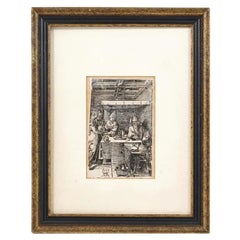
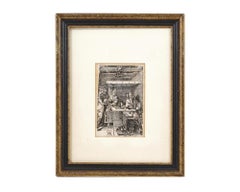
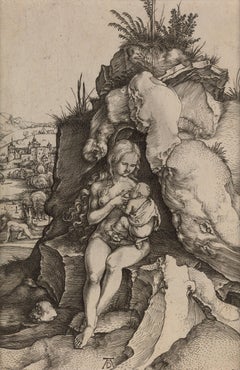
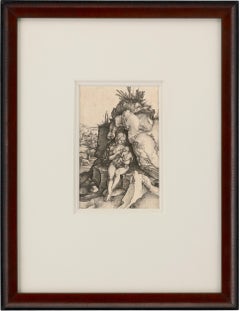
The Penance of St. Chrysostom by Albrecht Dürer

The Penance of St. Chrysostom by Albrecht Dürer

By Albrecht Dürer

Located in New Orleans, LA

Albrecht Dürer 1471-1528 German The Penance of St. Chrysostom Monogrammed in the plate lower center "AD" Copper engraving on laid paper “Whatever was mortal in Albrecht Dürer li...

Category

15th Century and Earlier Old Masters Albrecht Dürer Furniture

Materials

Copper

Selection of Early Modernist Art - Lautrec Durer et al

Selection of Early Modernist Art - Lautrec Durer et al

By Henri de Toulouse-Lautrec, Albrecht Dürer

Located in Atlanta, GA

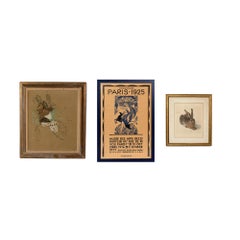
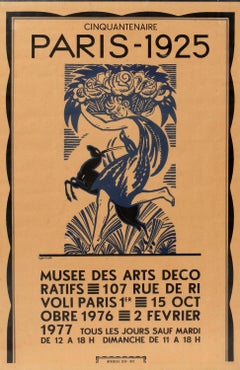
Selection of early Modernist Art, mostly French, 20th century. From left to right, as seen in the first photo, they are: 1) Henri de Toulouse-Lautrec color lithograph or print, circa 1960s. It measures 26.5"H x 23"W. 2) 50th Anniversary of the Legendary 1925 Exposition Art...

Category

1960s French Art Nouveau Vintage Albrecht Dürer Furniture

Materials

Glass, Wood, Paper

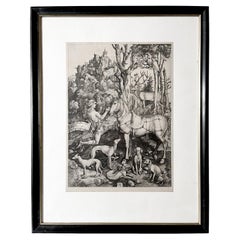
Albrecht Dürer - Saint Eustace

Albrecht Dürer - Saint Eustace

By Albrecht Dürer

Located in Paris, FR

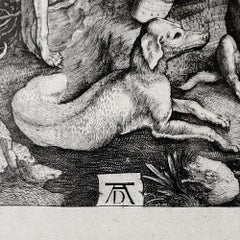
Albrecht Dürer, Saint Eustace. Copper engraving, 1501. Carved later in the 16 century. Signed with the monogram A.D (Albrecht Dürer) Why not having on a...

Category

16th Century German Renaissance Antique Albrecht Dürer Furniture

Materials

Paper

Related Items
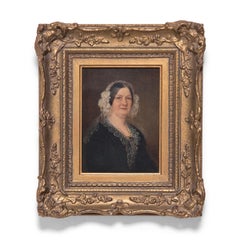
Oil Portrait of a Victorian Lady, c. 1850

Oil Portrait of a Victorian Lady, c. 1850, c. 1850

$1,480

H 13.75 in W 11.5 in D 1.75 in

Oil Portrait of a Victorian Lady, c. 1850

Located in Chicago, IL

Painted in the 19th century, this exquisite miniature portrait wonderfully exemplifies realism in traditional oil painting. The small artwork is painted in the conventional portraiture style of the Old Masters, and achieves soft realism with fine brushwork and a subdued, neutral palette. The half length portrait depicts a fine Victorian woman dressed in all black with a delicate lace collar and bonnet. She wears a ruby broach...

Category

Mid-19th Century Old Masters Albrecht Dürer Furniture

Materials

Oil

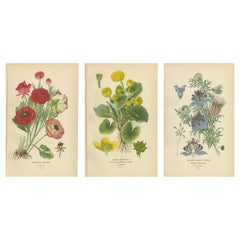
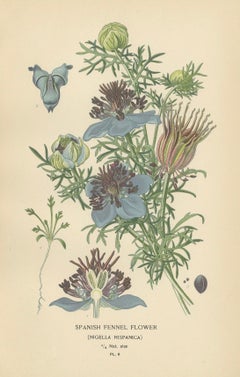
Heritage Blossoms: A Victorian Botanical Selection, 1896

Heritage Blossoms: A Victorian Botanical Selection, 1896

Located in Langweer, NL

"Heritage Blossoms: A Victorian Botanical Selection" Description: Unveiling "Heritage Blossoms: A Victorian Botanical Selection" a trio of original antique prints from the esteemed ...

Category

1890s Antique Albrecht Dürer Furniture

Materials

Paper

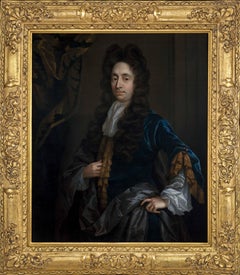
Portrait of a Gentleman in a Blue Coat Standing by a Curtain c.1695, Netscher

Portrait of a Gentleman in a Blue Coat Standing by a Curtain c.1695, Netscher

Located in London, GB

Portrait of a Gentleman in Blue Coat Standing by Curtain c.1695 Attributed to Constantyn Netscher (c.1668-c.1723), not signed The gentleman in this portrait has been depicted standi...

Category

17th Century Old Masters Albrecht Dürer Furniture

Materials

Canvas, Oil

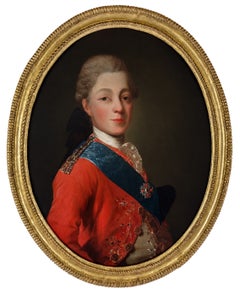
Portrait Painting Grand Duke Pavel Petrovich, Later Emperor Paul I, 18th century

Portrait Painting Grand Duke Pavel Petrovich, Later Emperor Paul I, 18th century

Located in London, GB

Portrait of Grand Duke Pavel Petrovich (1754–1801), later Emperor Paul I of Russia After Alexander Roslin (1718–1793) Oil on canvas, oval, late 18th century This is an exceptionally handsome and historically resonant eighteenth-century portrait, uniting the immediacy of an intimate likeness with the authority of one of the defining dynastic images of Imperial Russia. Grand Duke Pavel Petrovich, the future Emperor Paul I, turns towards the spectator with a composed, almost conversational expression, his youthful face emerging softly from the restrained brown background. The rich scarlet of his coat, the deep blue of the sash and the flashes of gold, lace and jewelled decoration give the picture remarkable visual distinction, while the oval format concentrates attention upon the sitter’s face and magnificent ceremonial attire. Painted during the eighteenth century, the present work is a contemporary reduced version of Alexander Roslin’s monumental state portrait of 1777, now in the State Hermitage Museum, St Petersburg. Roslin’s full-length original measures approximately 265 by 168 centimetres; here, its essential elements have been reformulated as a more intimate portrait suitable for display within an aristocratic residence, diplomatic household or private cabinet. Pavel is dressed in the height of European court fashion of the later 1770s. His scarlet habit à la française comprises a close-fitting coat and elaborately embroidered waistcoat, enriched with scrolling metallic ornament, floral motifs and a sequence of large decorative buttons. The shoulder is finished with a densely worked epaulette-like band, while a white linen stock and delicate lace jabot frame the face. His powdered hair is dressed in the fashionable bag-wig, drawn back and tied with a broad black silk ribbon. Although the costume is unmistakably Russian in its dynastic significance, its cut and ornament belong to the international language of court dress then prevailing from Versailles and Vienna to Stockholm and St Petersburg. In Roslin’s original full-length composition, the costume was completed by matching scarlet breeches, silk stockings, buckled shoes, a sword and a plumed tricorne, all identifying Pavel as both a prince of the blood and a cultivated participant in the ceremonial life of Europe’s great courts. Across his breast passes the broad blue watered-silk sash of the Imperial Order of St Andrew the First-Called, the senior Russian order of chivalry established by Peter the Great. The sash, conventionally worn from the right shoulder towards the left hip, proclaimed the sitter’s position at the summit of the imperial hierarchy. Superimposed upon it is the red-enamelled cross of the Order of St Anna, surrounded in the portrait by scintillating, jewel-like highlights. The cross had a particular dynastic resonance: the order had been founded by Pavel’s paternal grandfather, Duke Karl Friedrich of Holstein-Gottorp, in memory of his wife Anna Petrovna, daughter of Peter the Great. Pavel’s display of the two orders therefore asserted not only rank and honour, but his descent from the founder of Imperial Russia and his inheritance through the Romanov and Holstein-Gottorp lines. Contemporary portraits similarly identify Pavel through the blue sash and star of St Andrew and the red cross of St Anna. Born in St Petersburg in 1754, Pavel Petrovich was the only son of Grand Duke Peter Fyodorovich, later Emperor Peter III, and Grand Duchess Catherine Alexeyevna, the future Catherine the Great. Through his father he was a great-grandson of Peter the Great and inherited the Romanov and Holstein-Gottorp bloodlines; through his mother, born Princess Sophie of Anhalt-Zerbst, he was connected to the extensive network of German princely houses that shaped eighteenth-century European dynastic politics. His childhood was dominated by the uncertainties of imperial succession. Soon after his birth, the Empress Elizabeth removed him to her own household and assumed control of his upbringing. Educated under the statesman Nikita Panin, Pavel studied history, geography and mathematics and became fluent in Russian, French and German. He was eight when his father ascended the throne in 1762, only to be deposed by Catherine within months and to die shortly afterwards in confinement. Although Pavel remained the acknowledged heir, Catherine ruled for another thirty-four years and excluded him from meaningful political authority. He was therefore publicly honoured as the future sovereign while being denied the practical experience of government. In 1773 he married Princess Wilhelmina Louisa of Hesse-Darmstadt, who converted to Orthodoxy as Grand Duchess Natalia Alexeievna. She died in April 1776 after a prolonged labour, together with her stillborn child, leaving Pavel widowed and the succession unsecured. A second marriage was arranged within months. His new bride was Duchess Sophie Dorothea of Württemberg, daughter of Friedrich Eugen, later Duke of Württemberg, and Friederike Dorothea of Brandenburg-Schwedt. Raised at Montbéliard in a cultivated German princely household, she converted to Orthodoxy as Maria Feodorovna and married Pavel in October 1776. The union strengthened Russia’s links with Württemberg and Brandenburg-Prussia, but also became an enduring domestic and cultural partnership. Maria was intelligent and artistically gifted, practising drawing, embroidery, ivory carving and hardstone work, while collecting books and decorative art and later supporting charitable and educational institutions. The couple had ten children, nine of whom survived childhood. Their eldest son, Alexander, succeeded Pavel as Emperor Alexander I and ruled during the Napoleonic era; their younger son Nicholas later became Emperor Nicholas I. Constantine Pavlovich became a prominent military figure and briefly stood at the centre of the succession crisis of 1825. Their daughters married into leading European dynasties: Alexandra into the Austrian imperial family, Elena into Mecklenburg-Schwerin, Maria into Saxe-Weimar-Eisenach, Catherine into Württemberg and Anna into the Dutch royal house. Through their children, Pavel and Maria extended Romanov influence across much of Europe. The birth of Alexander in 1777 secured the succession and prompted Catherine to give the couple the estate that became Pavlovsk, south of St Petersburg. Its Neoclassical palace, begun by Charles Cameron in the early 1780s, became closely associated with Maria’s artistic interests, family life and refined sociability. Gatchina, by contrast, reflected Pavel’s more martial character. There he developed his own court and pursued his interests in military organisation, ceremony and administrative discipline. In 1781–82 Pavel and Maria travelled through Europe as the Count and Countess of the North, visiting royal courts, artists, manufactories and antiquities collections. They acquired paintings, furniture, bronzes, sculpture, textiles and porcelain, helping to make Pavlovsk one of Russia’s most sophisticated expressions of international Neoclassical taste. Yet Catherine continued to restrict their independence, taking charge of the upbringing of Alexander and Constantine just as Empress Elizabeth had once removed Pavel from his own parents. This repetition deepened the estrangement between mother and son. Pavel finally succeeded Catherine in 1796, aged forty-two. His reign lasted little more than four years, but his Act of Succession of 1797 established male-line primogeniture and ended much of the uncertainty surrounding the Russian imperial succession. His attempts to regulate the court, army and administration, and to reverse elements of Catherine’s policies, alienated powerful members of the nobility and officer corps. In March 1801 he was assassinated during a palace coup at the Mikhailovsky Castle and was succeeded by Alexander. This knowledge lends the portrait particular poignancy: Pavel appears not as the embattled emperor of his final years, but as the elegant young heir at a moment when marriage, dynasty and the anticipated birth of a son seemed to promise stability and renewal. Roslin’s portrait should be understood within this urgent dynastic context. The Swedish painter had travelled to St Petersburg in 1775 at the personal invitation of Catherine II and was commissioned to paint monumental state portraits of the Empress, Pavel and Maria Feodorovna. The pendant portraits of the young couple presented the heir and his new wife as the polished, fertile and internationally connected future of the Romanov dynasty. Roslin recorded in 1777 that the ruling family had ordered multiple copies. At least six versions of Pavel’s portrait and twelve of Maria’s are known, and such replicas were distributed as courtly and diplomatic gifts. A pair was presented to James Harris, later First Earl of Malmesbury, then the British ambassador to Russia. The existence of numerous eighteenth-century replicas was therefore not accidental or merely commercial: repetition was integral to the commission’s political purpose. Each version extended the official image of succession from the imperial palace into allied courts, embassies and aristocratic collections. The present portrait belongs to that wider culture of dynastic dissemination. Rather than reproducing Roslin’s entire monumental setting, with its architectural balustrade, extensive Neva prospect, sword, hat and full ceremonial costume, the painter has selected the head and upper body and adapted them to an oval. This transformation changes the character of the image. The grandeur of the original remains legible in the orders, costume and confident turn of the figure, but the reduced composition produces a greater sense of proximity to Pavel himself. The face becomes dominant, and the future emperor appears less as a remote emblem of state than as a recognisable young man. The type also circulated through prints: an oval engraved version published in 1781 and now represented in the British Museum demonstrates how rapidly Roslin’s conception entered the broader visual culture of late-eighteenth-century Europe. The artistic economy in which the portrait was created differed substantially from the modern open market. In Catherine’s Russia, the most prestigious portrait production was sustained by imperial commissions, aristocratic patronage and diplomatic gift-giving. Roslin’s success was extraordinary: during approximately two years in Russia he received around seventy-five commissions, many of which had to be completed after his return west. The appetite for his work reflected both the wealth of the Russian court and its determination to present itself through the most polished international style available. Alongside imported masters such as Roslin, Russia was developing its own institutional artistic culture. The Academy of the Three Noble Arts had been founded in St Petersburg in 1757 and was elevated by Catherine in 1764 to the Imperial Academy of Arts. It recruited European teachers, trained Russian...

Category

18th Century Old Masters Albrecht Dürer Furniture
Materials

Oil, Canvas

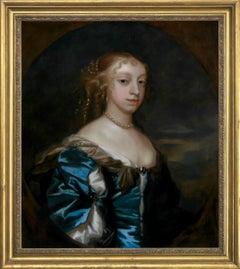
Portrait of Lady Diana Bruce in Blue Dress & Cut Sleeves c.1660-1670, Peter Lely

Portrait of Lady Diana Bruce in Blue Dress & Cut Sleeves c.1660-1670, Peter Lely

By Sir Peter Lely

Located in London, GB

Portrait of Lady Diana Bruce in a Blue Dress with Cut Sleeves c.1660-1670 Circle of Sir Peter Lely (1616-1680) Presented by Titan Fine Art is a captivating portrait of the noble Lad...

Category

17th Century Old Masters Albrecht Dürer Furniture
Materials

Oil, Canvas

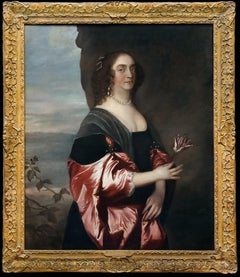
Portrait of a Lady, in Black Dress with Red Satin Sleeves and Pearls c.1660-1680

Portrait of a Lady, in Black Dress with Red Satin Sleeves and Pearls c.1660-1680

By Sir Peter Lely

Located in London, GB

Portrait of a Lady, in a Black Dress with Red Satin Sleeves and Pearls English School c.1660–1680 Circle of Sir Peter Lely (1618-1680) This striking portrait is a compelling exampl...

Category

17th Century Old Masters Albrecht Dürer Furniture
Materials

Canvas, Oil

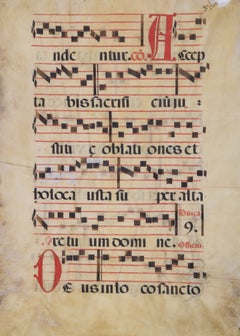
Spainish, Castille, Choir Book, c. 1575, Communion Acceptabis sacrificium

Spainish, Castille, Choir Book, c. 1575, Communion Acceptabis sacrificium

Located in Fairlawn, OH

Spanish, probably Castile Leaf from a Dominican Gradual: Acceptabis sacrificium and Deus in loco sancto suo Late 16th century Ink and red pigment on parchment; square-note plainsong...

Category

16th Century Old Masters Albrecht Dürer Furniture
Materials

Ink

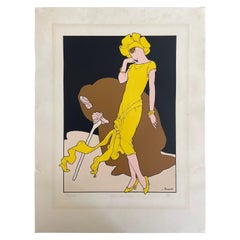
Art Deco Serigraph by Mexican Artist Ernesto Garcia Cabral Signed

Art Deco Serigraph by Mexican Artist Ernesto Garcia Cabral Signed

$1,020Sale Price|20% Off

H 19.25 in W 14.5 in D 0.1 in

Art Deco Serigraph by Mexican Artist Ernesto Garcia Cabral Signed

By Henri de Toulouse-Lautrec

Located in San Diego, CA

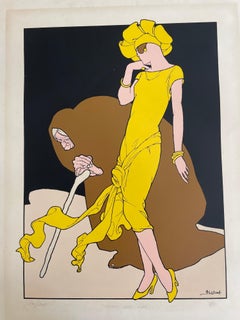
Beautiful and rare signed serigraph by Ernesto Garcia "El Chango" Cabral. 191/200 Titled: "Como me ves..." This beauty is a clear example of Art Deco, the colors are beautiful and ...

Category

20th Century Mexican Art Deco Albrecht Dürer Furniture

Materials

Paper

Portrait of King Charles I, in Armour, after Sir Anthony van Dyck, Carved framed

Portrait of King Charles I, in Armour, after Sir Anthony van Dyck, Carved framed

Located in London, GB

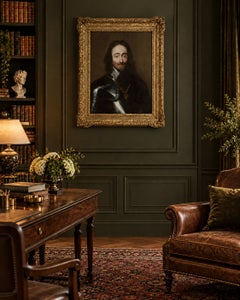
This handsome and unusually intimate image of King Charles I brings one of Sir Anthony van Dyck’s most commanding royal inventions into a scale ideally suited to private display. Aga...

Category

17th Century Old Masters Albrecht Dürer Furniture
Materials

Canvas, Oil, Wood Panel

Portrait of Sir John Wentworth and Mary, Lady Wentworth Gentleman Lady Dahl

Portrait of Sir John Wentworth and Mary, Lady Wentworth Gentleman Lady Dahl

By Michael Dahl

Located in London, GB

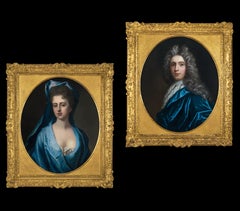
Portrait of Sir John Wentworth, 1st Baronet, and Mary, Lady Wentworth née Lowther c.1695–1705 Attributed to Michael Dahl (c.1659–1743) and Attributed to Thomas Murray (1663–1735) T...

Category

17th Century Old Masters Albrecht Dürer Furniture
Materials

Canvas, Oil

The Bathers ("De Zwemmertjes")

The Bathers ("De Zwemmertjes")

By Rembrandt van Rijn

Located in New York, NY

Etching and drypoint on laid paper, 1651. New Hollstein's third, and final, state. Full sheet size 5.38 x6.5 inches. Frame size 14.25 x 16.75 inches. Catalogue raisonné references...

Category

1650s Old Masters Albrecht Dürer Furniture
Materials

Drypoint, Etching

Print by Henri de Toulouse-Lautrec, featuring the cabaret singer Yvette Guilbert

Print by Henri de Toulouse-Lautrec, featuring the cabaret singer Yvette Guilbert

By Henri de Toulouse-Lautrec

Located in Beograd, RS

In this listing you will find a collotype or photolithography by Henri de Toulouse-Lautrec, depicting Miss Lender, Dancing a Bolero. The original piece titled “Mlle Lender, dansa...

Category

Early 1900s Austrian Art Nouveau Antique Albrecht Dürer Furniture

Materials

Paper

Previously Available Items
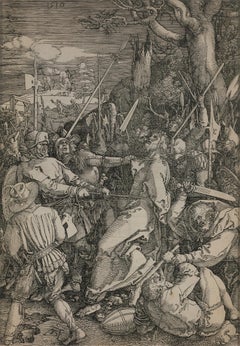
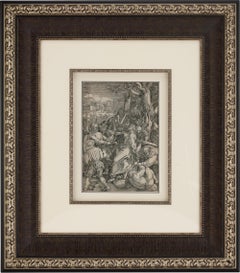
The Betrayal of Christ from Large Passion by Albrecht Dürer

The Betrayal of Christ from Large Passion by Albrecht Dürer

By Albrecht Dürer

Located in New Orleans, LA

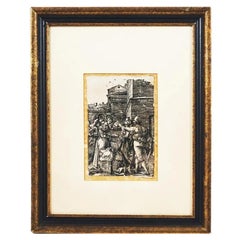
Albrecht Dürer 1471-1528 German The Betrayal of Christ Monogrammed in the block “AD” (lower left) Woodcut on laid paper with a tower and crown watermark “Whatever was mortal in A...

Category

16th Century Old Masters Albrecht Dürer Furniture
Materials

Laid Paper, Woodcut

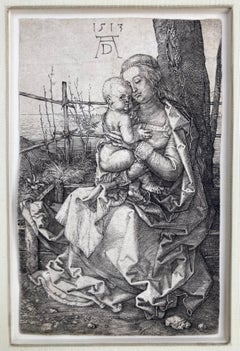
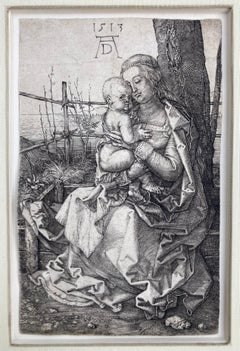
THE VIRGIN AND CHILD SEATED BY A TREE

THE VIRGIN AND CHILD SEATED BY A TREE

By Albrecht Dürer

Located in Santa Monica, CA

ALBRECHT DURER (1471-1528) THE VIRGIN AND CHILD SEATED BY A TREE 1513 (Bartsch 35; Meder 34 c-d, Hollstein 34) Engraving a generally good impression. Trimmed slightly into the i...

Category

16th Century Old Masters Albrecht Dürer Furniture
Materials

Engraving

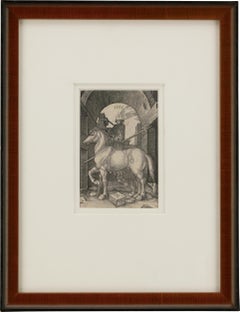
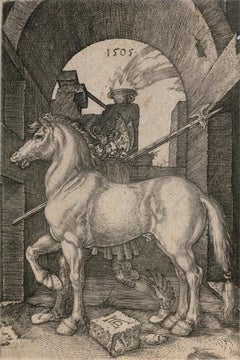
The Small Horse by Albrecht Dürer

The Small Horse by Albrecht Dürer

By Albrecht Dürer

Located in New Orleans, LA

Albrecht Dürer 1471-1528 German The Small Horse Dated in the plate on upper center; monogrammed in the plate lower center: AD Meder state a Copperplate engraving on laid paper “W...

Category

16th Century Renaissance Albrecht Dürer Furniture

Materials

Laid Paper, Engraving

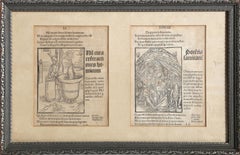
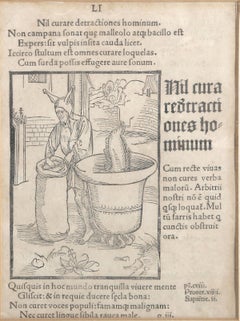
Ship of Fools Diptych, Old Masters Woodcut and Engraving by Albrecht Dürer

Ship of Fools Diptych, Old Masters Woodcut and Engraving by Albrecht Dürer

By Albrecht Dürer

Located in Long Island City, NY

Albrecht Dürer, German (1471 -1528) - Diptych from First Edition of The Ship of Fools, Year: 1494, Medium: Woodcut and Engraving, Image Size: 7 x 12.25 inches, Frame Size: 10.75 ...

Category

15th Century and Earlier Old Masters Albrecht Dürer Furniture
Materials

Engraving, Woodcut

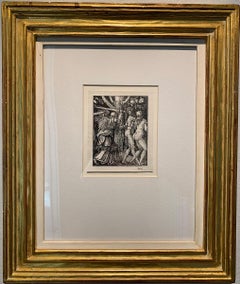
'Adam and Eve Expelled from Eden' by Albrecht Dürer, Woodcut Print

'Adam and Eve Expelled from Eden' by Albrecht Dürer, Woodcut Print

By Albrecht Dürer

Located in Oklahoma City, OK

This 18.75" x 15.75" framed, woodblock print was produced by German Renaissance artist, Albrecht Dürer, circa 1511. The 5.75" x 4.63" print floats on white mat board and is presented...

Category

16th Century Renaissance Albrecht Dürer Furniture
Materials

Woodcut

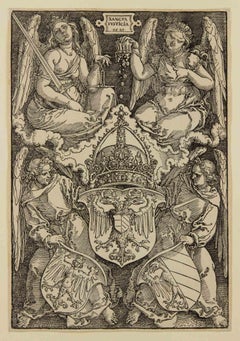
The Arms of the Holy Roman Empire and of the...-Woodcut by Albrecht Durer - 1521

The Arms of the Holy Roman Empire and of the...-Woodcut by Albrecht Durer - 1521

By Albrecht Dürer

Located in Roma, IT

Also called "The Justice", this woodcut print depicts The Arms of the Holy Roman Empire and of the City of Nuremberg. Realized by Durer in 1521, as dated in the top center of the pl...

Category

16th Century Modern Albrecht Dürer Furniture
Materials

Woodcut

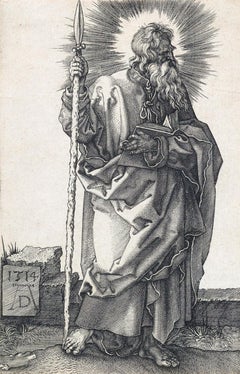
Saint Thomas
Saint Thomas

Albrecht DürerSaint Thomas, 1514

Sold

H 4.5 in W 2.75 in D 1 in

Saint Thomas

By Albrecht Dürer

Located in Greenwich, CT

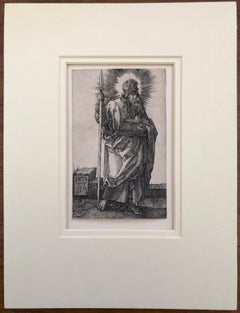
Albrecht Dürer (1471 – Nuremberg – 1528), St. Thomas , 1514, engraving 118x70 mm; 4 ½ x 2 ¾ inches matted : approx. 9 x 7 inches Bartsch 48 ; Meder 50 Provenance: Private colle...

Category

16th Century Albrecht Dürer Furniture
Materials

Engraving

Salome And Herod Woodcut After Albrecht Durer

Salome And Herod Woodcut After Albrecht Durer

Sold

H 17.5 in W 13.25 in D 3 in

Salome And Herod Woodcut After Albrecht Durer

By Albrecht Dürer

Located in Long Island City, NY

Woodcut print on paper, a reproduction of an original 1511 artwork titled The Head of Saint John the Baptist Brought to Herod by Albrecht Durer, 1471 to ...

Category

16th Century German Renaissance Antique Albrecht Dürer Furniture
Materials

Paper

Beheading of St John Woodcut After Albrecht Durer

Beheading of St John Woodcut After Albrecht Durer

By Albrecht Dürer

Located in Long Island City, NY

Woodcut print on paper, a reproduction of an original 1510 artwork titled Beheading of John the Baptist by Albrecht Durer, 1471 to 1528, a German painter and printmaker of the Northern Renaissance. The print depicts an executioner holding the head of St. John, which Salome waits to receive on a plate. Monogram AD...

Category

16th Century German Renaissance Antique Albrecht Dürer Furniture
Materials

Paper

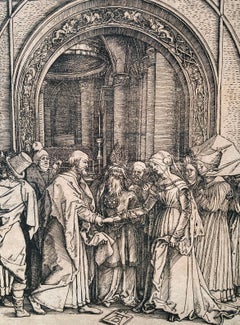
Dürer, Life of Virgin, Marriage of Virgin, Woodcut

Dürer, Life of Virgin, Marriage of Virgin, Woodcut

By Albrecht Dürer

Located in Greven, DE

Dürer Marriage of the Virgin One of the series of 20 woodcuts, without text, before a temple, a priest uniting the right hands of the Virgin Mary and St Joseph, on the right behind t...

Category

16th Century Northern Renaissance Albrecht Dürer Furniture
Materials

Woodcut

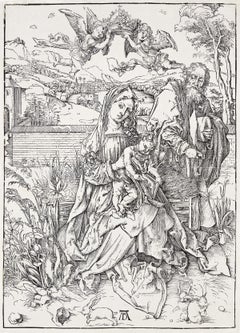
The Holy Family with the Three Hares

The Holy Family with the Three Hares

By Albrecht Dürer

Located in New York, NY

A very good, evenly-printed Meder h impression of this woodcut. Strong contrasts and the breaks in the border line but with less wear in the subject.

Category

15th Century and Earlier Northern Renaissance Albrecht Dürer Furniture
Materials

Woodcut

Albrecht Dürer furniture for sale on 1stDibs.
Albrecht Dürer furniture are available for sale on 1stDibs. These distinctive items are frequently made of paper and are designed with extraordinary care. There are many options to choose from in our collection of Albrecht Dürer furniture, although white editions of this piece are particularly popular. Many of the original furniture by Albrecht Dürer were created in the Art Nouveau style in europe during the 18th century and earlier. Prices for Albrecht Dürer furniture can differ depending upon size, time period and other attributes — on 1stDibs, these items begin at $180 and can go as high as $3,950, while a piece like these, on average, fetch $3,000.
Creators Similar to Albrecht Dürer

Francisco N. Tamagno
Johann Baptist Homann
Georges-Louis Leclerc, Comte de Buffon
Carle Vernet (Antoine Charles Horace Vernet)
François-Louis Schmied