Bruno Cassinari Art

Italian, 1912-1992

Bruno Cassinari was an Italian painter and sculptor, active in a style mixing cubist and expressionist elements. In 1946, he helped found the Fronte Nuovo delle Arti, an association aiming to restore optimism to post-war Italian art. Other members were Renato Birolli, Renato Guttuso, Ennio Morlotti, Leonardo Leoncillo and Alberto Viani.

to
3
Overall Width
to
Overall Height
to
3
1
1
3
3
2
2
2
1
1
2
2
2
2
1
5
10,634
2,826
2,495
1,410
2
3
Artist: Bruno Cassinari
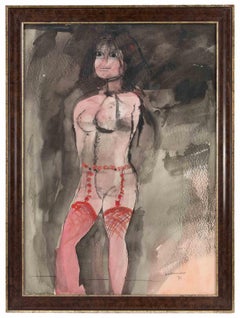
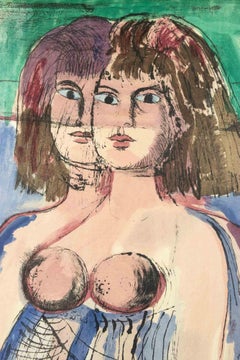
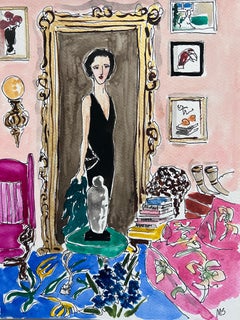
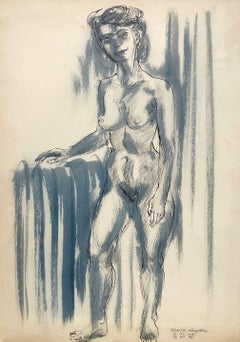
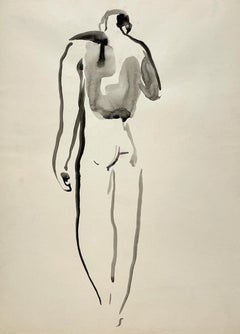
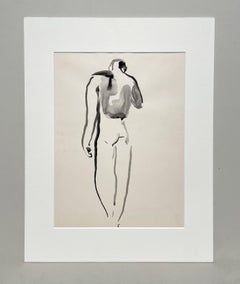
Female Portrait - Drawing by Bruno Cassinari - 1970s

Female Portrait - Drawing by Bruno Cassinari - 1970s

By Bruno Cassinari

Located in Roma, IT

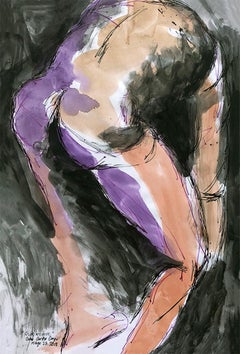
Female Portrait is a modern artwork realized by Bruno Cassinari in 1970s. Ink and watercolor on paper. Includes frame Hand signed by the artist on the lower margin

Category

Mid-20th Century Modern Bruno Cassinari Art

Materials

Paper, Watercolor, Ink

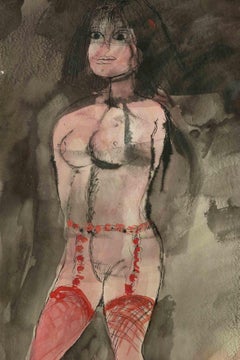
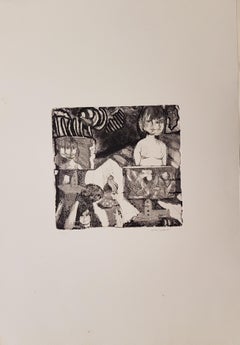
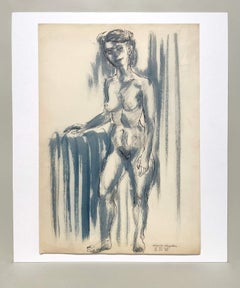
Woman - Drawing by Bruno Cassinari - 1971

Woman - Drawing by Bruno Cassinari - 1971

By Bruno Cassinari

Located in Roma, IT

Mixed media on paper realized 1971. Hand signed and dated. Framed, in excellent condition. Label of Studio Cassinari with inventory number on rear.

Category

1970s Modern Bruno Cassinari Art

Materials

Paper, Ink, Watercolor

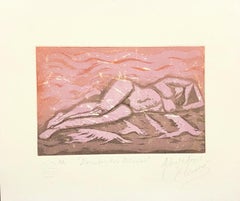
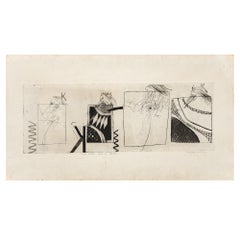
Atelier

Atelier

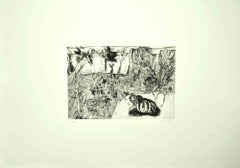
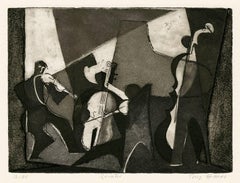
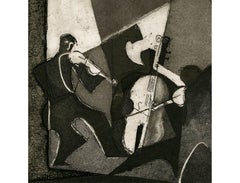
By Bruno Cassinari

Located in Roma, IT

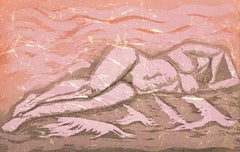
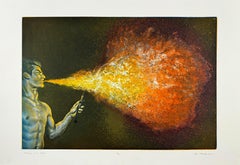
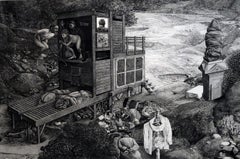
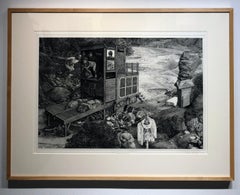
Original etching and aquatint realized by Bruno Cassinari in 1969. Hand signed and numbered in pencil on the lower margin. Edition of 25 prints. It represents women with some buildin...

Category

1960s Modern Bruno Cassinari Art

Materials

Etching, Aquatint

Related Items
Disegno figurativo neoclassico fiorentino del XIX secolo

Disegno figurativo neoclassico fiorentino del XIX secolo

Located in Florence, IT

Disegno inchiostro, gesso, acquerellature e rialzi a biacca su carta collegato alla serie di studi per la decorazione della Sala di Ercole di Palazzo Pitti a Firenze. Di mano di Piet...

Category

Early 19th Century Other Art Style Bruno Cassinari Art

Materials

Paper, Ink, Watercolor

Chinese Erotic Album Leaf, c. 1850

Chinese Erotic Album Leaf, c. 1850, c. 1850

$980

H 14.75 in W 11.75 in D 1 in

Chinese Erotic Album Leaf, c. 1850

Located in Chicago, IL

Despite its explicit content, this intimate scene conveys a sense of tenderness and romantic love characteristic of Chinese erotic art. Known as “spring palace paintings,” these ink and watercolor illustrations imagined the sensual delights of courtly life. Taken from an album of erotic paintings, this framed leaf departs from a tradition of depicting lovers in risqué outdoor settings by picturing an amorous coupling in a distinctly Qing-dynasty interior. The uniquely detailed surroundings shed light on the prevailing aesthetic tastes in decor and furniture of 19th-century China. Note the carved wooden headrest, blue and white censer...

Category

Mid-19th Century Qing Bruno Cassinari Art

Materials

Paper, Ink, Watercolor

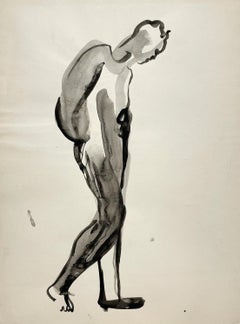
A Fine, Stylish 1930s Modern Figure Study Drawing of a Standing Male Nude Model

A Fine, Stylish 1930s Modern Figure Study Drawing of a Standing Male Nude Model

By Francis Chapin

Located in Chicago, IL

A Fine, Stylish 1930s Modern Figure Study Drawing of a Standing Male Nude Model (Back) by Famed Chicago Artist Francis Chapin (Am. 1899-1965). A wonderful, early example of Chapin's...

Category

1930s American Modern Bruno Cassinari Art

Materials

Paper, Watercolor, Ink

'Abstracted Figure', Sydney, Museum of Modern Art in Sao Paulo, Brazil

'Abstracted Figure', Sydney, Museum of Modern Art in Sao Paulo, Brazil

Located in Santa Cruz, CA

Signed lower right, 'Bonorat' and painted circa 1980 An elegant, modernist figural painting and early work by this Sydney-based Mexican artist who studied at the National School of Fine Arts in Mexico City (1982-84) and, subsequently, at the Museum of Modern Art in Sao Paulo, Brazil (1986). STUDIES 1982-1984 Painting and Drawing Ateliers – National School of Fine Arts, Mexico City 1985-1986 Artistic Experimentation – Carrillo Hill Museum, Mexico City 1986 Metal Engraving – Museum of Modern Art Sao Paulo Brazil SOLO EXHIBITIONS 1986 Art Gallery of Santos Municipal Cultural Centre, Sao Paulo, Brazil 1988 Art Gallery of Porto Alegre Municipal centre, R.S. Brazil 1991 Gallery Casa de la Cultura, Morelia Mexico 1994 The Beatty Gallery, Sydney 1996 The Beatty Gallery, Sydney 1996 Michael Burke Gallery, Brisbane 1997 The Beatty Gallery, Sydney 2019 ‘Golden Trinity’, Thienny Lee Gallery, Sydney 2019 ‘Continuous Thread, GAFFA Gallery, Sydney GROUP EXHIBITIONS 1985 Mail Art Network Kyoto City Museum, Kyoto Japan 1987 Banespa Cultural Centre, Sao Paulo Brazil 1988 IV National Contest of Fine Arts, Cubatao Brazil 1992 NCA Gallery, Sydney 1994 The Beatty Gallery, Sydney 1994/5/6 Selected for the “Fisher’s Ghost” Art...

Category

1980s Modern Bruno Cassinari Art

Materials

Paper, Ink, Watercolor, Gouache

L'Ogre Enjoue, 1969
L'Ogre Enjoue, 1969

Joan MiróL'Ogre Enjoue, 1969, 1976

$45,000

H 45.88 in W 59.38 in

L'Ogre Enjoue, 1969

By Joan Miró

Located in Palo Alto, CA

Vibrant hues of red, green, yellow and blue intersect against bold black curves in Joan Miró The Playful Ogre (L’Ogre Enjoue), 1969. This lively and commanding artwork is appropriate...

Category

1960s Modern Bruno Cassinari Art

Materials

Etching, Aquatint

CONRAD MARCA-RELLI Limited ed. Etching & Aquatint American Modern, Contemporary

CONRAD MARCA-RELLI Limited ed. Etching & Aquatint American Modern, Contemporary

By Conrad Marca-Relli 1

Located in Madrid, Madrid

Conrad Marca Relli - Composition I Date of creation: 1977 Medium: Etching and aquatint on Gvarro paper Edition: 75 + AP + HC Size: 56 x 76 cm Condition: In very good conditions and n...

Category

1970s Modern Bruno Cassinari Art

Materials

Paper, Etching, Aquatint

Night Light Signed Aquatint Etching California Modernist Woman Artist Susan Hall

Night Light Signed Aquatint Etching California Modernist Woman Artist Susan Hall

By Susan Hall

Located in Surfside, FL

Susan Hall Hand signed and numbered Aquatint Etching This piece has a Memphis Milano sort of vibe to it. Susan Hall lives and works in Point Reyes Station, California, a town in the heart of the Point Reyes National Seashore. This pristine wilderness area is dominated by a mosaic of bays and ocean, rolling grass lands and forests. It is inhabited by a diversity of wildlife, including over 450 species of birds, mountains lions, deer, bobcats, foxes, and elk. Ms. Hall who is a native of this area returned after spending twenty years in New York City. In her book, “Painting Point Reyes”, Hall says, “Point Reyes is the center of my painting life. Point Reyes has been my life and when I haven’t lived here, it has been an underground stream that spoke to me in dreams and visions.” While living and painting in New York City, Ms. Hall exhibited her work widely in museums and galleries. Among them are the Whitney Museum of Art; San Francisco Museum of Art; Nancy Hoffman Gallery, Trabia MacAfee Gallery, Phyllis Kind Gallery, Chicago; Ovsey Gallery, Los Angeles. In addition, her work has been featured in group exhibitions throughout the United States and abroad, including in 2020 Bud Shark's Ink: The California Crew at BMoCA, Boulder Museum of Contemporary Art Colorado USA representing the panoply of aesthetics, cultural backgrounds, viewpoints, and talent held within the bounty of art “made in California.” This remarkable grouping of artists, Brad Brown, Enrique Chagoya, Roy De Forest, Amy Ellingson, Susan Hall, Don Ed Hardy, Mildred Howard, Robert Hudson, Hung Liu, Kara Maria, Rex Ray, Alison Saar, Italo Scanga, and William T. Wiley. Women to the Fore, Hudson River Museum Yonkers 2021 A group of women artists working in oil painting and drawing, lithograph prints and photograph, collage and sculpture. Many icons of feminist art history. Judy Chicago, Judy Giera, Marisol, and Shanequa Benitez, Ann McCoy...

Category

1970s American Modern Bruno Cassinari Art

Materials

Etching, Aquatint

1970s Renato Guttuso Signed Classical Drawing Venus of Milo

1970s Renato Guttuso Signed Classical Drawing Venus of Milo

By Renato Guttuso

Located in Roma, IT

Wonderful Renato Guttuso drawing of the Venus de Milo A sensual evocation of antiquity: the classical Muse in Guttuso’s mature period A fine original drawing on paper by the painter Renato Guttuso (1911–1987), probably created in the 1970s, a period in which the artist produced numerous drawings on paper inspired by the female figure and classical sculpture, with an expressionist approach. Mixed media: ink and tempera. The work is enhanced by an Empire-style frame in gilded wood with gold leaf. The black line is bold and vigorous, typical of Guttuso’s drawings, whilst the colouring is fluid, expressive and non-realistic. Signed lower right "Guttuso" Our company has been present on this platform for many years, with more than 100 sales made and just as many excellent reviews received that you can under our Furniture account. Dimensions are frame included The painting is also protected by glass Aldo Renato Guttuso (26 December 1911 – 18 January 1987) was a very important Italian painter He is considered to be among the most important Italian artists of the 20th century and is among the key figures of Italian expressionism. His best-known works include Flight from Etna (1938–39), Crucifixion (1941), and La Vucciria (1974). Guttuso also designed for the theatre (including sets and costumes for Histoire du Soldat, Rome, 1940) and did illustrations for books. Those for Elizabeth David’s Italian Food (1954),introduced him to many in the English-speaking world. A fierce anti-Fascist, "he developed out of expressionism and the harsh light of his native land to paint landscapes and social commentary". Guttuso was born on 26 December, 1911 in Bagheria, near Palermo. He was the son of Gioacchino Guttuso, land surveyor and amateur watercolorist, and Giuseppina d'Amico. Guttuso's birth date is often incorrectly listed as January 2, 1912, as this is when Giuseppina reported his birth to the registry office. Guttuso began signing and dating his works at the age of thirteen. They were mostly copies of nineteenth-century Sicilian landscape painters as well as French painters such as Millet and contemporary artists such as Carrà, but there were also original portraits. In 1928 he participated in his first collective exhibition in Palermo. Guttuso lived close to a house amongst the Valguarnera villas and Palagonia, which he would soon represent in paintings inspired by the cliffs of Aspra. In Palermo and Bagheria Guttuso observed the dereliction of 18th-century villas previously belonging to the nobility, abandoned to decay as a consequence of political infighting within the municipal chambers. At the same time, his family suffered a period of economic stress because of the hostility shown by Fascists and the clergy towards his father. Guttuso finished the Umberto I classical high school in Palermo and continued his studies at the University of Palermo, where his development was modelled according to the European figurative trends of the day, from Courbet to Van Gogh and to Picasso. In the early 1930s Guttuso was a frequent visitor to the studio of one of the most prolific futuristic painters, Pippo Rizzo. In 1929 he began contributing to newspapers and periodicals and in 1933 his first article on Picasso was targeted by Fascist censorship and caused the suspension of his contribution to the Palermo newspaper L’ora. In 1931 two of his paintings were accepted by the jury of the Quadriennale di Roma and were included in a collective exhibition of six Sicilian painters at the Galleria del Milione, Milan, which aroused great interest among the Milanese artistic milieu. The paintings were acclaimed by critic Franco Grasso as a "disclosure, a Sicilian affirmation". Back in Palermo Guttuso opened a studio in Pisani street and together with painter Lia Pasqualino and sculptors Barbera and Nino Franchina formed the Gruppo dei Quattro (The Group of Four). In 1937 Guttuso moved to Rome and opened his first studio in Piazza Melozzo. Due to his exuberant lifestyle, his friend Marino Mazzacurati nicknamed him "Unbridled Guttuso". He lived close to significant artists of the time: Mario Mafai, Corrado Cagli, Antonello Trombadori, also keeping in contact with the group from Milan of Giacomo Manzù and Aligi Sassu. Having rejected every academic canon, Guttuso joined the Corrente movement and wrote for Corrente di Vita in Milan. The movement was characterized by its strong opposition to Fascist rule and its influence on culture. Here he developed his "social" art, with his political attitudes evident in paintings such as Fucilazione in Campagna (1938) and Escape from Etna, the former dedicated to the poet Federico García Lorca, who had been shot by Franco's supporters during the Spanish Civil War. Guttuso continued painting during World War II, with his work ranging from landscape glimpses of the Gulf of Palermo to a collection of drawings entitled Massacri ("Massacres"), which implicitly denounced slaughters such as the Adreatine massacre. In 1940 he joined the clandestine Italian Communist Party and briefly took refuge in Genova, later returning to Rome. Crocifissione ("Crucifixion"), painted in 1940, is the painting for which he is best remembered and which earned him the second prize in the fourth Bergamo Prize in 1942. At the time it was derided by the clergy, who labelled Guttuso a "pictor diabolicus" ("devilish painter"). The Fascists also denounced it for depicting the horrors of war through the lens of religion. Guttuso wrote in his diary: "this is a time of war. I wish to paint the torment of Christ as a contemporary scene... as a symbol of all those who, because of their ideas, endure outrage, imprisonment and torment". He became an active participant in the partisan struggle in 1943. After the war, in 1945, Guttuso, along with artists Birolli, Marchiori, Vedova and others, founded the Fronte Nuovo delle Arti (New Arts Front) as a vessel for the promotion of the work of those artists who had previously been bound by Fascist rule. He also collaborated on the magazine Il Calendario del Popolo, established the same year. During this time he also met and befriended Pablo Picasso. Their friendship would last until Picasso's death in 1973. Socio-political themes dominated Guttuso's work during this time, depicting the day-to-day lives of peasants and blue-collar workers. Guttuso finished Muratori in riposo ("Builders resting"), an artwork in china ink and watercolour that he had started during the war, a symbol of rebirth of which Pier Paolo Pasolini wrote in 1962: The shapes of ten workers
emerge white over white masonry
the noon is that of the summer.
But the humiliated flesh
projects a shadow; is the disarranged order
of the white colors, that is faithfully followed
by the black ones. The noon is a peaceful one. In the following years Guttuso painted Contadino che zappa (1947) and Contadini di Sicilia (ten drawings published in Rome in 1951), in which his pictorial language became clear and free of all superfluous elements. Guttuso wrote that these were preparatory sketches for his 1949...

Category

1970s Modern Bruno Cassinari Art

Materials

Watercolor, Pencil, Paper, Ink

Three Horses Running

Three Horses Running, 1970s

$1,400Sale Price|22% Off

H 27 in W 27 in

Three Horses Running

Located in Buffalo, NY

A modern Chinese watercolor painting depicting three stallions running underneath a blazing sun.

Category

1970s Modern Bruno Cassinari Art

Materials

Archival Ink, Paper, Watercolor

l'Homme au lavabo [Figure at a Washbasin]

l'Homme au lavabo [Figure at a Washbasin]

By Francis Bacon

Located in London, GB

Etching and aquatint in colours on Arches paper Signed by the artist in pencil, lower right on recto Image: 47.5 x 36.3 cm, Sheet: 67.5 x 52 cm, Framed: 87.9 x 71.7 cm Edition of 46 ...

Category

1870s Modern Bruno Cassinari Art

Materials

Etching, Aquatint

A Fine, Stylish 1930s Modern Figure Study Drawing of a Standing Male Nude Model

A Fine, Stylish 1930s Modern Figure Study Drawing of a Standing Male Nude Model

By Francis Chapin

Located in Chicago, IL

A Fine, Stylish 1930s Modern Figure Study Drawing of a Standing Male Nude Model by Famed Chicago Artist Francis Chapin (Am. 1899-1965). A wonderful, early example of Chapin's figura...

Category

1930s American Modern Bruno Cassinari Art

Materials

Paper, Ink, Watercolor

Previously Available Items
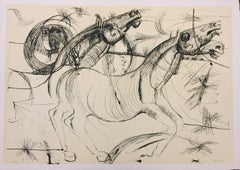
Horses

Bruno CassinariHorses

Sold

H 19.69 in W 27.56 in D 0.04 in

Horses

By Bruno Cassinari

Located in Roma, IT

Hand signed. Edition one of 25 prints.

Category

20th Century Contemporary Bruno Cassinari Art

Materials

Screen

Bruno Cassinari art for sale on 1stDibs.

Find a wide variety of authentic Bruno Cassinari art available for sale on 1stDibs. You can also browse by medium to find art by Bruno Cassinari in aquatint, etching and more. Much of the original work by this artist or collective was created during the 1960s and is mostly associated with the modern style. Not every interior allows for large Bruno Cassinari art, so small editions measuring 19 inches across are available. Customers who are interested in this artist might also find the work of Enzo Brunori, Antonio Recalcati, and Bruno Conte. Bruno Cassinari art prices can differ depending upon medium, time period and other attributes. On 1stDibs, the price for these items starts at $423 and tops out at $423, while the average work can sell for $423.

Artists Similar to Bruno Cassinari