Claude Weisbuch More Art

French, 1927-2014
Claude Weisbuch was born in Thionville, France in 1927 and was a pupil at L' École des Beaux-Arts de Nancy, France. As a painter, engraver, and exceptional lithographer, Claude Weisbuch has painted active motifs, such as musicians, horses, and characters. Dominating in his work, by the relief and the velvety line which characterizes drypoint, his etchings are the strongest representations of his figures, intensely lively after the 1960s. Using dark tones which express his sharp sense, Claude Weisbuch ceaselessly captures life's dynamics, as the pictorial, musical and literary expressions that are essentially human. Whether it is the impassioned violinist, the mercurial actor, or the sitter shrouded with silent intensity, they have all been rendered with Weisbuch's love for drama. The brushstrokes are sweeping and bold while the paint is fluid. His pictures, full of movement, give one the impression of time-lapsed motion and display an expression of passionate humanity tinged with a unique energy. Weisbuch has been quoted as saying “I like the sketch, the uncompleted, the painting filled with mystery,”. "Some important things to look for in evaluating an artist for such a position of honour are: an inventiveness of style, a prolific output, and a consistency of quality--Claude Weisbuch has all three. His style is unique with a color range that is rich and warm in tone, certainly equal to that of Rembrandt. The fluidity of line and creation of motion is even more vigorous than in the work of Daumier or Toulouse Lautrec. His creativeness in composition is awesome and seems to have infinite possibilities of variation and vision." - David Barnett
to
1
Overall Width
to
Overall Height
to
1
1
1
1
1
1
49
262
223
122
116
1
Artist: Claude Weisbuch
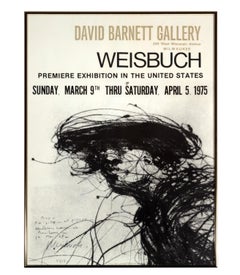
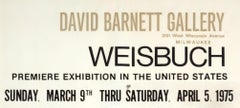
U.S. Premiere Exhibition Poster at the David Barnett Gallery (43/58)

U.S. Premiere Exhibition Poster at the David Barnett Gallery (43/58)

By Claude Weisbuch

Located in Milwaukee, WI

Art: 26-3/4"x19-3/4" Frame: 27"x20" Poster, signed & inscribed to Philip Barnett lower left (43/58) Claude Weisbuch was born in Thionville, France in 1927 and was a pupil at L' ...

Category

1970s Expressionist Claude Weisbuch More Art

Materials

Archival Pigment

Related Items
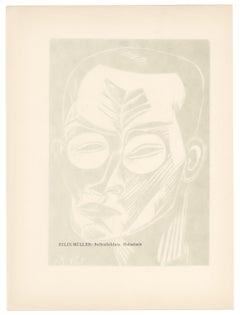
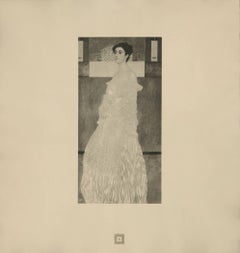
Max Eisler Eine Nachlese folio "Portrait of Baroness Wittgenstein" collotype

Max Eisler Eine Nachlese folio "Portrait of Baroness Wittgenstein" collotype

By (after) Gustav Klimt

Located in Palm Beach, FL

After Gustav Klimt, Max Eisler Plate #4, Bildnis Baronin Wittgenstein; dark grey monochrome collotype after the 1905 painting in oil on canvas. GUSTAV KLIMT EINE NACHLESE (GUSTAV KLIMT AN AFTERMATH), a portfolio of 30 collotypes prints, 15 are multi-color and 15 are monochrome, on chine colle paper laid down on heavy cream-wove paper with deckled edges; Max Eisler, Editor-Publisher; Osterreichischer Staatsdruckerei (Austrian State Printing Office), Printer; in a limited edition of 500 numbered examples of which: 200 were printed in German, 150 were printed in French and 150 were printed in English; Vienna, 1931. 2018 marks the 100th anniversary of Gustav Klimt’s death. It is a fitting time to reflect upon the enduring legacy and deep impact of his art. Recognizing this need for posterity with uncanny foresight, the publication of Gustav Klimt: An Aftermath (Eine Nachlese) provides a rare collection of work after Klimt which has proven to be an indispensable tool for Klimt scholarship as well as a source for pure visual delight. Approximately 25 percent of the original works featured in the Aftermath portfolio have since been lost. Of those 30, six were destroyed by fire on 8 May 1945. On that fateful final day of WWII, the retreating Feldherrnhalle, a tank division of the German Army, set fire to the Schloss Immendorf which was a 16th century castle in Lower Austria used between 1942-1945 to store objects of art. All three of Klimt’s Faculty Paintings: Philosophy, Medicine and Jurisprudence (1900-1907), originally created for the University of Vienna, were on premises at that time. Also among the inventory of Klimt paintings in storage there was art which had been confiscated by the Nazis. One of the most significant confiscated collections was the Lederer collection which featured many works by Gustav Klimt such as Girlfriends II and Garden Path with Chickens...

Category

1930s Vienna Secession Claude Weisbuch More Art

Materials

Paper

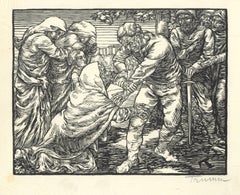
"Coriolan und seine Mutter" signed original woodcut

"Coriolan und seine Mutter" signed original woodcut

Located in Henderson, NV

Medium: original woodcut. Signed in pencil by Peter Trumm and printed in Germany in 1922 for the very rare "Die zweite Ganymed-Mappe" portfolio of "Das vierte Jahrbuch der Marees Ges...

Category

1920s Expressionist Claude Weisbuch More Art

Materials

Woodcut

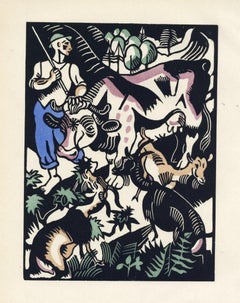
"Der Hirte" original woodcut

"Der Hirte" original woodcut

By Richard Seewald

Located in Henderson, NV

Medium: original color woodcut. Catalogue reference JH 771. Published in 1919 for Genius. Image size: 9 1/2 x 7 inches (240 x 178mm), on wove paper with full margins. This print is f...

Category

1920s Expressionist Claude Weisbuch More Art

Materials

Woodcut

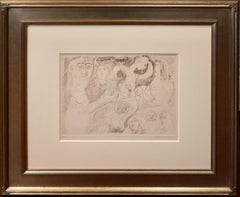
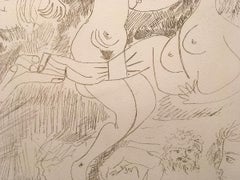
"Untitled Men and Women", 12" x 15" Lithograph Attributed to Pablo Picasso

"Untitled Men and Women", 12" x 15" Lithograph Attributed to Pablo Picasso

By Pablo Picasso

Located in Oklahoma City, OK

This 12" x 15" etching in a 26.5" x 30.5" frame is attributed to Pablo Picasso. The imprint of the plate can be seen imbedded into the paper and is created using a deep brown ink. Th...

Category

20th Century Expressionist Claude Weisbuch More Art

Materials

Etching

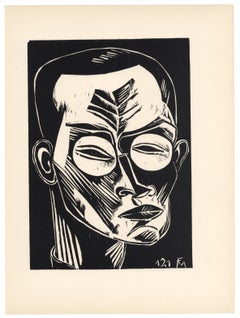
"Self Portrait" original woodcut

"Self Portrait" original woodcut

By Conrad Felixmuller

Located in Henderson, NV

Medium: original woodcut. Printed in 1920 for the Deutsche Graphiker der Gegenwart portfolio, and published in Leipzig by Klinkhardt & Biermann in an edition of 500. Catalogue refere...

Category

1910s Expressionist Claude Weisbuch More Art

Materials

Woodcut

"Le centaure" original woodcut

"Le centaure" original woodcut

By Auguste Louis Lepère

Located in Henderson, NV

Medium: original woodcut. This impression on thin wove paper was printed in 1902 and published by Gazette des Beaux Arts. Image size: 8 1/8 x 5 1/2 inches (207 x 140 mm). Signed in t...

Category

Early 1900s Expressionist Claude Weisbuch More Art

Materials

Woodcut

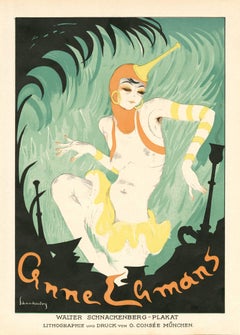
Kostume, Plakate, und Dekorationen, "Anne Lemans"

Kostume, Plakate, und Dekorationen, "Anne Lemans"

By Walter Schnackenberg

Located in Palm Beach, FL

Walter Schnackenberg’s style changed several times during his long and successful career. Having studied in Munich, the artist traveled often to Paris where he fell under the spell of the Henri de Toulouse-Lautrec’s colorful and sensuous posters depicting theatrical and decadent subjects. Schnackenberg became a regular contributor of similar compositions to the German magazines Jugend and Simplicissimus before devoting himself to the design of stage scenery and costumes. In the artist’s theatrical work, his mastery of form, ornamentation, and Orientalism became increasingly evident. He excelled at combining fluid Art Nouveau outlines, with spiky Expressionist passages, and the postures and patterns of the mysterious East. In his later years, Schnackenberg explored the unconscious, using surreal subject matter and paler colors that plainly portrayed dreams and visions, some imbued with political connotations. His drawings, illustrations, folio prints, and posters are highly sought today for their exceedingly imaginative qualities, enchanting subject matter, and arresting use of color. SCHNACKENBERG: KOSTUME, PLAKATE UND DEKORATIONEN, a cardboard bound art book consisting of 43 prints of work by Walter Schnackenberg, 30 of which are color lithographs that are signed and some are titled and dated in the plate, as well as black and white prints and photographs with accompanying text by Oskar Bie; lithographs printed at Kunstanstalt Oskar Consee in Munich, other images printed by Gesellschaft Pick & Co. in Munich, the text and cover with color images by Schnackenberg front and verso printed by R. Oldenbourg in Munich; published by Musarion Verlag, Munich, 1920. The majority of Walter Schnackenberg’s artistic output was destroyed by bomb attacks in Munich in 1944. The highly publicized 2013 auction in New York of the recovered pre-war poster collection once belonging to German poster aficionado, Hans Sachs has reintroduced the world to Walter Schnackenberg’s graphic genius and priceless ephemeral art from a lost era. Besides the museum world, designer Karl Lagerfeld is one of the most prodigious collectors of Schnackenberg. Flipping through the pages of Kostume, Plakate und Dekorationen, it becomes quite clear that Schnackenberg’s collection is ground zero at the crossroads of early modern fashion where the cult of celebrity meets up with dance, music, theater and cabaret, film and the graphic medium. Berlin and Munich under Germany’s Weimar Republic in the first quarter of the 20th century produced just the atmosphere to feed this burgeoning industry. Rising inflation sparked a recklessness to live large for the moment and heightened a desire for escapism. An influx of Indian and East Asian dancers and musicians added to the artsy bohemian cultural mix. A new decadence and tolerance resulted. Film boldly featured provocative subject matter. Cabarets became popular venues giving rise to the demi-monde in which people from all social stations mixed more freely in a thriving underground economy and culture where there was a blurring of boundaries and of social codes. Noted art historian and cultural doyen, Oskar Bie astutely observes in his introduction to Schnackenberg’s publication that what unites the images is fantasy and advertisement. Schnackenberg uses the eye as an instrument to brilliantly construct and convey this double message. His personages never directly confront the viewer. Their eyes gaze off in the distance like those of the screenplayer and film star Hedamaria Scholz in Schnackenberg’s “Die Rodelhexe” movie poster. Their eyes follow the path of a dance composition or become a transfixed and ogling male gaze such as the iconic 1911 Odeon Casino...

Category

1910s Expressionist Claude Weisbuch More Art
Materials

Lithograph

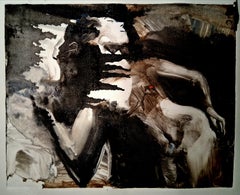
Everything Ends dramatic monochromatic, Monotype, Expressionist Style, New

Everything Ends dramatic monochromatic, Monotype, Expressionist Style, New

By Tom Bennett

Located in Brooklyn, NY

This monotype is a powerful expressionistic exploration of psychological and bodily fragmentation. It blends visceral textures with sharp, high-contrast imagery to evoke a deep sense...

Category

2010s Expressionist Claude Weisbuch More Art
Materials

Monotype

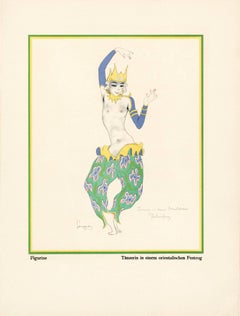
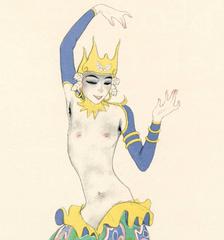
Kostume, Plakate, und Dekorationen, "Dancer in an Oriental Pageant"

Kostume, Plakate, und Dekorationen, "Dancer in an Oriental Pageant"

By Walter Schnackenberg

Located in Palm Beach, FL

Walter Schnackenberg’s style changed several times during his long and successful career. Having studied in Munich, the artist traveled often to Paris where he fell under the spell o...

Category

1910s Expressionist Claude Weisbuch More Art
Materials

Paper

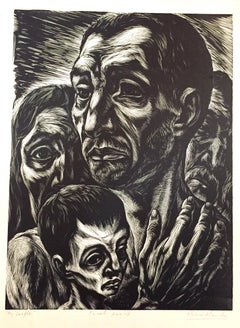
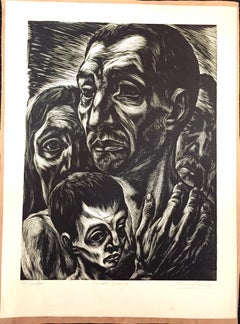
Isaac Friedlander, My People

Isaac Friedlander, My People

By Isaac Friedlander

Located in New York, NY

Isaac (sometimes Isac) Friedlander's large wood engraving, My People, 1944, reflects his genuine social interest. After a youth of extreme hardship, including incarceration in a czar...

Category

1940s Expressionist Claude Weisbuch More Art
Materials

Woodcut

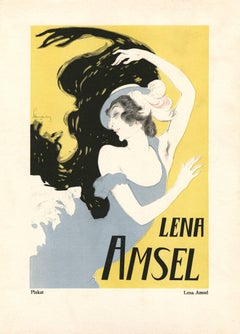
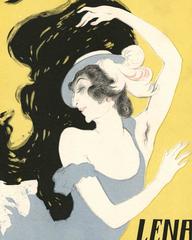
Kostume, Plakate, und Dekorationen, "Lena Amsel"

Kostume, Plakate, und Dekorationen, "Lena Amsel"

By Walter Schnackenberg

Located in Palm Beach, FL

Walter Schnackenberg’s style changed several times during his long and successful career. Having studied in Munich, the artist traveled often to Paris where he fell under the spell of the Henri de Toulouse-Lautrec’s colorful and sensuous posters depicting theatrical and decadent subjects. Schnackenberg became a regular contributor of similar compositions to the German magazines Jugend and Simplicissimus before devoting himself to the design of stage scenery and costumes. In the artist’s theatrical work, his mastery of form, ornamentation, and Orientalism became increasingly evident. He excelled at combining fluid Art Nouveau outlines, with spiky Expressionist passages, and the postures and patterns of the mysterious East. In his later years, Schnackenberg explored the unconscious, using surreal subject matter and paler colors that plainly portrayed dreams and visions, some imbued with political connotations. His drawings, illustrations, folio prints, and posters are highly sought today for their exceedingly imaginative qualities, enchanting subject matter, and arresting use of color. SCHNACKENBERG: KOSTUME, PLAKATE UND DEKORATIONEN, a cardboard bound art book consisting of 43 prints of work by Walter Schnackenberg, 30 of which are color lithographs that are signed and some are titled and dated in the plate, as well as black and white prints and photographs with accompanying text by Oskar Bie; lithographs printed at Kunstanstalt Oskar Consee in Munich, other images printed by Gesellschaft Pick & Co. in Munich, the text and cover with color images by Schnackenberg front and verso printed by R. Oldenbourg in Munich; published by Musarion Verlag, Munich, 1920. The majority of Walter Schnackenberg’s artistic output was destroyed by bomb attacks in Munich in 1944. The highly publicized 2013 auction in New York of the recovered pre-war poster collection once belonging to German poster aficionado, Hans Sachs has reintroduced the world to Walter Schnackenberg’s graphic genius and priceless ephemeral art from a lost era. Besides the museum world, designer Karl Lagerfeld is one of the most prodigious collectors of Schnackenberg. Flipping through the pages of Kostume, Plakate und Dekorationen, it becomes quite clear that Schnackenberg’s collection is ground zero at the crossroads of early modern fashion where the cult of celebrity meets up with dance, music, theater and cabaret, film and the graphic medium. Berlin and Munich under Germany’s Weimar Republic in the first quarter of the 20th century produced just the atmosphere to feed this burgeoning industry. Rising inflation sparked a recklessness to live large for the moment and heightened a desire for escapism. An influx of Indian and East Asian dancers and musicians added to the artsy bohemian cultural mix. A new decadence and tolerance resulted. Film boldly featured provocative subject matter. Cabarets became popular venues giving rise to the demi-monde in which people from all social stations mixed more freely in a thriving underground economy and culture where there was a blurring of boundaries and of social codes. Noted art historian and cultural doyen, Oskar Bie astutely observes in his introduction to Schnackenberg’s publication that what unites the images is fantasy and advertisement. Schnackenberg uses the eye as an instrument to brilliantly construct and convey this double message. His personages never directly confront the viewer. Their eyes gaze off in the distance like those of the screenplayer and film star Hedamaria Scholz in Schnackenberg’s “Die Rodelhexe” movie poster. Their eyes follow the path of a dance composition or become a transfixed and ogling male gaze such as the iconic 1911 Odeon Casino poster...

Category

1910s Expressionist Claude Weisbuch More Art
Materials

Lithograph

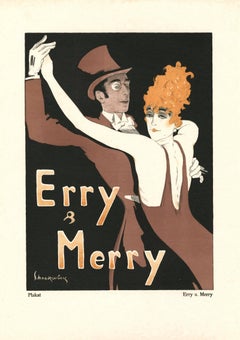
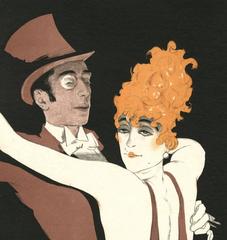
Kostume, Plakate, und Dekorationen, "Erry & Merry"

Kostume, Plakate, und Dekorationen, "Erry & Merry"

By Walter Schnackenberg

Located in Palm Beach, FL

Walter Schnackenberg’s style changed several times during his long and successful career. Having studied in Munich, the artist traveled often to Paris where he fell under the spell of the Henri de Toulouse-Lautrec’s colorful and sensuous posters depicting theatrical and decadent subjects. Schnackenberg became a regular contributor of similar compositions to the German magazines Jugend and Simplicissimus before devoting himself to the design of stage scenery and costumes. In the artist’s theatrical work, his mastery of form, ornamentation, and Orientalism became increasingly evident. He excelled at combining fluid Art Nouveau outlines, with spiky Expressionist passages, and the postures and patterns of the mysterious East. In his later years, Schnackenberg explored the unconscious, using surreal subject matter and paler colors that plainly portrayed dreams and visions, some imbued with political connotations. His drawings, illustrations, folio prints, and posters are highly sought today for their exceedingly imaginative qualities, enchanting subject matter, and arresting use of color. SCHNACKENBERG: KOSTUME, PLAKATE UND DEKORATIONEN, a cardboard bound art book consisting of 43 prints of work by Walter Schnackenberg, 30 of which are color lithographs that are signed and some are titled and dated in the plate, as well as black and white prints and photographs with accompanying text by Oskar Bie; lithographs printed at Kunstanstalt Oskar Consee in Munich, other images printed by Gesellschaft Pick & Co. in Munich, the text and cover with color images by Schnackenberg front and verso printed by R. Oldenbourg in Munich; published by Musarion Verlag, Munich, 1920. The majority of Walter Schnackenberg’s artistic output was destroyed by bomb attacks in Munich in 1944. The highly publicized 2013 auction in New York of the recovered pre-war poster collection once belonging to German poster aficionado, Hans Sachs has reintroduced the world to Walter Schnackenberg’s graphic genius and priceless ephemeral art from a lost era. Besides the museum world, designer Karl Lagerfeld is one of the most prodigious collectors of Schnackenberg. Flipping through the pages of Kostume, Plakate und Dekorationen, it becomes quite clear that Schnackenberg’s collection is ground zero at the crossroads of early modern fashion where the cult of celebrity meets up with dance, music, theater and cabaret, film and the graphic medium. Berlin and Munich under Germany’s Weimar Republic in the first quarter of the 20th century produced just the atmosphere to feed this burgeoning industry. Rising inflation sparked a recklessness to live large for the moment and heightened a desire for escapism. An influx of Indian and East Asian dancers and musicians added to the artsy bohemian cultural mix. A new decadence and tolerance resulted. Film boldly featured provocative subject matter. Cabarets became popular venues giving rise to the demi-monde in which people from all social stations mixed more freely in a thriving underground economy and culture where there was a blurring of boundaries and of social codes. Noted art historian and cultural doyen, Oskar Bie astutely observes in his introduction to Schnackenberg’s publication that what unites the images is fantasy and advertisement. Schnackenberg uses the eye as an instrument to brilliantly construct and convey this double message. His personages never directly confront the viewer. Their eyes gaze off in the distance like those of the screenplayer and film star Hedamaria Scholz in Schnackenberg’s “Die Rodelhexe” movie poster. Their eyes follow the path of a dance composition or become a transfixed and ogling male gaze such as the iconic 1911 Odeon Casino poster...

Category

1910s Expressionist Claude Weisbuch More Art
Materials

Lithograph

Claude Weisbuch more art for sale on 1stDibs.

Find a wide variety of authentic Claude Weisbuch more art available for sale on 1stDibs. You can also browse by medium to find art by Claude Weisbuch in archival pigment print, pigment print and more. Not every interior allows for large Claude Weisbuch more art, so small editions measuring 20 inches across are available. Customers who are interested in this artist might also find the work of Eduardo Paolozzi, Jean Cocteau, and Donald Baechler. Claude Weisbuch more art prices can differ depending upon medium, time period and other attributes. On 1stDibs, the price for these items starts at $2,400 and tops out at $2,400, while the average work can sell for $2,400.