Cornelius Johnson Art

British, 1593-1661
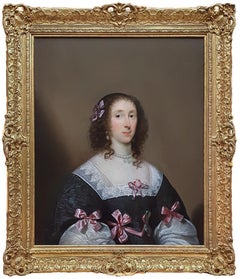
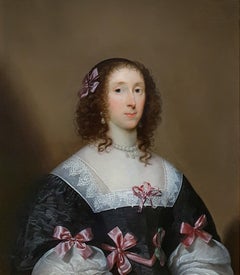
Cornelius Johnson Cornelius Johnson or Cornelis Janssens van Ceulen (Dutch) also Cornelius Jonson van Ceulen, (born 14 October 1593 – died 5 August 1661) was an English painter of portraits of Dutch or Flemish parentage. He was active in England, from at least 1618 to 1643, when he moved to Middelburg in the Netherlands to escape the English Civil War. Johnson painted many portraits of emerging new English gentry. His early portraits were panel paintings with "fictive" oval frames – they appear to have a wooden or marble oval surround, but this is actually painted on to the panel. This trompe-l'œil effect was one of Johnson' favourite devices in the early part of his career. "His figures are usually placed in front of dark, undefined backgrounds with focus on their faces and elaborate costumes that denote their social standing. Cornelius Johnson has been described as "one of the most gifted and prolific portrait painters practising in England during the 1620s and 1630s". One of his remarkable paintings Portrait of a Woman, 1655-56, is found at Princeton University Art Museum, USA. Following the Netherlandish tradition, he was particularly accurate and detailed in depiction of clothing. As a result, his portraits are especially useful to costume historians. His works can be found in major collections in the UK and overseas as well as in private collections in stately homes in Britain.
to
2
Overall Width
to
Overall Height
to
1
1
1
1
1
1
1
2

Use search to find more

2
11,862
2,889
2,541
1,621

Use search to find more

Artist: Cornelius Johnson
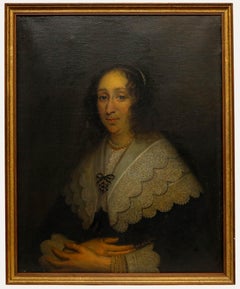
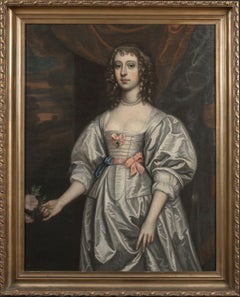
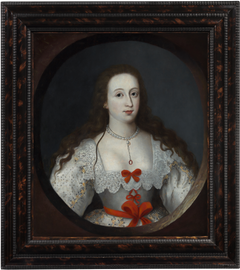
Jacobean Portrait of a Lady with Long Hair in White Dress with Red Bows c.1620s

Jacobean Portrait of a Lady with Long Hair in White Dress with Red Bows c.1620s

By Cornelius Johnson

Located in London, GB

Circle of Cornelius Johnson (1593–1661), circa 1620–1630 Portrait of a Young Lady with Long Hair, in White Dress with Red Bows There is something unusually intimate about this beaut...

Category

17th Century Old Masters Cornelius Johnson Art

Materials

Canvas, Oil

Related Items
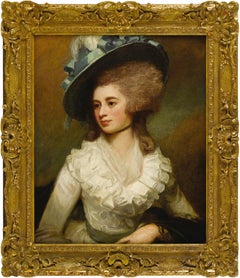
Portrait of Lady Caroline Price

Portrait of Lady Caroline Price

By George Romney

Located in Miami, FL

DESCRIPTION: Perhaps the best Romney in private hands. If Vogue Magazine existed in the late 18th century, this image of Lady Caroline Price would be ...

Category

1970s Old Masters Cornelius Johnson Art

Materials

Oil, Canvas

Male and female portrait, both in silk kimono, possibly textile dealers

Male and female portrait, both in silk kimono, possibly textile dealers

By Christoffel Lubieniecki

Located in Amsterdam, NL

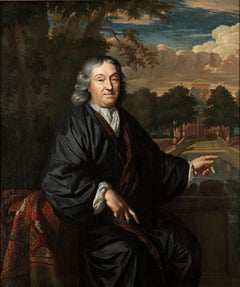
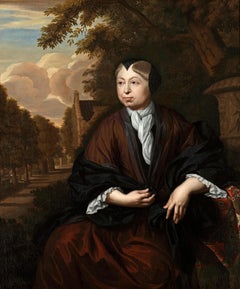
CHRISTOFFEL LUBIENIECKI (1659-1729) Pair of portraits of a gentleman and a lady, both in silk kimono, before a country house (circa 1680) Indistinctly signed “C.......” on a box under the man’s left hand Oil on canvas, 79.5 x 67 cm each Both sitters are portrayed wearing a silk “Japanese” coat. During the second half of the seventeenth the Japanese silk coat, an adapted Japanese kimono, became a real vogue in the Dutch elite. The exclusive Dutch trade contacts with Japan can explain the popularity of the kimono-style silk coats in the Netherlands. Everybody who could afford one, dressed in such a fashionable and comfortable coat and, like the present sitters, some proud owners had themselves portrayed in a “Japanese” coat often together with an oriental carpet to underline their standing and international connections. These portraits are the work of the Polish-born portraitist Christoffel Lubieniecki (also known as Lubienitski, Lubinitski or Lubiniecki) Lubieniecki was first trained in Hamburg under Julian Stuhr and after 1675 in Amsterdam under Adriaen Backer and Gerard de Lairesse. He specialized in landscapes, generally of an Italianate character, and in portraits. The loving execution of these contented burghers, enjoying the garden vistas of their country house, places him alongside Amsterdam portraitists such as Constantijn Netscher and Michiel van Musscher...

Category

1680s Old Masters Cornelius Johnson Art

Materials

Canvas, Oil

Oil Portrait of a Victorian Lady, c. 1850

Oil Portrait of a Victorian Lady, c. 1850, c. 1850

$1,480

H 13.75 in W 11.5 in D 1.75 in

Oil Portrait of a Victorian Lady, c. 1850

Located in Chicago, IL

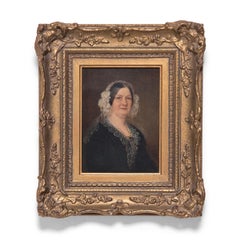
Painted in the 19th century, this exquisite miniature portrait wonderfully exemplifies realism in traditional oil painting. The small artwork is painted in the conventional portraiture style of the Old Masters, and achieves soft realism with fine brushwork and a subdued, neutral palette. The half length portrait depicts a fine Victorian woman dressed in all black with a delicate lace collar and bonnet. She wears a ruby broach...

Category

Mid-19th Century Old Masters Cornelius Johnson Art

Materials

Oil

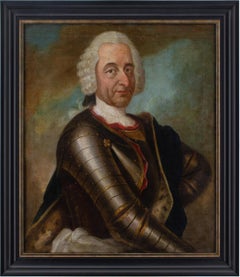
Mid-18th-Century German School, Portrait Of An Aristocrat In Armour, Oil

Mid-18th-Century German School, Portrait Of An Aristocrat In Armour, Oil

Located in Cheltenham, GB

This mid-18th-century half-length German portrait depicts a middle-aged aristocrat wearing armour and a wig. Despite his heavily-clad appearance, it’s likely that this rather noncha...

Category

1750s Old Masters Cornelius Johnson Art

Materials

Oil, Canvas

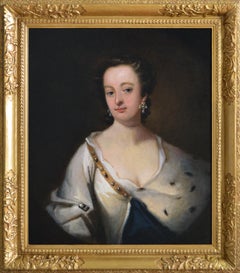
18th Century portrait oil painting of a lady in an ermine trimmed cloak

18th Century portrait oil painting of a lady in an ermine trimmed cloak

By Sir Godfrey Kneller

Located in Nr Broadway, Worcestershire

Circle of Sir Godfrey Kneller Dutch, (1646-1723) Portrait of a Lady in an Ermine Trimmed Cloak Oil on canvas Image size: 26.5 inches x 22.5 inches Size including frame: 33.5 inches x 29.5 inches A well-executed half-length portrait of a lady painted in a feigned oval, circle of Sir Godfrey Kneller. The use of a feigned oval was a device used in portraiture to give a sense of depth and add an intimacy to the painting, drawing your attention to the sitter. The subject, posed without her wig in the undressed fashion of the day, wears a blue ermine trimmed blue cloak over a white silk robe...

Category

18th Century Old Masters Cornelius Johnson Art

Materials

Canvas, Oil

Two royal portraits (the Duc d'Angoulême and the Duc de Berry) by H.P. Danloux

Two royal portraits (the Duc d'Angoulême and the Duc de Berry) by H.P. Danloux

Located in PARIS, FR

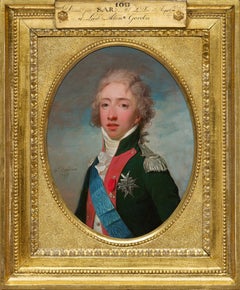
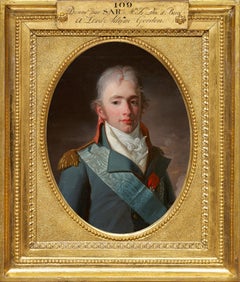
These two royal portraits are a major historical testimony to the stay of the Comte d'Artois (the future Charles X) and his family in Edinburgh in 1796-1797. Given by the sitters to Lord Adam Gordon, the Governor of Edinburgh, and kept by family descent to this day, these two portraits provide us with a vivid and spontaneous image of the Duc d’Angoulême and his brother the Duc de Berry. Danloux, who had emigrated to London a few years before, demonstrate his full assimilation of the art of British portrait painters in the brilliant execution of these portraits. 1. Henri-Pierre Danloux, a portraitist in the revolutionary turmoil Born in Paris in 1753, Henri-Pierre Danloux was first a pupil of the painter Nicolas-Bernard Lépicié (1735 - 1784) and then, in 1773, of Joseph-Marie Vien (1716 - 1809), whom he followed to Rome when, at the end of 1775, Vien became Director of the Académie de France. In Rome he became friends with the painter Jacques-Louis David (1748 - 1825). Returning to France around 1782, he settled in Lyon for a few years before returning to Paris in 1785. One of his first portraits was commissioned by the Baroness d'Etigny, the widow of the former Intendant of the Provinces of Gascony, Bearn and Navarre Antoine Mégret d'Etigny (1719 – 1767). He then became close to his two sons, Mégret de Sérilly and Mégret d'Etigny, who in turn became his patrons. In 1787, this close relationship with the d'Etigny family was further strengthened by his marriage to Antoinette de Saint-Redan, a relative of Madame d'Etigny. After his marriage, he left for Rome and did not return to France until 1789. It was during the winter of 1790-1791 that he painted one of his masterpieces, the portrait of Baron de Besenval. Set in a twilight atmosphere, this portrait of an aristocrat who knows that his death is imminent symbolizes the disappearance of an erudite and refined society which would be swept away by the French Revolution. The Jacobin excesses led Danloux to emigrate to England in 1792; many members of his family-in-law who remained in France were guillotined on 10 May 1794. Danloux enjoyed great success as a portrait painter in England before returning to France in 1801. During his stay in England, Danloux was deeply under the influence of English portraitists: his colors became warmer (as shown by the portrait of the Duc d'Angoulême that we are presenting), and his execution broader. 2. Description of the two portraits and biographical details of the sitters The Duc d'Angoulême (1775-1844) was the eldest son of the Comte d'Artois, the younger brother of King Louis XVI (the future King Charles X), and his wife Marie-Thérèse of Savoie. He is shown here, in the freshness of his youth, wearing the uniform of colonel-general of the "Angoulême-Dragons" regiment. He is wearing the blue cordon of the Order of the Holy Spirit, which was awarded to him in 1787, and two decorations: the Cross of Saint-Louis and the Maltese Cross, as he was also Grand Prior of the Order of Malta. Born on 16 August 1775 in Versailles, Louis-Antoine d'Artois followed his parents into emigration on 16 July 1789. In 1792, he joined the émigrés’ army led by the Prince de Condé. After his stay in Edinburgh (which will be further discussed), he went to the court of the future King Louis XVIII, who was in exile at the time, and in 1799 married his first cousin Marie-Thérèse Charlotte of France, the daughter of Louis XVI and the sole survivor of the royal family. The couple had no descendants. He became Dauphin of France in 1824, upon the accession to the throne of his father but played only a minor political role, preferring his military position as Grand Admiral. Enlisted in Spain on the side of Ferdinand VII, he returned home crowned with glory after his victory at Trocadero in 1823. He reigned for a very short time at the abdication of Charles X in 1830, before relinquishing his rights in favor of his nephew Henri d'Artois, the Duc de Bordeaux. He then followed his father into exile and died on 3 June 1844 in Gorizia (now in Italy). His younger brother, the Duc de Berry, is shown in the uniform of the noble cavalry of the émigrés’ Army. He is wearing the blue cordon of the Order of the Holy Spirit, awarded to him in May 1789, and the Cross of Saint-Louis (partly hidden by his blue cordon). Born on 24 January 1778 in Versailles, Charles-Ferdinand d'Artois also followed his parents into emigration and joined the émigrés’ army in 1792. After his stay in Edinburgh, he remained in Great Britain, where he had an affair with Amy Brown...

Category

1790s Old Masters Cornelius Johnson Art

Materials

Canvas, Oil, Wood Panel

Oil on Canvas Painting Portrait of the Italian Noble Family of Zanardi Count

Oil on Canvas Painting Portrait of the Italian Noble Family of Zanardi Count

By Lucia Casalini Torelli

Located in Firenze, IT

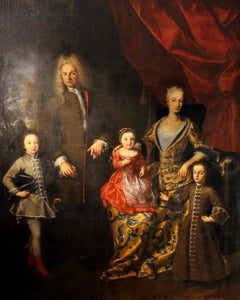
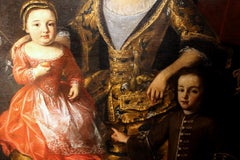
This museum quality old master oil on canvas formal portrait painting depicting the family of the Count Zanardi is signed by the artist- the female painter Lucia Casalini Torelli- and published in a book dedicated to Casalini Torelli’s workshop and academy. This palatial masterpiece artwork comes directly from the ancient Villa Maraini Guerrieri - Palidano di Gonzaga (Mantua), an historic Italian heritage building owned by the descendants of the family portrayed for more than two centuries, until 1998. The big scale of this oil on canvas masterpiece painting states the relevance of Lucia Casalini Torelli as a painter. The present artwork is a formal family portrait painting that aim to introduce the characters depicted according to their social role in the society. The noble family is all gathered under a loggia overlooking a park, the landscape in the background is partially covered by a beautiful red cloth on the right side. The father stands up and holds the hand of his eldest son, proudly introducing his future heir. The son wears a light-blue dress and red boots, he is depicted in a serious pose holding a black tricorn hat under his arm and a rapier sword on his belt. The mother wears an elegant gold and dark green brocade dress, she is sitting with her youngest daughter on her knees while her second son is by her side. The little daughter wears a lovely long red and dress with white lace and holds an apple on her hand. The son stands next to his mother and is dressed in a brown priestly clothes. This palatial old masters piece was probably painted in 1740 due to the similarities with Cardinal Doria’ s portrait, now on display at the Doria Palace Museum, the official residence of the Prince of Genoa. The painting features original canvas (“prima tela”) and antique original patina, it is in excellent overall condition considering the age, use and its large scale. A formal detailed condition report and the results of the inspection with the UV lamp accompanied by photos is available on request. As well as for its exceptional quality and quite perfect state of conservation, this painting is particularly important and even more valuable both for the artist who painted it and for its absolutely exclusive provenance. Lucia painted the most prominent and powerful noble families of her time, the location of these paintings is unknown to the art market as it is extremely likely that the portraits are still kept in private collections. Furthermore, Lucia was one of the most appreciated artists of her time, so important that she was admitted as a member of the academy at a time when women were forbidden to attend these studies. In 1706, Felice Torelli...

Category

18th Century Old Masters Cornelius Johnson Art

Materials

Canvas, Oil

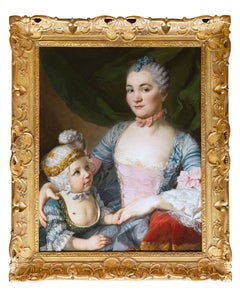
Portrait of a lady with her son, studio of F.H. Drouais, Paris, French, 18th c.

Portrait of a lady with her son, studio of F.H. Drouais, Paris, French, 18th c.

By François Hubert Drouais

Located in PARIS, FR

Portrait of a lady with her son, Workshop of François Hubert Drouais (Paris 1727-1775) (no visible signature) French School, mid-18th century, circa 1760 Oil on canvas: h. 71.5 cm, w...

Category

Mid-18th Century Old Masters Cornelius Johnson Art

Materials

Canvas, Oil

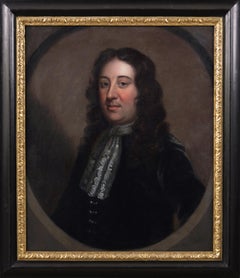
17th Century portrait oil painting of a gentleman

17th Century portrait oil painting of a gentleman

By John Riley

Located in Nr Broadway, Worcestershire

Circle of John Riley British, (1646-1691) Portrait of a Gentleman Oil on canvas Image size: 29 inches x 24 inches Size including frame: 36 inches x 31 inch...

Category

17th Century Old Masters Cornelius Johnson Art

Materials

Canvas, Oil

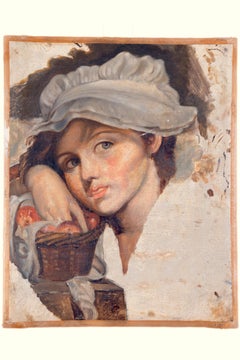
Young Girl with a Basket of Fruit, Oil on Canvas, French, Circa 1790

Young Girl with a Basket of Fruit, Oil on Canvas, French, Circa 1790

By Jean-Baptiste Greuze

Located in Paris, Île-de-France

French School, late 18th century, circle of Jean-Baptiste Greuze (1725–1805) Young Girl with a Basket of Fruit Oil on canvas, preparatory work, Unsigned 39 x 31 cm Provenance: Pri...

Category

1790s Old Masters Cornelius Johnson Art

Materials

Canvas, Oil

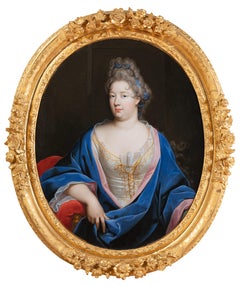
Portrait of a French noblewoman - late 17th French school, attr. to N. Fouché

Portrait of a French noblewoman - late 17th French school, attr. to N. Fouché

Located in PARIS, FR

Portrait of a Lady Attributed to Nicolas Fouché (Troyes, 1653-Paris, 1733) Late 17th century French School, Paris, circa 1690-1695 not signed Oil on canvas: h. 99 cm, w. 79 cm Impo...

Category

Late 17th Century Old Masters Cornelius Johnson Art

Materials

Canvas, Oil

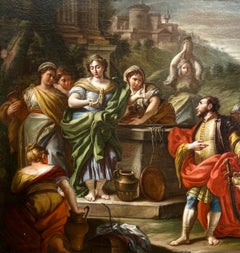
Rebecca at the Well, Oil on Canvas, 18th Century, Framed, Old Masters

Rebecca at the Well, Oil on Canvas, 18th Century, Framed, Old Masters

Located in Fredericksburg, VA

Nicola Maria Rossi masterfully captures the biblical tale of Rebecca and Eliezer at the Well, a story from the Book of Genesis. In this scene, Abraham’s servant, Eliezer, arrives at ...

Category

18th Century Old Masters Cornelius Johnson Art

Materials

Canvas, Oil

Portrait Of A Lady, Frances Bard (1646-1702) Mistress of The Duke Of Cumberland

Portrait Of A Lady, Frances Bard (1646-1702) Mistress of The Duke Of Cumberland

By Anthony van Dyck

Located in Liphook, GB

Portrait Of A Lady, Frances Bard (1646-1702) Mistress of Prince Rupert von de Pfalz, Duke of Cumberland (1619-1882) follower of Anthony Van Dyck (1599-1641) Huge 17th Century Engli...

Category

Late 17th Century Old Masters Cornelius Johnson Art

Materials

Oil, Canvas

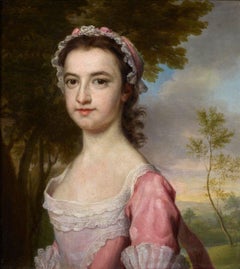
Portrait of a Girl, 18th Century Oil Old Master

Portrait of a Girl, 18th Century Oil Old Master

By George Knapton

Located in London, GB

George Knapton 1698-1778 Portrait of a Girl Oil on canvas Image size: 20 x 18 inches Original giltwood frame This beautiful half length portrait  of a young woman, turned to left, gazing at the spectator, wearing a pink, white lace-embroidered, dress, in her hair a pink bonnet trimmed with lace to match her dress. The depiction of a young girl epitomises child portraiture of the late eighteenth century, in which painters such as William Beechey, Joshua Reynolds, Thomas Gainsborough had begun to discover and express the true character of children, in contrast to the stiff, miniature-adults of previous generations. The Artist Knapton was born in Lymington, one of four sons of James Knapton. He was apprenticed to Jonathan Richardson from 1715 to 1722, and in 1720 was a founding subscriber to the academy of St. Martin's Lane established by Louis Chéron...

Category

18th Century Old Masters Cornelius Johnson Art

Materials

Canvas, Oil

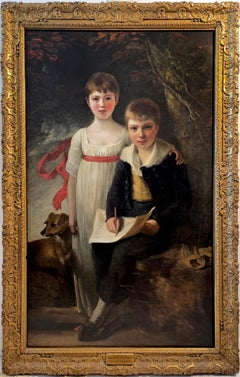
British Portrait of Two English Children Dog - Circle Sir William Beechey

British Portrait of Two English Children Dog - Circle Sir William Beechey

Located in Miami, FL

This charming portrait is a statement piece for any space. The two elegantly handsome sitters are brother and sister and are accompanied by their loyal dog. With 18th and 19th century British portraiture, it's the sitters' attractiveness that makes a painting desirable and drives price. There are lively brush strokes with impasto in the trees The nameplate identifies the sitters as Robert & Marianne Lawrence-Townsend - The Family of Lawrence-Townsend were originally descendants of the Lawrence Family of Wiltshire who inherited the name Townsend along with an estate, Steanbridge House near Stroud in Gloucestershire. Robert would appear to be the son born in 1797, educated at Eton and Christ Church, Oxford, former Captain in the British Army and who became a Magistrate for Gloucester. Condition is good with some old repairs. painting beckons with vibrancy. Presents very well and is best viewed with a top key light. Private collection and perhaps Phillips Auctioneers New York 1995 per letter. Framed Size 66 x 43.5 x 4 W.R. Peddigrew, Western Cardiff, South Wales Provenance: The Estate of Mrs. Eleanor Goddard Daniels, Worcester, Massachusetts. Sotheby Parke-Bernet, New York, June 1981 The uploaded video on 1stDibs is coming up a bit off color. Refer to the still images for more accurate color Originally this work was attributed to Sir William Beechey...

Category

Early 1800s Old Masters Cornelius Johnson Art

Materials

Canvas, Oil

Previously Available Items
Portrait of Lady, Mary Hammond, Oil on Panel c.1618-22, Manor House Provenance

Portrait of Lady, Mary Hammond, Oil on Panel c.1618-22, Manor House Provenance

By Cornelius Johnson

Located in London, GB

Portrait of Mary Hammond in Sumptuous Attire, Jewels and Lace c.1618-22 Circle of Cornelius Johnson (1593-1661) This portrait of a lady, presented by Titan Fine Art, is an exquisite example of early seventeenth-century portraiture, remarkable both for the lavishness of its subject’s attire and for the distinguished provenance that has accompanied it across four centuries that adds a rich layer of historical significance. It was once part of the notable collection of Sir William Temple, 1st Baronet (1628–1699) at Moor Park, a stately mansion in Hertfordshire. Temple was a diplomat, essayist, philosopher, and the patron of Jonathan Swift. He was a key participate at an important period in English history, helping not only to negotiate the Triple Alliance, but also the marriage between William of Orange and Princess Mary. His collection at Moor Park was well known in its day, reflecting both his cultivated taste in art and literature and his international connections. Its fabulous attire, rendered with almost microscopic attention, is not merely decorative but emblematic of a world in which visual display was a language of power. Its provenance, stretching from the English country house and Enlightenment scholarship to modernist circles, forms a microcosm of cultural exchange across four centuries. Thus, the portrait of Mary Hammond stands as both a masterpiece of early seventeenth-century craftsmanship and a witness to the grand narrative of collecting and connoisseurship—a testament to the enduring fascination of beauty, status, and history intertwined. By tradition the portrait depicts Mary Hammond (born c.1602), who was Sir William Temple’s mother, and the daughter of the royal physician who served James I, Dr John Hammond (c.1555–1617) and whose family owned Chertsey Abbey in Surrey. The woman appears between 18 and 25 years old, and Mary would be about 18–20 when the portrait was painted circa 1620, therefore this matches the apparent age of the sitter and the fashion perfectly. Mary stood at the intersection of learned/courtly and gentry worlds. On 22 June 1627 she married her first cousin (a common practice for consolidating family wealth and influence during that era.) Sir John Temple (1600-1677) at St Michael, Cornhill in the City of London. The couple resided nearby, at Blackfriars. Her marriage to Sir Temple placed her at the heart of the social and political circles that shaped British history. The couple had at least five children, and they became highly significant historical figures: The eldest son, Sir William Temple, 1st Baronet, became a distinguished diplomat, statesman, and essayist, famous for his role in the Triple Alliance and as a patron and mentor to the writer Jonathan Swift – our portrait was in his collection. Their daughter, Martha Temple, later Lady Giffard, was a notable figure in her own right. She became her brother William's first biographer and a respected letter-writer, providing a rare female perspective on the events and high society of the time. Another son, also named Sir John Temple, became Attorney General for Ireland and was involved in the turbulent politics surrounding the English Civil War and the Act of Settlement in Ireland. Mary died in November 1638 after giving birth to twins and was buried at Penshurst, Kent. The family's connection to Penshurst Place is a major point of interest as this historic manor was the seat of the Sidney family, a major aristocratic and literary dynasty. The portrait was in the collection of the Mary’s son, Sir William Temple. From there it descended to his daughter, and then to her nephew, the Reverend Nicholas Bacon of Spixworth Park, Norfolk (his mother was Dorothy Temple who died in 1758). Indeed, by this time, many Temple relics were in the collection at Spixworth including the engagement ring of the illustrious Dorothy Osborne, Lady Temple, wife of Sir William Temple. The portrait thus linked two prominent English families—the Temples and the Bacons—for generations. It is listed in a Spixworth Park inventory of 27 October 1910 by the local collector and art historian, Prince Duleep Singh. He described it with characteristic precision as: “No. 69. Lady Half Length, body and face turned towards the sinister, hazel eyes upwards to the dexter, red hair dressed low and over the ears, a jewelled coronet behind, pearl ear-rings tied with black strings. Dress: black, bodice cut low and square, with lace all round the opening and over shoulders, sleeves with double slashes showing red lining and lace under, falling thin pleated lace collar, black strings tied behind it, a jewel suspended on a black string round the neck, and a double row of agate and silver beads all round to the shoulders. M. In brown veined stone frame. Age 30. Date c.1620. It is called ‘Dutch portrait from Moor Park, mentioned by Nicholas Bacon of Coddenham and Shrubland as a very valuable painting.’ A few years later, when Robert Bacon Longe’s executors sold the contents of Spixworth Park (19–22 May 1912), the portrait appeared as lot 262, described as: “A very valuable half-length portrait on panel, ‘Dutch Lady, with deep lace collar and pearl and amethyst necklace, pendant, and ear-rings, and auburn hair, with coronet’ Early Dutch School 1620.” Following this sale the painting entered the collection of David and Constance Garnett, prominent literary figures of the early twentieth century, before being gifted to Andre Vladimervitch Tchernavin by 1949, and subsequently passed by him to the present owners in 1994. The two great houses associated with the painting, Moor Park and Spixworth Park, further underscore its pedigree. Moor Park, in Hertfordshire, was among the grandest country estates of seventeenth-century England—its gardens famously redesigned by Sir William Temple himself and later influencing landscape design across Europe. Sir William's Temple's secretary was Jonathan Swift, who lived at Moor Park between 1689 and 1699. Swift began to write "A Tale of the Tub" and "The Battle of the Books" at Moor Park. Spixworth Park, near Norwich, was an Elizabethan country house in Spixworth, Norfolk, located just north of the city of Norwich. It was home to successive generations of the Bacon family, one of Norfolk’s most distinguished dynasties (later, the Bacon Longe family), who were considerable land owners (owning Reymerston Hall, Norfolk, Hingham Hall, Norfolk, Dunston Hall, Norfolk, Abbot's Hall, Stowmarket, and Yelverton Hall, Norfolk). Spixworth Hall and the surrounding parkland remained in the Longe family for 257 years until 1952, when it was demolished. Rendered with meticulous precision and sumptuous detail, the painting depicts an elegantly dressed woman—her poise, costume, and jewels all communicating a message of wealth, refinement, and social rank. Every brushstroke conveys an artist deeply attuned to the textures of luxury and the nuances of feminine dignity. The sitter’s attire is nothing short of magnificent. Her bodice and sleeves are fashioned from the finest black silk or satin, the fabric absorbing and reflecting light in equal measure, suggesting both depth and lustre. Around her shoulders lies an opulent lace ruff—a deep, radiating lace collar worked in such intricate detail that it testifies to both the artist’s technical skill and the sitter’s extravagant taste. Lace of this quality, especially Venetian or Flemish bobbin lace, was one of the costliest materials available in early seventeenth-century Europe, its weight worth more than gold, and was a marker of prestige that rivalled jewels in value. The painter has taken great care to delineate every loop and scallop of the lace, achieving an almost tactile realism. Pale skin was also a desired beauty standard, sometimes accentuated with contrasting black ribbons or strings. Her jewels amplify this display of affluence. Matching earrings and a delicate coronet or jewelled hair ornament with a feather adorn her hair, which is styled in the modest yet fashionable manner of the time. These details are far from decorative excess—they serve as visual emblems of social standing, refinement, and lineage. Portraits of this kind were statements of both identity and aspiration, intended to project a family’s prosperity and moral virtue to posterity. The portrait was most likely painted in London around 1618-1622. The low-cut, décolletage-revealing neckline was fashionable in the courts of England and France during the late Elizabethan and Jacobean eras (c. 1590s-1610s), this style did not prevail in the public fashion of the Low Countries at this time. This style of lace ruff — delicate needle lace with geometric openwork — was fashionable from c.1615 to 1622, and the jewelled caul (hair net) and lace edging over a stiffened coif are consistent with high-status English women’s portraiture between 1610–1620. The puffed sleeve slash and the use of pink satin beneath black velvet belong squarely to the late Jacobean...

Category

17th Century Old Masters Cornelius Johnson Art
Materials

Oil, Panel

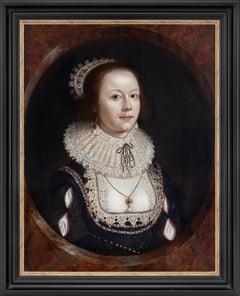
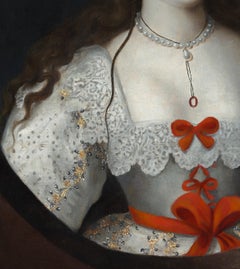
Portrait of Elizabeth Penyston; Cornelius Johnson (1593-1664), Signed and Dated

Portrait of Elizabeth Penyston; Cornelius Johnson (1593-1664), Signed and Dated

By Cornelius Johnson

Located in London, GB

Portrait of Elizabeth Penyston Cornelius Johnson 1593-1664), Signed and Dated Through merit and splendid achievement, the artist of this portrait ca...

Category

Mid-17th Century Old Masters Cornelius Johnson Art
Materials

Oil, Canvas

Cornelius Johnson art for sale on 1stDibs.

Find a wide variety of authentic Cornelius Johnson art available for sale on 1stDibs.

Artists Similar to Cornelius Johnson