Daniel Marot Art

to
1
1
1
1
Daniel Marot's The Siege of the Dutch Fortified City of Ypres by Louis XIV

Daniel Marot's The Siege of the Dutch Fortified City of Ypres by Louis XIV

By Daniel Marot

Located in Alamo, CA

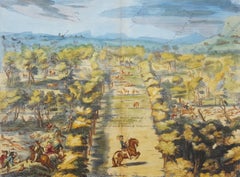
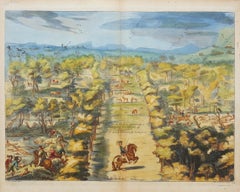
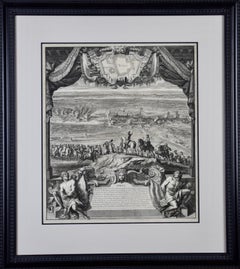
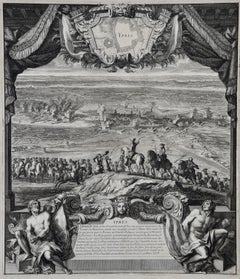
"Ypres, Grand Ville Riche & Marchande" is an engraving and etching by Daniel Marot (le Vieux) (1661–1752). It depicts a view of the siege of the city of Ypres and its citadel on the left in the Spanish Netherlands by Louis XIV's troops. This battle took place between March 18 and March 25, 1678, as part of the Franco-Dutch War. Marot illustrated in great detail (best appreciated with magnification) the French attack on the strong pentagonal citadel on the extreme left, which had been built recently in anticipation of a French attack. The trenches built by the French approaching the town are seen on the right. King Louis XIV can be seen in the foreground surveying the battle mounted on his white horse, surrounded by his officers and troops. The print is presented in an attractive ornate black wood frame with a cream-colored double mat with a black inner trim. It is glazed with plexiglas. The frame measures 25.38" x 22.63" x .88". The engraving, frame, mat and glazing are in excellent condition. Artist: Daniel Marot (1661–1752) was also called "Le Vieux". He was the son of the famous architect, Jean Marot. Marot had diverse interests and talents. In addition to his art, he designed garden projects, architectural ornaments, furniture, and even upholstery. Marot as a Huguenot protestant was forced to leave France in 1685 following the revocation of the Edict of Nantes. He emigrated to Holland, where he worked for William of Orange (an arch enemy of his former employer Louis XIV). Marot was largely responsible for the interiors of Williams palace at the Loo. In 1694 he went Britain as William had married Queen Mary and he had become King William III of England. He later returned to Holland in about 1698 and died in the Hague in 1752. He left a lasting legacy on the decorative arts in the Netherlands, where his grand version of the Louis XIV style remained popular into the 1730s. Historical Background: In October 1677, Mary Stuart, niece and possible successor of Charles II of England, married Louis XIV's arch enemy William III of Orange...

Category

Late 17th Century Old Masters Daniel Marot Art

Materials

Engraving, Etching
Related Items
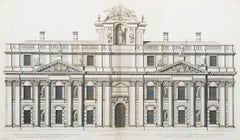
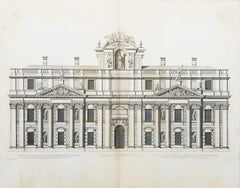
Royal Hospital att Greenwich to the River /// "Vitruvius Britannicus" Engraving

Royal Hospital att Greenwich to the River /// "Vitruvius Britannicus" Engraving

By Colen Campbell

Located in Saint Augustine, FL

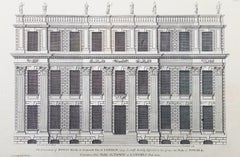
Artist: Colen Campbell (Scottish, 1676-1729) Title: "Royal Hospital att Greenwich to the River" (Vol. 1, Plates 86, 87) Portfolio: Vitruvius Britannicus; or The British Architect, Co...

Category

1710s Old Masters Daniel Marot Art

Materials

Laid Paper, Engraving, Intaglio, Etching

Set of Two Engravings from Campbell's "Vitruvius Britannicus" /// Architecture

Set of Two Engravings from Campbell's "Vitruvius Britannicus" /// Architecture

By Colen Campbell

Located in Saint Augustine, FL

Artist: Colen Campbell (Scottish, 1676-1729) Titles: "The Plan of this New Design to the Earl of Islay" (Vol. 1, Plate 53) and "This New Design to the Earl of Islay" (Vol. 1, Plate 5...

Category

1710s Old Masters Daniel Marot Art

Materials

Laid Paper, Engraving, Etching, Intaglio

St Peters Church at Rome /// "Vitruvius Britannicus" Architecture Engraving Art

St Peters Church at Rome /// "Vitruvius Britannicus" Architecture Engraving Art

By Colen Campbell

Located in Saint Augustine, FL

Artist: Colen Campbell (Scottish, 1676-1729) Title: "St Peters Church at Rome" (Vol. 1, Plate 6) Portfolio: Vitruvius Britannicus; or The British Architect, Containing the Plans, Ele...

Category

1710s Old Masters Daniel Marot Art

Materials

Laid Paper, Engraving, Etching, Intaglio

L' Orage
L' Orage

L' Orage

Located in New York, NY

Etching and engraving, circa 1770. Coat-of-arms with an eagle watermark. The sheet overall in good condition with narrow to thread margins.

Category

1770s Old Masters Daniel Marot Art

Materials

Engraving, Etching
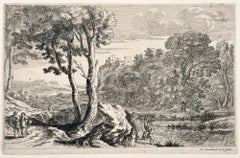
The Anglers
The Anglers

The Anglers

By Herman van Swanevelt

Located in Middletown, NY

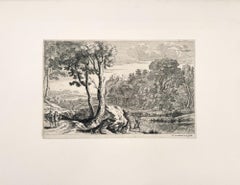
Etching with engraving on cream laid paper with a large unidentified alphabetic watermark, 6 1/2 x 9 7/8 inches (165 x 251 mm), the full sheet. In good condition with handling wear a...

Category

Early 17th Century Old Masters Daniel Marot Art

Materials

Laid Paper, Engraving, Etching
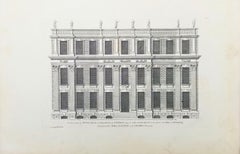
Set of Two Engravings from Nash's "History of Worcestershire" /// Landscapes Art

Set of Two Engravings from Nash's "History of Worcestershire" /// Landscapes Art

By Treadway Russell Nash

Located in Saint Augustine, FL

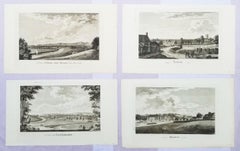
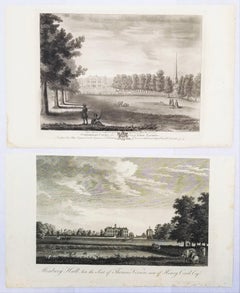
Artist: Treadway Russell Nash (English, 1724-1811) Title: "Henbury Hall, late the Seat of Thomas Vernon, now of Henry Cecil Esq." and "Ombersley Court, the Seat of Lord Sandys" Portfolio: Collections for the History of Worcestershire Year: 1781-1782 (First edition) Medium: Set of Two Original Engravings and Etching with Aquatint on watermarked laid paper Limited edition: Unknown Printer: John Nichols, London, UK Publisher: T. Payne and Son, J. Robson, B. White, Leigh and Sotheby, London, UK; Fletcher, Oxford, UK; and Lewis, Worcester, UK Sheet size (each): approx. 10.13" x 16.88" Image size (each): approx. 8.13" x 12.63" Reference: Upcott III, page 1330 Condition: "Henbury Hall, late the Seat of Thomas Vernon, now of Henry Cecil Esq." has scattered light foxmarks in margins. The top edge is unevenly trimmed and a small taped tear to lower right corner. "Ombersley Court, the Seat of Lord Sandys" has light toning to sheet and some faint discoloration in right margin. A small light water stain to lower left corner. Have been professionally stored away for decades. They are both otherwise strong impressions in good condition Notes: Provenance: private collection - Aspen, CO. "Henbury Hall, late the Seat of Thomas Vernon, now of Henry Cecil Esq." was likely engraved by English artist James Ross (1745-1821) after a drawing by himself. "Ombersley Court, the Seat of Lord Sandys" was engraved by English artist Valentine Green (1739-1813) and English artist Francis Jukes (1745-1812) after a drawing by an unknown, likely English artist. The first work is an engraving; the second work is an etching with aquatint. Comes from Nash's two volume "Collections for the History of Worcestershire", (1781-1782) (First edition), which consists of 75 engravings. Each work is printed from copper plates in one color: black. There was a (Second edition) "with Additions" bound in with Volume II of this portfolio published by John White in (1799). And both the First and Second editions of "Collections for the History of Worcestershire" are based off Thomas Sanders' 1779-1781 "Perspective Views of the Market Towns within the County of Worcester". "Ombersley Court, the Seat of Lord Sandys" has an unidentified watermark in the center of its sheet. "Henbury Hall" is actually incorrectly misnamed; its correct name is "Hanbury Hall". "PLATES, Drawn and engraved by J. Ross, unless otherwise expressed." - "A Bibliographical Account of the Principal Works Relating to English Topography", (1818) - William Upcott. Biography: Treadway Russell Nash (24 June 1724 – 26 January 1811) was an English clergyman, now known as an early historian of Worcestershire and the author of Collections for the History of Worcestershire, an important source document for Worcestershire county histories. He was a fellow of the Society of Antiquaries of London. Treadway Russell Nash was born on 24 June 1724 born at Clerkenleap, in Kempsey, Worcestershire. His family were from Ombersley. They had lands there and at Claines, and had later bought lands in the Reformation around St Peter's, Droitwich. He was related to James Nash and John Nash, both MPs for Worcester. His father Richard, a grandson of Sir Rowland Berkeley, died in 1740, and Richard's eldest son in 1757. As a result, Treadway Russell Nash inherited the Russells' Strensham estates from his brother, as well as the Nash estates, and took both names. He was educated from the age of twelve at King's School, Worcester, and became a scholar at Worcester College, Oxford aged fifteen. In March 1749, he accompanied his brother on a trip to the continent, to aid Richard's health. They visited Paris for about six weeks, before spending the summer "on the banks of the Loire". They then visited "Bourdeaux, Thoulouse, Montpelier, Marseilles, Leghorn, Florence, Rome, Naples, Bologna, Venice, Padua, Verona, Milan, Lyons, and again Paris"; such expeditions are often known as the Grand Tour. On his return in late summer 1751, Nash took up a post as Vicar of Eynsham through his friend and future brother-in-law, John Martin. He also had an income as a tutor at Oxford. He took his Doctor of Divinity degree and left Oxford, having "gone out grand compounder", following the death of his brother. He also left his benefice at Eynsham in 1757. While at Oxford he had proposed a road from there to Witney (now the A40 and B4022), and also stood for Parliament. Nash married Margaret Martin...

Category

1780s Old Masters Daniel Marot Art

Materials

Laid Paper, Engraving, Intaglio, Etching, Aquatint

Christ Crowned with Thorns, from The Passion of Christ

Christ Crowned with Thorns, from The Passion of Christ

By Hendrick Goltzius

Located in Middletown, NY

Engraving on cream wove paper, 8 x 5 3/8 inches (203 x 137 mm), narrow to thread margins. First state (of 2). A fine impression with archival paper adhered at left top and bottom cor...

Category

Early 17th Century Old Masters Daniel Marot Art

Materials

Engraving

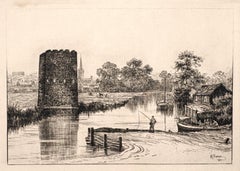
Shere Mill Pond
Shere Mill Pond

Shere Mill Pond

By Sir Francis Seymour Haden, R.A.

Located in Missouri, MO

Shere Mill Pond, No. II (large plate). 1860. Etching and drypoint. Schneiderman 37.v/ix. 7 x 13 1/8 (sheet 10 3/4 x 16 3/8). This state is prior to publication in Études à l'Eau-Forte. Illustrated: Keppel The Golden Age of Engraving; Print Collector's Quarterly 1 (1911): 18; : Guichard, British Etchers, 1850-1940. A rich, brilliant proof with drypoint burr printed on white laid paper. Signed in pencil. ------------------------------------------------------------------------------------------- Shere Mill Pond, No. II was one of the most highly praised landscape prints of the etching revival. An impression was exhibited at the Royal Academy in 1861 under Haden’s pseudonym, H. Dean. Francis Seymour Haden used this anagram of his own name early in his career as an artist, in order to retain his anonymity and preserve his professional reputation as a surgeon. Biography: Sir Francis Seymour Haden (16 September 1818 - 1 June 1910), was an English surgeon, best known as an etcher. He was born in London, his father, Charles Thomas Haden, being a well-known doctor and lover of music. He was educated at Derby School, Christ's Hospital, and University College, London, and also studied at the Sorbonne, Paris, where he took his degree in 1840. He was admitted as a member of the College of Surgeons in London in 1842. In 1843-1844, with his friends Duval, Le Cannes and Colonel Guibout, he travelled in Italy and made his first sketches from nature. Haden attended no art school and had no art teachers, but between 1845 and 1848 he studied portfolios of prints belonging to a second-hand dealer named Love, who had a shop in Bunhill Row, the old Quaker quarter of London. Arranging the prints in chronological order, he studied the works of the great original engravers, Albrecht Dürer, Lucas van Leyden and Rembrandt. These studies, besides influencing his original work, led to his important monograph on the etched work of Rembrandt. By lecture and book, and with the aid of the memorable exhibition at the Burlington Fine Arts Club in 1877, he tried to give a true reflection of Rembrandt's work, giving a nobler idea of the master's mind by taking away from the list of his works many dull and unseemly plates that had long been included in the lists. His reasons were founded upon the results of a study of the master's works in chronological order, and are clearly expressed in his monograph, The Etched Work of Rembrandt critically reconsidered, privately printed in 1877, and in The Etched Work of Rembrandt True and False (1895). Haden's printmaking was invigorated by his much younger brother-in-law, James Whistler, at the Haden home in Sloane Street in 1855. A press was installed there and for a while Haden and Whistler collaborated on a series of etchings of the Thames. The relationship and project did not last. Haden followed the art of original etching with such vigour that he became not only the foremost British exponent of that art but brought about its revival in England. His strenuous efforts and perseverance, aided by the secretarial ability of Sir WR Drake, resulted in the foundation of the Royal Society of Painter-Etchers and Engravers. As president he ruled the society with a strong hand from its first beginnings in 1880. Notwithstanding his study of the old masters of his art, Haden's own plates were very individual, and are particularly noticeable for a fine original treatment of landscape subjects, free and open in line, clear and well divided in mass, and full of a noble and dignified style of his own. Even when working from a picture his personality dominates the plate, as for example in the large plate he etched after J.M.W. Turner's "Calais Pier," which is a classical example of what interpretative work can do in black and white. Of his original plates, more than 250 in number, one of the most notable was the large "Breaking up of the Agamemnon." An early plate, rare and most beautiful, is "Thames Fisherman". "Mytton Hall" is broad in treatment, and a fine rendering of a shady avenue of yew trees leading to an old manor-house in sunlight. "Sub Tegmine" was etched in Greenwich Park in 1859; and "Early Morning--Richmond", full of the poetry and freshness of the hour, was done, according to Haden, actually at sunrise. One of the rarest and most beautiful of his plates is "A By-Road in Tipperary"; "Combe Bottom" is another; and "Shere Mill Pond" (both the small study and the larger plate), "Sunset in Ireland," "Penton Hook," "Grim Spain" and "Evening Fishing, Longparish," are also notable examples of his genius. A catalogue of his works was begun by Sir William Drake and completed by Harrington in 1880. During later years Haden began to practise the sister art...

Category

Late 19th Century Old Masters Daniel Marot Art

Materials

Drypoint, Etching

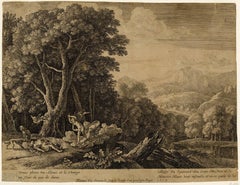
Venus abducting Adonis.; Plate 2 from The Story of Adonis

Venus abducting Adonis.; Plate 2 from The Story of Adonis

By Herman van Swanevelt

Located in Middletown, NY

Etching with engraving on thin laid paper with an unidentified ovoid purple ink stamp (not in Lugt), 9 3/4 x 12 7/8 inches (247 x 326 mm), thread margins. Uniform age tone with scatt...

Category

Early 17th Century Old Masters Daniel Marot Art

Materials

Laid Paper, Engraving, Etching

Thorsby House in the County of Nottingham /// "Vitruvius Britannicus" Engraving

Thorsby House in the County of Nottingham /// "Vitruvius Britannicus" Engraving

By Colen Campbell

Located in Saint Augustine, FL

Artist: Colen Campbell (Scottish, 1676-1729) Title: "Thorsby House in the County of Nottingham" (Vol. 1, Plate 91) Portfolio: Vitruvius Britannicus; or The British Architect, Contain...

Category

1710s Old Masters Daniel Marot Art

Materials

Laid Paper, Engraving, Etching, Intaglio

The Beheading of the King of England; Enthauptung des Königs in England

The Beheading of the King of England; Enthauptung des Königs in England

By Matthäus Merian the Elder

Located in Middletown, NY

The execution of Charles I (1600-1649) at Whitehall, January 30th 1649, in front of the Banqueting House. The executioner holding the head of Charles up to the crowd below. Engravin...

Category

Mid-17th Century Old Masters Daniel Marot Art

Materials

Laid Paper, Engraving

"Torksey Hall" and "Newark Castle" from "Buck's Antiquities" /// Architecture UK

"Torksey Hall" and "Newark Castle" from "Buck's Antiquities" /// Architecture UK

By Samuel & Nathaniel Buck

Located in Saint Augustine, FL

Artist: Samuel and Nathaniel Buck (English, 1696-1779) and (?-1759/1774) Title: "Torksey Hall" (Plate 179) and "Newark Castle" (Plate 226) Portfolio: Buck's Antiquities or Venerable ...

Category

1720s Old Masters Daniel Marot Art

Materials

Laid Paper, Engraving, Intaglio

Daniel Marot art for sale on 1stDibs.

Find a wide variety of authentic Daniel Marot art available for sale on 1stDibs. You can also browse by medium to find art by Daniel Marot in engraving, etching and more. Much of the original work by this artist or collective was created during the 18th century and earlier and is mostly associated with the Old Masters style. Not every interior allows for large Daniel Marot art, so small editions measuring 23 inches across are available. Customers who are interested in this artist might also find the work of Adriaen van Ostade, Giovan Battista Falda, and Cornelis Bega. Daniel Marot art prices can differ depending upon medium, time period and other attributes. On 1stDibs, the price for these items starts at $1,275 and tops out at $1,275, while the average work can sell for $1,275.

Artists Similar to Daniel Marot