By Daum
Located in Vienna, AT
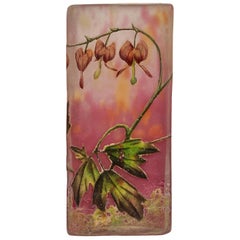
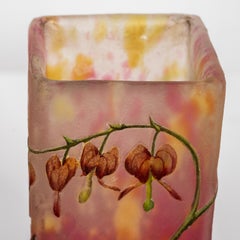
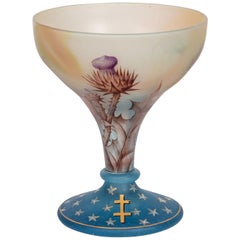
A museum piece of French Art Nouveau glass art:
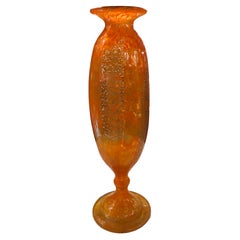
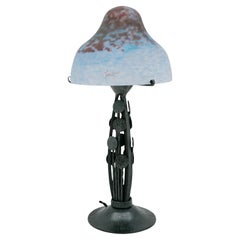
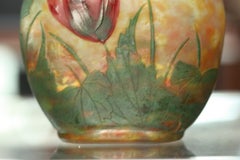
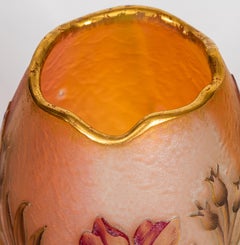
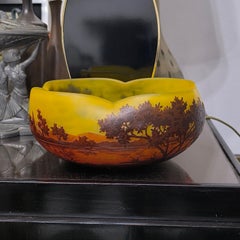
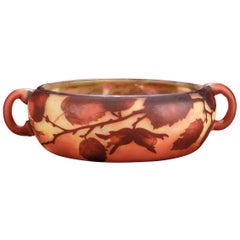
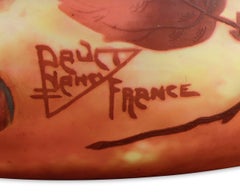
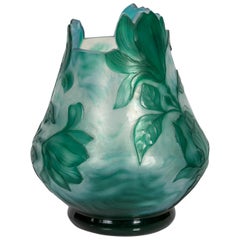
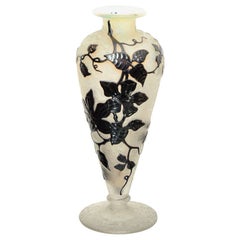
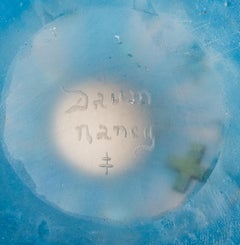
Lamp with baluster-shaped foot on a stepped, flat, round stand raised in the centre, hemispherical shade, slightly heat-stretched and pressed upwards on four sides, made of multi-layered glass with coloured powder fusions, predominantly in yellow-orange, red, brown, green and blue-violet tones, with highly etched vine leaves and grapevine decoration, two fully sculpted snails on the foot as a special accent, Cameo signature ‘DAUM NANCY’ with Lorraine cross on the foot in the lower area, and on the shade, which rests on a patinated metal mount, which also carries the threads for the light sources, one at the top and one inside the foot.
Technique: Handmade cameo glass
Glass overlaid with several layers, with high-cut worked out motifs. Since the middle of the 19th century, the design has also been done by etching. Cameo glass vessels were already being made in antiquity; cameo glass vessels were already being made in ancient times, and at the end of the 19th century this glass art was further developed,
especially in Nancy.
Manufactory: Daum Frères / Nancy, Lorraine, France
Dating: Circa 1905
Dimensions:
Height: 53,5 cm / 21.06 in
Diameter: 32,0 cm / 12.59 in
Bibliography:
Carolus Hartmann, Glasmarken-Lexikon / Encyclopedia of Glass Marks, Stuttgart / Germany 1997, Signature number 2984 on page 148, and page 561: Daum Frères & Cie, Verreries de Nancy
Condition: Very good
The electrification is functional, but should be renewed for safety reasons.
About the design:
The development of Art Nouveau glass art coincides with a revolution in lighting, the significance of which we can no longer fully appreciate today in the 21st century. Around 1880-1890, oil lamps and paraffin lamps were still almost unrivalled in every household. It was not until the beginning of the 20th century that the ‘electricity fairy’ emerged as a remarkable advance and gradually found its way into the daily lives of all social classes. The glassmakers at the Ecole de Nancy were true pioneers and eagerly seized the opportunity to use electricity to illuminate the colours
applied to the glass. Colour was one of the main concerns of the master glassmakers at the Ecole de Nancy.
Emile and Antonin Daum returned to the colours that had made the stained glass of the Middle Ages so splendid and extended the palette of colours in the glass mass as they needed it for the floral motifs and exact representations of nature. But the modulation of the colours, their arrangement in juxtaposed patches, the technique that the Impressionist painters practised on their canvases at the same time, was difficult to achieve due
to the nature of the glass melted in a large mass.
To achieve this richness of expression, around 1900 Daum developed ‘the process of applying glass powder and enamel to the outside of the vases to create coloured backgrounds or decorative spots’, according to the report of the jury of the 1900 World Exhibition.
The field of naturalistic, contrasting and shimmering colours was one in which Antonin Daum excelled. This new technical process made it possible to create the symphonies of colour that we find on the ‘Vignes et escargots’ lamp...
Category
Early 1900s French Art Nouveau Antique Daum Furniture