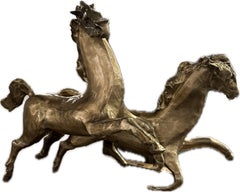
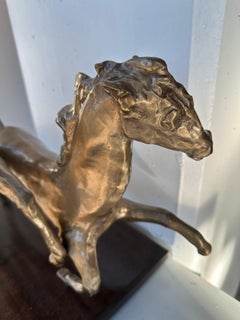
"MAN ON HORSE" DAVID ADICKES (1927-2025). MCM. Houston Artist Bronze Sculpture
David Adickes
(1927-2024)
"Man On Horse" Bronze Sculpture
7.5 x 6.5 x 3
Signed inner rear leg.
cowboy, horseback, horse, western, wooden base
Houston sculptor and painter David Pryor Adickes died on Sunday, July 13 at age 98, leaving a legacy of nearly eight decades of artmaking that included many notable monumental public sculptures and signature paintings. Mr. Adickes may have cut a diminutive figure — at 105 pounds he was once deemed too slight to enlist as a World War II Army pilot — but he became a giant of Texas art over his long lifetime.
Mr. Adickes was born in Huntsville in 1927, and lived there through graduating with a degree in math and physics from Sam Houston State University (SHSU), before decamping to Paris in 1948. There he studied the art of El Greco, Pablo Picasso, Georges Braque, and Marc Chagall. In a 2017 Texas Country Reporter story, Mr. Adickes quoted his friend, noted author James Michener — whom he called “Jim” — in saying, “I just come from Texas, but I’m not a Texan. I’m a French artist, if you had to really put geography [on it]. Paris influenced me more than any other place in the world.”
But few artists could have been more Texan. In true maverick style, Mr. Adickes sidestepped traditional methods of applying for public art commissions through governmental channels, instead parlaying successful real estate ventures into buying land on which to situate his artworks. One such example is his massive Sam Houston sculpture — a Huntsville icon, titled A Tribute to Courage — grandly stands nearly 70 feet tall on a grassy plot he owned on the southern edge of town, overlooking Interstate 45.
Dixie Friend Gay, a longtime friend of Mr. Adickes and noted public sculptor who goes through traditional channels to propose and site her work, said good humoredly, “He talked to me about how I did public art, and he goes, ‘You know what? I just go buy the property and stick what I want to on it.’”
Ms. Gay said Mr. Adickes was generous in sharing his substantial knowledge on complex sculptural processes. This trait was also recognized by artist Jack Massing, Executive Director of The Orange Show Center for Visionary Art, who to work through the complex concrete layering processes of building his huge sculptures. “As a maker, he was fearless in making these giant things. He figured it out. He got it done, and he did it for so long,” Mr. Massing said.
Linda Wiley also admired Mr. Adickes, for his work as an artist and for his charming personality. They met 30 years ago while he was working on the Sam Houston sculpture. “Those of us around in Huntsville ... had heard of this guy that was building a giant statue, and so I went out and met David and his charming self, and started taking pictures,” she said. That initial encounter eventually became Ms. Wiley’s 1996 book about Adickes as an inspiration for creativity in everyone, Making It Happen: Exploring the Creative Process Through the Sculptures of David Adickes. The title is a reference to Mr. Adickes’ fortitude, Ms. Wiley said.
“David didn’t just dream up the dream, he realized the dream.” The two became a couple, then life partners. One dream of Mr. Adickes’ that remains unrealized was finding a permanent Texas home for his collection of 43 famed giant president’s head sculptures, which remain at his downtown studio. The building faces demolition by the Texas Department of Transportation through eminent domain. “So there’s the ticking of the clock, because we’re hoping to get them transferred to their new home before TxDOT says you gotta move them now,” Ms. Wiley said.
Thirty years ago, after seeing firsthand the monumental Mount Rushmore National Memorial in South Dakota, Mr. Adickes undertook what would become an expensive and consuming obsession to craft large-scale concrete heads for each president. By the end of his life, he had completed every president through Barack Obama. In a 2014 interview with Houston Public Media, Mr. Adickes said, “It’s this crazy idea, but I have crazy ideas,” concluding with a lightheartedly self-deprecating pronouncement, "It's a curse."
In a February 2025 Texas Monthly article on the quandary of their preservation, Mr. Adickes is quoted as saying, “I don’t want them to die. ... My goal is to create works of art that will be here for generations — that will bring pleasure for generations to come. My whole life is based on that desire.”
Mr. Adickes purchased the former Huntsville High School, when the building was to be razed, and converted it into the Adickes Art Foundation Art Museum to house his ever-growing collection of paintings and sculptures. Ms. Wiley said they sold the building a few years ago to SHSU, which turned it into a natural history museum. Regarding what will happen to the artistic legacy of Mr. Adickes, “As far as a museum in his honor, that remains to be seen. I’m going to let the stars align on that and see what happens.” She said TammyDowe of Spot On Public Relations in Houston is working on finding a home for the presidents’ heads, and Mr. Massing said he believes the heads will be the most important part of Mr. Adickes’ legacy and hopes they find a home.
According to those who knew him, Mr. Adickes will be remembered for his good will as much as his artwork. Mr. Massing said, “His impact is going to be felt for another 30 to 50 years because of the people that he touched.” Ms. Gay remembered him as an engaging personality. “I loved his stories. He was such a unique storyteller,” she said, describing him as a “Renaissance Man” with a wide range of interests. In a 2008 oral history book by Sarah C. Reynolds, Houston Reflections: Art in the City, 1950s, ‘60s, and ‘70s, Mr. Adickes recalled starting The Studio School of Contemporary Art on Truxillo Street with Paris colleague Herb Mears in 1951, and later, opening the Love Street Light Circus and Feel Good Machine in 1967, calling it “the hottest psychedelic club in town," having hosted such bands as The Red Crayola, at the time "just a bunch of kids from Rice (University)."
In 2017, Mr. Adickes told the Texas Country Reporter that loving what he did was key to his longevity, declaring, “I’ll never retire. That’s not possible.” Ms. Wiley said he stayed active, in mind and spirit, until he died. “He was David until the very last.”
For an extended visual tour of Mr. Adickes’ Houston- and Huntsville-based monumental sculpture, visit the Houston Chronicle’s recent memorial photo essay. A public memorial event will be held in mid-October, Ms. Wiley said, with further details forthcoming.
Source: Glasstire (2025), written by Nicholas Frank
Submitted by: Stephanie Reeves
Biography from the Archives of askART
Photo of David Pryor Adickes
Sculptor David Adickes is known for a major project titled Presidents Park in Williamsburg, Virginia, where he created 42 portraits bust of American presidents. Each sculpture is twenty feet tall, and their size was the subject of much protest and controversy. However, a court ruling allowed them to stay.
Source: Art & Antiques, November 2000
Now mainly known as a creator of giant sculpture, Adickes spent most of his professional life teaching, painting, and creating small bronzes. A commission for Houston's Performing Art Center in 1982 marks the beginning of his giant sculpture design. After the 36-foot tall cellist called the Virtuoso in a cubist style, he created a number of abstract works, including a giant cornet for the jazz stage at the 1984 World's Fair in New Orleans, Louisiana.
Circa 1994 he finished a giant statue of Sam Houston, first President of Texas, followed by his 42 statue tribute to United States Presidents.
Adickes has degrees in mathematics and physics which serve him well in the engineering of his works. Working on a giant sculpture series which includes the Beatles, and he hopes to end with a 280-foot tall
cowboy statue...