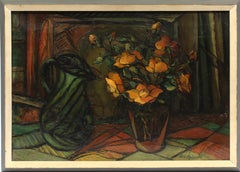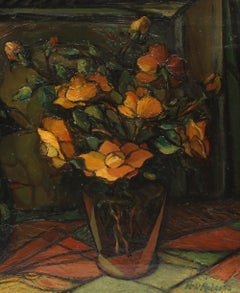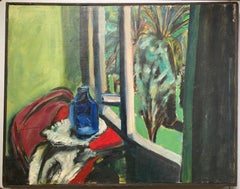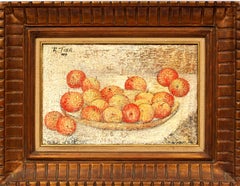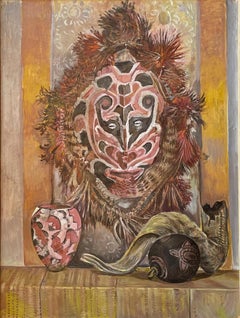
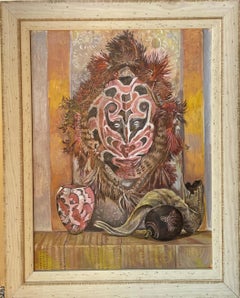
Edith Kramer"Ethnographic Still Life, " Edith Kramer, African Mask and Shofar, Art Therapy
$3,200Sale Price|20% Off
"Ethnographic Still Life, " Edith Kramer, African Mask and Shofar, Art Therapy
By Edith Kramer
Located in New York, NY
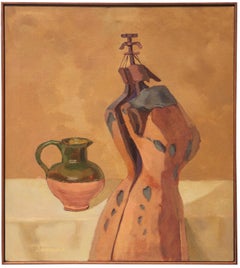
Edith Kramer (1916 - 2014) Still Life with Mask, n.d. Oil on canvas 26 x 20 inches Signed and titled on the stretcher Provenance: Estate of the artist Kramer was born in Vienna, Austria-Hungary in 1916. At age 13 Kramer began art lessons with Friedl Dicker. Dicker was graduate of the Bauhaus in Weimar, Germany and was an artist and art teacher of note. Kramer studied drawing, sculpture and painting, and was influenced by the method for teaching art developed by Bauhaus artist Johannes Itten. It was in 1934 after Kramer graduated from Realgymnasium that she, then 18, followed Dicker to Prague to continue to study under her. During this time in Prague, Kramer witnessed the therapeutic impact of art when she assisted Dicker in teaching art to the children of political refugees. With the threat of Nazi invasion looming, Kramer took refuge in America in 1938. In New York City, she worked for three years teaching sculpture at a progressive school called the Little Red School House. During World War II Kramer worked as a machinist at a tool and die shop in the Soho district of New York City. She stayed after her shift to draw the other workers in their industrial setting. These works were rendered in the social realist style. In 1947 Kramer visited some of the earliest known artwork, in the caves at Lascaux. Kramer spoke of these cave paintings as an example of the universal language of art. At the age of 33 she returned to New York City, with hopes of making a living as an artist. Still in her 33rd year, Kramer was offered a job at Wiltwyck School for Boys, a school and residential treatment facility for children with behavioral and emotional needs. This job was arranged for her by psychoanalyst and board member at Wiltwyck, Dr. Viola Bernard. Dr. Bernard gave Kramer the title, "Art Therapist," noting that few teachers were willing to work with such challenging students. It was here that Kramer worked with disturbed boys, ages 8 through 13, for the following seven years. Raised in a family which was interested in psychoanalytic theory, Kramer herself became a follower of Sigmund Freud. Kramer especially believed in the concept of sublimation. Freudian theory describes sublimation as a process in which primitive urges coming from the id are transformed into socially productive activities that lead to gratification of the original urge. Kramer's training was in art, art education and psychoanalytically informed psychotherapy. Kramer believed sublimation to be one of the most vital goals of art therapy...
20th Century American Modern Edith Kramer Art
Canvas, Oil