Edward Bainbridge Copnall Art

1903-1970

Edward Bainbridge Copnall was born in Cape Town, South Africa in 1903, and moved to Horsham, West Sussex in England as a young child after the death of his mother. His father, photographer Edward White Copnall (born 1878, Isle of Wight), lived and worked in Horsham from 1915–62. Copnall's uncle was Liverpool-based portrait painter Frank Thomas Copnall (1870-1948). The Copnall family have a long association with Horsham, the street Copnall Way is named after them. The exterior sculptural scheme for the Royal Institute of British Architects new building in Portland Place, London, completed in 1934, was an important early commission. In the Second World War, he worked as a camouflage officer in the Middle East, building dummies as part of the military deception for Operation Crusader. Copnall lived in Burma from 1955 to 1956, and completed 50–60 paintings, mainly portraits, during that time. He was also commissioned to do a memorial of General Aung San, the first Prime Minister of Free Burma. The statue was unveiled in Burma in 1955. Copnall was the president of the Royal Society of British Sculptors from 1961 to 1966. He wrote A Sculptor's Manual, published in 1971, and Cycles: An Autobiography - The Life and Work of a Sculptor, published in 2001. Copnall’s son is artist John Copnall (1928–2007).

to
1
2
Overall Width
to
Overall Height
to
2
2
2
2
2
1
1
1
1
1
1
2
10,491
2,810
2,500
1,412
2
2
Artist: Edward Bainbridge Copnall
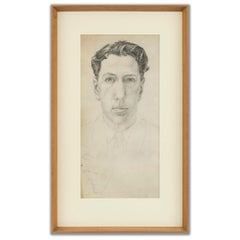
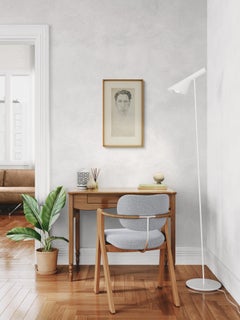
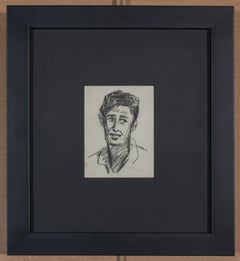
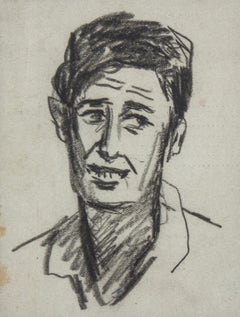
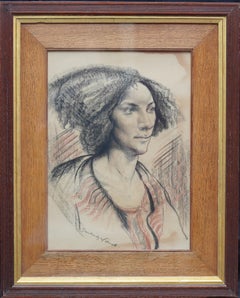
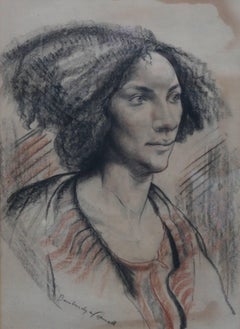
Portrait of a Lady - British art Post Impressionist 40s drawing female portrait

Portrait of a Lady - British art Post Impressionist 40s drawing female portrait

By Edward Bainbridge Copnall

Located in Hagley, England

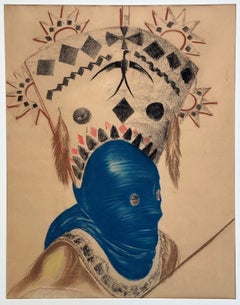
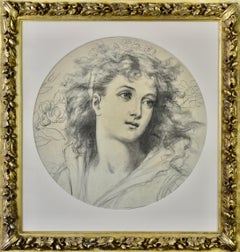
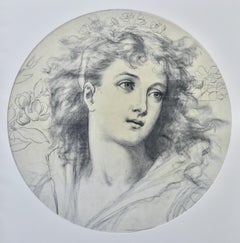
A dramatic head and shoulders portrait of a lady in coloured chalks attributed to noted British artist Edward Bainbridge Copnall. This is just a stunning artwork which dates to circa 1940. Signed Bainbridge Copnall. Provenance. Midlands collection. Condition. Coloured chalks on paper, 16 inches by 13 inches and in good colour and condition. Some staining to edges. Housed in its original gallery frame 21 by 18 inches. In excellent condition. Edward Bainbridge Copnall MBE ( 1903-1973) was a British sculptor and painter. He was best known for his architectural and decorative sculptures featuring allegorical and religious subjects. He was the President of the Royal Society of Sculptors from 1961 - 1966. Edward Bainbridge Copnall was born in Cape Town, South Africa in 1903 and moved to Horsham, West Sussex in England as a young child after the death of his mother. His father, photographer Edward White Copnall (born 1878, Isle of Wight), lived and worked in Horsham from 1915-1962. His uncle was Liverpool-based portrait painter Frank Thomas Copnall...

Category

Early 20th Century Realist Edward Bainbridge Copnall Art

Materials

Chalk

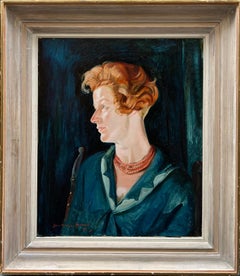
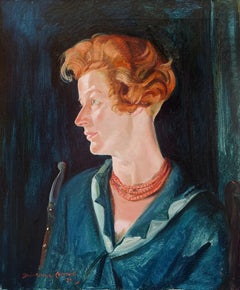
Portrait of a Lady in Blue

Portrait of a Lady in Blue

By Edward Bainbridge Copnall

Located in London, GB

Edward Bainbridge Copnall Portrait of a Lady in Blue 1903-1973 Oil on canvas, signed lower left and dated '30' Image Size: 24 x 20 inches (61 x 50.7 cm) Contemporary style frame Thi...

Category

20th Century Edward Bainbridge Copnall Art

Materials

Canvas, Oil

Related Items
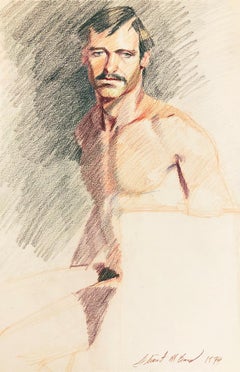
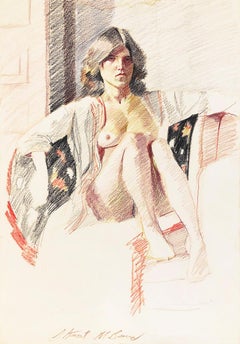
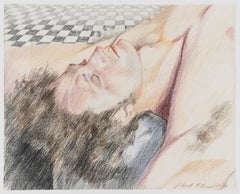
Untitled (Man Reclining on Tile Floor)

Untitled (Man Reclining on Tile Floor)

By Mark Beard

Located in New York, NY

Graphite and conté crayon on paper Signed and dated, l.r. This artwork is offered by ClampArt, located in New York City. Mark Beard, born in 1956 in Salt Lake City, now lives in Ne...

Category

1970s Realist Edward Bainbridge Copnall Art
Materials

Paper, Graphite, Conté

Portrait Of A Young Girl  In A Lilac Dress With A Black Bow. Circa 1860. SIgned.

Portrait Of A Young Girl In A Lilac Dress With A Black Bow. Circa 1860. SIgned.

$322Sale Price|40% Off

H 23.23 in W 15.36 in D 1.19 in

Portrait Of A Young Girl In A Lilac Dress With A Black Bow. Circa 1860. SIgned.

Located in Firenze, IT

Portrait of a young girl in a lilac dress with a black bow. Circa 1860. Signature below right, partially visible. Size with frame 59cm x 49cm Size without frame 33cm x 24cm The portrait depicts a young girl with an elegant hairstyle, her hair carefully tied back. Dressed in the fashion of the 1860s, her light lilac dress reflects the synthetic aniline colors, a novelty in fashion at the time. A black bow at the neck and slightly black straps accentuate her attire. Represented at mid-length, with a mysterious and melancholic gaze, suggesting a mourning endured over a year ago. The portrait, executed in pastels, chalks, and charcoals on paper, highlights the mastery and speed of the artist's execution. Framed in a vintage oval frame...

Category

Mid-19th Century Realist Edward Bainbridge Copnall Art
Materials

Paper, Chalk, Crayon, Carbon Pencil

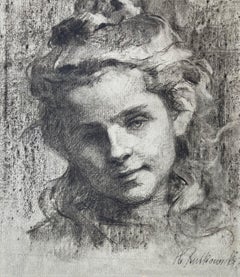
Sketch of a head - Carved in stone -

Sketch of a head - Carved in stone -

Located in Berlin, DE

Emil Faesch (1865 Basel - 1915 Basel). Sketch of a head. Charcoal on painting cardboard, 60 x 47.5 cm (folio size), signed and dated at lower right "E. Faesch. 1888.". Minor browning. - Carved in stone - About the artwork The life-size head has an immensely present presence. This effect is due to the fact that Faesch took his cue from academic classical...

Category

1880s Realist Edward Bainbridge Copnall Art
Materials

Chalk

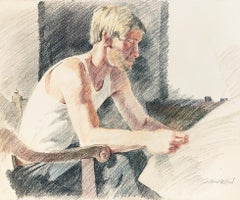
Untitled (Seated Man Facing Left)

Untitled (Seated Man Facing Left)

By Mark Beard

Located in New York, NY

Conté crayon on paper Signed and dated, l.r. This artwork is offered by ClampArt, located in New York City. Mark Beard, born in 1956 in Salt Lake City, now lives in New York City. ...

Category

1970s Realist Edward Bainbridge Copnall Art
Materials

Paper, Conté

18th century diptych portraits man and woman American formal dress flower

18th century diptych portraits man and woman American formal dress flower

By William Jennys

Located in Milwaukee, WI

The present pair of portraits would make an exceptional addition to any collection of early American art not only because they were painted by the notable William Jennys, but also because the sitters are members of notable and influential New England families. In addition, these pendants have impeccable provenance: they have never left ownership of the decedents of the Kimball family and this is the first time they have been available for purchase. David Kimball (1766-1848) and Nancy Stacy Kimball (1774-1844) were members of historic Massachusetts families. David Kimball is a sixth-generation decedent of Richard Kimball (d. 1675) and Ursula Scott (d. 1659), who emigrated from Rattlasden, Suffolk County, England to Watertown MA around 1634. The family then relocated in 1637 to Ipswich, the city with which the family is now most strongly identified, when Richard was appointed to be a wheelwright.[1] Nancy likewise had early New England ancestry, descended from Simon Stacy and Elizabeth Clark, who were married in London in 1620.[2] Nancy Stacy was the second wife of David Kimball, and the two were married in 1799. Given this, the present pendant portraits were likely completed shortly after the marriage. David had two children by his first wife Mary Morse, who died in September of 1798. David and Nancy would have nine additional children between 1801 and 1815.[3] Most notably, the couple were parents of the Boston politician and showman Moses Kimball (1809-1895).[2][3] Moses would found the Boston Museum, an early for-profit museum and theater opened in 1841 that resembled European curiosity cabinets: the museum displayed paintings of Thomas Scully and Charles Peale alongside Chinese artwork, stuffed animals, dwarves and mermaids. Alongside these exhibits, visitors could attend the theater which held performances by gymnasts and contortionists, followed by performances of Shakespeare and Dickens.[4] This museum set the model for the Museum of Fine Arts, Boston, which when founded in 1870 held a similarly diverse collection and appealed to the interests of a diverse set of visitors.[5] Moreover, some Greek antiquities from Moses Kimball's museum were eventually given to the MFA and Moses donated approximately $5,000 to the MFA's endowment upon his death.[6][7] William Jennys (1774–1859), also known as J. William Jennys, is an important American primitive portrait...

Category

1790s Academic Edward Bainbridge Copnall Art

Materials

Oil, Canvas

Half-length portrait of a Pharisee - In the shadow of betrayal -

Half-length portrait of a Pharisee - In the shadow of betrayal -

Located in Berlin, DE

Hermann Prell (1854 Leipzig - 1922 Dresden-Loschwitz). Half-length portrait of a Pharisee, 1885. Sketch for the right-hand figure in the painting Judas Iscariot, 1886. Pencil drawing heightened with opaque white and black chalk on beige-grey wove paper (papier vélin), 34 x 27.8 cm (visible size), 52 x 45 cm (mount), signed, dated and inscribed "H. PRELL 1885 zu 'Judas'". Minor browning, collection stamp on the reverse. - In the shadow of betrayal - About the artwork This painting is the sketch for the head of the Pharisee offering the coins to Judas in one of Herrmann Prell's major works, the painting Betrayal of Judas, completed in 1886. The painting belongs to the Staatliche Kunstsammlungen Dresden and is illustrated in Adolf Rosenberg: Prell, Bielefeld and Leipzig 1901, p. 21 (Fig. 19). It is especially highlighted in Thieme-Becker (vol. 27, p. 376). Hermann Prell, Betrayal of Judas, 1886 The monumental head, which fills the picture and is distinguished by its ornamented robe, is almost a lost profile, which in the executed painting is justified by the Pharisee's turning towards Judas. Despite the fact that the sitter withdraws from the viewer by turning away, it was necessary to artistically elaborate the motivation for the purchase of one of Christ's disciples, which is why the drawing focuses on the expression of the face, while the 'accessories' are treated in a more summary manner. In characterising the face, Hermann Prell performs a balancing act: since the Pharisee, despite his destructive actions, is an actor in the history of salvation, the head must show a dignity appropriate to the event, but at the same time the physiognomy must also bear witness to the scheming attitude that led to the betrayal. To solve this dilemma, Prell draws on the traditional depictions of the heads of the apostles, shading the face to indicate the obdurate darkness of the spirit and moving the base of the nose slightly upwards while the mouth falls away, thus giving a physiognomic expression to the motivation of the action. The fatal drama of the betrayal is expressed in the monumentalisation of the head and in the thunderous white highlights that contrast with the darkness of the chalk. As a study, considered by the artist to be a work in itself, this drawing reveals the pictorial problems and brainstorming of monumental painting. About the artist In 1872 Prell, who was one of the most important exponents of monumental painting of his time, began studying painting with Theodor Grosse at the Dresden Academy of Art and continued with Carl Gussow at the Berlin Academy in 1876. Hans von Marées taught him in Rome in 1878. More influential on his work, however, were Arnold Böcklin and Max Klinger, with whom Prell had been friends since his student days and with whom he worked together on several occasions. Prell's first major work, which established his reputation as a monumental painter, were the frescoes in the banqueting hall of the Architektenhaus in Berlin in 1881/82, commissioned by the state and depicting the different periods of architecture. Prell then went to Italy for two years to study fresco painting. Other major commissions followed. These included monumental frescoes in the town halls of Worms (1884), Hildesheim (1882-92), Gdansk (1895) and Dresden, the staircase of the Silesian Museum of Fine Arts in Breslau (1893/94), the throne room of the German Embassy in Rome (1896-99) and the staircase of the Albertinum in Dresden (1900-1904). From 1886 Prell taught at the academy of arts in Berlin and in 1892 he was appointed professor at the academy of arts in Dresden. His students included Osmar Schindler and Hans Unger...

Category

1880s Realist Edward Bainbridge Copnall Art

Materials

Chalk

Portrait of a Lady with Red Fan, Oil on Canvas, Circa 1945

Portrait of a Lady with Red Fan, Oil on Canvas, Circa 1945

Located in Sitges, Barcelona

Artist: Francesc Domingo i Segura (Barcelona, 1893 – São Paulo, 1974) Title: Portrait of a Lady with Red Fan Technique: Oil on canvas Dimensions: 76 × 56 cm (29.9 × 22 in), unframed Signature: Signed lower left “F. Domingo” Estimated Date: ca. 1945–1955 Provenance: Private collection Condition Report: Homogeneous superficial craquelure across the surface, especially in the background; varnish possibly not original, with slight yellowing. No paint losses or visible dirt. Canvas stable and well-stretched. DESCRIPTION This female portrait depicts a distinguished woman dressed in a floral-patterned gown in green and pink tones, holding a red fan that provides contrast and character to the composition. The sitter, with a serene expression and a slightly melancholic gaze, is softly illuminated, highlighting the texture of her hair and the delicacy of her skin. The work exemplifies Francesc Domingo’s mature style, where his academic beginnings merge with a livelier palette and touches of modernity, particularly visible in the treatment of patterns. The pink background, with loose brushwork and an almost abstract texture, enhances the sitter’s presence. ARTIST BIOGRAPHY Francesc Domingo i Segura (Barcelona, 1893 – São Paulo, 1974) was one of the most versatile Catalan painters of the 20th century. Trained at the Escola Superior de Belles Oficis of the Mancomunitat, he began in the Noucentisme movement and later traveled to Paris, where he absorbed the influence of Cézanne, Cubism, and modern currents. In the 1930s, he cultivated social realism with scenes of Barcelona’s Paral·lel district and the working-class world. After the Spanish Civil War, he went into exile in Latin America, residing first in Buenos Aires and later in São Paulo, where he taught printmaking and co-founded the Grupo Bisonte. His work, with both European influences and local echoes, is represented in museums such as the MNAC and in international collections. SIMILAR ARTISTS For his focus on portraiture and the fusion of academicism and modernity, Francesc Domingo can be compared with: Ricardo Macarrón...

Category

1940s Academic Edward Bainbridge Copnall Art

Materials

Canvas, Oil

Boy & His Dog, 19th Century  by Jules BRETON (1827-1906)

Boy & His Dog, 19th Century by Jules BRETON (1827-1906)

By Jules Breton

Located in Blackwater, GB

Boy & His Dog, 19th Century by Jules BRETON (1827-1906) sales to $1,500,000 Large 19th Century French country portrait of a Boy and his Dog, oil on canvas by Jules Breton. Large 19th century portrait...

Category

19th Century Edward Bainbridge Copnall Art

Materials

Canvas, Oil

Cain & The Death Of Abel, 18th Century

Cain & The Death Of Abel, 18th Century

By William Blake

Located in Blackwater, GB

Cain & The Death Of Abel, 18th Century School of William Blake (1757-1827) Circa 1790 English School depiction of Cain and the Death Of Abel, oil on canvas. Rare biblical depiction...

Category

18th Century Edward Bainbridge Copnall Art

Materials

Canvas, Oil

Portrait Of A Bride, circa 1900

Portrait Of A Bride, circa 1900

By Sir George Clausen

Located in Blackwater, GB

Portrait Of A Bride, circa 1900 circle of George CLAUSEN (1852-1944) Circa 1900 Impressionist portrait of a young bride with a French landscape b...

Category

Early 20th Century Edward Bainbridge Copnall Art

Materials

Canvas, Oil

“Guitar Player in Recife, Brazil, 1886” Pernambuco Brazilian Coast Oil Signed

“Guitar Player in Recife, Brazil, 1886” Pernambuco Brazilian Coast Oil Signed

Located in Yardley, PA

“Guitar Player in Recife, Brazil, 1886” by Ferdinand Piereck (1844-1925) An extremely rare 19th century painting of a Brazilian guitarist by Austrian-Brazilian artist Ferdinand Pier...

Category

1880s Realist Edward Bainbridge Copnall Art
Materials

Canvas, Oil

An Unwelcome Surprise, 19th Century

An Unwelcome Surprise, 19th Century

$4,401

H 25.6 in W 31.5 in

An Unwelcome Surprise, 19th Century

Located in Blackwater, GB

An Unwelcome Surprise, 19th Century French School - Signed Indistinctly Fine large 19th Century French scene of two pug puppies startling a tabby cat in a barn, oil on canvas. Sign...

Category

19th Century Edward Bainbridge Copnall Art
Materials

Canvas, Oil

Edward Bainbridge Copnall art for sale on 1stDibs.

Find a wide variety of authentic Edward Bainbridge Copnall art available for sale on 1stDibs. You can also browse by medium to find art by Edward Bainbridge Copnall in chalk and more. Not every interior allows for large Edward Bainbridge Copnall art, so small editions measuring 18 inches across are available. Customers who are interested in this artist might also find the work of Chikako Okada, Gustave Poetzsch, and Adriaan Lubbers. Edward Bainbridge Copnall art prices can differ depending upon medium, time period and other attributes. On 1stDibs, the price for these items starts at $5,439 and tops out at $5,439, while the average work can sell for $5,439.

Artists Similar to Edward Bainbridge Copnall