Emilio Pucci Prints and Multiples

Italian, 1914-1992

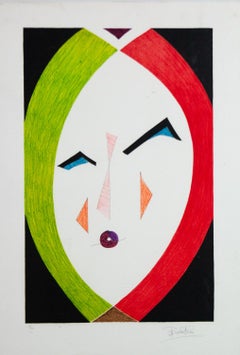
By the mid-1960s, the international fashion press, enamored of his dazzling scarves and slithery dresses in sensuous psychedelic silk jersey, had dubbed Florentine designer Emilio Pucci the Prince of Prints. Less well known is that, starting in the early 1950s, Pucci applied his colorful, abstract patterns to static angular mediums such as ceramics, floors and furniture, imbuing them with movement, not to mention glamour. He was the first fashion designer to enter the lifestyle market, founding the successful brand that exists today.

Born in 1914 to one of Italy’s oldest noble families, Emilio Pucci, Marchese Pucci di Barsento, was a member of the postwar international jet set, hopping from beach to mountain to city. His fashion career began unexpectedly in 1947, when he created a revolutionary stretch ski outfit that was photographed on the Swiss slopes for Harper’s Bazaar.

Eschewing a life of aristocratic glamour, the self-taught Pucci opened a boutique on Capri dedicated to simple resort clothing (think capri pants) that evoked the Mediterranean’s undulating waves and refreshingly bright colors. At the time, luxury fashion was as constricted as a Dior cocktail dress, but the Swinging Sixties were on the horizon. Signed with what Vogue International editor Suzy Menkes calls a “handwritten ‘Emilio’ flourish” — a concept, she points out, as novel as that of designer ready-to-wear — his designs were soon seen on celebrities like Jackie Kennedy and Marilyn Monroe.

From the airline uniforms he created for Braniff in the 1960s to the emblem he crafted for the Apollo XV space mission in 1971, Pucci’s designs were visionary. In spite of his traditional roots (or because of them), the Prince of Prints was forward thinking and outward looking. Pucci put his signature flourish on patterns that were flexible — first for fashion, then for furnishings and objects. Whether on fabric or foam, shelves or sails, as he first explained some 70 years ago, the ornamental designs work in “continuous motion.” Venturing into nontraditional design partnerships, he laid the groundwork for a future brand, a classic legacy that his daughter Laudomia Pucci continues today.

Find vintage Emilio Pucci evening dresses, scarves, skirts and other clothing and accessories on 1stDibs.

to
1
Overall Width
to
Overall Height
to
1
587
1,566
1,071
923
767
1
1
1
1
1
Artist: Emilio Pucci
Related Items
America (Limited Edition Print)

Mauro OliveiraAmerica (Limited Edition Print), Contemporary

$556Sale Price|20% Off

H 36 in W 36 in D 0.1 in

America (Limited Edition Print)

By Mauro Oliveira

Located in LOS ANGELES, CA

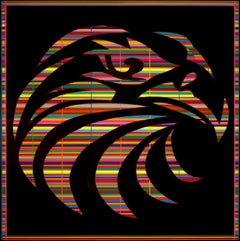
**ANNUAL SUPER SALE UNTIL MAY 15TH ONLY** THIS PRICE WON'T BE REPEATED AGAIN THIS YEAR - TAKE ADVANTAGE OF IT** "America" is a unique eagle design by Mauro Oliveira. This exquisite...

Category

21st Century and Contemporary Abstract Expressionist Emilio Pucci Prints and Multiples

Materials

Cotton Canvas

Living Painting - Colour Pochoir

Living Painting - Colour Pochoir

By (after) Sonia Delaunay

Located in Collonge Bellerive, Geneve, CH

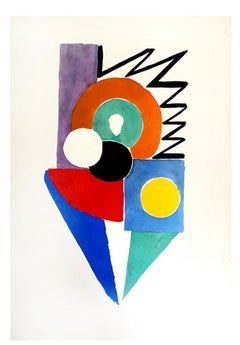
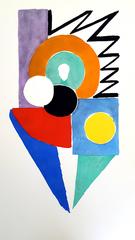
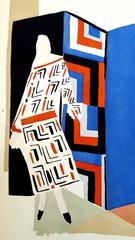
Sonia Delaunay Full-page, colour pochoir after costume designs by Sonia Delaunay Edition 331/500 copies on Velin Aussedat Dimensions: 28.5 x 19.5 cm. From 27 Living Paintings. [Milano, Edizioni del Naviglio, 1969]. Jacques Damase. Robes Poèmes, Introduction. Text by Guillaume Apollinaire and Blaise Cendrars. Sonia Delaunay was known for her vivid use of color and her bold, abstract patterns, breaking down traditional distinctions between the fine and applied arts as an artist, designer and printmaker. Born Sarah Stern on November 14, 1885 in Gradizhsk, Ukraine, she was adopted in 1890 by her maternal uncle, Henri Terk, a lawyer in St. Petersburg, where she grew up, exposed to music and art, and learning several foreign languages. In 1903, she moved to Germany to study drawing with Ludwig Schmidt-Reutler (1863–1909) at the Karlsruhe academy of fine arts; Arnold Schoenberg (1874–1951), composer-to-be, was among her classmates there. In 1905, she traveled to Paris where she attended art classes at the Académie de la Palette, learned printmaking from Rudolf Grossman (1889–1941), and met Amédée Ozenfant (1886–1966), André Dunoyer de Segonzac (1884–1974), and Jean-Louis Boussingault (1883–1943). Sonia spent much of her time at exhibitions and galleries in Paris, which showed works by Paul Cézanne, Vincent Van Gogh, Pierre Bonnard, and Edouard Vuillard, as well as Les Fauves, Henri Matisse and André Derain. She did, however, maintain contact with Germany, exhibiting at the Galerie Der Sturm, Berlin, in 1913, 1920 and 1921. During her first year in Paris, Sonia met the German collector and art-dealer, Wilhelm Uhde (1874–1947), whom she married on December 5, 1908, and whose Montparnasse gallery, the Galerie Notre-Dame des Champs, showed her first solo exhibition. Through Uhde, Sonia encountered many painters, including Pablo Picasso, Georges Braque, Maurice de Vlaminck, and Robert Delaunay (1885–1941). In 1910, Sonia divorced Uhde by mutual agreement, married Delaunay that same year, and gave birth to their son, Charles, in January 1911. Together Sonia and Robert Delaunay pursued the study of color, influenced by theories of Michel-Eugène Chevreul (1786–1889). Sonia’s interest in simultaneous contrast, as evidenced in her early collages, book bindings, small painted boxes...

Category

1960s Abstract Geometric Emilio Pucci Prints and Multiples

Materials

Vellum

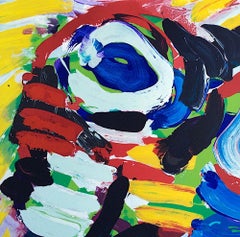
YELLOW PERSONNAGE Signed Lithograph 1980, Abstract Portrait, CoBrA Artist

YELLOW PERSONNAGE Signed Lithograph 1980, Abstract Portrait, CoBrA Artist

By Karel Appel

Located in Union City, NJ

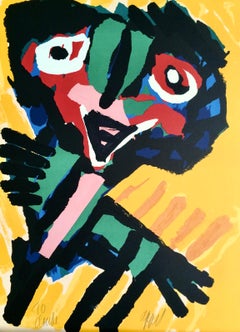
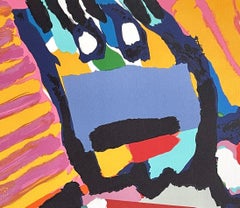
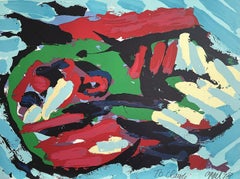
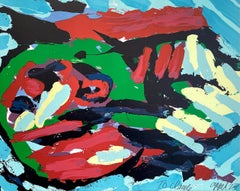
YELLOW PERSONNAGE is an original hand drawn, limited edition lithograph by the Dutch artist Karel Appel printed using hand lithography techniques on Arches paper, 100% acid free. YELLOW PERSONNAGE presents a lively, imaginative child-like character printed in bold colors - bright yellow, black, green, red, pink, blue and hints of white pop out as a smiling face attached to a stick figure style body suggesting two arms and black paint stroke fingers. YELLOW PERSONNAGE is a playful, wild abstract portrait by Appel, one of the founders of the avant-garde art movement CoBrA active during the late 1940's thru early 1950's. His paintings are known for incorporating applications of vibrant, violent colors often possessing a primal, childlike quality. Print size - 30 x 22 inches, unframed, full bleed image, hand signed in pencil by Karel Appel, dedicated Printers Proof aside from the edition of 175, printers chop mark embossed on lower corner, from the master printers private collection, print documentation provided Edition size - 175, plus proofs Year published - 1980, printed at J K Fine Art Editions Co. NYC About the artist - Karel Appel, (born April 25, 1921, Amsterdam, Netherlands—died May 3, 2006, Zürich, Switzerland), Dutch painter of turbulent, colorful, and semi-abstract compositions, who was a co-founder (1948) of the CoBRA group of northern European Expressionists. He was also a noted sculptor and graphic artist. Appel attended the Royal Academy of Fine Arts, Amsterdam (1940–43), and helped found the “Reflex” group, which became known as CoBRA (for Copenhagen, Brussels, and Amsterdam), in 1948. He moved to Paris in 1950 and by the 1960s had settled in New York City; he later lived in Italy and Switzerland. Partly in reaction against what they perceived as the sterile academicism of the de Stijl movement, the CoBRA artists...

Category

1980s Abstract Emilio Pucci Prints and Multiples

Materials

Lithograph

BLUE BOY Signed Lithograph, Abstract Figure, Blue Pants, Pink Yellow Stripes

BLUE BOY Signed Lithograph, Abstract Figure, Blue Pants, Pink Yellow Stripes

By Karel Appel

Located in Union City, NJ

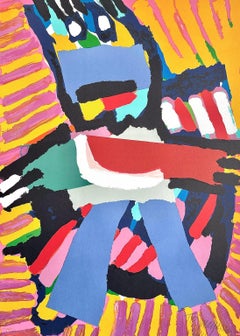
BLUE BOY is a limited edition lithograph by the Dutch artist Karel Appel, printed using hand lithography techniques on archival Arches paper, 100% acid free. BLUE BOY presents a fant...

Category

1980s Abstract Emilio Pucci Prints and Multiples

Materials

Lithograph

Mask Face Personnage, Signed Lithograph, Abstract Collage Portrait, CoBrA Artist

Mask Face Personnage, Signed Lithograph, Abstract Collage Portrait, CoBrA Artist

By Karel Appel

Located in Union City, NJ

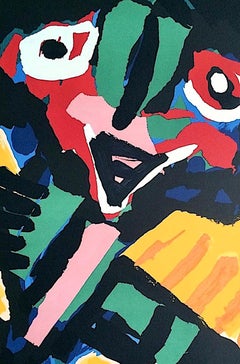
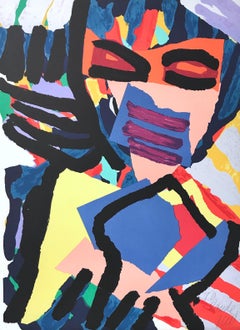
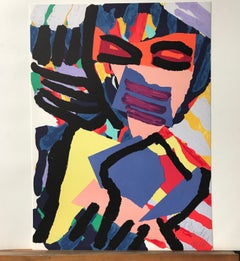
Mask Face Personnage is an original limited edition lithograph by the Dutch artist Karel Appel, printed using hand lithography techniques on archival Arches paper, 100% acid free. Ma...

Category

1980s Abstract Emilio Pucci Prints and Multiples

Materials

Lithograph

Jacques Villon - Original Lithograph

Jacques Villon - Original Lithograph

By Jacques Villon

Located in Collonge Bellerive, Geneve, CH

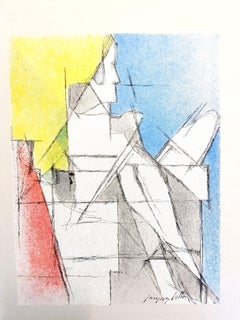
Jacques Villon - Original Lithograph Lithograph, 1964 Dimensions: 32 x 24 cm Revue Art de France Pierre Soulages or the "painter of black" as he is often referred to, has rightfull...

Category

1960s Abstract Geometric Emilio Pucci Prints and Multiples

Materials

Lithograph

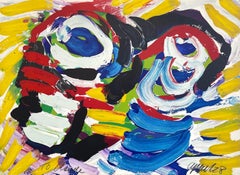
HAPPY COUPLE I Signed Lithograph, Abstract Portrait, Yellow, Blue, Black, Red

HAPPY COUPLE I Signed Lithograph, Abstract Portrait, Yellow, Blue, Black, Red

By Karel Appel

Located in Union City, NJ

HAPPY COUPLE I is a limited edition lithograph by the Dutch artist Karel Appel printed in 1978 in New York City using traditional hand lithography techniques on archival printmaking...

Category

1970s Abstract Emilio Pucci Prints and Multiples

Materials

Lithograph

WALKING IN COLORS Signed Lithograph 1979, Colorful Abstract Figure, CoBrA Artist

WALKING IN COLORS Signed Lithograph 1979, Colorful Abstract Figure, CoBrA Artist

By Karel Appel

Located in Union City, NJ

WALKING IN COLORS is an original limited edition lithograph by the Dutch artist Karel Appel printed using hand lithography techniques on archival printmaking paper, 100% acid free. W...

Category

1970s Abstract Emilio Pucci Prints and Multiples

Materials

Lithograph

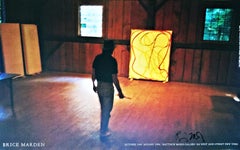
Brice Marden's studio Poster (Hand signed by Brice Marden), photo by Nan Goldin

Brice Marden's studio Poster (Hand signed by Brice Marden), photo by Nan Goldin

By Brice Marden

Located in New York, NY

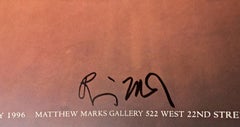
Brice Marden's Studio Offset lithograph poster on wove paper (hand signed by Brice Marden in 2015) This print was published on the occasion of Brice Marden's 1996 exhibition at the Matthew Marks Gallery in Chelsea, New York City. The image is based on Nan Goldin's 1995 photograph of Marden working in his studio. The print was signed by Brice Marden for the present owner. A collectors item when hand signed! About Brice Marden: Ultimately I’m using the painting as a sounding board for the spirit. . . . You can be painting and go into a place where thought stops—where you can just be and it just comes out. . . . I present it as an open situation rather than a closed situation. —Brice Marden Brice Marden (1938–2023) continuously refined and extended the traditions of lyrical abstraction. Experimenting with self-imposed rules, limits, and processes, and drawing inspiration from his extensive travels, Marden brought together the diagrammatic formulations of Minimalism, the immediacy of Abstract Expressionism, and the intuitive gesture of calligraphy in his exploration of gesture, line, and color. Born in Bronxville, New York, Marden received an MFA from Yale University’s School of Art and Architecture, where his teachers included the painters Alex Katz and Jon Schueler. After graduation he worked as a guard at the Jewish Museum in New York. There, during a 1964 Jasper Johns retrospective, Marden studied Johns’s early works extensively and considered them in relation to the Baroque masters he has long admired, such as Francisco de Zurbarán, Francisco Goya, and Diego Velázquez. Marden’s paintings from the 1960s include subtle, shimmering monochromes in gray tones, sometimes assembled into multipanel works, in a manner similar to the black paintings and White Paintings of Robert Rauschenberg, who hired Marden as a studio assistant in 1966. A trip to Greece in the early 1970s led Marden to create the Hydra paintings (1972), which capture the turquoise hues of the Mediterranean, and Thira (1979–80), a painting composed of eighteen interconnected panels inspired by the shadows and geometry of ancient temples. To heighten the effect of each color, plane, and brushstroke, Marden developed the unique process of adding beeswax and turpentine to oil paint and applying the mixture in many thin layers. Marden employed this technique for the Grove Group paintings (1972–76)—exhibited at Gagosian’s Madison Avenue gallery in New York in 1991, along with related works—and the Red Yellow Blue paintings (1973–74)—five permutations of the primary trio—which were united for the first time since their making at Gagosian, 980 Madison Avenue, New York, in 2013. In the 1980s Marden began to incorporate organic, intersecting lines, creating rhythmic patterns over fields of color. Exploring these winding lines, he experimented with blank space, erasure, and references to the natural world. He sought to create a mystical experience through the creation of elusive abstract spaces. As his many themes and techniques have overlapped, Marden brought them together in cohesive, often multipart works, which he has described as his “summation paintings.” Among them is The Propitious Garden of Plane Image, Third Version (2000–06), held in the collection of the Museum of Modern Art in New York, where he had his first comprehensive retrospective in 2006. In his later years Marden continued his exploration of the qualities of monochrome. This engagement with muted colors informed his calligraphic drawings and works on canvas, such as the Nevis Stele paintings (2007–15), inspired by Chinese stone carvings from the late eighth century. In 2017 he turned his gaze to the expansive possibilities of terre verte (green earth), an iron silicate clay pigment, which he first used in the Grove Group. These paintings incorporate many different brands of terre verte, each a variation on the indefinable hue. Marden thinned his slow-drying paint and applied it gradually to the canvas in many successive layers, leaving a visible residue of the painting process at the lower edge of each canvas. Courtesy of Gagosian Gallery About Nan Goldin: The camera is as much a part of my everyday life as talking or eating or sex. —Nan Goldin Emerging from the artist’s own life and relationships, and including herself as a subject, Nan Goldin’s work has transformed the role of photography in contemporary art. Her photographs and moving-image works address essential themes of identity, love, sexuality, addiction, and mortality. Uniting art and activism, Goldin has confronted the HIV/AIDS epidemic since the 1980s and today brings international attention to the overdose crisis. Born in Washington, DC, in 1953, Goldin grew up outside of Boston. She left home at age fourteen, and at sixteen enrolled in the Satya Community School in Lincoln, Massachusetts, where she acquired her first camera. Goldin’s early black-and-white photographs, which convey the beauty, vulnerability, and joy of her friends in Boston’s transgender community, were initially shown in her first solo exhibition in 1973 at Project, Inc., Cambridge, Massachusetts. Attending Boston’s School of the Museum of Fine Arts beginning in 1974, she would start working principally with Cibachrome prints and 35mm slides, taking photographs in saturated color. Relocating to New York in 1978, Goldin began documenting members of her chosen family in a milieu of New Wave clubs, No Wave cinema, and post-Stonewall gay culture. Capturing moments of revelry and friendship, intimacy and loss, she titled this body of work The Ballad of Sexual Dependency after a song from The Threepenny Opera (1928) by Kurt Weill and Bertolt Brecht. Constantly evolving, it grew into a multimedia presentation of almost seven hundred slides accompanied by an eclectic soundtrack. Initially projected in nightclubs, it was included in The Times Square Show in 1980, the Whitney Biennial in 1985, and countless other museum exhibitions around the world. It was published by Aperture in 1986 as the first of Goldin’s many books and was recently reprinted for the twenty-first time. Goldin unflinchingly documents the struggles and courage that defined her community’s response to the devastating AIDS epidemic. In 1989, she organized Witnesses: Against Our Vanishing at New York’s Artists Space, the first exhibition featuring the work of artists who were living with or had died from AIDS, or whose art responded to the disease, including David Armstrong, Peter Hujar, Greer Lankton...

Category

2010s Abstract Emilio Pucci Prints and Multiples

Materials

Pencil, Lithograph, Offset
Untitled: Woman with Plant

Untitled: Woman with Plant

Located in New York, NY

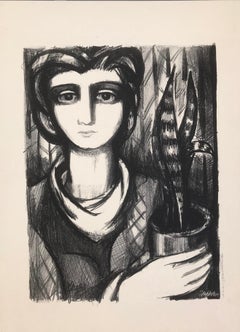
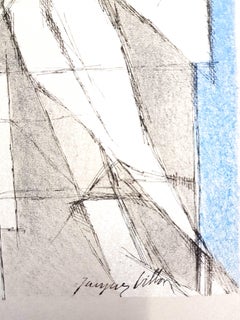
Unknown/Unidentified Artist, "Untitled: Woman with Plant", Abstract Figurative/ Portrait Lithograph signed in Pencil, 16 x 11.50 (Image: 12 x 9), Mid-20th Century, 1949 Colors: Blac...

Category

1940s Abstract Emilio Pucci Prints and Multiples

Materials

Lithograph

Living Painting - Colour Pochoir

Living Painting - Colour Pochoir

By (after) Sonia Delaunay

Located in Collonge Bellerive, Geneve, CH

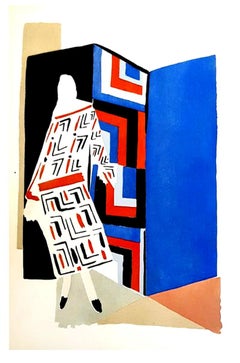
Full-page, colour pochoir after a costume design by Sonia Delaunay Edition 331/500 copies on Velin Aussedat Dimensions: 28.5 x 19.5 cm. From 27 Living Paintings. [Milano, Edizioni del Naviglio, 1969]. Jacques Damase. Robes Poèmes, Introduction. Text by Guillaume Apollinaire and Blaise Cendrars. Sonia Delaunay was known for her vivid use of color and her bold, abstract patterns, breaking down traditional distinctions between the fine and applied arts as an artist, designer and printmaker. Born Sarah Stern on November 14, 1885 in Gradizhsk, Ukraine, she was adopted in 1890 by her maternal uncle, Henri Terk, a lawyer in St. Petersburg, where she grew up, exposed to music and art, and learning several foreign languages. In 1903, she moved to Germany to study drawing with Ludwig Schmidt-Reutler (1863–1909) at the Karlsruhe academy of fine arts; Arnold Schoenberg (1874–1951), composer-to-be, was among her classmates there. In 1905, she traveled to Paris where she attended art classes at the Académie de la Palette, learned printmaking from Rudolf Grossman (1889–1941), and met Amédée Ozenfant (1886–1966), André Dunoyer de Segonzac (1884–1974), and Jean-Louis Boussingault (1883–1943). Sonia spent much of her time at exhibitions and galleries in Paris, which showed works by Paul Cézanne, Vincent Van Gogh, Pierre Bonnard, and Edouard Vuillard, as well as Les Fauves, Henri Matisse and André Derain. She did, however, maintain contact with Germany, exhibiting at the Galerie Der Sturm, Berlin, in 1913, 1920 and 1921. During her first year in Paris, Sonia met the German collector and art-dealer, Wilhelm Uhde (1874–1947), whom she married on December 5, 1908, and whose Montparnasse gallery, the Galerie Notre-Dame des Champs, showed her first solo exhibition. Through Uhde, Sonia encountered many painters, including Pablo Picasso, Georges Braque, Maurice de Vlaminck, and Robert Delaunay (1885–1941). In 1910, Sonia divorced Uhde by mutual agreement, married Delaunay that same year, and gave birth to their son, Charles, in January 1911. Together Sonia and Robert Delaunay pursued the study of color, influenced by theories of Michel-Eugène Chevreul (1786–1889). Sonia’s interest in simultaneous contrast, as evidenced in her early collages, book bindings, small painted boxes...

Category

1960s Abstract Geometric Emilio Pucci Prints and Multiples

FLYING HEAD OVER OCEAN Signed Lithograph 1978, Multi-color Abstract Face

FLYING HEAD OVER OCEAN Signed Lithograph 1978, Multi-color Abstract Face

By Karel Appel

Located in Union City, NJ

FLYING HEAD OVER OCEAN is an original limited edition lithograph by the Dutch artist Karel Appel printed using hand lithography techniques on Arches paper, 100% acid free. FLYING HEA...

Category

1970s Abstract Emilio Pucci Prints and Multiples

Materials

Lithograph

Emilio Pucci prints and multiples for sale on 1stDibs.

Find a wide variety of authentic Emilio Pucci prints and multiples available for sale on 1stDibs. You can also browse by medium to find art by Emilio Pucci in lithograph and more. Much of the original work by this artist or collective was created during the 1940s and is mostly associated with the abstract style. Not every interior allows for large Emilio Pucci prints and multiples, so small editions measuring 19 inches across are available. Customers who are interested in this artist might also find the work of Pietro Consagra, jean-Michel Atlan, and Dan Christensen. Emilio Pucci prints and multiples prices can differ depending upon medium, time period and other attributes. On 1stDibs, the price for these items starts at $2,500 and tops out at $2,500, while the average work can sell for $2,500.

Questions About Emilio Pucci Prints and Multiples

  • 1stDibs ExpertApril 5, 2022
    A keen sportsman, Emilio Pucci first designed clothes for the ski team at Reed College in Portland, Oregon. Soon after, he set up his own house of haute couture on the Isle of Capri to produce athletic wear for American manufacturers. On 1stDibs, you’ll find a collection of vintage and contemporary Emilio Pucci clothing and accessories from some of the world’s top boutiques.
  • 1stDibs ExpertApril 5, 2022
    Can’t find anything definitive for this one…
  • 1stDibs ExpertApril 5, 2022
    Emilio Pucci was an Italian fashion designer who founded his own fashion house in 1947. In the mid-20th century, Pucci’s joyful and dynamic designs were seen as a transition between luxurious couture and a new era of ready-to-wear pieces. Today, modern collections from his company and vintage examples of his work are celebrated by collectors. On 1stDibs, shop a wide array of vintage and contemporary Emilio Pucci clothing and accessories.
  • 1stDibs ExpertApril 5, 2022
    The luxury company Emilio Pucci is owned by the holding company LVMH Moët Hennessy Louis Vuitton, often known simply as LVMH. Pucci was added to the group in 2000, under the leadership of current CEO and chairman Bernard Arnault. On 1stDibs, find a collection of vintage and contemporary Emilio Pucci clothing and accessories from some of the world’s top sellers.
  • 1stDibs ExpertApril 5, 2022
    Camille Miceli has been the artistic director of Emilio Pucci since September 2021. Miceli came to the brand with experience from Chanel, Louis Vuitton, and Christian Dior. Find a collection of expertly-vetted Emilio Pucci clothing and accessories from some of the world’s top boutiques on 1stDibs.
  • 1stDibs ExpertApril 5, 2022
    Emilio Pucci is and Italian name, pronounced “uh-MEE-lee-ow POO-chee.” The company is named after Emilio Pucci who founded it in 1947. Today, modern collections from his company and vintage examples of his work are sought after by collectors. On 1stDibs, shop a wide array of vintage and contemporary Emilio Pucci clothing and accessories.
  • 1stDibs ExpertApril 5, 2022
    No, Guess is not a part of Emilio Pucci. Since 2000, Emilio Pucci has been owned by the holding company LVMH Moët Hennessy Louis Vuitton. Pucci was added to this group under the leadership of current CEO and chairman Bernard Arnault. On 1stDibs, shop a collection of Emilio Pucci fashions from some of the world’s top boutiques.
  • 1stDibs ExpertApril 5, 2022
    No, Ralph Pucci is not related to famed fashion designer Emilio Pucci. Ralph Pucci is an American entrepreneur known for his mannequin design and luxury furniture through Ralph Pucci International. Shop a collection of Ralph Pucci furniture from some of the world’s top sellers on 1stDibs.
  • 1stDibs ExpertFebruary 7, 2024
    Emilio Pucci used a variety of materials for his clothing and accessories. The Italian fashion designer favored natural materials like cotton and cashmere and gained notoriety for his signature jersey silk fabric. Pucci's colorful prints became synonymous with his eponymous fashion house and went on to influence the next generation of designers. On 1stDibs, shop a variety of Pucci apparel and accessories.
  • 1stDibs ExpertMarch 22, 2022
    Yes, Emilio Pucci is a designer brand of clothing and homewares founded by a designer by the same name in 1947. Today, the brand is well known for its bold, colorful prints. On 1stDibs, find a range of Emilio Pucci apparel, accessories and handbags.
  • 1stDibs ExpertApril 5, 2022
    There are dozens of ways to tie and wear an Emilio Pucci scarf, and the best way is really a matter of preference. Whether you like to have it draped over your shoulders or tied like a shawl, experiment to find the style that suits each of your looks best. Shop a collection of Emilio Pucci scarves from some of the world’s top boutiques on 1stDibs.
  • 1stDibs ExpertApril 5, 2022
    Emilio Pucci’s famous ski clothes used a signature fabric, dubbed “Emilioform,” which was developed in 1960. A special blend of shantung silk and nylon, it was designed to be aerodynamic and took the world by storm. Shop a wide collection of expertly-vetted Emilio Pucci clothing and accessories from some of the world’s top sellers on 1stDibs.