Fasem International Tables

to
Height
to
1
2
1
2
1
1
2
2
2
1
1
2
2
2
2
2
17
841
773
674
489
Creator: Fasem International
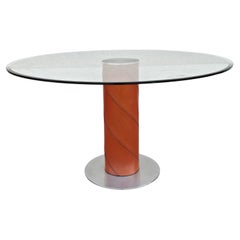
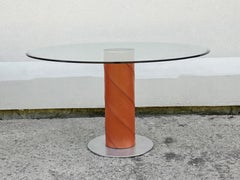
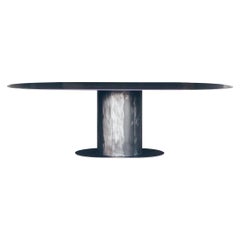
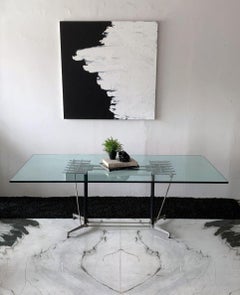
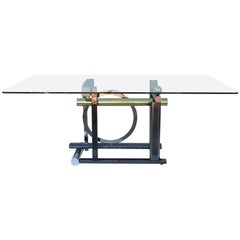
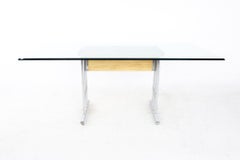
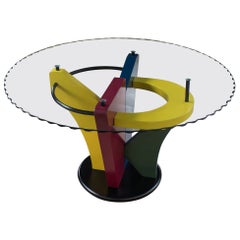
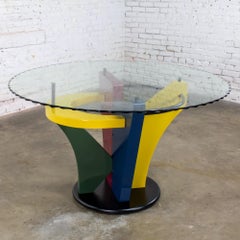
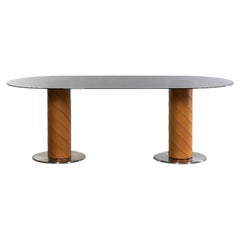
Postmodern Dining Table in leather and glass top by Giancarlo Vegni for Fasem

Postmodern Dining Table in leather and glass top by Giancarlo Vegni for Fasem

By Giancarlo Vegni, Fasem International

Located in Beograd, RS

In this listing you will find a rare postmodern dining table designed by Giancarlo Vegni for Fasem. Table features the base done in steel and saddle leather with a round thick glass ...

Category

1980s Italian Post-Modern Vintage Fasem International Tables

Materials

Leather, Glass

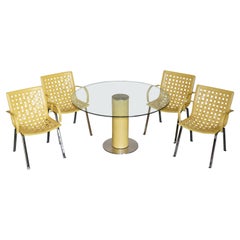
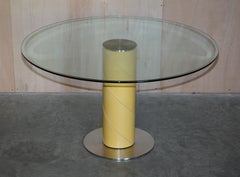
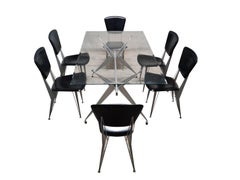
Vintage Giancarlo Vegni for Fasem Italy Leather Woven Net Dining Chairs & Table

Vintage Giancarlo Vegni for Fasem Italy Leather Woven Net Dining Chairs & Table

By Giancarlo Vegni, Fasem International

Located in West Sussex, Pulborough

We are delighted to offer for sale this exceptionally rare original vintage Giancarlo Vegni designed for Fasem Italy dining table and Net chair suite A very good looking and well ...

Category

20th Century Italian Mid-Century Modern Fasem International Tables

Materials

Chrome

Related Items
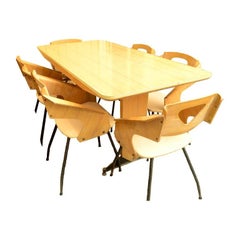
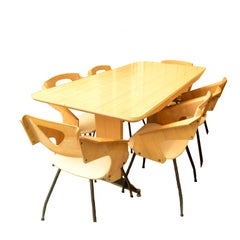
1940s Laminated Wood Dining Table Six Chairs Seat Skai Covered  Italian Design

1940s Laminated Wood Dining Table Six Chairs Seat Skai Covered Italian Design

By Carlo Ratti, Vittorio Nobili

Located in Milan, IT

Dining table in laminated wood with wooden and satin finish black metal legs with brass feet adjustable in height, complete with six chairs in plywood and bent, with seat covered wit...

Category

1940s Italian Vintage Fasem International Tables

Materials

Wood

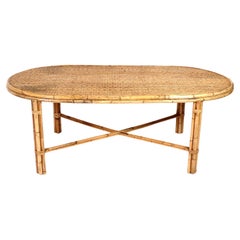
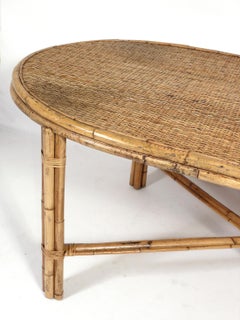
Oval Rattan Dining Table

Oval Rattan Dining Table

$2,800

H 29 in W 80 in D 36 in

Oval Rattan Dining Table

Located in Atlanta, GA

Oval racetrack shape rattan or bamboo dining table, American, circa 1960s. Retains warm original patina.  

Category

1960s American Mid-Century Modern Vintage Fasem International Tables

Materials

Bamboo, Cane, Rattan

1980's Postmodern Tobia Scarpa for Knoll Andre Dining Table

1980's Postmodern Tobia Scarpa for Knoll Andre Dining Table

By Piotr Sierakowski, Tobia Scarpa, Massimo Vignelli, Knoll

Located in Burbank, CA

Vintage Post Modern dining table for sale. The table was designed in 1968 by Tobia Scarpa for Gavina, and then went to be manufactured by Knoll. It's the Andre dining table with a st...

Category

1980s American Post-Modern Vintage Fasem International Tables

Materials

Metal

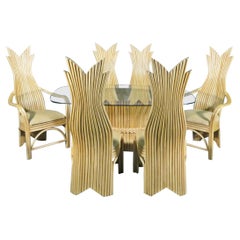
McGuire Style Rattan Dining Table & Chairs

McGuire Style Rattan Dining Table & Chairs

$4,800 / set

H 30 in W 61.5 in D 41 in

McGuire Style Rattan Dining Table & Chairs

Located in Brooklyn, NY

Odd rattan bases with woven faux leather seats with high backs. Table has rattan base with oval glass top. 2 arm chairs measure 49" H x 26 1/4" W x 26" D. Seat height 18 1/2". 6 ...

Category

20th Century Post-Modern Fasem International Tables

Materials

Rattan

Jorge Zalszupin 'Guanabara' Rosewood Vintage Dining Table, 1960s, Brazil

Jorge Zalszupin 'Guanabara' Rosewood Vintage Dining Table, 1960s, Brazil

By Jorge Zalszupin

Located in New York, NY

The iconic Guanabara is a table designed by Jorge Zalszupin (1922-2020) in 1959 and produced by his company, L'atelier. A rosewood patchwork top rests over one concrete base finished...

Category

1950s Brazilian Mid-Century Modern Vintage Fasem International Tables

Materials

Leather, Wood

Afra & Tobia Scarpa Midcentury “778” Extensible Dining Table for Cassina, 1967

Afra & Tobia Scarpa Midcentury “778” Extensible Dining Table for Cassina, 1967

By Afra & Tobia Scarpa, Cassina

Located in Vicenza, IT

The “778” model is an example of solid wood boards arranged to form a C-shaped frame. The table, with a top that opens, is supported by four trestles, two of which are a few centimet...

Category

1960s Italian Mid-Century Modern Vintage Fasem International Tables

Materials

Walnut

Iron & Glass Brutalist Dining Set Table & 8 Leather Chairs after Ilana Goor

Iron & Glass Brutalist Dining Set Table & 8 Leather Chairs after Ilana Goor

By Ilana Goor

Located in Philadelphia, PA

Remarkable high quality Mid 20th Century Iron and Glass Dining Set Consisting of a Large Glass & Iron Dining Table and 8 Iron Chairs with Distressed Tooled Leather Seats and Backs af...

Category

20th Century American Brutalist Fasem International Tables

Materials

Iron

Carlo Scarpa Cognac Leather “Kentucky” Dining Chair for Bernini, 1977, Set of 5

Carlo Scarpa Cognac Leather “Kentucky” Dining Chair for Bernini, 1977, Set of 5

By Carlo Scarpa, Bernini

Located in Vicenza, IT

Set of 5 mod. 783 “Kentucky” dining chairs, designed by Carlo Scarpa for the Italian manufacturer Bernini in 1977. Structure made from oak and walnut timber. Seats and backrest made from cognac leather. Excellent vintage condition. Carlo Scarpa designed this chair for the “Scuderia” series., the last project he made for Bernini. The architect took inspiration from the “shaker” movement. He designed the chair slightly inclined at the front. This feature allows you to swing backward (until you lean on a wall) and remain in balance. Born in Venice on June 2nd, 1906, Carlo Scarpa began working at a very early age. A year after he had first qualified as an architect in 1926, he began working for the Murano glassmakers Cappellin & Co. in a consultative capacity. From 1927, Carlo Scarpa began to experiment with the Murano glass, and this research not only gave him excellent results here but would also inform his progress for many years to come. Between 1935 and 1937, as he entered his thirties, Carlo Scarpa accepted his first important commission, the renovation of Venice’s Cà Foscari. He adapted the spaces of this stately University building that stands on the Grand Canal banks, creating rooms for the Dean’s offices and a new hall for academic ceremonies; Mario Sironi and Mario De Luigi were charged with doing the restoration work on the frescos. After 1945, Carlo Scarpa found himself constantly busy with new commissions, including various furnishings and designs for the renovation of Venice’s Hotel Bauer and designing a tall building in Padua and a residential area in Feltre, all worth mentioning. One of his key works, despite its relatively modest diminished proportions, was the [bookshop known as the] Padiglione del Libro, which stands in Venice’s Giardini di Castello and clearly shows Scarpa’s passion for the works of Frank Lloyd Wright. In the years which were to follow, after he had met the American architect, Scarpa repeated similar experiments on other occasions, as can be seen, in particular, in the sketches he drew up in 1953 for villa Zoppas in Conegliano, which show some of his most promising work. However, this work unfortunately never came to fruition. Carlo Scarpa later created three museum layouts to prove pivotal in terms of how twentieth-century museums were set up from then on. Between 1955 and 1957, he completed extension work on Treviso’s Gipsoteca Canoviana [the museum that houses Canova’s sculptures] in Possagno, taking a similar experimental approach to the one he used for the Venezuelan Pavilion at [Venice’s] Giardini di Castello which he was building at the same time (1954-56). In Possagno Carlo Scarpa was to create one of his most significant ever works, which inevitably bears comparison with two other museum layouts that he was working on over the same period, those of: – Galleria Nazionale di Sicilia, housed in the Palazzo Abatellis in Palermo (1953-55) – Castelvecchio in Verona (1957- 1974), all of which were highly acclaimed, adding to his growing fame. Two other buildings, which are beautifully arranged in spatial terms, can be added to this long list of key works that were started and, in some cases, even completed during the nineteen fifties. After winning the Olivetti award for architecture in 1956, Scarpa began work in Venice’s Piazza San Marco on an area destined to house products made by the Industrial manufacturers Ivrea. Over the same period (1959-1963), he also worked on the renovation and restoration of the gardens and ground floor of the Fondazione Querini Stampalia in Venice, which many consider one of his greatest works. While he busied himself working on-site at the Fondazione Querini Stampalia, Carlo Scarpa also began work building a villa in Udine for the Veritti family. To shed some light on the extent to which his work evolved over the years, it may perhaps be useful to compare this work with that of his very last building, villa Ottolenghi Bardolino, which was near to completion at the time of his sudden death in 1978. Upon completion of villa Veritti over the next ten years, without ever letting up on his work on renovation and layouts, Scarpa accepted some highly challenging commissions, working on the Carlo Felice Theatre in Genoa and another theatre in Vicenza. Towards the end of this decade, in 1969, Rina Brion commissioned Carlo Scarpa to build the Brion Mausoleum in San Vito d’Altivole (Treviso), a piece he continued to work on right up until the moment of his death. Nevertheless, even though he was totally absorbed by work on this mausoleum, there are plenty of other episodes which can offer some insight into the final years of his career. As work on the San Vito d’Altivole Mausoleum began to lessen from 1973, Carlo Scarpa started building the new headquarters for the Banca Popolare di Verona. He drew up plans that were surprisingly different from the work he was carrying out at the same time on the villa Ottolenghi. However, the plans Carlo Scarpa drew up, at different times, for a monument in Brescia’s Piazza della Loggia commemorating victims of the terrorist attack on May 28th, 1974, make a sharp contrast to the work he carried out in Verona, almost as if there is a certain hesitation after so many mannered excesses. The same Pietas that informs his designs for the Piazza Della Loggia can also be seen in the presence of the water that flows through the Brion Mausoleum, almost as if to give a concrete manifestation of pity in this twentieth-century work of art. Carlo Scarpa has put together a highly sophisticated collection of structures, occupying the mausoleum’s L-shaped space stretching across both sides of the old San Vito d’Altivole cemetery. A myriad of different forms and an equally large number of different pieces, all of which are separate and yet inextricably linked to form a chain that seems to offer no promise of continuity, rising up out of these are those whose only justification for being there is to bear the warning “si vis vitam, para mortem,” [if you wish to experience life prepare for death] as if to tell a tale that suggests the circle of time, joining together the commemoration of the dead with a celebration of life. At the entrance of the Brion Mausoleum stand the “propylaea” followed by a cloister which ends by a small chapel, with an arcosolium bearing the family sarcophagi, the main pavilion, held in place on broken cast iron supports, stands over a mirror-shaped stretch of water and occupies one end of the family’s burial space. The musical sound of the walkways teamed with the luminosity of these harmoniously blended spaces shows how, in keeping with his strong sense of vision, Carlo Scarpa could make the most of all of his many skills to come up with this truly magnificent space. As well as a great commitment to architectural work, with the many projects which we have already seen punctuating his career, Carlo Scarpa also made many equally important forays into the world of applied arts. Between 1926 and 1931, he worked for the Murano glassmakers Cappellin, later taking what he had learned with him when he went to work for the glassmakers Venini from 1933 until the 1950s. The story of how he came to work on furniture design is different, however, and began with the furniture he designed to replace lost furnishings during his renovation of Cà Foscari. The later mass-produced furniture started differently, given that many pieces were originally one-off designs “made to measure.” Industrial manufacturing using these designs as prototypes came into being thanks to the continuity afforded him by Dino Gavina, who, as well as this, also invited Carlo Scarpa to become president of the company Gavina SpA, later to become SIMON, a company Gavina founded eight years on, in partnership with Maria Simoncini (whose own name accounts for the choice of company name). Carlo Scarpa and Gavina forged a strong bond in 1968 as they began to put various models of his into production for Simon, such as the “Doge” table, which also formed the basis for the “Sarpi” and “Florian” tables. In the early seventies, other tables that followed included “Valmarana,” “Quatour,” and “Orseolo.” While in 1974, they added couch and armchair “Cornaro” to the collection and the “Toledo” bed...

Category

1970s Italian Mid-Century Modern Vintage Fasem International Tables

Materials

Walnut, Leather, Plastic

Carlo Scarpa Mid-Century Brown Walnut “Scuderia” Dining Table for Bernini, 1977

Carlo Scarpa Mid-Century Brown Walnut “Scuderia” Dining Table for Bernini, 1977

By Bernini, Carlo Scarpa

Located in Vicenza, IT

“Scuderia” dining table, designed by Carlo Scarpa and produced by the Italian manufacturer Bernini in 1977. Originally, Carlo Scarpa designed the table to restore the stable of Villa Valmarana in Vicenza in 1972. The table features a solid walnut structure. Available also five “Kentucky” dining...

Category

1970s Italian Mid-Century Modern Vintage Fasem International Tables

Materials

Walnut

Postmodern Mix-Metals and Glass Dining Table by Rick Lee for DIA

Postmodern Mix-Metals and Glass Dining Table by Rick Lee for DIA

$3,200Sale Price|20% Off

H 29.5 in W 76 in D 44 in

Postmodern Mix-Metals and Glass Dining Table by Rick Lee for DIA

By Kaizo Oto, Design Institute America

Located in Palm Springs, CA

A sculptural postmodern dining table or desk design by Rick Lee for Design Institute of America in 1993 The base is made out of mix metals (brass, chrome, br...

Category

1980s American Post-Modern Vintage Fasem International Tables

Materials

Brass, Stainless Steel, Chrome

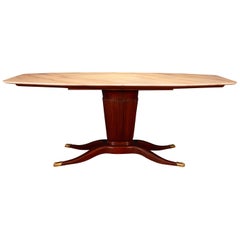
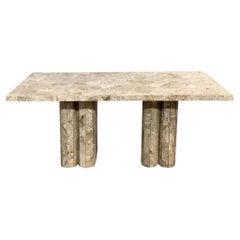
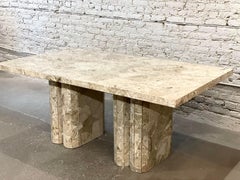
Postmodern Vintage Marble Dining Table

Postmodern Vintage Marble Dining Table

$6,000

H 30 in W 72 in D 39 in

Postmodern Vintage Marble Dining Table

Located in Chicago, IL

Stunning marble dining table with channel bases. This table is so solid and can be used as table for 6 or maybe a desk? The perfect blend of neutrals - ivory gray brown.

Category

1980s Post-Modern Vintage Fasem International Tables

Materials

Marble

Postmodern Industrial Dining Table Designed by Robert Josten

Postmodern Industrial Dining Table Designed by Robert Josten

By Robert Josten

Located in Culver City, CA

This dining table is equal parts post modern and industrial modern and just oozes California modernism. This dining table or writing desk was designed by Robert Josten in the 1970's. Made of aluminum, this metal grille / grid style is a staple of Robert Josten's work. This dining table is a great transitional piece that could easily flex into any contemporary environment. The table has an almost Allsaints, industrial modern feel with a slight steampunk vibe as well. The table could also be used in an ultra modern environment and would look great in a new modern designed home. This piece could also be used as a retail display table...

Category

1970s Post-Modern Vintage Fasem International Tables

Materials

Aluminum

Previously Available Items
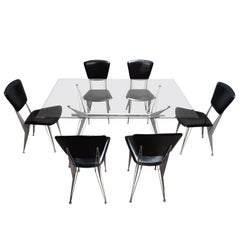
Dining Table and Chairs by Fasem Italy, 1990s

Dining Table and Chairs by Fasem Italy, 1990s

Sold

H 30.71 in W 46.07 in D 31.89 in

Dining Table and Chairs by Fasem Italy, 1990s

By Fasem International

Located in Leuven, Vlaams Gewest

Dining table and chairs made by Fasem italy. The table has a rectangular glass top but can be changed to a custom glass if desired. The chairs are up...

Category

1990s Italian Modern Fasem International Tables

Materials

Metal

Fasem International tables for sale on 1stDibs.

Fasem International tables are available for sale on 1stDibs. These distinctive items are frequently made of metal and are designed with extraordinary care. There are many options to choose from in our collection of Fasem International tables, although beige editions of this piece are particularly popular. Many of the original tables by Fasem International were created in the mid-century modern style in italy during the 20th century. If you’re looking for additional options, many customers also consider tables by Melchiorre Bega, Maxalto, and Umberto Mascagni. Prices for Fasem International tables can differ depending upon size, time period and other attributes — on 1stDibs, these items begin at $15,556 and can go as high as $15,556, while a piece like these, on average, fetch $15,556.