Grady McDonald Abstract Paintings

American, 1938-1980

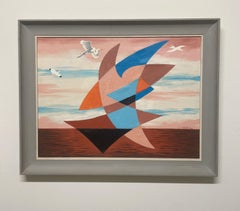
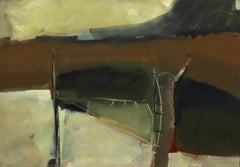
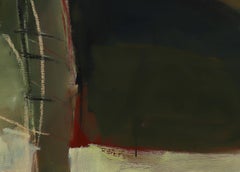
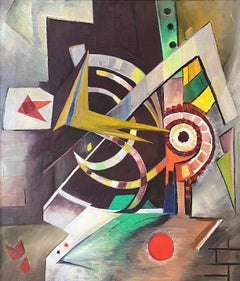
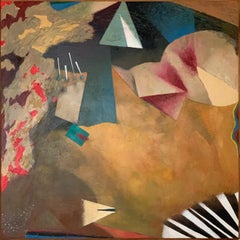
Grady McDonald was a part of the Bay Area School of Abstract Expressionists. His work was often a blend of traditional Cherokee imagery with modern abstract fields of expression. About his paintings, Thomas Albright had said in the San Francisco Chronicle, on November 15, 1979, that “There is a kind of spectral presence that illumines the surface qualities of these paintings with something that is not inherent in the materials and forms alone.” Alfred Frankenstein was quoted in the San Francisco Chronicle in 1978 saying, “his (McDonald’s) imagery goes back to tribal symbols (Cherokee) and the drawings in tepees, shields and drums, all of it taken out of its literal contexts and given an extra thrust of visual meaning through abstraction.”

to
1
1
Overall Width
to
Overall Height
to
1
1
1
1
1
1
1
1
1
691
643
559
336
1
Artist: Grady McDonald
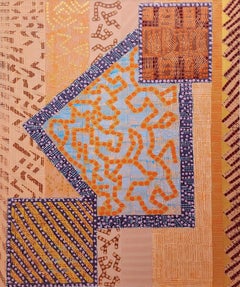
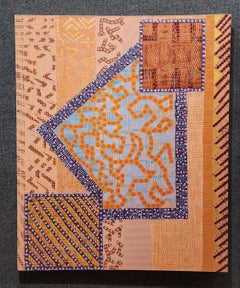
Modernist Blue & Yellow Abstract

Modernist Blue & Yellow Abstract

By Grady McDonald

Located in Soquel, CA

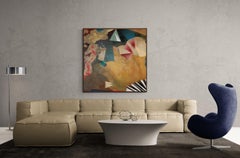
Beautiful oil abstract titled "Coming Out" by Grady McDonald (American, 1938-1980). Signed lower right, titled and dated 1974 on verso. Unframed. Image, 50”H x 44”W. Grady McDona...

Category

1970s American Modern Grady McDonald Abstract Paintings
Materials

Canvas, Oil

Related Items
Divided By Time, Large Modern Abstract Painting

Divided By Time, Large Modern Abstract Painting

Located in Grand Rapids, MI

Robert Sealock (American, 20th Century) Signed: RWS 93 (Canvas Verso) " Divided By Time ", 1993 Oil on Canvas 48 1/4" x 40" This large modern painting is in nice original condi...

Category

Late 20th Century American Modern Grady McDonald Abstract Paintings
Materials

Canvas, Oil

"Untitled" Edward Zutrau, Mid Century, Modernist, Abstract Composition, Green

"Untitled" Edward Zutrau, Mid Century, Modernist, Abstract Composition, Green

By Edward Zutrau

Located in New York, NY

Edward Zutrau Untitled, 1956 Signed and dated on the reverse Oil on linen 40 x 82 inches Edward Zutrau (1922–1993) was an American painter whose career spanned from the 1940s throu...

Category

1950s American Modern Grady McDonald Abstract Paintings
Materials

Canvas, Oil

A Large Mid-Century Modern, Cubist Art Deco Painting, "The Dancers"

A Large Mid-Century Modern, Cubist Art Deco Painting, "The Dancers"

By Charles Turzak

Located in Chicago, IL

A Large, Colorful, Modernist Art Deco Cubist Painting, "The Dancers" by Famed Chicago Painter and Printmaker, Charles Turzak (Am. 1899 - 1986). A large, vertical composition relating to the artist's notable 1930s woodcut of the same title. The painting is completed in a vividly textured Cubist style, with striking hues of rich greens and yellows, deep blues and rose pinks. The painting is oiI on canvas mounted to Masonite (artist's original mount), and offers a superb visual appeal. A perfect complement to any Mid-Century Modern home or collection. Artwork size: 38 x 24 inches (Framed size: 38 1/4 x 24 1/4 inches). Signed "Turzak" lower right. Provenance: Estate of the artist. Charles Turzak was one of Chicago’s greatest printmakers of the Art Deco-era. Son of a coal miner, Turzak was born in Streeter, IL in 1899. In 1920, Turzak won the first prize a cartoon contest sponsored by the Purina company and he used his prize money to enroll in the Art Institute of Chicago. Best known as a print maker, in the 1920s & 30s, he created woodcuts of many of Chicago’s most notable buildings, including the Merchandise Mart, Palmolive Building and the Old Water Tower, among others. In 1933, he was commissioned to create woodcuts of many of Chicago’s most iconic buildings to illustrate a guidebook called “All About Chicago” by John and Ruth Ashenhurst” that featured the upcoming Century of Progress Exhibition in Chicago. During the 1933 World’s Fair...

Category

20th Century American Modern Grady McDonald Abstract Paintings
Materials

Canvas, Oil, Masonite

A Large Mid-Century Modern, Cubist Tribal Motif Painting, "Artifact Contour"

A Large Mid-Century Modern, Cubist Tribal Motif Painting, "Artifact Contour"

By Charles Turzak

Located in Chicago, IL

A Large, Colorful, Mid-Century Modern Art Deco Painting, "Artifact Contour" by Famed Chicago Painter and Print Maker, Charles Turzak (Am. 1899 - 1986). Titled "Artifact Contour", t...

Category

20th Century American Modern Grady McDonald Abstract Paintings
Materials

Canvas, Oil

Modernist Abstraction in Newcomb Macklin carved frame

Modernist Abstraction in Newcomb Macklin carved frame

By Wifredo Lam

Located in Wilton Manors, FL

Abstract painting, ca. 1950s measures 25 x 30 inches. Oil on canvas, unsigned and unattributed. Stunning modernist custom carved picture frame by Newcomb Macklin. ca. 1950 productio...

Category

Mid-20th Century American Modern Grady McDonald Abstract Paintings
Materials

Canvas, Wood, Oil

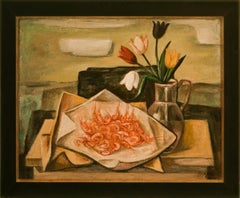
"Shrimp"

"Shrimp"

By Bror Julius Olsson Nordfeldt

Located in Lambertville, NJ

Signed Lower Right Bror Julius Olsson “B.J.O.” Nordfeldt (1878 - 1955) Bror Julius Olsson was born in Tullstrop, Sweden in 1878. He immigrated to the United States in 1891, later adopting his mother’s maiden name of Nordfeldt. Beginning his art studies at the Art Institute of Chicago where he was chosen to assist fellow artist, Albert Herter, with a large mural project for the McCormick Harvester Company. In 1900, he was sent to Paris by McCormick to help set up the completed mural at the Paris Exposition. While there, he studied briefly at the Academie Julian before traveling to England to study woodblock printmaking under F. Morley Fletcher. Returning to Chicago in 1903, Nordfeldt would spend the next ten years painting mainly figurative works in an academic style similar to that of the Old Masters. By the mid-teens he had developed a bold dramatic modernist style and divided his time between New York and Provincetown, Massachusetts. There, he invented the “Provincetown Print...

Category

1940s American Modern Grady McDonald Abstract Paintings
Materials

Canvas, Oil

Excavation
Excavation

Excavation

By Charles Houghton Howard

Located in New York, NY

Charles Houghton Howard was born in Montclair, New Jersey, the third of five children in a cultured and educated family with roots going back to the Massachusetts Bay colony. His father, John Galen Howard, was an architect who had trained at M.I.T. and the École des Beaux Arts in Paris, and apprenticed in Boston with H. H. Richardson. In New York, the elder Howard worked for McKim, Mead and White before establishing a successful private practice. Mary Robertson Bradbury, Charles’s mother, had studied art before her marriage. John Galen Howard moved his household to California in 1902 to assume the position of supervising architect of the new University of California campus at Berkeley and to serve as Professor of Architecture and the first Dean of the School of Architecture (established in 1903). The four Howard boys grew up to be artists and all married artists, leaving a combined family legacy of art making in the San Francisco Bay area that endures to this day, most notably in design, murals and reliefs at the Coit Tower and in buildings on the Berkeley campus. Charles Howard graduated from the University of California at Berkeley in 1921 as a journalism major, and pursued graduate studies in English at Harvard and Columbia Universities before embarking on a two-year trip to Europe. Howard went to Europe as a would-be writer. But a near-religious experience, seeing a picture by Giorgione in a remote town outside of Venice, proved a life-altering epiphany. In his own words, “I cut the tour at once and hurried immediately back to Paris, to begin painting. I have been painting whenever I could ever since” (Charles Howard, “What Concerns Me,” Magazine of Art 39, no. 2 [February 1946], p. 63). Giorgione’s achievement, in utilizing a structured and rational visual language of art to convey high emotion on canvas, instantly convinced Howard that painting, and not literature, offered the best vehicle to express what he wanted to say. Howard returned to the United States in 1925, confirmed in his intent to become an artist. Howard settled in New York and supported himself as a painter in the decorating workshop of Louis Bouché and Rudolph Guertler, where he specialized in mural painting. Devoting spare time to his own work, he lived in Greenwich Village and immersed himself in the downtown avant-garde cultural milieu. The late 1920s and early 1930s were the years of Howard’s art apprenticeship. He never pursued formal art instruction, but his keen eye, depth of feeling, and intense commitment to the process of art making, allowed him to assimilate elements of painting intuitively from the wide variety of art that interested him. He found inspiration in the modernist movements of the day, both for their adherence to abstract formal qualities and for the cosmopolitan, international nature of the movements themselves. Influenced deeply by Surrealism, Howard was part of a group of American and European Surrealists clustered around Julien Levy. Levy opened his eponymously-named gallery in 1931, and rose to fame in January 1932, when he organized and hosted Surrealisme, the first ever exhibition of Surrealism in America, which included one work by Howard. Levy remained the preeminent force in advocating for Surrealism in America until he closed his gallery in 1949. Howard’s association with Levy in the early 1930s confirms the artist’s place among the avant-garde community in New York at that time. In 1933, Howard left New York for London. It is likely that among the factors that led to the move were Howard’s desire to be a part of an international art community, as well as his marriage to English artist, Madge Knight...

Category

20th Century American Modern Grady McDonald Abstract Paintings
Materials

Canvas, Oil

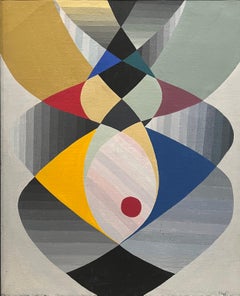
Moving Forms

Beulah Barnes WeaverMoving Forms, c. 1947

$8,500

H 23.5 in W 20 in D 1.5 in

Moving Forms

Located in Los Angeles, CA

Moving Forms, c. 1947, oil on canvas, apparently unsigned, 23 ½ x 20 inches, exhibited The Twenty-Seventh Annual Exhibition of the Southern States Art League, Virginia Museum of Fine...

Category

1940s American Modern Grady McDonald Abstract Paintings
Materials

Canvas, Oil

"Untitled" Edward Zutrau, Modernist, Mid-Century, Abstract, Blue, White, Gray

"Untitled" Edward Zutrau, Modernist, Mid-Century, Abstract, Blue, White, Gray

By Edward Zutrau

Located in New York, NY

Edward Zutrau Untitled, 1960 Signed and dated "11/60" on the reverse Oil on canvas 9 3/4 x 13 1/4 inches Edward Zutrau (1922–1993) was an American painter whose career spanned from...

Category

1960s American Modern Grady McDonald Abstract Paintings
Materials

Canvas, Oil

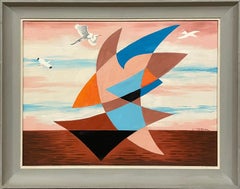
1997 "Blue Heaven" Abstract Oil Painting on Canvas Illustrator Bill Shields

1997 "Blue Heaven" Abstract Oil Painting on Canvas Illustrator Bill Shields

By William Shields 2

Located in Arp, TX

William Stephens Shields, Jr., 1925 - 2010 "Blue Heaven" 1997 Oil on canvas 48"x48" artist framed Signed lower right William Stephens Shields, Jr., 1925 -...

Category

Late 20th Century American Modern Grady McDonald Abstract Paintings
Materials

Canvas, Oil

Grady Mcdonald abstract paintings for sale on 1stDibs.

Find a wide variety of authentic Grady McDonald abstract paintings available for sale on 1stDibs. If you’re browsing the collection of abstract paintings to introduce a pop of color in a neutral corner of your living room or bedroom, you can find work that includes elements of yellow and other colors. You can also browse by medium to find art by Grady McDonald in canvas, fabric, oil paint and more. Much of the original work by this artist or collective was created during the 1970s and is mostly associated with the modern style. Not every interior allows for large Grady McDonald abstract paintings, so small editions measuring 51 inches across are available. Customers who are interested in this artist might also find the work of Wes Olmsted, Eleanor Perry, and Audrey Anastasi. Grady McDonald abstract paintings prices can differ depending upon medium, time period and other attributes. On 1stDibs, the price for these items starts at $2,000 and tops out at $2,000, while the average work can sell for $2,000.