Gustave Baumann Prints and Multiples

American, German, 1881-1971

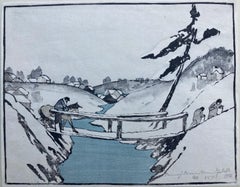
Gustave Baumann was born in Magdeburg, Germany, on June 27, 1881. Baumann immigrated to the USA as a child. He grew up in Chicago but became curious about New Mexico. He visited friends there in 1917 and settled in Santa Fe in 1918. He spent over 50 years there, where he participated in the art community. He created woodblocks from which he made prints and also became a carver of saints and marionettes, working with the Marionette Theatre. Baumann also created numerous paintings in bright colors. His woodcut subjects are church figures, scenes of sacred Indian pictographs and landscapes, including the Grand Canyon. During the 1930s, Baumann was a Works Progress Administration co-ordinator for Santa Fe. He died in Santa Fe on October 8, 1971.

to
5
Overall Width
to
Overall Height
to
3
5
1,321
1,026
921
892
5
2
1
4
1
3
2
1
1
1
1
1
1
1
1
4
1
1
2
5
Artist: Gustave Baumann
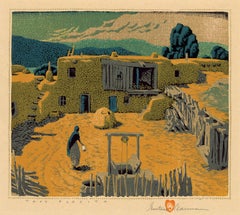
'Taos Placita' — American Southwest Regionalist Masterwork

'Taos Placita' — American Southwest Regionalist Masterwork

By Gustave Baumann

Located in Myrtle Beach, SC

Gustave Baumann, 'Taos Placita', color woodcut, 1947, edition 125. Baumann 132. Signed, titled, and numbered '20-125' in pencil; with the artist’s Hand-in-Heart chop. A superb, richly-inked impression, with fresh colors, on fibrous oatmeal wove paper; the full sheet with margins (2 to 3 1/8 inches); slight rippling at the left sheet edge, in excellent condition. Matted to museum standards, unframed. Image size 9 5/8 x 11 1/4 inches (244 x 286 mm); sheet size 13 1/4 x 17 inches (337 x 432 mm). Collections: Harwood Museum of Art, New Mexico Museum of Art, Phoenix Art Museum, Scottsdale Art Museum, Wichita Art Museum. ABOUT THE ARTIST Gustave Baumann (1881-1971) was a renowned printmaker and a leading figure of the American color woodcut revival whose exquisite craftsmanship and vibrant imagery captured the essence of the Southwest. "A brilliant printmaker, Baumann brought to the medium a full mastery of the craft of woodworking that he acquired from his father, a German cabinetmaker. This craftsmanship was coupled with a strong artistic training that resulted in the handsome objects we see in the exhibition today. After discovering New Mexico in 1918, Baumann began to explore in his woodblock prints of this period the light. color, and architectural forms of that landscape. His prints of this period are among the most beautiful and poetic images of the American West." —Lewis I. Sharp, Director, Denver Art Museum Baumann, the son of a craftsman, immigrated to the United States from Germany with his family when he was ten, settling in Chicago. From 1897 to 1904, he studied in the evenings at the Art Institute of Chicago, working in a commercial printmaking shop during the day. In 1905, he returned to Germany to attend the Kunstwerbe Schule in Munich, where he decided on a career in printmaking. He returned to Chicago in 1906 and worked for a few years as a graphic designer of labels. Baumann made his first prints in 1909 and exhibited them at the Art Institute of Chicago the following year. In 1910, he moved to the artists’ colony in Nashville, Indiana, where he explored the creative and commercial possibilities of a career as a printmaker. In 1915, he exhibited his color woodcuts at the Panama-Pacific International Exposition in San Francisco, winning the gold medal. Among Baumann’s ongoing commercial activities was his work for the Packard Motor Car Company from 1914 to 1920 where he produced designs, illustrations, and color woodcuts until 1923. In 1919, Baumann’s printmaking work dominated the important exhibition of American color woodcuts at the Detroit Institute of Arts. Twenty-six of his prints were included, far more than the works of any other artist. A set of his blocks, a preparatory drawing, and seven progressive proofs complemented the exhibition. That same year, Baumann worked in New York and, over the summer, in Provincetown, Massachusetts. His airy images of Cape Cod employed soft, pastel colors and occasionally showed the influence of the white-line woodcut technique. Many of his Chicago artist friends had traveled to the southwest, and Baumann became intrigued by their paintings, souvenirs, and stories of an exotic place named Taos, New Mexico. In the summer of 1918, he spent the summer in Taos sketching and painting before visiting Santa Fe. Paul Walter, the director of the Museum of New Mexico, offered him a studio in the museum's basement. Inspired by the rugged beauty of the Southwest—the vibrant colors and dramatic landscapes of the region became a central theme in his work, influencing his artistic style and subject matter for the remainder of his career. Later in the decade, he traveled to the West Coast and made prints of California landscape. Baumann's prints became synonymous with the Southwest, capturing the spirit of its place in America's identity with a unique sense of authenticity and reverence. His iconic images of desert vistas, pueblo villages, and indigenous cultures served as visual tributes to the region's rich cultural heritage, earning him a dedicated following among collectors and curators alike. A true craftsman and artist, Baumann completed every step of the printmaking process himself, cutting each block, mixing the inks, and printing every impression on the handmade paper he selected. His dedication to true craftsmanship and his commitment to preserving the integrity of his artistic vision earned him widespread acclaim and recognition within the art world. About the vibrant colors he produced, Baumann stated, “A knowledge of color needs to be acquired since they don’t all behave the same way when ground or mixed...careful chemistry goes into the making of colors, with meticulous testing for permanence. While complicated formulae evolve new colors, those derived from Earth and metal bases are still the most reliable.” In the 1930s, Baumann became interested in puppet theater. He designed and carved his own marionettes and established a little traveling company. From 1943 to 1945, the artist carved an altarpiece for the Episcopal Church of the Holy Faith in Santa Fe. In 1952, a retrospective exhibition of his prints was mounted at the New Mexico Museum of Fine Arts. Throughout his prolific career, Baumann executed nearly four hundred color woodcuts. Baumann’s woodcuts...

Category

1940s American Modern Gustave Baumann Prints and Multiples

Materials

Woodcut
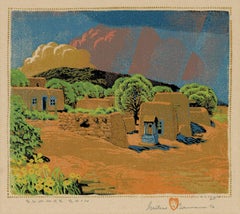
Gustave Baumann Color Woodblock - Rancho de Taos

Gustave Baumann Color Woodblock - Rancho de Taos

By Gustave Baumann

Located in Phoenix, AZ

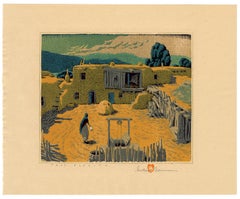
“Rancho de Taos” by well-known woodblock artist Gustave Baumann (1881-1971). The medium is color woodblock. It's a beautiful print in excellent condition. Baumann's personal Hand and...

Category

Mid-20th Century Gustave Baumann Prints and Multiples

Materials

Woodcut
Gustave Baumann Color Woodblock - Three Pines

Gustave Baumann Color Woodblock - Three Pines

By Gustave Baumann

Located in Phoenix, AZ

“Three Pines” by well-known woodblock artist Gustave Baumann (1881-1971). The medium is color woodblock. It's a beautiful print in excellent condition. Baumann's personal Hand and He...

Category

Mid-20th Century Gustave Baumann Prints and Multiples

Materials

Paper, Color, Woodcut

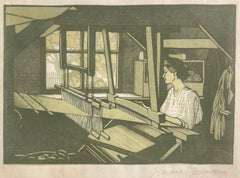
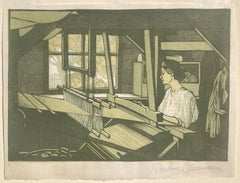
THE RUG WEAVER
THE RUG WEAVER

THE RUG WEAVER

By Gustave Baumann

Located in Santa Monica, CA

GUSTAVE BAUMANN (1881 – 1971) THE RUG WEAVER, 1910 (Chamberlain 26) Color woodcut signed in pencil. Unnumbed from an edition 100 as published in the Hills o’ Brown...
Category

1910s American Modern Gustave Baumann Prints and Multiples

Materials

Woodcut

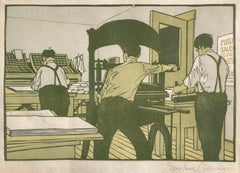
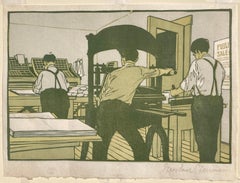
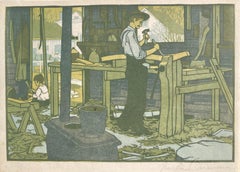
The Print Shop
The Print Shop

The Print Shop

By Gustave Baumann

Located in Santa Monica, CA

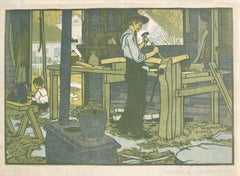
GUSTAVE BAUMANN (1881 – 1971) THE PRINT SHOP 1910 (Chamberlain 27) Color woodcut signed in pencil. Unnumbed from an edition 100 as published in the Hills o’ Brown Portfolio, (plate 11 of 12). Image 9 x 13 1/8, sheet 10 ¼ x 13 7/8 with deckle edge at the bottom. The print portrays the Brown County...
Category

1910s American Modern Gustave Baumann Prints and Multiples

Materials

Lithograph

Related Items
"Mine Shaft", Soviet Union: An Early 20th C. Woodcut Engraving by Abramovitz
"Mine Shaft", Soviet Union: An Early 20th C. Woodcut Engraving by Abramovitz

By Albert Abramovitz

Located in Alamo, CA

This is a signed woodcut engraving entitled "Mine Shaft" created by Albert Abramovitz in 1935, after a trip to the Soviet Union. It depicts two Russian workers constructing a mine sh...

Category

1930s Gustave Baumann Prints and Multiples

Materials

Woodcut

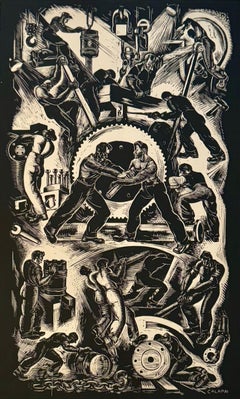
"Labor in a Diesel Plant" Machine Age American Scene Industrial Mid 20th Century

"Labor in a Diesel Plant" Machine Age American Scene Industrial Mid 20th Century

By Letterio Calapai

Located in New York, NY

"Labor in a Diesel Plant" Machine Age American Scene Industrial Mid 20th Century Letterio Calapai (American 1902-1993) ''Labor in A Diesel Plant'' Wood engraving, 1940 17 x 10 1/2...

Category

1940s American Modern Gustave Baumann Prints and Multiples

Materials

Lithograph

THE THAW
THE THAW

THE THAW

By William Seltzer Rice

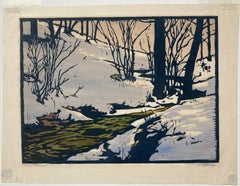
Located in Santa Monica, CA

WILLIAM SELTZER RICE (1873 - 1963) THE THAW c 1915-20 Color woodcut, signed and titled in pencil. Image 8 7/8 x 12 inches, sheet 10 3/4 x 14 3/8 inches. On textured fibrous paper. V...

Category

1910s American Modern Gustave Baumann Prints and Multiples

Materials

Color, Woodcut

Winslow Homer 19th Century Woodcut Engraving "Making Hay"

Winslow Homer 19th Century Woodcut Engraving "Making Hay"

By Winslow Homer

Located in Alamo, CA

This Winslow Homer woodcut engraving entitled "Making Hay", was published in Harper's Weekly in the July 6, 1872 edition. It depicts a two men hand cutting high grass on a hill. The man in the foreground is looking at a young boy and a girl (presumably his children), who are sitting on the ground with a picnic basket. This beautiful Homer woodcut engraving is presented in a brown wood frame and a light beige fabric mat with a black inner mat. The print is in excellent condition. There are two other Homer woodcut engravings in identical frames and mats that are listed on 1stdibs. See LU117326148332 and LU117326148272. These would make a wonderful display grouping. A discount is available for the purchase of two or all three of these prints. This Winslow Homer engraving...

Category

1870s American Impressionist Gustave Baumann Prints and Multiples

Materials

Engraving, Woodcut

Tokyo Tower in Shiba

Tokyo Tower in Shiba

Located in Fairlawn, OH

Tokyo Tower in Shiba Color woodblock, 1960 Signed and sealed lower right Signed with the artist's name:" Keimei" (see photo) Signed with the artist's seal in red (see photo) Publishe...

Category

1960s Other Art Style Gustave Baumann Prints and Multiples

Materials

Woodcut

"Dawn Inside the Yoshiwara" Utagawa Hiroshige, Japanese Landscape, Ukiyo-e

"Dawn Inside the Yoshiwara" Utagawa Hiroshige, Japanese Landscape, Ukiyo-e

By Utagawa Hiroshige

Located in New York, NY

Utagawa Hiroshige Dawn Inside the Yoshiwara, circa 1857 Woodblock print 11 x 7 inches Utagawa Hiroshige is recognized as a master of the ukiyo-e woodblock printing tradition, havin...

Category

1850s Naturalistic Gustave Baumann Prints and Multiples

Materials

Paper, Ink, Woodcut

Bougival
Bougival

Maurice de VlaminckBougival, 1914

$5,500

H 13.25 in W 16.25 in

Bougival

By Maurice de Vlaminck

Located in Fairlawn, OH

Bougival Woodcut, 1914 Signed and numbered in pencil Edition 30, this numberd 22 Printed on laid Van Gelder Zonen paper Published by Henri Kanweiler, Paris Printed by Paul Birault, P...

Category

1910s Fauvist Gustave Baumann Prints and Multiples

Materials

Woodcut

1870 View of Proposed Brooklyn Bridge and New York City

1870 View of Proposed Brooklyn Bridge and New York City

By Theodore R. Davis

Located in Alamo, CA

This framed engraving entitled "Birds-eye View of the Southern End of New York and Brooklyn, Showing the Projected Suspension-Bridge Over the East River, From the Western Terminus in Printing-House Square, New York" by Theodore R. Davis (1840–1894) was published as a supplement of Harper's Weekly, November 19, 1870. The print is presented in a maple frame and a double mat. The frame measures 23.5" high, 29" wide and 0.75" deep. There is a vertical center fold and additional vertical lines, where wood engraving blocks were joined for the printing process. It is in excellent condition. This framed image depicting New York in 1870 was a centerfold for the November 19, 1870 issue of Harper's Weekly. It includes the site and eventual appearance of the East River New York-Brooklyn Bridge; the name later shortened to the Brooklyn Bridge. The print was issued eleven months after the start of construction of the bridge on January 2, 1870, which would take another 12.5 years to complete. When this view was drawn, work on the bridge was all below ground, constructing the supports for the bridge’s towers. Labels in the upper portion of the print identify locations in the background including "Light Ship...

Category

Late 19th Century Naturalistic Gustave Baumann Prints and Multiples

Materials

Woodcut

"Skating on Ladies' Pond Central Park": Winslow Homer 19th C. Woodcut Engraving

"Skating on Ladies' Pond Central Park": Winslow Homer 19th C. Woodcut Engraving

By Winslow Homer

Located in Alamo, CA

This Winslow Homer woodcut engraving entitled "Skating on the Ladies' Skating-Pond in Central Park, New York", was published in Harper's Weekly in the January 28, 1860 edition. It depicts a large number of men, women and children skating on a recently opened pond in Central Park. At the time of publication of this engraving, Central Park was in the early stages of construction. This engraving documents the very early appearance of Frederick Law Olmstead and Calvert Vaux's masterpiece of landscape design. According to Olmsted, the park was "of great importance as the first real Park made in this century – a democratic development of the highest significance". The people of New York were very proud of the plans for their park. It was stated at the time: "Our Park, which is progressing very satisfactorily under the management of the Commissioners, will undoubtedly be, one of these days, one of the finest place of the kind in the world...Those who saw the Park before the engineers went to work on it are amazed at the beautiful sites which have been contrived with such unpromising materials; all fair persons believe that the enterprise is managed with honesty and good taste." Skating was rapidly rising in national popularity in part due to the opening of Central Park’s lake to skaters on a Sunday in December 1858 with 300 participants. The following Sunday it attracted ten thousand skaters. By Christmas Day, a reported 50,000 people came to the park, most of them to skate. There were rules governing who could use the skating pond. “The Ladies’ Pond...

Category

1870s American Impressionist Gustave Baumann Prints and Multiples

Materials

Engraving, Woodcut

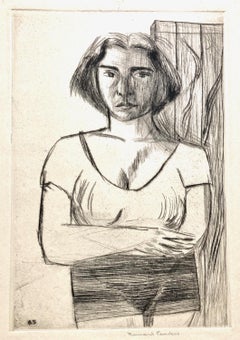
Bernard Sanders, Young Girl (With Arms Crossed), about 1930

Bernard Sanders, Young Girl (With Arms Crossed), about 1930

By Bernard Sanders

Located in New York, NY

Young Girl by Bernard Sanders (1906-1967) is a classic example of his masterful portraiture. This is a drypoint. It is signed in pencil, titled in the lower left margin, and initial...

Category

1930s American Modern Gustave Baumann Prints and Multiples

Materials

Drypoint

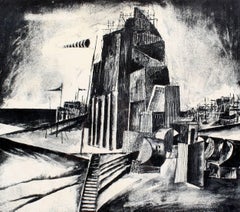
Modern American Industrial Landscape

Modern American Industrial Landscape

Located in Buffalo, NY

An original woodblock print dated 1965, titled "Our Town" but signed illegibly.

Category

1960s American Modern Gustave Baumann Prints and Multiples

Materials

Paper, Woodcut

House in Kyoto
House in Kyoto

Kiyoshi SaitōHouse in Kyoto, 1963

$1,850

H 15 in W 20.75 in

House in Kyoto

By Kiyoshi Saitō

Located in Fairlawn, OH

House in Kyoto Color woodcut, 1963 Signed in white brush bottom left of image, along with the artist's red stamp (see photo) Titled, dated and numbered in pencil bottom margin (see p...

Category

1960s Contemporary Gustave Baumann Prints and Multiples

Materials

Woodcut

Previously Available Items
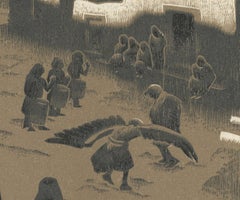
An Eagle Ceremony at Tesuque Pueblo

An Eagle Ceremony at Tesuque Pueblo

By Gustave Baumann

Located in Fairlawn, OH

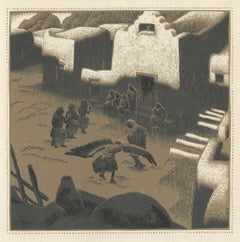
An Eagle Ceremony at Tesuque Pueblo Woodcut printed in two colors, 1932 Unsigned as usual; initialed in the plate lower left (see photo) As published by Elmer Adler in "The Colophon:...

Category

1930s American Modern Gustave Baumann Prints and Multiples

Materials

Woodcut

THE WAGON SHOP
THE WAGON SHOP

THE WAGON SHOP

By Gustave Baumann

Located in Santa Monica, CA

GUSTAVE BAUMANN (1881 – 1971) THE WAGON SHOP, 1910 (Chamberlain 24) Color woodcut signed in pencil. Unnumbed from an edition 100 as published in the Hills o’ Brown...

Category

1910s Modern Gustave Baumann Prints and Multiples

Materials

Woodcut

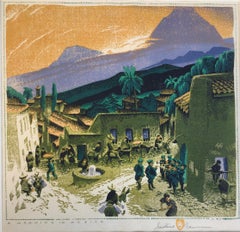
MORNING IN MEXICO (RARE UNDESCRIBED STATE)

MORNING IN MEXICO (RARE UNDESCRIBED STATE)

By Gustave Baumann

Located in Santa Monica, CA

GUSTAVE BAUMANN (1881 -1971) MORNING IN MEXICO 1934-36 (Chamberlain 143) Color woodcut, 2nd version after Baumann discarded the first blocks. This version 1936. POSSIBLY AN UNIQUE VARIANT IMPRESSION. DIFFERS FORM THE IMAGE IN THE CATALOG RAISONNE. Aside from differing colors not uncommon with Baumann, there are also differences in the blocks. The area along the left edge is different e. g. the left edge - elimination of cross hatching below the roof and the elimination of the lower left corner shrub like cross hatching. . There are also differences in the sky with more clouds. Although the intended edition was 125, this print is very scarce and rarely comes on the market. Very good and fresh impression. No. II - 41 /125. Image, 13 x 13 ¼”, full sheet, 16 7/8 x 14 3/8”, deckle edge. Excellent condition. Provenance: Zaplin Lampert...

Category

1930s American Modern Gustave Baumann Prints and Multiples

Materials

Woodcut

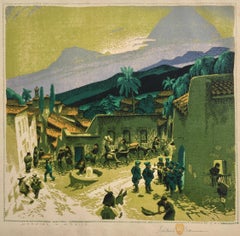
MORNING IN MEXICO
MORNING IN MEXICO

MORNING IN MEXICO

By Gustave Baumann

Located in Santa Monica, CA

GUSTAVE BAUMANN (1881 -1971) MORNING IN MEXICO 1934-36 (Chamberlain 143: Baumann 107) Color woodcut, 2nd version after Baumann discarded the first blocks. ...

Category

1930s American Modern Gustave Baumann Prints and Multiples

Materials

Woodcut

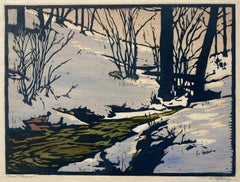
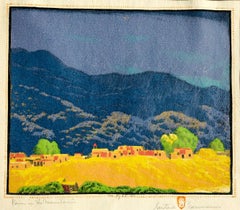
RAIN IN THE MOUNTAINS

RAIN IN THE MOUNTAINS

By Gustave Baumann

Located in Portland, ME

Baumann, Gustave. RAIN IN THE MOUNTAINS. Chamberlain 108, Edition 1; Baumann Inventory #76. Color woodcut, 1926. Printed in seven colors by Baum...

Category

1920s Gustave Baumann Prints and Multiples

Materials

Woodcut

Summer Rain
Summer Rain

Gustave BaumannSummer Rain, 1926

Sold

H 9.38 in W 11.13 in

Summer Rain

By Gustave Baumann

Located in Myrtle Beach, SC

Signed, titled, numbered RC 20-50 and dated 56 in pencil, with the artist’s hand-in-heart chop. A superb impresson, with brilliant, fresh colors, on oatmeal wove paper; with wide m...

Category

1920s American Modern Gustave Baumann Prints and Multiples

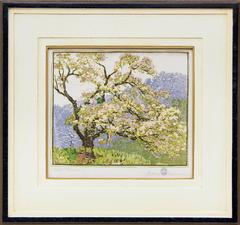
Apple Blossoms
Apple Blossoms

Gustave BaumannApple Blossoms, 1917

Sold

H 18.5 in W 19.5 in D 1 in

Apple Blossoms

By Gustave Baumann

Located in Denver, CO

Original color woodcut. Housed in a custom frame with all archival materials and Museum Glass (UV Protection/Anti-reflective). Framed dimensions measure 18 ½ x 19 ½ x 1 inches; image dimensions measure 9.5 x 11.25 inches. About the artist: Gustave Baumann’s family emigrated from Germany to Chicago in 1891, when he was only ten years old. When Baumann was 17, he worked for a commercial engraving house while attending night classes at the School of the Art Institute of Chicago. In 1905, he returned to his native Munich where he enrolled in the Kunstgewerbe Schule (Arts and Crafts School). There he studied wood carving while mastering the European technique of color wood block prints. After a year in Germany, Baumann resettled in the United States. He moved to Brown County, Indiana in 1910. The landscapes of Indiana became his main focus. He produced a portfolio of colored woodcuts entitled, “In the Hills of Brown.” In 1915, these woodcuts of Indiana won the gold medal for printmaking at the Panama Pacific International Exposition in San Francisco. In 1916, he organized the first national exhibition of color woodcuts by American artists at the Art Institute of Chicago. Baumann headed to Santa Fe in 1918 to visit his friends Walter Ufer and Victor Higgins. Once in New Mexico, Baumann was overwhelmed by the natural beauty of the state and decided to live there permanently. It was there he met and worked with John Sloane...

Category

Early 20th Century Gustave Baumann Prints and Multiples

Materials

Woodcut

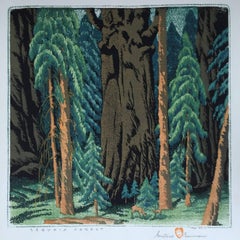
Sequoia Forest
Sequoia Forest

Sequoia Forest

By Gustave Baumann

Located in Santa Monica, CA

GUSTAVE BAUMANN (1881 -1971) SEQUOIA FOREST 1935 (60) (Chamberlain 146.2) Color woodcut. Signed in pencil and with the hand and Heart stamp. No. 1960 3...

Category

1930s American Modern Gustave Baumann Prints and Multiples

Materials

Woodcut

New Year’s Greeting Card Outer: Announcing a New Year’s Broadcast, Santa Fe, N M

New Year’s Greeting Card Outer: Announcing a New Year’s Broadcast, Santa Fe, N M

By Gustave Baumann

Located in Fairlawn, OH

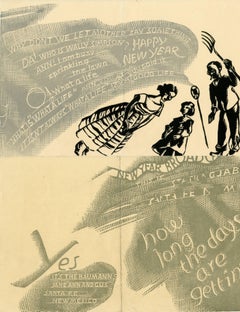
Gustave Baumann (1881-1971) New Year’s Greeting Card Outer: Announcing a New Year’s Broadcast, Santa Fe, N M Inner: Why Don’t We Ley Mother Say Something Da!, with vignettes of the a...

Category

1930s American Modern Gustave Baumann Prints and Multiples

Materials

Woodcut

Spring Serenade
Spring Serenade

Spring Serenade

By Gustave Baumann

Located in New York, NY

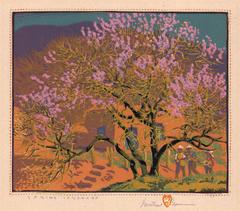
When this color woodcut was created in 1927, Gustave Baumann was living and working in New Mexico. “Spring Serenade” is a beautiful example of his work inspired from the Southwestern landscape and color palate. This impression is signed and titled in pencil. Inscribed "No. 45-120" with Bauman’s hand heart...

Category

Early 20th Century American Modern Gustave Baumann Prints and Multiples

Materials

Woodcut

Hoosier Garden
Hoosier Garden

Gustave BaumannHoosier Garden, 1961.

Sold

H 22 in W 22.5 in D 2 in

Hoosier Garden

By Gustave Baumann

Located in New York, NY

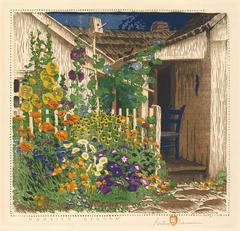
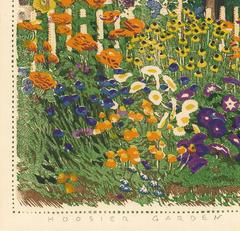
This color woodcut by Gustave Baumann was printed in 1961. The original woodcut blocks were made in 1927 with an edition of prints created and entitled ...

Category

Mid-20th Century American Modern Gustave Baumann Prints and Multiples

Materials

Woodcut

THE SYCAMORE
THE SYCAMORE

Gustave BaumannTHE SYCAMORE, 1915

Sold

H 20 in W 18.5 in D 2 in

THE SYCAMORE

By Gustave Baumann

Located in Portland, ME

Baumann, Gustave (American, born Germany, 1881-1971). THE SYCAMORE. Color Woodblock, 1915. Edition not stated. Titled and signed in pencil, and stamped with the Swanli chop in blue. ...

Category

1910s Realist Gustave Baumann Prints and Multiples

Materials

Woodcut

Gustave Baumann prints and multiples for sale on 1stDibs.

Find a wide variety of authentic Gustave Baumann prints and multiples available for sale on 1stDibs. You can also browse by medium to find art by Gustave Baumann in woodcut print, lithograph and more. Much of the original work by this artist or collective was created during the 20th century and is mostly associated with the modern style. Not every interior allows for large Gustave Baumann prints and multiples, so small editions measuring 7 inches across are available. Customers who are interested in this artist might also find the work of Arthur William Heintzelman., Walt Kuhn, and John French Sloan. Gustave Baumann prints and multiples prices can differ depending upon medium, time period and other attributes. On 1stDibs, the price for these items starts at $2,000 and tops out at $4,750, while the average work can sell for $2,250.