Harry Morley Art

British, 1881-1943

Harry Morley was a British painter, etcher and engraver, known for his classical and mythological compositions. He was born in Leicester, where he attended Alderman Newton's School. At the age of 16 years, he left school to study architecture at Leicester School of Art, under Augustus Spencer and Benjamin Fletcher. In 1900, Morley was awarded a scholarship to study architecture under Professor Beresford Pite at the Royal College of Art (RCA). He won an RCA scholarship in 1903, which enabled him to visit Italy for the first time. Later that year, Morley was articled to Beresford Pite, whose architectural practice was on the RCA campus. At the Royal College, Morley also attended the mural painting department and life classes. He won two further scholarships in 1905 an RCA Architecture Award and another from the Royal Institute of British Architects (RIBA), for the study of colour decoration. These awards allowed him to spend long periods in Italy, between 1905 and 1908, where he came to admire early Renaissance painters, such as Pinturicchio, Pietro Perugino, Paolo Uccello and Sandro Botticelli. Now, determined to become a painter himself, he attended the Académie Julian, Académie Colarossi and Académie de la Grande Chaumière in Paris.

In London, in 1911, Morley married Lilias Helen Swain ARCA. A skilful calligrapher and embroiderer, Lilias had studied design at the Royal College of Art under William Lethaby. She was trained in lettering and illumination by Professor Edward Johnston and went on to become his first assistant. She studied embroidery under Grace Christie, whom she assisted after her graduation. Lilias was teaching calligraphy and embroidery at the Royal College, when she became engaged to Harry Morley. Lilias all gave up her artistic career to support Morley in his work. Whenever the opportunity arose, she undertook private commissions in calligraphy and embroidery design. She continued to draw and paint under the name Lester Romley. A quiet feminist from an early age, Lilias shared digs in Chelsea with fellow Royal College of Art student, Sylvia Pankhurst, who like Lilias, was from Manchester. Lilias designed and embroidered for the Pankhursts, a demonstration banner (now lost).

By 1921, Morley had been elected a member of the Art Workers' Guild. He joined the Society of Painters in Tempera, two years later. The ethos and camaraderie of artist groups appealed to him. He was an active member of both organisations. The Society of Painters in Tempera frequently held their meetings in Morley's studio. John D. Batten, the painter-activist, Mary Sargant Florence, Francis Ernest Jackson, Maxwell Armfield and Joseph Southall were among the many that attended. The revival of British interest in tempera painting had begun as early as 1901, with the formation of the Society. By the 1920s, the medium was better understood. However, it was only after the Royal Academy of Arts's ground-breaking “Italian Art exhibition”, at Burlington House, in 1930, that the Academy accepted contemporary tempera paintings in its “Summer Exhibition”. A tempera of Morley's was one of the 36 tempera paintings shown that first year. Morley was considered to be an artist's artist. His pictures  proclaim their dependence on the early Italian masters, not only by their oil and tempera technique, but in their visual vocabulary. The artist's strong sense of monumental form and spatial clarity reflected his early training as an architect. Together, with his use of clean lines, academic coolness and detachment, Morley's work is clearly distinguished from the narrative purpose and sentiment of the Pre-Raphaelites. Morley's principal concern was the mythological and biblical figure paintings in oil and tempera that he exhibited at the Royal Academy of Arts from 1912. In 1924, his tempera painting, Apollo and Marsyas was purchased for the Tate, under the terms of the Chantrey Bequest.

The 1920s and 1930s, marked for Morley, a period of relative success and public recognition. Despite the collapse of the art market, during the economic depression that followed the 1929 Wall Street Crash, Morley continued to paint, engrave and exhibit. In 1932, he reluctantly accepted a post at St. Martin's School of Art, where for eight years, he taught painting and life drawing, two days a week. Portrait commissions also supplemented his income, during the 1930s. Morley's friend and Keeper of the Royal Academy Schools, Sir Walter Westley Russell invited him to attend the Schools, as a visiting teacher to critique students' work. Morley was appointed to the Faculty of Engraving, at the British School at Rome, in 1931. He was elected Associate of the Royal Watercolour Society (RWS), in 1927 and a full member, in 1931. He served as RWS Vice President, from 1937 to 1941. Having been nominated for Associate Membership of the Royal Academy of Arts (ARA) since 1921, he was eventually elected ARA in 1936. That same year, he was also elected Master of the Art Workers's Guild. A series of six articles by Morley on the “Theory and Practice of Figure Painting in Oils” appeared in the Artist Magazine, between September 1936 to February 1937. Morley's mythological and classical figure compositions helped establish his reputation and attract critical approval. By the mid 1930s, however, he had begun to experiment with a new approach to landscape painting, influenced in part by his long-standing admiration for the work of Paul Cézanne. Were it not for the disruption caused by World War II, his relocation out of London, his ill-health and early death, it is impossible to tell where this new direction might have led.
to
1
1
Overall Width
to
Overall Height
to
2
1
1
1
2
2
2
1
1
1
1
1
2
10,524
2,810
2,500
1,412
1
1
1
Artist: Harry Morley
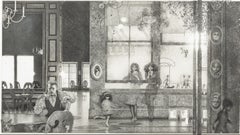
The Sacristan
The Sacristan

The Sacristan

By Harry Morley

Located in New Orleans, LA

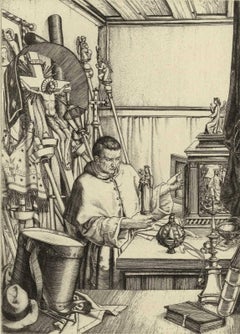
This image shows a cleric seated in a church sacristy surrounded by religious statues, croziers, various saints, statues and chalices. It is an origina...

Category

Early 20th Century Modern Harry Morley Art

Materials

Engraving

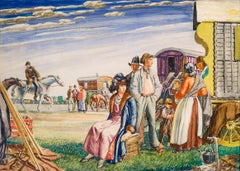
Harry Morley - The Romany Camp - 20th Century British watercolour

Harry Morley - The Romany Camp - 20th Century British watercolour

By Harry Morley

Located in London, GB

HARRY MORLEY, ARA, RWS (1881-1943) The Romany Camp Signed and dated 1927 Watercolour and bodycolour, framed 36.5 by 52cm., 14 ¼ by 20 ½ in. (frame size 60.5 by 75 cm., 23 ¾ by 29...

Category

Early 20th Century Realist Harry Morley Art

Materials

Watercolor

Related Items
Don Juan
Don Juan

Louis IcartDon Juan, 1928

$2,800Sale Price|20% Off

H 28 in W 20.5 in

Don Juan

By Louis Icart

Located in Missouri, MO

Aquating Engraving Image Size: approx. 20 1/4 x 13 3/8 Framed Size: 28 x 20.5 inches Pencil Signed Lower Right Louis Justin Laurent Icart was born in Toulouse in 1890 and died in Paris in 1950. He lived in New York City in the 1920s, where he became known for his Art-Deco color etchings of glamourous women. He was first son of Jean and Elisabeth Icart and was officially named Louis Justin Laurent Icart. The use of his initials L.I. would be sufficient in this household. Therefore, from the moment of his birth he was dubbed 'Helli'. The Icart family lived modestly in a small brick home on rue Traversière-de-la-balance, in the culturally rich Southern French city of Toulouse, which was the home of many prominent writers and artists, the most famous being Henri de Toulouse-Lautrec. Icart entered the l'Ecole Superieure de Commerce de Toulouse in order to continue his studies for a career in business, particularly banking (his father's profession). However, he soon discovered the play writings of Victor Hugo (1802-1885), which were to change the course of his life. Icart borrowed whatever books he could find by Hugo at the Toulouse library, devouring the tales, rich in both romantic imagery and the dilemmas of the human condition. It was through Icart's love of the theater that he developed a taste for all the arts, though the urge to paint was not as yet as strong for him as the urge to act. It was not until his move to Paris in 1907 that Icart would concentrate on painting, drawing and the production of countless beautiful etchings, which have served (more than the other mediums) to indelibly preserve his name in twentieth century art history. Art Deco, a term coined at the 1925 Paris Exposition des Arts Decoratifs, had taken its grip on the Paris of the 1920s. By the late 1920s Icart, working for both publications and major fashion and design studios, had become very successful, both artistically and financially. His etchings reached their height of brilliance in this era of Art Deco, and Icart had become the symbol of the epoch. Yet, although Icart has created for us a picture of Paris and New York life in the 1920s and 1930s, he worked in his own style, derived principally from the study of eighteenth-century French masters such as Jean Antoine Watteau, François Boucher and Jean Honoré Fragonard. In Icart's drawings, one sees the Impressionists Degas...

Category

1920s Art Deco Harry Morley Art

Materials

Engraving, Aquatint

Sportsmen
Sportsmen

Louis LegrandSportsmen, 1908

$800Sale Price|54% Off

H 11.25 in W 5.75 in D 0.5 in

Sportsmen

By Louis Legrand

Located in Plano, TX

Sportsmen. 1908. Etching and drypoint. Exsteens 271.i/ii. 11 1/4 x 5 3/4 (sheet 17 3/8 x 12 1/4). Series: Les Bars. From the first state edition of 30 proofs with the remarque sketch...

Category

Early 1900s Post-Impressionist Harry Morley Art

Materials

Drypoint, Etching

The Prince and the Siren, Watercolor & Gouache, Nocturne, Figural, Illustration

The Prince and the Siren, Watercolor & Gouache, Nocturne, Figural, Illustration

Located in Wiscasset, ME

John Richard Flanagan was born in Sydney, Australia. At the age of thirteen Flanagan left school to help support his family as an assistant to a lithographer producing advertising co...

Category

20th Century Realist Harry Morley Art

Materials

Paper, Watercolor, Gouache

'Jesus and the Woman at the Well, ' by Amand-Durand, Engraving

'Jesus and the Woman at the Well, ' by Amand-Durand, Engraving

By Armand Durand

Located in Oklahoma City, OK

This early 19th century framed 35" x 31" engraving by artist Amand-Durand depcits an etching of 'Jesus and the Woman at the Well,' after the Dutch master, Rembrandt van Rijn. This poignant Biblical story is depicted by Arman-Durand in Rembrandt style...

Category

Early 19th Century Old Masters Harry Morley Art

Materials

Engraving

La diligence de Beaucaire

La diligence de Beaucaire

By Félix Hilaire Buhot

Located in Middletown, NY

Paris: Lemerre, 1880. Etching, drypoint, aquatint (dust ground and spirit ground), spit bite, and roulette in black on cream laid paper with a deckle edge, 6 3/4 x 4 1/2 inches (170 x 112 mm), full margins. Third state (of 3). An illustration from Alphonse Daudet's, Lettres de mon moulin, Paris, 1880. In very good condition with some light uniform toning and two areas of paper tape at the top right and left corners on the verso (from a former mount). With the 1921 J.H. de Bois circular ink stamp in green ink in the lower right margin on the recto (Lugt L.733). [Bourcard 110]. A note regarding the provenance: J. H. de Bois was a well known late-19th century modern art...

Category

1880s French School Harry Morley Art

Materials

Laid Paper, Drypoint, Etching, Aquatint

"The Small Collar", Trees Inhabited by Human, Paper Drawing with Pigment Colors

"The Small Collar", Trees Inhabited by Human, Paper Drawing with Pigment Colors

By Frank Girard

Located in Clermont-Ferrand, Auvergne-Rhône-Alpes

This drawing by Frank Girard is created with ink and pigments Colors, on 300g/m2 neutral white paper. It is not framed. Through drawings, the masterful French artist Frank Girard is...

Category

2010s Realist Harry Morley Art

Materials

Paper, Ink, Watercolor, Pigment

The Market Place Venice - British Victorian art watercolour painting Italy

The Market Place Venice - British Victorian art watercolour painting Italy

By Thomas Ellison

Located in Hagley, England

A fine, large watercolour by British listed artist Thomas Ellison who exhibited at The Royal Academy and the British Art institutions. It is a busy scene depicting the market at Veni...

Category

19th Century Realist Harry Morley Art

Materials

Watercolor

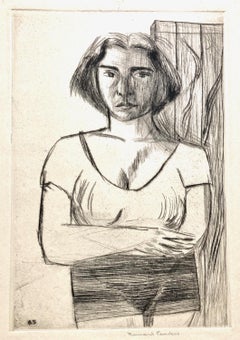
Bernard Sanders, Young Girl (With Arms Crossed), about 1930

Bernard Sanders, Young Girl (With Arms Crossed), about 1930

Located in New York, NY

Young Girl by Bernard Sanders (1906-1967) is a classic example of his masterful portraiture. This is a drypoint. It is signed in pencil, titled in the lower left margin, and initial...

Category

1930s American Modern Harry Morley Art

Materials

Drypoint

Vin Rouge (Red Wine)

Edmund BlampiedVin Rouge (Red Wine), 1932

$1,750Sale Price|30% Off

H 9.25 in W 11.63 in

Vin Rouge (Red Wine)

By Edmund Blampied

Located in Plano, TX

1932. Drypoint. Appleby 167. 9 1/4 x 11 5/8 (sheet 11 3/8 x 17 15/16). Edition 100 #48. Mat line, well outside the image; otherwise excellent condition. A rich impression with drypo...

Category

1930s Modern Harry Morley Art

Materials

Drypoint

"Great Pine", Tree Inhabited by Human in Nature, Drawing and Pigments on Paper

"Great Pine", Tree Inhabited by Human in Nature, Drawing and Pigments on Paper

By Frank Girard

Located in Clermont-Ferrand, Auvergne-Rhône-Alpes

This drawing by Frank Girard is created with pigments, Chinese ink, watercolors, acrylic, and colored pencils on 300g/m2 neutral white paper. It is not framed. Through drawings, the...

Category

2010s Realist Harry Morley Art

Materials

Paper, Ink, Acrylic, Watercolor, Color Pencil, Pigment

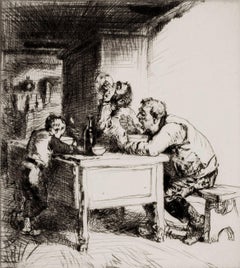
Soup
Soup

Edmund BlampiedSoup, 1920

$850

H 20 in W 16 in D 2 in

Soup

By Edmund Blampied

Located in Plano, TX

Soup. 1920. Drypoint. Appleby 65. 9 x 8 1/8 (sheet 15 x 11 9/16). Edition 100. Illlustrated: Print Collector's Quarterly 13 (1926): 85. Signed in pencil. Edmund Blampied was a painter, etcher, lithographer and sculptor. Born in 1886 to a family of three boys in St. Martin, Jersey, Blampied became interested in drawing at an early age. After visiting the studio of John Helier Lander in 1899, Blampied decided to make a career as an artist. In 1903 he went to London to attend Lambeth Art School, where he studied etching under Walter Seymour. In 1905, he joined the Daily Chronicle as an artist. In that year he was awarded a scholarship to Bolt Court Scool of Photo-engraving and Lithography. In 1912 he left the Chronicle and established his own studio. He earned a living by illustrating novels and short stories. In 1913, he had his first exhibition at the Leicester Gallery in London. The following year he married Marianne Van Abbé. During the 1920's, he became a member of the Royal Society of Painter-Etchers and Engravers. During the 1920s Blampied became a member of the Royal Society of Painters-Etchers and Engravers and exhibited in London to critical acclaim. He produced a folio of comic drawings in the 1930s which was published in New York in 1934 and another that was published in London in 1936. The Keeper of Prints and Drawings at the British Museum published a mongraph on his work. His London exhibitions were highly successful. In 1938, he moved to Bulwarks, St.Aubin in Jersey, but at the onset of the Occupation, had to relocate to Route Orange, St. Brelade. remained there throughout World War II during the German Occupation, despite the fact that his wife was Jewish. During the Occupation he designed bank...

Category

1920s Modern Harry Morley Art

Materials

Drypoint, Etching

Previously Available Items
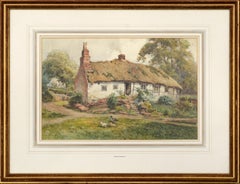
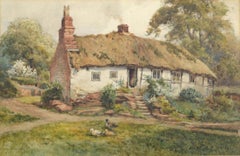
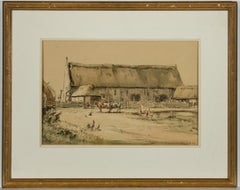
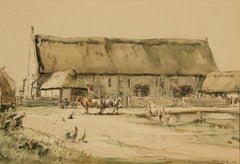
Harry Morley RWS - Signed 1920 Welsh Watercolour, Tithe Barn, Wrexham

Harry Morley RWS - Signed 1920 Welsh Watercolour, Tithe Barn, Wrexham

By Harry Morley

Located in Corsham, GB

A very fine watercolour sketch with pen and ink detail from English artist Harry Morley RWS (1881-1943), depicting a Welsh Farmyard with thatched barn and cattle. Known for his water...

Category

1920s Realist Harry Morley Art

Materials

Watercolor

Harry Morley art for sale on 1stDibs.

Find a wide variety of authentic Harry Morley art available for sale on 1stDibs. You can also browse by medium to find art by Harry Morley in paint, oil paint, canvas and more. Much of the original work by this artist or collective was created during the 20th century and is mostly associated with the Post-Impressionist style. Not every interior allows for large Harry Morley art, so small editions measuring 5 inches across are available. Customers who are interested in this artist might also find the work of Joseph Floch, Laurence Henry Irving, and William Malherbe. Harry Morley art prices can differ depending upon medium, time period and other attributes. On 1stDibs, the price for these items starts at $400 and tops out at $15,337, while the average work can sell for $5,256.

Artists Similar to Harry Morley