Henry Pether Art

to
1
1
1
1
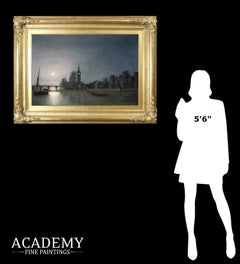
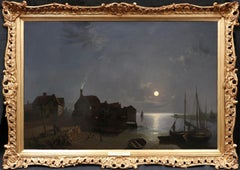
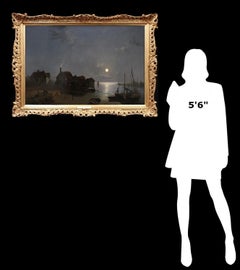
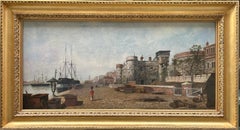
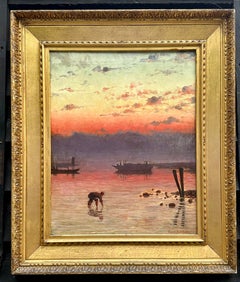
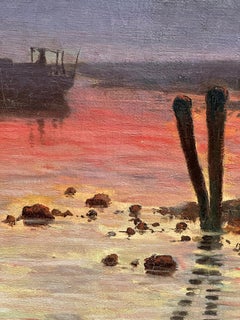
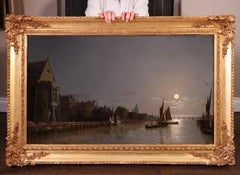
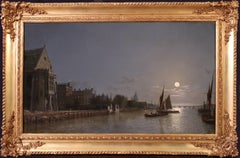
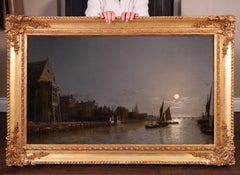
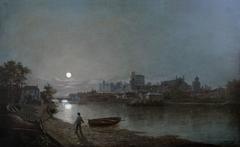
River Thames by Moonlight - Large Fine 19th Century Oil Painting Nightscape 1851
By Henry Pether
Located in Gerrards Cross, GB
‘The River Thames at Leigh by Moonlight’ by Henry Pether (1800-1880). The painting is signed by the artist and dated 1851 and is presented in a bespoke gold metal leaf frame. • Vi...
Category

1850s Old Masters Henry Pether Art

Materials

Oil

Related Items
Grand 19th Century English Marine Painting in Stunning Light
By John Wilson Ewbank
Located in London, GB
John Wilson Ewbank (1799 - 1847) Shipping in the Harbour, South Shields Oil on canvas 39.5 x 58 inches unframed 47.75 x 66.5 inches framed Provenance: Christie's October 2002; Lot 11. Fine Art Society; Private Collection This marvellous up to scale Ewbank is full of light and warmth and almost certainly his greatest work of the sort rarely - if ever - seen on the market. John W. Ewbank (4 May 1799–28 November 1847), was an English-born landscape and marine painter largely operational from Scotland. The Humber river is a large tidal estuary on the east coast of Northern England. Life Ewbank was born at Darlington on 4 May 1799, the son of Michael Ewbank, an innkeeper. He was adopted as a child by a wealthy uncle who lived at Wycliffe, on the banks of the River Tees, in the North Riding of Yorkshire. Intended for the Roman Catholic priesthood, he was sent to Ushaw College, from which he absconded. In 1813 Ewbank was apprenticed to Thomas Coulson, an ornamental painter in Newcastle. In around 1816 he moved with Coulson to Edinburgh, where he had some lessons with Alexander Nasmyth. He found work both as a painter and a teacher. He was nominated in 1830 one of the foundation members of the Royal Scottish Academy. In 1833 he is listed as living at 7 Union Street on the eastern fringe of the New Town in Edinburgh. Works His sketches from nature were especially admired, and a series of 51 drawings of Edinburgh by him were engraved by W. H. Lizars for James Browne's Picturesque Views of Edinburgh (1825). He also made a reputation with cabinet pictures of banks of rivers, coast scenes, and marine subjects. As an illustrator he illustrated some early editions of Scott's Waverley Novels and one edition of Gilbert White...
Category

19th Century Old Masters Henry Pether Art

Materials

Oil

Two Arcadic Landscapes - J.F. Van Bloemen (follower of) - Oil on Canvas
By Jan Frans van Bloemen (Orizzonte)
Located in Roma, IT
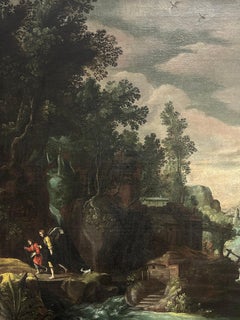
Two Arcadic Landscapes are a couple of original oil paintings by a follower of the Flemish artist, Jan Frans Van Bloemen (1662-1749). These old master's original paintings represen...
Category

Early 18th Century Old Masters Henry Pether Art

Materials

Oil

A Peasant Removing a Plaster: The Sense of Touch. By a Follower of David Teniers
By David Teniers the Younger
Located in Stockholm, SE
David Teniers the Younger (1610-1690) Follower of A Peasant Removing a Plaster: The Sense of Touch signed T on the table oil on panel panel size 7,20 x 5,55 inches (18,3 x 14,4 cm)...
Category

Early 18th Century Old Masters Henry Pether Art

Materials

Oil, Panel

Christ Supported by an Angel in the Garden of Gethsemane, On Slate
Located in Stockholm, SE
This evocative Veronese School painting captures the moment in the Garden of Gethsemane when Christ, overwhelmed with sorrow, prays to God before his arrest and crucifixion. Supporte...
Category

Early 17th Century Old Masters Henry Pether Art

Materials

Slate

Peasants in a Cornfield (Boer in het veld) by David Teniers the Younger
By David Teniers the Younger
Located in Stockholm, SE
Remembering the magic of everyday life moments in the art of David Teniers: The art of David Teniers the Younger (1610–1690) coincided with the heyday of the Flemish Baroque and captured a great variety of motifs of his time. In this painting of a seemingly simple peasant scene lies keys to understanding both the imaginative mind of Teniers as well as why this time period produced some of the most iconic works in all of art history.  As indicated by the name, Teniers was more or less born into his profession. As the son of David Teniers the elder, himself a painter who studied under Rubens, the younger David received training in art from a very young age and had no less than three brothers who also became painters. Because of his father’s frequent financial failures that even at times saw him imprisoned, David the younger helped to rescue the family from ruin through painting copies of old masters. Essentially, the young Teniers was confronted with painting as both a passion and creative expression as well as a necessity during difficult times, an experience that would shape much of his capacity and sensitivity in his coming life. Despite the hardships, the talent and determination of Teniers was recognized and quickly expanded his possibilities. He had already spent time in France and possibly also England when he was hired by his father’s former teacher Rubens to help with a prestigious commission with mythological paintings, now considered lost, for Philip IV the king Spain. In 1644–54 Teniers was appointed dean of the Antwerp Guild of Saint Luke, manifesting his esteemed position within the artistic community. A few years afterwards he took an important step when relocating to Brussels, where Teniers yet again found new career opportunities that would prove to be very successful. As the keeper of the collections of Archduke Leopold Wilhelm, a role similar to what we now refer to as an art advisor, Teniers purchased hundreds of important artworks that manifested the prominent status of the Archduke’s collection while at the same time providing an unusual access to inspiration and knowledge for Teniers himself. Since he kept on painting during the same time, his creative scope must have seemed almost bewildering in the great variety of images and stories that he surrounded himself with.  Regardless of how glamorous and culturally stimulating the career of Teniers was, he was as open to the charm and existential importance of everyday life as he was to works of great masters and luxurious collectibles. In his impressive repertoire of genres with everything from exquisite royal portraits, interiors, landscapes and history paintings he always added something new and inventive, highlighting the possibilities of art and importance of an experimental and intuitive mind. It is difficult to single out one aspect or genre to summarize his legacy, since it lies much more in the broad virtuosity across many motifs, although he is particularly remembered for farm scenes and meticulously depicted interiors where other paintings and artworks are captured with an astonishing precision. However, the fact that he is still today one of the most known and celebrated names of the Dutch Golden Age is a proof to the magic of his work, which continues to spark dialogue and wonder in the contemporary viewer of his works. The farm boy in the field in this painting, which likely dates to the mature part of his career, is a wonderful entry into the mind of Teniers. In the tightly cropped motif, we see him standing right in the middle of the busy harvest when men, women and everyone capable were sent out in the field to collect the crop that formed the very core of their diet and survival. In the background we see a fresh blue sky interspersed with skillfully painted clouds, some trees reaching their autumnal colours and in the far distance the glimpse of a small church and village. The presence of a church in a landscape, so typical of Dutch art, served both a symbolic and visual function as a representation of faith while at the same time defining scale and distance. In the field, the work is in full action with the farmers spread out in various positions, all in the midst of hard and sweaty labour. While they are portrayed as having nothing else than the work on their mind, our farm boy seems to have his attention directed elsewhere. Standing there with his white, half open shirt, flowy curls and strong, sturdy body; his gaze is directed away, out of the picture and the scythes in his hands. He looks almost smirking, expressed with tremendous subtlety in the slight smile of his lips and big eyes, being just in the middle of losing focus on the work. What is it that steals his attention? What has he seen, or realized, or felt – to break him free of the arduous task of harvesting, if but for a moment? Here starts the wondering and the questions that are the hallmark of a great piece of art. Instead of explicitly locking in the motif in overly clear symbolism Teniers has chosen an open ended, subtle yet striking moment for us to consider. While it of course can be related to numerous other farm scene depictions of this time, and clever usages of gazes and real-life scenes to underscore various moral or symbolic meanings, the painting can be much more of a contemplation than an explanation or illustration. The ordinary nature and understated yet emotionally textured composition of the motif gives greater space for our own reactions and thoughts. Has he seen a pretty farm girl just passing by? Is he fed up with the farm life, joyously dreaming away for a minute, imagining another future? Or is he simply in need of distraction, looking away and ready for anything that can steal his attention? One quality that never seem to have escaped Teniers was that of curiosity. During all of his career he constantly investigated, expanded and experimented with not only the style and technique of painting, but with the vision of art itself. Being credited with more or less introducing farm motifs for a broader audience not only tells us of his ability to understand the demand for different motifs, but the sensitivity to transform seemingly ordinary parts of life into deep aesthetic experiences, far beyond their expected reach. The farm boy in this painting is, of course, exactly that. But with the help of one smirk the entire picture is charged with a different energy, awakening many contrasts and relationships between the calm landscape, the hard work and his own breach of effectivity, holding sharp scythes while thinking or seeing something else. It is no wonder Teniers chose to work with farm scenes as a way of investigating these intricate and delicate plays on expectations and surprises, clarity and ambivalence. It invites us to an appreciation of human everyday life that connects us with the people of 17th century...
Category

Late 17th Century Old Masters Henry Pether Art

Materials

Canvas, Oil

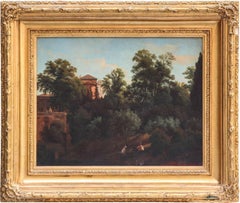
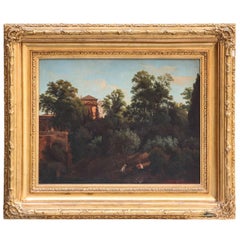
19th Century Roman Landscape oil on canvas with Giltwood Frame
Located in Rome, IT
Amaizing 19' century Roman landscape depicting a part of Villa Borghese with Trinità dei Monti. With a finely carved gilt wood coeval frame. Measurements with frame cm 65 x78 wit...
Category

19th Century Old Masters Henry Pether Art

Materials

Oil

Period Marine Landscape Credited to Warren Sheppard
By Warren W. Sheppard
Located in Roma, IT
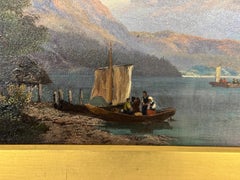
This beautiful painting, due to its very high quality of execution, style and era, can be referred to the great artist Warren Sheppard, who specialized in seascapes. Of great evocati...
Category

19th Century Old Masters Henry Pether Art

Materials

Canvas, Oil

Venice Guardi See Landscape 18/19th CEntury Paint Oil on canvas Old master Italy
Located in Riva del Garda, IT
Giacomo Guardi (Venice, 1764 – Venice, 1835) follower View of Venice with the Basilica della Salute and the Punta della Dogana oil on canvas Dimensions: 40 x 52 cm. framed 48...
Category

18th Century Old Masters Henry Pether Art

Materials

Oil

Macbeth and the Three Witches a Painting on Panel by Francesco Zuccarelli
By Francesco Zuccarelli
Located in PARIS, FR
This painting, created during Zuccarelli's stay in England, represents the decisive moment when Macbeth, together with Banquo, meets the three witches who announce that he will be Ki...
Category

1760s Old Masters Henry Pether Art

Materials

Oil, Wood Panel

17th Century Classical Oil Painting - Diana With Her Attendants in a Grotto
By Abraham van Cuylenborch
Located in London, GB
Abraham van CUYLENBROCH (1620-1658) Diana With Her Attendants in a Grotto 1651 signed oil on panel 12.2 in x 15.7 inches, inc. frame; 31 x 40 cm Provenance: Sale of Sotheby's Lo...
Category

17th Century Old Masters Henry Pether Art

Materials

Oil

Five mid 20th century Italian oil landscapes with figures, castles, Churchs
Located in Woodbury, CT
A very interesting set of five mid-20th-century Italian oils on copper. All five are classical landscape subjects and are signed Roger, though we don't know which artist with the n...
Category

1950s Old Masters Henry Pether Art

Materials

Copper

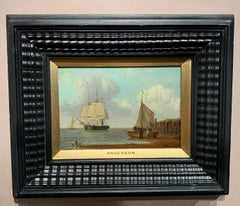
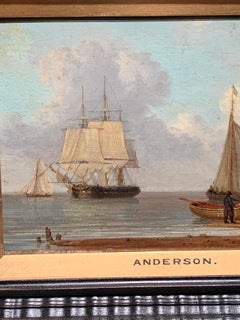
Antique English 19th century marine scene
By William Anderson
Located in Woodbury, CT
Outstanding English late 18th / early 19th century marine scene by one of Britain's best known and sought after painters. William (or Wiliam) Anderson (1757 – 27 May 1837) was a Scottish artist specializing in maritime and patriotic themes. He was well-regarded for his detailed and accurate portraits of ships under sail, exhibiting his works annually in London between 1787 and 1811 and then occasionally until 1834. Anderson influenced other artists, notably John Ward and others of the Hull school. Anderson's early life is obscure, but he is known to have trained as a shipwright before moving to London to become a maritime painter when he was about 30. His training served him well as a painter, providing "a practical nautical knowledge" of his subjects. He earned a reputation for "accuracy and refinement of detail" and was admired for his bright, clear colours. He worked in both oils and watercolours. He based his style on that of well-known Dutch maritime...
Category

1810s Old Masters Henry Pether Art

Materials

Oil, Wood Panel

Previously Available Items
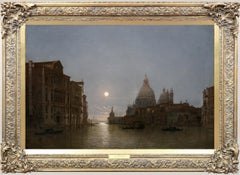
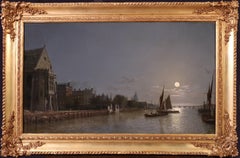
Venice by Moonlight - 19th Century Oil Painting of the Grand Canal by Full Moon
By Henry Pether
Located in Gerrards Cross, GB
'Venice by Moonlight' by Henry Pether (1800-1880). The painting – which depicts an extensive nocturnal view of the Grand Canal with the Palazzo Pisani Gritti to the left and the Dors...
Category

Mid-19th Century Old Masters Henry Pether Art

Materials

Oil

River Thames by Moonlight - 19th Century Oil Painting Victorian London by Night
By Henry Pether
Located in Gerrards Cross, GB
‘The River Thames by Moonlight’ by Henry Pether (1800-1880). The painting which depicts an extensive nocturnal view of London from the Temple to St Paul’s Cathedral and Blackfriars B...
Category

Mid-19th Century Victorian Henry Pether Art

Materials

Oil

River Thames by Moonlight - 19th Century Landscape Oil Painting Victorian London
By Henry Pether
Located in Gerrards Cross, GB
‘The River Thames by Moonlight’ by Henry Pether (1800-1880). The painting which depicts an extensive nocturnal view of London from the Temple to St Paul’s Cathedral and Blackfriars B...
Category

Mid-19th Century Victorian Henry Pether Art

Materials

Oil

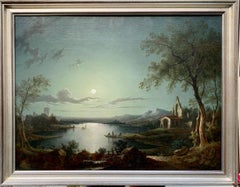
Late 18th century Antique English Moonlight over a lake and church landscape
By Henry Pether
Located in Woodbury, CT
Henry Pether, late 18th-century Moonlight lake Landscape. Born into a family of artists, Henry was the son of Abraham Pether (1756-1812), a talented la...
Category

1790s Old Masters Henry Pether Art

Materials

Canvas, Oil

Windsor Nocturne
By Henry Pether
Located in London, GB
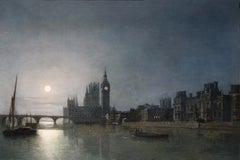
Henry Pether (Flourished 1828 - 1865) Windsor Nocturne Oil on canvas, signed lower right Image size: 30 x 50 inches Gilt frame The strong diagonal of the river leads the eye far into the distance, to where the clouds are silvered by the moon. Henry Pether captures the numinous moment when the heavens fade from blue to midnight blue and clouds acquire an almost sculptural solidity. The moonlight is shining on the buildings, defining the whole range of the castle. The artist recreates the experience of objects coming into focus as the viewer’s eyes become accustomed to the twilight. After gazing for a few moments, we are made aware of the complexity of the foreground scene: a man gazing at the approaching man with horses. Pether employs a very subtle range of colours, from the icy blue of the deep heavens, to a rich range of browns, to the silver-gilt of the moonlight, to evoke a peaceful spring night. This painting can be compared to the similar work, of much the same size and date, in Anglesey Abbey. Here, Pether uses a personal technique, covering his canvas with blue before using a camera obscura to obtain exact shapes and perspective directly from real life. Pether was supremely competent in the technique of representing moonlight shining through cloud by the use of soft glazes over patches of dense paint. Henry Pether was an English landscape painter, the son of Abraham Pether (1756-1812) and brother of Sebastian Pether...
Category

Mid-19th Century Henry Pether Art
Materials

Canvas, Oil

Henry Pether art for sale on 1stDibs.
Find a wide variety of authentic Henry Pether art available for sale on 1stDibs. You can also browse by medium to find art by Henry Pether in oil paint, paint, canvas and more. Much of the original work by this artist or collective was created during the 19th century and is mostly associated with the Old Masters style. Not every interior allows for large Henry Pether art, so small editions measuring 33 inches across are available. Customers who are interested in this artist might also find the work of John Frederick Herring Sr., William Shayer Senior, and Adolphus Knell. Henry Pether art prices can differ depending upon medium, time period and other attributes. On 1stDibs, the price for these items starts at $6,243 and tops out at $77,277, while the average work can sell for $36,221.
Artists Similar to Henry Pether