Hugó Scheiber Figurative Paintings

to
1
1
Overall Width
to
Overall Height
to
2
1
1
2
1
1
1
1
2
2
2
1
1
8
509
313
282
230
1
1
Artist: Hugó Scheiber
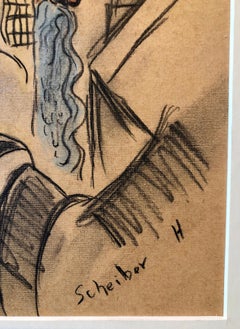
Rare Modernist Hungarian Rabbi Pastel Drawing Gouache Painting Judaica Art Deco

Rare Modernist Hungarian Rabbi Pastel Drawing Gouache Painting Judaica Art Deco

By Hugó Scheiber

Located in Surfside, FL

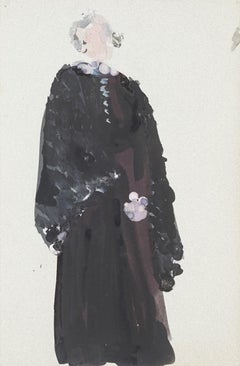
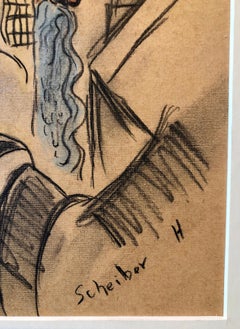
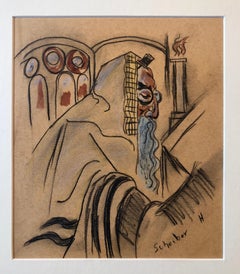
Rabbi in the synagogue at prayer wearing tallit and tefillin. Hugó Scheiber (born 29 September 1873 in Budapest – died there 7 March 1950) was a Hungarian modernist painter. Hugo Scheiber was brought from Budapest to Vienna at the age of eight where his father worked as a sign painter for the Prater Theater. At fifteen, he returned with his family to Budapest and began working during the day to help support them and attending painting classes at the School of Design in the evening, where Henrik Papp was one of his teachers. He completed his studies in 1900. His work was at first in a post-Impressionistic style but from 1910 onward showed his increasing interest in German Expressionism and Futurism. This made it of little interest to the conservative Hungarian art establishment. However, in 1915 he met the great Italian avant-gardist Filippo Tommaso Marinetti and the two painters became close friends. Marinetti invited him to join the Futurist Movement. The uniquely modernist style that he developed was, however, closer to German Expressionism than to Futurism and eventually drifted toward an international art deco manner similar to Erté's. In 1919, he and his friend Béla Kádar held an exhibition at the Hevesy Salon in Vienna. It was a great success and at last caused the Budapest Art Museum to acquire some of Scheiber's drawings. Encouraged, Scheiber came back to live in Vienna in 1920. A turning point in Scheiber's career came a year later, when Herwarth Walden, founder of Germany's leading avant-garde periodical, Der Sturm, and of the Sturm Gallery in Berlin, became interested in Scheiber's work. Scheiber moved to Berlin in 1922, and his paintings soon appeared regularly in Walden's magazine and elsewhere. Exhibitions of his work followed in London, Rome, La Paz, and New York. Scheiber's move to Germany coincided with a significant exodus of Hungarian artists to Berlin, including Laszlo Moholy-Nagy and Sandor Bortnyik. There had been a major split in ideology among the Hungarian avant-garde. The Constructivist and leader of the Hungarian avantgarde, Lajos Kassák (painted by Hugó Scheiber in 1930) believed that art should relate to all the needs of contemporary humankind. Thus he refused to compromise the purity of his style to reflect the demands of either the ruling class or socialists and communists. The other camp believed that an artist should be a figurehead for social and political change. The fall out and factions that resulted from this politicisation resulted in most of the Hungarian avant gardists leaving Vienna for Berlin. Hungarian émigrés made up one of the largest minority groups in the German capital and the influx of their painters had a significant effect on Hungarian and international art. Another turning point of Scheiber's career came in 1926, with the New York exhibition of the Société Anonyme, organized by Katherine Dreier. Scheiber and other important avant garde artists from more than twenty-three countries were represented. In 1933, Scheiber was invited by Marinetti to participate in the great meeting of the Futurists held in Rome in late April 1933, Mostra Nazionale d’Arte Futurista where he was received with great enthusiasm. Gradually, the Hungarian artists began to return home, particularly with the rise of Nazism in Germany. Kádar went back from Berlin in about 1932 and Scheiber followed in 1934. He was then at the peak of his powers and had a special flair in depicting café and cabaret life in vivid colors, sturdily abstracted forms and spontaneous brush strokes. Scheiber depicted cosmopolitan modern life using stylized shapes and expressive colors. His preferred subjects were cabaret and street scenes, jazz musicians, flappers, and a series of self-portraits (usually with a cigar). his principal media being gouache and oil. He was a member of the prestigious New Society of Artists (KUT—Képzőművészek Új Társasága)and seems to have weathered Hungary's post–World War II transition to state-communism without difficulty. He continued to be well regarded, eventually even receiving the posthumous honor of having one of his images used for a Russian Soviet postage stamp (see image above). Hugó Scheiber died in Budapest in 1950. Paintings by Hugó Scheiber form part of permanent museum collections in Budapest (Hungarian National Museum), Pecs (Jannus Pannonius Museum), Vienna, New York, Bern and elsewhere. His work has also been shown in many important exhibitions, including: "The Nell Walden Collection," Kunsthaus Zürich (1945) "Collection of the Société Anonyme," Yale University Art Gallery, New Haven, Connecticut (1950) "Hugó Scheiber: A Commemorative Exhibition," Hungarian National Museum, Budapest (1964) "Ungarische Avantgarde," Galleria del Levante, Munich (1971) "Paris-Berlin 1900-1930," Centre Georges Pompidou, Paris (1978) "L’Art en Hongrie, 1905-1920," Musée d’Art et l’Industrie, Saint-Etienne (1980) "Ungarische Avantgarde in der Weimarer Republik," Marburg (1986) "Modernizmus," Eresz & Maklary Gallery, Budapest (2006) "Hugó Scheiber & Béla Kádár," Galerie le Minotaure, Paris and Tel Aviv (2007) Hugó Scheiber's paintings continue to be regularly sold at Sotheby's, Christie's, Gillen's Arts (London), Papillon Gallery (Los Angeles) and other auction houses. He was included in the exhibition The Art Of Modern Hungary 1931 and other exhibitions along with Vilmos Novak Aba, Count Julius Batthyany, Pal Bor, Bela Buky, Denes Csanky, Istvan Csok, Bela Czobel, Peter Di Gabor, Bela Ivanyi Grunwald, Baron Ferenc Hatvany, Lipot Herman, Odon Marffy, C. Pal Molnar...

Category

Early 20th Century Modern Hugó Scheiber Figurative Paintings

Materials

Paper, Charcoal, Pastel, Watercolor, Gouache
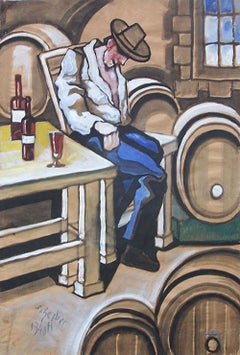
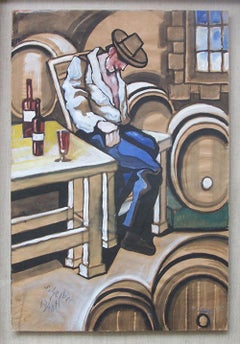
At the Winery - Hungarian Art

At the Winery - Hungarian Art

By Hugó Scheiber

Located in London, GB

This original painting is hand signed by the artist "Scheiber H" in the lower left corner, and dated "1940" below the signature. Exhibited: Hugo Scheiber - Bela Kadar, Galerie Le Mi...

Category

1940s Hugó Scheiber Figurative Paintings

Materials

Tempera, Gouache
Related Items
At the Beach - Tempera and Watercolor by Aldo Riso - 1970s

At the Beach - Tempera and Watercolor by Aldo Riso - 1970s

By Aldo Riso

Located in Roma, IT

At the beach is an artwork realized by Aldo Riso. Mixed colored tempera and watercolor painting. Titled on lower left. Frame included: 70.5 x 91.5 cm This beautiful mixed media...

Category

1970s Contemporary Hugó Scheiber Figurative Paintings

Materials

Tempera, Watercolor

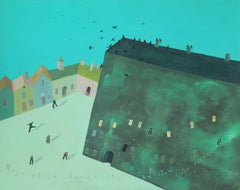
The biggest house in town - Figurative Gouache Painting, Landscape, Architecture

The biggest house in town - Figurative Gouache Painting, Landscape, Architecture

By Piotr Fąfrowicz

Located in Warsaw, PL

PIOTR FĄFROWICZ (born in 1958). He studied art history at the Catholic University of Lublin. He deals with painting and graphic design. Winner of numerous awards for illustrations, i...

Category

21st Century and Contemporary Other Art Style Hugó Scheiber Figurative Paintings

Materials

Paper, Tempera, Gouache

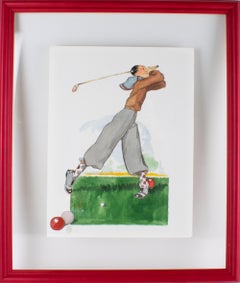
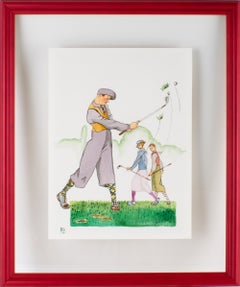
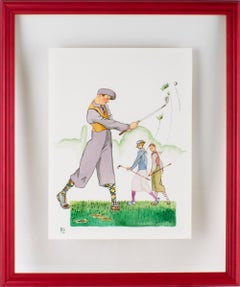
French Art Deco Golf Illustration Watercolor Drawing After René Vincent

French Art Deco Golf Illustration Watercolor Drawing After René Vincent

By Rene Vincent

Located in Atlanta, GA

A striking Art Deco watercolor created after an original design by René Vincent (1879-1936), this lively golfing scene captures the playful elegance and graphic charm associated with...

Category

1920s Art Deco Hugó Scheiber Figurative Paintings

Materials

Parchment Paper, Ink, Watercolor

Modern Dancers
Modern Dancers

Mick MicheylModern Dancers, 1964

$1,373Sale Price|50% Off

H 29.53 in W 24.02 in

Modern Dancers

By Mick Micheyl

Located in London, GB

'Modern Dancers', pastel, ink and gouache on fine art paper by French artist, singer and sculptor, Mick Micheyl (1964). Two elegant young men are depicted in a graceful dancing pose, arms outstretched, their lithe bodies so agile and limber. Perhaps one of the dancers was her friend, Philippe, to whom the painting is dedicated on the bottom. The dedication says: 'For you Philippe, all my friendship'. Signed: 'Mick Micheyl'. The work has been newly framed and glazed after having been acquired in the S. of France. It is in good vintage condition commensurate with age showing minor blemishing on the paper. Upon request a video of the piece can be provided. Dimensions with Frame: H 75 cm / 29.5" W 61 cm / 24" Dimensions without Frame: H 56 cm / 22" W 42 cm / 16.5" About the Artist: Mick Micheyl (1922 - 2019) was born in Lyon and had a busy and rewarding artistic career as a singer, producer, reviewer, metal sculptor, artist. After having received training at the School of Fine Arts in Lyon she became a painter and decorator in the theatre but then commenced a career in the musical activities of a theatrical troupe. She won the ABC competition in Paris in 1949 with a song, Le Marchand de Poésie, which she composed herself. She then performed in many cabarets: L'Échelle de Jacob, Harlequin and Liberty's. In the 1950s she was one of the most important French cabaret singers of that period. One of her titles, 'Un Gamin de Paris', became one of the French standards and also performed by Yves Montand and Robert Clary...

Category

1960s Modern Hugó Scheiber Figurative Paintings

Materials

Paper, Pastel, Ink, Gouache

Godzilla like Dinosaur Monster, SciFi, Science Fiction Cover Illustration

Godzilla like Dinosaur Monster, SciFi, Science Fiction Cover Illustration

By Paul Wenzel

Located in Miami, FL

Beautiful Godzilla-like monster illustration from 1961. Wenzel was a prolific Disney Artist for decades. The work is beautifully matted and framed and looks better in person. Sign...

Category

1960s American Modern Hugó Scheiber Figurative Paintings

Materials

Mixed Media, Gouache, Tempera, Illustration Board

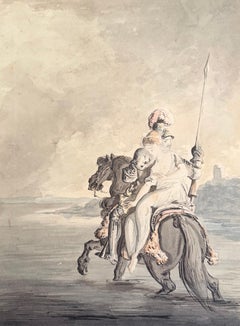
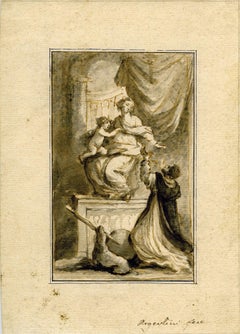
Neoclassical composition of a sculptor kneeling before his statue of the Madonna

Neoclassical composition of a sculptor kneeling before his statue of the Madonna

Located in Middletown, NY

An allegory of loyalty, with the subject's dog pictured seated, holding his master's chisel in his mouth; fidelity personified. Italian School, 18th century Ink wash in gray and bl...

Category

Mid-18th Century Italian School Hugó Scheiber Figurative Paintings

Materials

Laid Paper, Ink, Watercolor

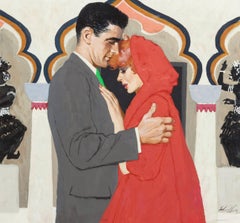
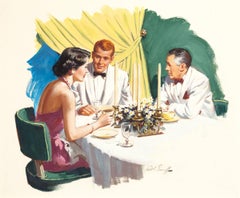
The Head and the Heart, American Magazine Story Illustration

The Head and the Heart, American Magazine Story Illustration

By Arthur Sarnoff

Located in Fort Washington, PA

Date: 1951 Medium: Gouache and Tempera on Board Dimensions: 10.25" x 12.50" Signature: Signed Lower Right The Head and the Heart, American Magazine story illustration, September 1951

Category

1950s Hugó Scheiber Figurative Paintings

Materials

Tempera, Gouache, Board

Martinique F.W.I

Lloyd NeyMartinique F.W.I

$14,500

H 21.75 in W 14.75 in

Martinique F.W.I

Located in Bryn Mawr, PA

Signed lower left: Martinique F.W.I. / NEY Provenance Private collection Lloyd Ney was an American painter and member of the “New Hope Modernist School.” Born in Pennsylvania in 18...

Category

20th Century Modern Hugó Scheiber Figurative Paintings

Materials

Tempera, Watercolor, Pencil

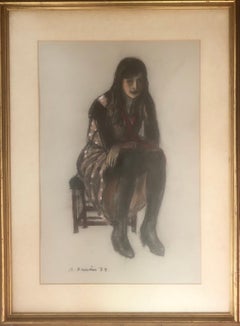
Sit woman pastel drawing

Rafael Duran BenetSit woman pastel drawing, 1979

$450Sale Price|32% Off

H 24.41 in W 16.54 in

Sit woman pastel drawing

By Rafael Duran Benet

Located in Sitges, Barcelona

Rafael Duran Benet (1931-2015) - Sit woman - Pastel Drawing measurements 62x42 cm. Frame measurements 82x62 cm. Rafael Duran Benet (Terrassa, 1931 - Barcelona, 2015) is a Catalan painter...

Category

1970s Post-Impressionist Hugó Scheiber Figurative Paintings

Materials

Pastel

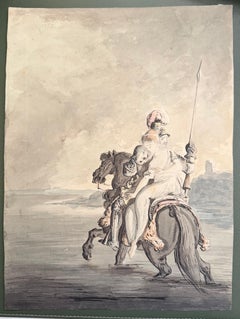
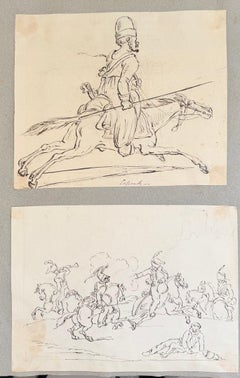
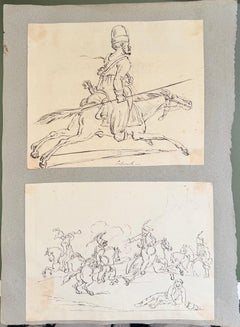
Fine English School Ink & Watercolor Man Carrying Table with Knives in Battle

Fine English School Ink & Watercolor Man Carrying Table with Knives in Battle

Located in Cirencester, Gloucestershire

1780's-1800 Fine English School Ink & Watercolor Man Carrying Table with Knives Piercing Top Dramatic Figure Study Late 18th / Early 19th Century English School circa 1780–1800 ink d...

Category

Mid-20th Century English School Hugó Scheiber Figurative Paintings

Materials

Ink, Watercolor

Self Portrait - Contemporary Figurative Watercolor Painting, New Expressionism

Self Portrait - Contemporary Figurative Watercolor Painting, New Expressionism

By Maciej Olekszy

Located in Salzburg, AT

The artwork on paper will be sent unframed to you. Maciej Olekszy was born in 1982, Poland. Graduated from the Academy of Fine Arts in Poznan, Poland in 2007. Faculty of Painting i...

Category

2010s Contemporary Hugó Scheiber Figurative Paintings

Materials

Paper, Watercolor

Previously Available Items
Rare Modernist Hungarian Rabbi Pastel Drawing Gouache Painting Judaica Art Deco

Rare Modernist Hungarian Rabbi Pastel Drawing Gouache Painting Judaica Art Deco

By Hugó Scheiber

Located in Surfside, FL

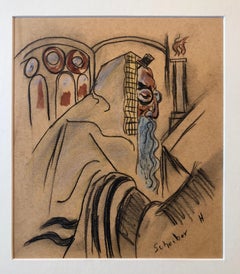
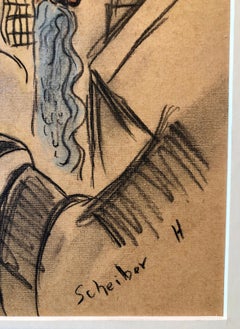
Rabbi in the synagogue at prayer wearing tallit and tefillin. Hugó Scheiber (born 29 September 1873 in Budapest – died there 7 March 1950) was a Hungarian modernist painter. Hugo Scheiber was brought from Budapest to Vienna at the age of eight where his father worked as a sign painter for the Prater Theater. At fifteen, he returned with his family to Budapest and began working during the day to help support them and attending painting classes at the School of Design in the evening, where Henrik Papp was one of his teachers. He completed his studies in 1900. His work was at first in a post-Impressionistic style but from 1910 onward showed his increasing interest in German Expressionism and Futurism. This made it of little interest to the conservative Hungarian art establishment. However, in 1915 he met the great Italian avant-gardist Filippo Tommaso Marinetti and the two painters became close friends. Marinetti invited him to join the Futurist Movement. The uniquely modernist style that he developed was, however, closer to German Expressionism than to Futurism and eventually drifted toward an international art deco manner similar to Erté's. In 1919, he and his friend Béla Kádar held an exhibition at the Hevesy Salon in Vienna. It was a great success and at last caused the Budapest Art Museum to acquire some of Scheiber's drawings. Encouraged, Scheiber came back to live in Vienna in 1920. A turning point in Scheiber's career came a year later, when Herwarth Walden, founder of Germany's leading avant-garde periodical, Der Sturm, and of the Sturm Gallery in Berlin, became interested in Scheiber's work. Scheiber moved to Berlin in 1922, and his paintings soon appeared regularly in Walden's magazine and elsewhere. Exhibitions of his work followed in London, Rome, La Paz, and New York. Scheiber's move to Germany coincided with a significant exodus of Hungarian artists to Berlin, including Laszlo Moholy-Nagy and Sandor Bortnyik. There had been a major split in ideology among the Hungarian avant-garde. The Constructivist and leader of the Hungarian avantgarde, Lajos Kassák (painted by Hugó Scheiber in 1930) believed that art should relate to all the needs of contemporary humankind. Thus he refused to compromise the purity of his style to reflect the demands of either the ruling class or socialists and communists. The other camp believed that an artist should be a figurehead for social and political change. The fall out and factions that resulted from this politicisation resulted in most of the Hungarian avant gardists leaving Vienna for Berlin. Hungarian émigrés made up one of the largest minority groups in the German capital and the influx of their painters had a significant effect on Hungarian and international art. Another turning point of Scheiber's career came in 1926, with the New York exhibition of the Société Anonyme, organized by Katherine Dreier. Scheiber and other important avant garde artists from more than twenty-three countries were represented. In 1933, Scheiber was invited by Marinetti to participate in the great meeting of the Futurists held in Rome in late April 1933, Mostra Nazionale d’Arte Futurista where he was received with great enthusiasm. Gradually, the Hungarian artists began to return home, particularly with the rise of Nazism in Germany. Kádar went back from Berlin in about 1932 and Scheiber followed in 1934. He was then at the peak of his powers and had a special flair in depicting café and cabaret life in vivid colors, sturdily abstracted forms and spontaneous brush strokes. Scheiber depicted cosmopolitan modern life using stylized shapes and expressive colors. His preferred subjects were cabaret and street scenes, jazz musicians, flappers, and a series of self-portraits (usually with a cigar). his principal media being gouache and oil. He was a member of the prestigious New Society of Artists (KUT—Képzőművészek Új Társasága)and seems to have weathered Hungary's post–World War II transition to state-communism without difficulty. He continued to be well regarded, eventually even receiving the posthumous honor of having one of his images used for a Russian Soviet postage stamp (see image above). Hugó Scheiber died in Budapest in 1950. Paintings by Hugó Scheiber form part of permanent museum collections in Budapest (Hungarian National Museum), Pecs (Jannus Pannonius Museum), Vienna, New York, Bern and elsewhere. His work has also been shown in many important exhibitions, including: "The Nell Walden Collection," Kunsthaus Zürich (1945) "Collection of the Société Anonyme," Yale University Art Gallery, New Haven, Connecticut (1950) "Hugó Scheiber: A Commemorative Exhibition," Hungarian National Museum, Budapest (1964) "Ungarische Avantgarde," Galleria del Levante, Munich (1971) "Paris-Berlin 1900-1930," Centre Georges Pompidou, Paris (1978) "L’Art en Hongrie, 1905-1920," Musée d’Art et l’Industrie, Saint-Etienne (1980) "Ungarische Avantgarde in der Weimarer Republik," Marburg (1986) "Modernizmus," Eresz & Maklary Gallery, Budapest (2006) "Hugó Scheiber & Béla Kádár," Galerie le Minotaure, Paris and Tel Aviv (2007) Hugó Scheiber's paintings continue to be regularly sold at Sotheby's, Christie's, Gillen's Arts (London), Papillon Gallery (Los Angeles) and other auction houses. He was included in the exhibition The Art Of Modern Hungary 1931 and other exhibitions along with Vilmos Novak Aba, Count Julius Batthyany, Pal Bor, Bela Buky, Denes Csanky, Istvan Csok, Bela Czobel, Peter Di Gabor, Bela Ivanyi Grunwald, Baron Ferenc Hatvany, Lipot Herman, Odon Marffy, C. Pal Molnar...

Category

Early 20th Century Modern Hugó Scheiber Figurative Paintings

Materials

Paper, Pastel, Watercolor, Gouache, Charcoal

Hugó Scheiber figurative paintings for sale on 1stDibs.

Find a wide variety of authentic Hugó Scheiber figurative paintings available for sale on 1stDibs. You can also browse by medium to find art by Hugó Scheiber in paint, gouache, watercolor and more. Much of the original work by this artist or collective was created during the 20th century and is mostly associated with the Expressionist style. Not every interior allows for large Hugó Scheiber figurative paintings, so small editions measuring 13 inches across are available. Customers who are interested in this artist might also find the work of Jack Levine, Charles Kvapil, and Louis Bosa. Hugó Scheiber figurative paintings prices can differ depending upon medium, time period and other attributes. On 1stDibs, the price for these items starts at $5,500 and tops out at $28,076, while the average work can sell for $9,359.