By Jean Target 1
Located in San Francisco, CA
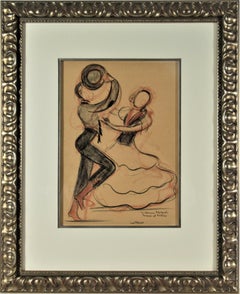
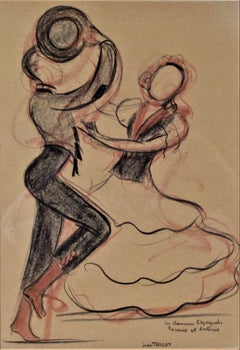
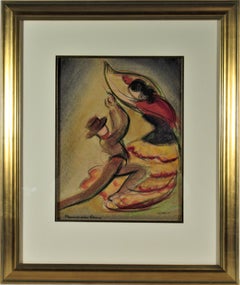
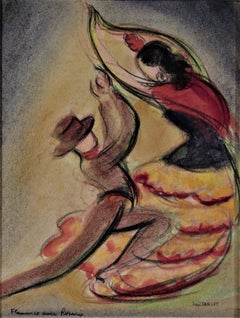
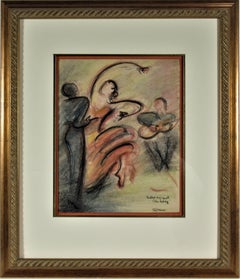
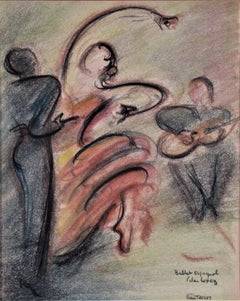
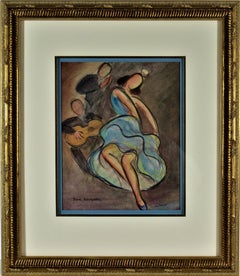
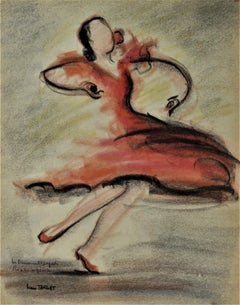
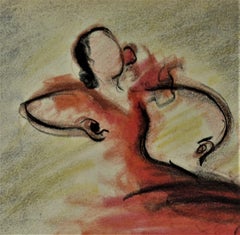
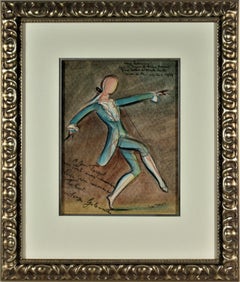
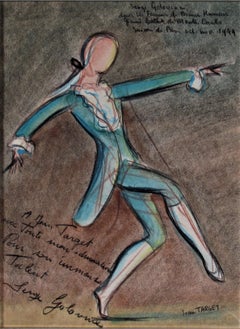
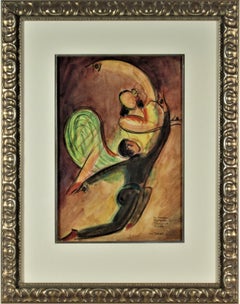
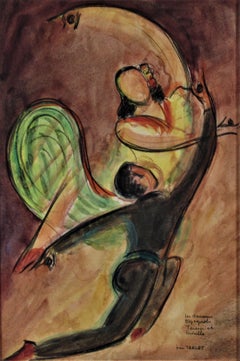
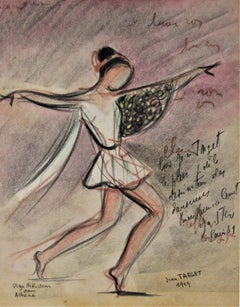
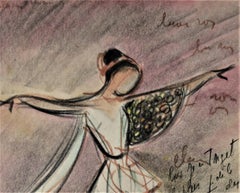
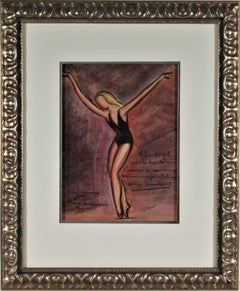
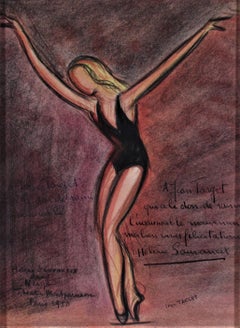
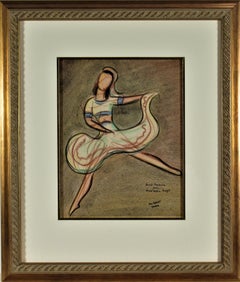
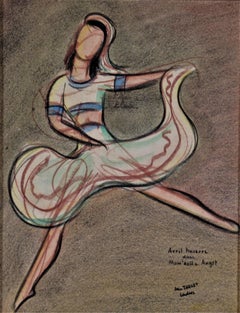
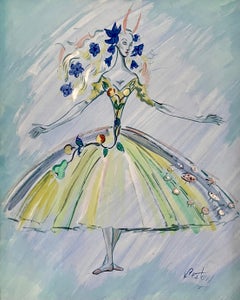
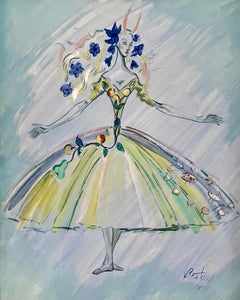
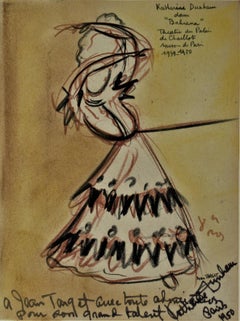
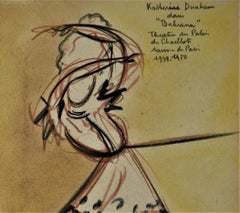
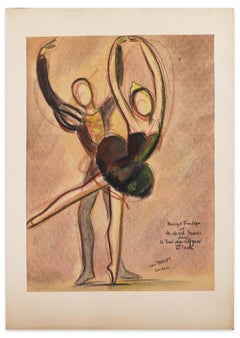
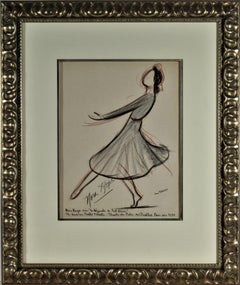
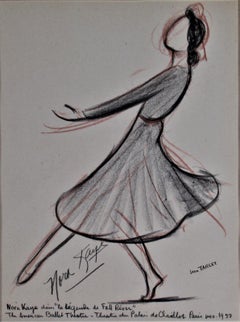
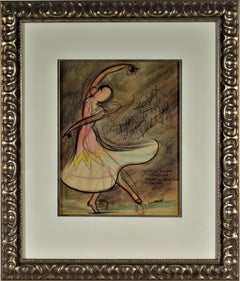
This artwork titled "Nora Kaye, Dans la Legende de Fall River, The American Ballet Theatre du Palais de Chaillot, Paris 1950" Referring to the famous American ballet dancer Nora Kaye 1920-1987, is a pastel and crayon on paper by noted French artist Jean Target, 1910-1997 It is signed, dated and titled at the lower middle by the artist, also signed by Nora Kaye. The artwork size is 11.75 x 9.25 inches, framed is 21.75 x 18.25 inches. it is beautifully custom framed in a wooden silver frame, with matting and silver color spacer. it is in excellent condition, the colors are fresh and bright.
About the artist.
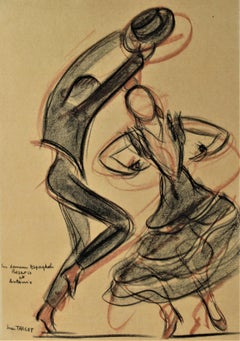
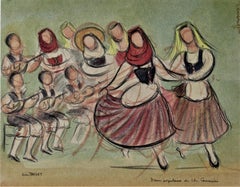
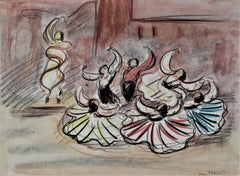
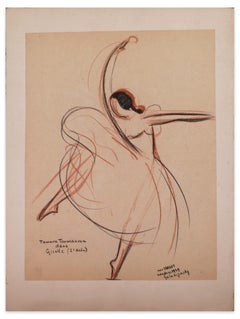
Jean Target was born in France in 1910. From a very young age early on, he was impassioned by the two forms of art that would remain the focal point of his career for all his life: visual arts and performing arts. In the 30s and 40s, as a young man, Jean Target frequented the Parisian theaters and cabarets, just like his role model, the famous impressionist painter Toulouse Lautrec, did at the end of the 19th century. Jean became friends with many performers and captured many formal as well as candid depictions. He gained exclusive access and used this privilege to create art with unparalleled perspective as an insider to the seedy, dark, yet glamorous underworld of Parisian cabaret. He drew the dancers on-site, capturing the dancer’s movements in his immediately recognizable signature style. In the 40s and 50s, he continued his artistic career, gaining recognition among collectors in France and all over Europe. His work depicting the Parisian performing art scene captures the feeling and history of the the theater and golden age of cabaret in Paris. Jean Target continued to draw, paint and sculpt until his death in 1997. The work of Jean Target is held in collections and museums worldwide including the world renowned Victoria And Albert Museum in London.
About the subject.
Nora Kaye, original name Nora Koreff, (born Jan. 17, 1920, New York, N.Y., U.S.—died Feb. 28, 1987, Los Angeles, Calif.), American dramatic ballerina, called the “Duse of the Dance.” Miss Kaye was one of the foremost ballerinas of her time. Although she danced many classical roles, she became known for creating a new contemporary look among dancers, especially in Antony Tudor's dance-dramas in the 1940's and 1950's. In an era when ballet was considered a Russian art, Miss Kaye remained steadfastly an American dancer. Her last name was originally Koreff, but she changed it to Kaye because ''an American dancer ought to have an American name,'' as she put it. Called the ''Duse of the dance,'' Miss Kaye excelled in dramatic roles. The world premiere by Ballet Theater, now American Ballet Theater, of Mr. Tudor's psychological ballet ''Pillar of Fire'' catapulted her to stardom in 1942. Symbol of Tenacity and Vigor Mikhail Baryshnikov, Ballet Theater's current artistic director, said of the ballerina: ''She was undoubtedly a great woman of the theater and a symbol to any dancer of tenacity, vigor and what it means to be a great star. Everyone in the dance world mourns her and is sad today.'' Miss Kaye was a charter member of Ballet Theater from the company's first year, 1939. There she worked with Mr. Tudor, one of the company's choreographers and teachers, who revealed ballet to her as an expressive art. During Ballet Theater's first New York season early in 1940, she danced in the chorus of several Tudor ballets. The choreographer offered Miss Kaye her first important dramatic or character role, that of the Russian ballerina in his comic ballet ''Gala Performance,'' for its premiere in February 1941. But it was her portrayal of the sexually repressed Hagar in ''Pillar o Fire,'' that raised Miss Kaye to the status of prima ballerina and helped make her one of the best-known American ballerinas in the world. Reviewing the ballet at its premiere in April 1942, John Martin, then dance critic of The New York Times, rated Miss Kaye's characterization as among ''the great examples of tragic acting of its generation.'' 'I Wanted to Extend Myself' By 1943, Miss Kaye was dancing most of the lead female roles in the Ballet Theater repertory. She performed with the company through 1951, when she left todance with the New York City Ballet. She was not well suited to the City Ballet style, however. though she had notable triumphs, among them her portrayal of the man-killing Novice in ''The Cage,'' which Jerome Robbins created for her. ''I wanted to extend myself,'' she said in 1977 of her years with City Ballet, ''but I was wrong for it.'' She returned to Ballet Theater in 1954 and danced with the company until 1959. She retired from the stage in 1961. Miss Kaye was known as a Tudor ballerina, but she danced ballets by many other contemporary choreographers, including Jerome Robbins, George Balanchine, Valerie Bettis, Kenneth MacMillan, John Taras and Herbert Ross, whom she married in 1959. Born in New York City, and named after the heroine of ''A Doll's House,'' Miss Kaye was exposed at an early age to Stanislavskian acting by her father, Gregory Koreff, a former actor with the Moscow Art Theater. She began studying dance at the age of 5, working with the celebrated choreographer Michel Fokine. At 8, Miss Kaye entered Margaret Curtis...
Category
Mid-20th Century Realist Jean Target Art