Joan Gardy Artigas Art

French, b. 1949

Joan Gardy Artigas is a Catalan ceramist, artist and was a close collaborator with Joan Miró. Artigas was born on June 18th, 1938 in Boulogne-Billancourt (near Paris) and his father was Josep Llorens i Artigas, who worked closely with Miró and Pablo Picasso. Artigas was able to work for Miró while still a teenager because of his father's relationship with Miró. Artigas trained at the École des beaux-arts in Paris, where he met the Swiss sculptor Alberto Giacometti. Artigas established his studio, and at Giacometti's suggestion, he concentrated on sculpture. Artigas had some success and shared his expertise with the Cubists Georges Braque and Marc Chagall. When Artigas created the 7,200 tiles for the Miró Wall, he coloured the tiles based on an image that Miró had created. Artigas later returned to assisting Miró when his father decided to retire. His father had worked with Miró for 20 years, creating large murals including examples for UNESCO, IBM and the Palacio de Exposiciones y Congresos in Madrid.

Artigas worked with Miró on, Dona i Ocell, one of his last large works, which was covered in broken tiles by Artigas. In this case, the tiles remind the viewer of Gaudi's work. In 1982, Antoni Tàpies won the Gold Medal of Catalonia for a mosaic in the Plaça de Catalunya in Sant Boi de Llobregat. Artigas had constructed the ceramics for this prize-winning exhibit. Artigas continued his art, and he was awarded his first solo exhibition in America in 1982. He has been a visiting artist at two American universities and has started a foundation to celebrate his father's work. Artigas serves on the board of the foundation Fundació Joan Miró in Barcelona.

to
1
5
4
9
5
3
3
2
1
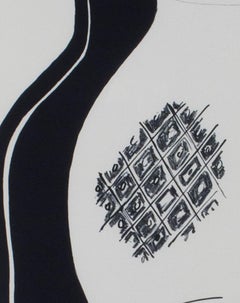
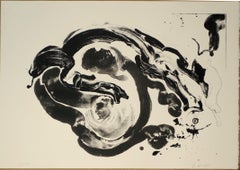
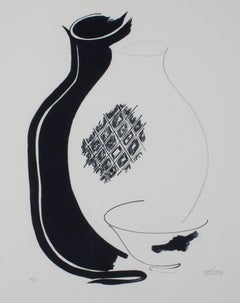
"Two Bottles & Bowl, " Original Black & White Litho. signed by Joan Gardy Artigas

"Two Bottles & Bowl, " Original Black & White Litho. signed by Joan Gardy Artigas

By Joan Gardy Artigas

Located in Milwaukee, WI

"Two Bottles & Bowl" is an original lithograph by Joan Gardy Artigas. It depicts a still life in black and white. The artist signed the piece lower right and wrote the edition number...

Category

Mid-20th Century Abstract Expressionist Joan Gardy Artigas Art

Materials

Lithograph

original lithograph

original lithograph

By Joan Gardy Artigas

Located in Henderson, NV

Medium: original lithograph. Printed in 1982 for the art revue Derriere le Miroir (issue number 250, dedicated in homage to Aime and Marguerite Maeght) and published in Paris by the ...

Category

1980s Joan Gardy Artigas Art

Materials

Lithograph

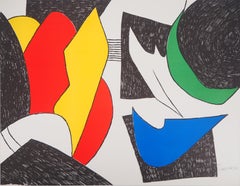
Hotchpotch - Original Handsigned Lithograph

Hotchpotch - Original Handsigned Lithograph

By Joan Gardy Artigas

Located in Paris, IDF

Joan Gardy Artigas Hotchpotch Original Lithograph Handsigned Justified H.C (Hors Commerce) On Velum 59 x 76 m (c. 24 x 30 inch) Excellent Condition

Category

1970s Modern Joan Gardy Artigas Art

Materials

Lithograph

'Chamonix' Mid-Century Hand Signed Original Lithograph.

'Chamonix' Mid-Century Hand Signed Original Lithograph.

By Joan Gardy Artigas

Located in Cotignac, FR

Mid-Century original lithograph entitled " Chamonix " hand signed by Joan Gardy Artigas and numbered 12/75 on arches vellum rag paper from the 1966-70 edition. Presented in period 19...

Category

Mid-20th Century Abstract Joan Gardy Artigas Art

Materials

Printer's Ink, Rag Paper, Lithograph

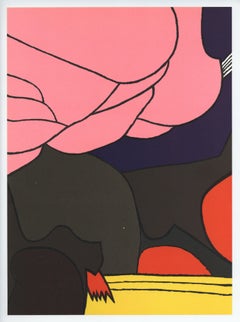
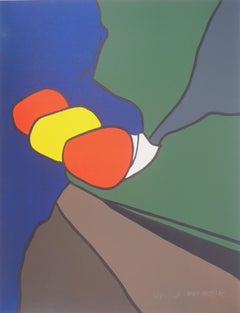
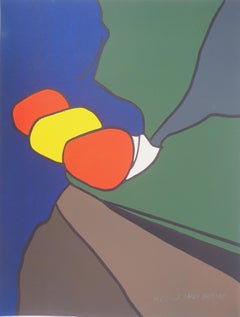
Joan Gardy Artigas, Untitled, from Derriere le Miroir, 1982

Joan Gardy Artigas, Untitled, from Derriere le Miroir, 1982

By Joan Gardy Artigas

Located in Southampton, NY

This exquisite lithograph by Joan Gardy Artigas (born 1938), titled Sans titre (Untitled), originates from the historic 1982 folio Derriere le Miroir, No. 250, Hommage a Aime et Marg...

Category

1980s Pop Art Joan Gardy Artigas Art

Materials

Lithograph

Love Interest - Original Lithograph, handsigned

Love Interest - Original Lithograph, handsigned

By Joan Gardy Artigas

Located in Paris, IDF

Joan Gardy Artigas Love Interest, c. 1977 Original Lithograph Handsigned Justified H.C (Hors Commerce) On Velum 75.5 x 35.5cm (c. 29.5x 13.6inch) Excellent Condition

Category

1970s Abstract Joan Gardy Artigas Art

Materials

Lithograph

Intimacy - Original Handsigned Lithograph

Intimacy - Original Handsigned Lithograph

By Joan Gardy Artigas

Located in Paris, IDF

Joan Gardy Artigas Intimacy Original Lithograph Handsigned in Pencil Justified H.C (Hors Commerce) On Velum 65x 50cm (c. 25.5x 19.6inch) Excellent C...

Category

1970s Modern Joan Gardy Artigas Art

Materials

Lithograph

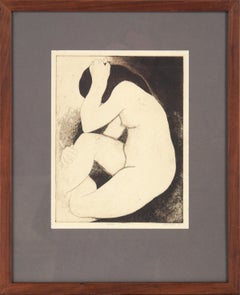
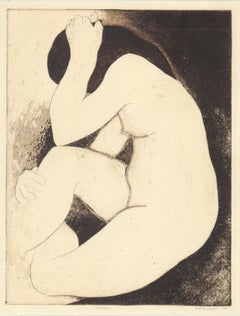
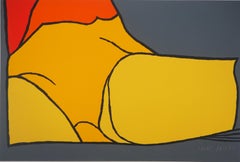
Female Form, Abstract Nude Screenprint by Joan Gardy Artigas

Female Form, Abstract Nude Screenprint by Joan Gardy Artigas

By Joan Gardy Artigas

Located in Long Island City, NY

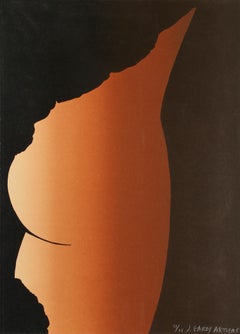
Artist: Joan Gardy Artigas, Spanish (1938 - ) Title: Untitled Year: circa 1960 Medium: Screenprint, Signed and numbered in pencil Edition: 72/75 Size: 24 in. x 17 in. (60.96 cm x 43...

Category

1960s Pop Art Joan Gardy Artigas Art

Materials

Screen

Singapore Singapour Original Modernist Lithograph on Arches vellum

Singapore Singapour Original Modernist Lithograph on Arches vellum

By Joan Gardy Artigas

Located in Surfside, FL

Original lithograph, handsigned and numbered HC On Arches vellum ragpaper Dimensions : 69 x 54,5 cm (27.2 x 21.5 inches) Joan Gardy Artigas (born 1938) is a Catalan ceramist, artist...

Category

20th Century Modern Joan Gardy Artigas Art

Materials

Lithograph

Related Items
Newman, Sans titre, In Memory of My Feelings (after)

Newman, Sans titre, In Memory of My Feelings (after)

By Barnett Newman

Located in Southampton, NY

Lithograph on vélin Mohawk Superfine Smooth paper. Paper Size: 11.937 x 8.96 inches. Inscription: Signed in the plate and unnumbered, as issued. Notes: From the folio, In Memory of M...

Category

1960s Abstract Expressionist Joan Gardy Artigas Art

Materials

Lithograph

La Partie de Campagne

La Partie de Campagne

By Fernand Léger

Located in Paris, FR

Lithograph, 1952 Handsigned by the artist in pencil and numbered 6/75 Publisher : Maeght (Paris) Printer : Mourlot (Paris) Catalog : Saphire E 14 37.00 cm. x 55.50 cm. 14.57 in. x 2...

Category

1950s Abstract Joan Gardy Artigas Art

Materials

Lithograph

Joan Miro (Plate 4)
Joan Miro (Plate 4)

Joan MiróJoan Miro (Plate 4), 1956

$795

H 15.5 in W 14.25 in

Joan Miro (Plate 4)

By Joan Miró

Located in Washington, DC

Artist: Joan Miro Title: Joan Miro (Plate 4) Portfolio: Joan Miro Medium: Original lithograph Year: 1956 Edition: Unnumbered Frame Size: 15 1/2" x 14 1/4" Sheet Size: 9" x 7 1/2" Sig...

Category

1950s Abstract Joan Gardy Artigas Art

Materials

Lithograph

"Un Apres Midi au Champs de Courses, " Original Color Lithograph signed by Batet

"Un Apres Midi au Champs de Courses, " Original Color Lithograph signed by Batet

By Francois Batet

Located in Milwaukee, WI

"Un Apres Midi au Champs de Courses" is an original color lithograph by Francois Batet. The artist signed the piece in the lower right and wrote the edition number (11/200) in the lo...

Category

1980s Joan Gardy Artigas Art

Materials

Lithograph

She Lay Down Deep Beneath the Sea

She Lay Down Deep Beneath the Sea

By Tracey Emin

Located in London, GB

2012 Offset lithograph in colours on wove paper 80 x 60 cm Signed in black in by Tracey Emin Published by Turner Contemporary Accompanied by a gallery Certificate of Authenticity Tr...

Category

2010s Contemporary Joan Gardy Artigas Art

Materials

Paper, Lithograph, Offset

La Melodie Acide II
La Melodie Acide II

(after) Joan MiróLa Melodie Acide II, 1980

$680

H 25.75 in W 21.5 in D 1.25 in

La Melodie Acide II

By (after) Joan Miró

Located in San Francisco, CA

This artwork titled "La Melodie Acide II" 1980 (printed and published in 1983) is a color lithograph on Guarro paper after Joan Miro 1893-1983. It is si...

Category

Late 20th Century Abstract Joan Gardy Artigas Art

Materials

Lithograph

Charms against harms, Robert Rauschenberg

Charms against harms, Robert Rauschenberg

By Robert Rauschenberg

Located in Fairfield, CT

Artist: Robert Rauschenberg (1925-2008) Title: Charms against harms Year: 1993 Medium: Lithograph on wove paper Edition: H.C. 8/15, 100, plus proofs Size: 40.5 x 28 inches Condition:...

Category

1990s Pop Art Joan Gardy Artigas Art

Materials

Lithograph

19th century color lithograph watercolor landscape figurative animal print

19th century color lithograph watercolor landscape figurative animal print

By Nathaniel Currier

Located in Milwaukee, WI

The present hand-colored lithograph presents the viewer with a hunting scene in a picturesque landscape. In the foreground, a man approaches two partridges as his two pointers prepare to flush them out. Beyond, a white fence draws our eyes to the homestead in the distance. Images like this one show how people in the United States were trying to identify themselves as a new nation in the North American landscape - as separate from their European counterparts but with similar similar and specific wildlife and magesties of nature. It also identifies hunting in this landscape as an American pastime. 9.25 x 12.5 inches, artwork 18.38 x 22 inches, frame Entitled bottom center "Partridge Shooting...

Category

Mid-19th Century Romantic Joan Gardy Artigas Art

Materials

Watercolor, Lithograph

19th century color lithograph figures cemetery willow tree memorial headstone

19th century color lithograph figures cemetery willow tree memorial headstone

By Nathaniel Currier

Located in Milwaukee, WI

The present hand-colored lithograph was produced as part of the funeral and mourning culture in the United States during the 19th century. Images like this were popular as ways of remembering loved ones, an alternative to portraiture of the deceased. This lithograph shows a man, woman and child in morning clothes next to an urn-topped stone monument. Behind are additional putto-topped headstones beneath weeping willows, with a steepled church beyond. The monument contains a space where a family could inscribe the name and death dates of a deceased loved one. In this case, it has been inscribed to a young Civil War soldier: William W. Peabody Died at Fairfax Seminary, VA December 18th, 1864 Aged 18 years The young Mr. Peabody probably died in service for the Union during the American Civil War. Farifax Seminary was a Union hospital and military headquarters in Alexandria, Virginia. The hospital served nearly two thousand soldiers during the war time. Five hundred were also buried on the Seminary's grounds. 13.75 x 9.5 inches, artwork 23 x 19 inches, frame Published before 1864 Inscribed bottom center "Lith. & Pub. by N. Currier. 2 Spruce St. N.Y." Framed to conservation standards using 100 percent rag matting and TruVue Conservation Clear glass, housed in a gold gilded moulding. Nathaniel Currier was a tall introspective man with a melancholy nature. He could captivate people with his piercing stare or charm them with his sparkling blue eyes. Nathaniel was born in Roxbury, Massachusetts on March 27th, 1813, the second of four children. His parents, Nathaniel and Hannah Currier, were distant cousins who lived a humble yet spartan life. When Nathaniel was eight years old, tragedy struck. Nathaniel’s father unexpectedly passed away leaving Nathaniel and his eleven-year-old brother Lorenzo to provide for the family. In addition to their mother, Nathaniel and Lorenzo had to care for six-year-old sister Elizabeth and two-year-old brother Charles. Nathaniel worked a series of odd jobs to support the family, and at fifteen, he started what would become a life-long career when he apprenticed in the Boston lithography shop of William and John Pendleton. A Bavarian gentleman named Alois Senefelder invented lithography just 30 years prior to young Nat Currier’s apprenticeship. While under the employ of the brothers Pendleton, Nat was taught the art of lithography by the firm’s chief printer, a French national named Dubois, who brought the lithography trade to America. Lithography involves grinding a piece of limestone flat and smooth then drawing in mirror image on the stone with a special grease pencil. After the image is completed, the stone is etched with a solution of aqua fortis leaving the greased areas in slight relief. Water is then used to wet the stone and greased-ink is rolled onto the raised areas. Since grease and water do not mix, the greased-ink is repelled by the moisture on the stone and clings to the original grease pencil lines. The stone is then placed in a press and used as a printing block to impart black on white images to paper. In 1833, now twenty-years old and an accomplished lithographer, Nat Currier left Boston and moved to Philadelphia to do contract work for M.E.D. Brown, a noted engraver and printer. With the promise of good money, Currier hired on to help Brown prepare lithographic stones of scientific images for the American Journal of Sciences and Arts. When Nat completed the contract work in 1834, he traveled to New York City to work once again for his mentor John Pendleton, who was now operating his own shop located at 137 Broadway. Soon after the reunion, Pendleton expressed an interest in returning to Boston and offered to sell his print shop to Currier. Young Nat did not have the financial resources to buy the shop, but being the resourceful type he found another local printer by the name of Stodart. Together they bought Pendleton’s business. The firm ‘Currier & Stodart’ specialized in "job" printing. They produced many different types of printed items, most notably music manuscripts for local publishers. By 1835, Stodart was frustrated that the business was not making enough money and he ended the partnership, taking his investment with him. With little more than some lithographic stones, and a talent for his trade, twenty-two year old Nat Currier set up shop in a temporary office at 1 Wall Street in New York City. He named his new enterprise ‘N. Currier, Lithographer’ Nathaniel continued as a job printer and duplicated everything from music sheets to architectural plans. He experimented with portraits, disaster scenes and memorial prints, and any thing that he could sell to the public from tables in front of his shop. During 1835 he produced a disaster print Ruins of the Planter's Hotel, New Orleans, which fell at two O’clock on the Morning of the 15th of May 1835, burying 50 persons, 40 of whom Escaped with their Lives. The public had a thirst for newsworthy events, and newspapers of the day did not include pictures. By producing this print, Nat gave the public a new way to “see” the news. The print sold reasonably well, an important fact that was not lost on Currier. Nat met and married Eliza Farnsworth in 1840. He also produced a print that same year titled Awful Conflagration of the Steamboat Lexington in Long Island Sound on Monday Evening, January 18, 1840, by which melancholy occurrence over One Hundred Persons Perished. This print sold out very quickly, and Currier was approached by an enterprising publication who contracted him to print a single sheet addition of their paper, the New York Sun. This single page paper is presumed to be the first illustrated newspaper ever published. The success of the Lexington print launched his career nationally and put him in a position to finally lift his family up. In 1841, Nat and Eliza had their first child, a son they named Edward West Currier. That same year Nat hired his twenty-one year old brother Charles and taught him the lithography trade, he also hired his artistically inclined brother Lorenzo to travel out west and make sketches of the new frontier as material for future prints. Charles worked for the firm on and off over the years, and invented a new type of lithographic crayon which he patented and named the Crayola. Lorenzo continued selling sketches to Nat for the next few years. In 1843, Nat and Eliza had a daughter, Eliza West Currier, but tragedy struck in early 1847 when their young daughter died from a prolonged illness. Nat and Eliza were grief stricken, and Eliza, driven by despair, gave up on life and passed away just four months after her daughter’s death. The subject of Nat Currier’s artwork changed following the death of his wife and daughter, and he produced many memorial prints and sentimental prints during the late 1840s. The memorial prints generally depicted grief stricken families posed by gravestones (the stones were left blank so the purchasers could fill in the names of the dearly departed). The sentimental prints usually depicted idealized portraits of women and children, titled with popular Christian names of the day. Late in 1847, Nat Currier married Lura Ormsbee, a friend of the family. Lura was a self-sufficient woman, and she immediately set out to help Nat raise six-year-old Edward and get their house in order. In 1849, Lura delivered a son, Walter Black Currier, but fate dealt them a blow when young Walter died one year later. While Nat and Lura were grieving the loss of their new son, word came from San Francisco that Nat’s brother Lorenzo had also passed away from a brief illness. Nat sank deeper into his natural quiet melancholy. Friends stopped by to console the couple, and Lura began to set an extra place at their table for these unexpected guests. She continued this tradition throughout their lives. In 1852, Charles introduced a friend, James Merritt Ives, to Nat and suggested he hire him as a bookkeeper. Jim Ives was a native New Yorker born in 1824 and raised on the grounds of Bellevue Hospital where his father was employed as superintendent. Jim was a self-trained artist and professional bookkeeper. He was also a plump and jovial man, presenting the exact opposite image of his new boss. Jim Ives met Charles Currier through Caroline Clark, the object of Jim’s affection. Caroline’s sister Elizabeth was married to Charles, and Caroline was a close friend of the Currier family. Jim eventually proposed marriage to Caroline and solicited an introduction to Nat Currier, through Charles, in hopes of securing a more stable income to support his future wife. Ives quickly set out to improve and modernize his new employer’s bookkeeping methods. He reorganized the firm’s sizable inventory, and used his artistic skills to streamline the firm’s production methods. By 1857, Nathaniel had become so dependent on Jims’ skills and initiative that he offered him a full partnership in the firm and appointed him general manager. The two men chose the name ‘Currier & Ives’ for the new partnership, and became close friends. Currier & Ives produced their prints in a building at 33 Spruce Street where they occupied the third, fourth and fifth floors. The third floor was devoted to the hand operated printing presses that were built by Nat's cousin, Cyrus Currier, at his shop Cyrus Currier & Sons in Newark, NJ. The fourth floor found the artists, lithographers and the stone grinders at work. The fifth floor housed the coloring department, and was one of the earliest production lines in the country. The colorists were generally immigrant girls, mostly German, who came to America with some formal artistic training. Each colorist was responsible for adding a single color to a print. As a colorist finished applying their color, the print was passed down the line to the next colorist to add their color. The colorists worked from a master print displayed above their table, which showed where the proper colors were to be placed. At the end of the table was a touch up artist who checked the prints for quality, touching-in areas that may have been missed as it passed down the line. During the Civil War, demand for prints became so great that coloring stencils were developed to speed up production. Although most Currier & Ives prints were colored in house, some were sent out to contract artists. The rate Currier & Ives paid these artists for coloring work was one dollar per one hundred small folios (a penny a print) and one dollar per one dozen large folios. Currier & Ives also offered uncolored prints to dealers, with instructions (included on the price list) on how to 'prepare the prints for coloring.' In addition, schools could order uncolored prints from the firm’s catalogue to use in their painting classes. Nathaniel Currier and James Merritt Ives attracted a wide circle of friends during their years in business. Some of their more famous acquaintances included Horace Greeley, Phineas T. Barnum, and the outspoken abolitionists Rev. Henry Ward, and John Greenleaf Whittier (the latter being a cousin of Mr. Currier). Nat Currier and Jim Ives described their business as "Publishers of Cheap and Popular Pictures" and produced many categories of prints. These included Disaster Scenes, Sentimental Images, Sports, Humor, Hunting Scenes, Politics, Religion, City and Rural Scenes, Trains, Ships, Fire Fighters, Famous Race Horses, Historical Portraits, and just about any other topic that satisfied the general public's taste. In all, the firm produced in excess of 7500 different titles, totaling over one million prints produced from 1835 to 1907. Nat Currier retired in 1880, and signed over his share of the firm to his son Edward. Nat died eight years later at his summer home 'Lion’s Gate' in Amesbury, Massachusetts. Jim Ives remained active in the firm until his death in 1895, when his share of the firm passed to his eldest son, Chauncey. In 1902, faced will failing health from the ravages of Tuberculosis, Edward Currier sold his share of the firm to Chauncey Ives...

Category

Mid-19th Century Romantic Joan Gardy Artigas Art

Materials

Watercolor, Lithograph

Lotus
Lotus

Angelo SavelliLotus, c. 1965

$1,500

H 26 in W 21.5 in D 1 in

Lotus

By Angelo Savelli

Located in Missouri, MO

Angelo Savelli (1911-1995) "Lotus" c. 1965 Collage and Lithograph Signed, Titled and Numbered Ed. 58/200 Framed Size: approx 26 x 21 inches Image Size: approx. 23 x 19 inches Octob...

Category

1960s Modern Joan Gardy Artigas Art

Materials

Lithograph

Spring 69
Spring 69

Nancy GennSpring 69, 1969

$950

H 23.75 in W 34.65 in D 0.01 in

Spring 69

By Nancy Genn

Located in San Francisco, CA

This artwork titled "Spring 69" 1969 is an original color lithograph by American artist Nancy Genn, b. 1929. It is hand signed, titled and inscribed Artist Proof in pencil by the artist. The size is 23.75 x 34.65 inches. It is in excellent condition, it has very small marks in the back due to tape removal from previous framing, not visible from the front. About the artist: Nancy Genn is an American artist living and working in Berkeley, California known for works in a variety of media, including paintings, bronze sculpture, printmaking, and handmade paper rooted in the Japanese washi paper making tradition Her work explores geometric abstraction, non-objective form, and calligraphic mark making, and features light, landscape, water, and architecture motifs. She is influenced by her extensive travels, and Asian craft, aesthetics and spiritual traditions. Genn's first noted solo exhibition was in 1955 at Gump's Gallery in San Francisco. She received international recognition through her inclusion in French art critic Michel Tapié’s seminal text Morphologie Autre (1960), which cited her as one of the most important exponents of post-war informal art. Her abstract expressionist paintings of this period, continuing through the mid-1970s, featured all-over compositions of colorful layers of gestural brushwork and calligraphic mark making resembling asemic writing. In 1961, Genn began creating bronze sculptures using the lost-wax casting method. Influenced by noted sculptor and family friend Claire Falkenstein, who used open-formed structures in her work, Genn cast forms woven from long grape vine cuttings, and produced vessels, fountains, fire screens, a menorah, a lectern, and, notably, the Cowell Fountain (1966) at UC Santa Cruz. In 1963 her sculptural work was exhibited with Berkeley artists Peter Voulkos and Harold Paris in the influential exhibition Creative Casting curated by Paul J. Smith at the Museum of Contemporary Crafts, New York. Genn was one of the first American artists to express herself through handmade paper, first receiving wide recognition via exhibitions at Susan Caldwell Gallery, New York, beginning in 1977, and in traveling exhibitions with Robert Rauschenberg and Sam Francis. In 1978-1979, supported by the National Endowment for the Arts and Japan Creative Arts Fellowship, she studied papermaking in Japan, visiting local paper craftspeople, working in Shikenjo studio in Saitama Prefecture,[5] and exhibiting her work in Tokyo. She also learned techniques from Donald Farnsworth...

Category

Early 20th Century Abstract Expressionist Joan Gardy Artigas Art

Materials

Lithograph

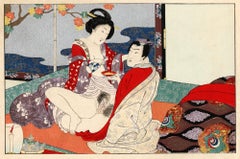
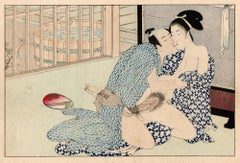
Seishi Ai-oi Genji – Set of 12 Shunga works together w/astrological commentary

Seishi Ai-oi Genji – Set of 12 Shunga works together w/astrological commentary

By Utagawa Kunisada (Toyokuni III)

Located in Middletown, NY

Set of 12 woodblock prints in colors on handmade, laid mulberry paper, 6 3/4 x 10 1/4 inches (170 x 258 mm), printed in Ka-ei 4 (1851). Each print with minor handling wear, otherwise in excellent condition with bright and fresh color, and with details printed in silver ink. The images themselves contain several illusive characters indicating the publisher which are obfuscated by figures, as intended. Presented loose, as issued. A fine set. The astrological commentary print has a large and meandering blind stamp with a bird and palm frond motif. This print lists various phrases concerning the Twelve Zodiac Animals as historically counted in Japan, and appears to include erotic commentary on the traits of people born under each of the twelve signs. These Shunga images were issued in books that paralleled (in an erotic fashion...

Category

Mid-19th Century Edo Joan Gardy Artigas Art

Materials

Ink, Handmade Paper, Woodcut

Previously Available Items
Feminity - Original Handsigned Lithograph

Feminity - Original Handsigned Lithograph

By Joan Gardy Artigas

Located in Paris, IDF

Joan Gardy Artigas Feminity Original Lithograph Handsigned in Pencil Justified H.C (Hors Commerce) On Velum 33x 50cm (c. 13x 19.6inch) Excellent Condition

Category

1970s Modern Joan Gardy Artigas Art

Materials

Lithograph

Joan Gardy Artigas Untitled Abstract Surrealism Serigraph Signed 45/75 Unframed

Joan Gardy Artigas Untitled Abstract Surrealism Serigraph Signed 45/75 Unframed

By Joan Gardy Artigas

Located in Keego Harbor, MI

A bold and bright limited-edition serigraph by modern Spanish artist Joan Gardy Artigas. Hand signed in pencil with an annotation of 45/75 on the bottom right. Artigas was a Catalan ...

Category

20th Century Joan Gardy Artigas Art

Materials

Paper

Joan Gardy Artigas -  Original Lithograph

Joan Gardy Artigas - Original Lithograph

By Joan Gardy Artigas

Located in Collonge Bellerive, Geneve, CH

Joan Gardy Artigas - Original Lithograph 1976 Dimensions: 32 x 25 cm Revue XXe Siècle Edition: Cahiers d'art published under the direction of G. di San Lazzaro. Joan Gardy Artigas...

Category

1970s Abstract Geometric Joan Gardy Artigas Art

Materials

Lithograph

Singapore Singapour Original Modernist Lithograph on Arches vellum

Singapore Singapour Original Modernist Lithograph on Arches vellum

By Joan Gardy Artigas

Located in Surfside, FL

Original lithograph, handsigned and numbered HC On Arches vellum ragpaper Dimensions : 69 x 54,5 cm (27.2 x 21.5 inches) Joan Gardy Artigas (born 1938) is a Catalan ceramist, artist...

Category

20th Century Modern Joan Gardy Artigas Art

Materials

Lithograph

Joan Gardy Artigas art for sale on 1stDibs.

Find a wide variety of authentic Joan Gardy Artigas available for sale on 1stDibs. If you’re browsing the collection of art to introduce a pop of color in a neutral corner of your living room or bedroom, you can find work that includes elements of orange and other colors. You can also browse by medium to find art by Joan Gardy Artigas in lithograph, ink, paper and more. Much of the original work by this artist or collective was created during the 20th century and is mostly associated with the modern style. Not every interior allows for large Joan Gardy Artigas, so small editions measuring 11 inches across are available. Customers who are interested in this artist might also find the work of Bernard Cathelin, Albert Zavaro, and Mathurin Meheut. Joan Gardy Artigas prices can differ depending upon medium, time period and other attributes. On 1stDibs, the price for these items starts at $100 and tops out at $3,400, while the average work can sell for $516.
Artists Similar to Joan Gardy Artigas