John Edward Thompson Paintings

John Edward Thompson was one of Colorado's most acclaimed modernist painters. He was born in Buffalo in 1882. He studied at the Art Students League in New York with L.W. Hitchcock and also at the Académie Julian in Paris with J.P. Laurens in 1907. In 1917, Thompson moved to Denver. He organized a Colorado Armory Show in 1918, undaunted by the negative attitude that modern art received in the first half of the 20th century. Thompson began teaching at the Denver Academy of Applied Art and later taught at the University of Denver. While teaching at the University of Denver he helped to found the Chappell House which was later known as the Denver University art department. Through the exposure he gained from his mural work, Thompson quickly made a name for himself among Denver society. In 1928, Thompson became one of the founding members of the Denver Artists Guild. Thompson spent many summers painting and teaching in Santa Fe and made important contributions to that art community as well. For his dedication to art and the community, John Edward Thompson came to be known as the Dean of Colorado Painters. John Edward Thompson died in Colorado in 1945.

to
1
1
1
1
Overall Width
to
Overall Height
to
4
2
1
1
2
2
3
1
3
2
1
1
1
1
4
4
1
1
4
757
757
744
674
4
4
4
Artist: John Edward Thompson
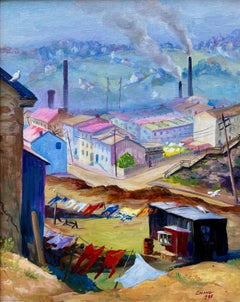
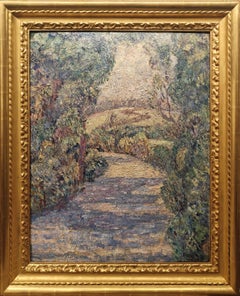
1920s Colorado Landscape by John E. Thompson

1920s Colorado Landscape by John E. Thompson

By John Edward Thompson

Located in Denver, CO

This charming 1920s oil on canvas by celebrated Colorado modernist John E. Thompson (1882–1966) beautifully captures the quiet majesty of the Rocky Mountain landscape. Signed lower l...

Category

1920s American Impressionist John Edward Thompson Paintings

Materials

Oil

John Edward Thompson Early Spring (Artist Studio) 1933 Colorado Modernist

John Edward Thompson Early Spring (Artist Studio) 1933 Colorado Modernist

By John Edward Thompson

Located in Denver, CO

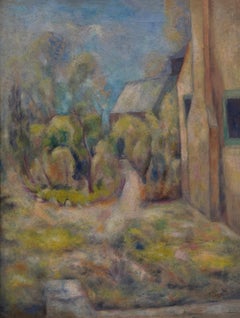
A luminous 1933 modernist landscape by John Edward Thompson titled Early Spring (Thompson’s Studio), depicting the exterior of the artist’s Denver studio surrounded by the quiet emer...

Category

1930s American Modern John Edward Thompson Paintings

Materials

Oil, Canvas

John E. Thompson “High Bridge, New York City” 1924 Original Oil Painting

John E. Thompson “High Bridge, New York City” 1924 Original Oil Painting

By John Edward Thompson

Located in Denver, CO

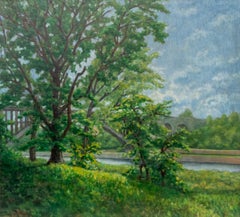
This exceptional 1924 original oil painting by influential Colorado modernist John E. Thompson depicts the historic High Bridge—New York City’s oldest surviving bridge—as it rises gracefully above the Harlem River. A rare and dynamic example of Thompson’s early modernist style, the work blends architectural realism with expressive, textured brushwork. The elegant stone arches, rhythmic spans, and atmospheric urban setting reveal Thompson’s mastery of composition and color. Signed and dated in the lower right, the painting carries strong historical authenticity and collector appeal. It is presented in a custom vintage frame that complements the period and enhances its refined, timeless presence. This rare early 20th-century view of New York City architecture is an important acquisition for collectors of American modernism, urban landscapes, and historic engineering landmarks. It captures a pivotal moment where traditional realism meets the burgeoning energy of modernist vision—making it a standout work in any distinguished collection. About the Artist: John E. Thompson – Pioneer of Colorado Modernism John Edward Thompson (1876–1945) is celebrated as the “Dean of Colorado Artists” and a foundational figure in introducing European modernism to the American West. Educated at the Art Students League of Buffalo and later in New York, he absorbed avant-garde influences while working in Europe, particularly inspired by Paul Cézanne. Settling in Denver in 1914, Thompson became a catalyst for the region’s modern art movement. He taught at the University of Denver and the Santa Fe Art School, working alongside Andrew Dasburg, B.J.O. Nordfeldt, and Walter Ufer. His mentorship shaped artists such as Józef Bakoś and Walter Mruk, co-founders of the influential group Los Cinco Pintores...

Category

1920s American Impressionist John Edward Thompson Paintings

Materials

Oil

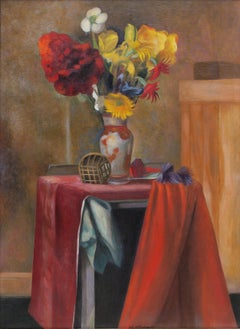
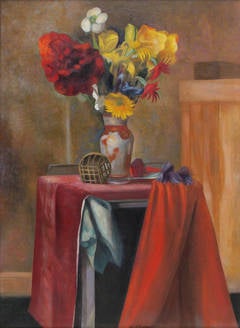
1940 John Edward Thompson Modernist Still Life Oil Painting of Flowers

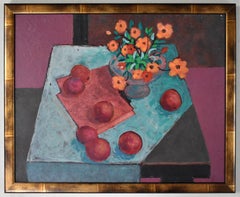
1940 John Edward Thompson Modernist Still Life Oil Painting of Flowers

By John Edward Thompson

Located in Denver, CO

This original 1940 Modernist still life oil painting by celebrated American artist John Edward Thompson (1882–1945) showcases a bold and expressive floral arrangement, rendered with ...

Category

1940s American Modern John Edward Thompson Paintings

Materials

Oil

Related Items
"The Wild Rose Hip Bush 06.23.2020" contemporary oil painting - impressionism

"The Wild Rose Hip Bush 06.23.2020" contemporary oil painting - impressionism

By Nelson White

Located in Sag Harbor, NY

Oil Painting of a rose bush, on a bright sunny day. Crisp blues make up the sky above, the horizon meets distant land across a body of water. bright greens and yellows make up a verd...

Category

21st Century and Contemporary American Impressionist John Edward Thompson Paintings

Materials

Linen, Oil

"Trumans Beach, East Marion 06.06.2022" contemporary impressionist seascape, oil

"Trumans Beach, East Marion 06.06.2022" contemporary impressionist seascape, oil

By Nelson H. White

Located in Sag Harbor, NY

"Trumans Beach, East Marion 06.06.2022" is an almost-abstract palette knife landscape painting of a beach and beach shrubs. Off in the distance is a little white triangle of paint to emulate a sailboat...

Category

21st Century and Contemporary American Impressionist John Edward Thompson Paintings

Materials

Canvas, Oil, Panel

Horse at the Golden Hills, California , Impressionist California landscaper.

Horse at the Golden Hills, California , Impressionist California landscaper.

By Lynn Gertenbach

Located in La Canada Flintridge, CA

Lynn Gertenbach's "Ride at Golden Hills" is a remarkable oil painting that captures a serene moment of a lady riding a horse under a tree, surrounded by lush grass and vibrant scener...

Category

2010s American Impressionist John Edward Thompson Paintings

Materials

Oil

NYC Cityscape American Scene WPA Modern Realism Mid 20th Century Architectural

NYC Cityscape American Scene WPA Modern Realism Mid 20th Century Architectural

By Ernest Fiene

Located in New York, NY

NYC Cityscape American Scene WPA Modern Realism Mid 20th Century Architectural Ernest Fiene (1894-1965) Cityscape 36 x 30 inches Oil on canvas Signed and dated 1930. lower right Provenance Estate of the artist. ACA Galleries, New York Exhibited New York, Frank Rehn Gallery, Changing Old New York, 1931. New York, ACA Galleries, Ernest Fiene: Art of the City, 1925-1955, May 2-23, 1981, n.p., no. 5. BIO Ernest Fiene was born in Elberfeld, Germany in 1894. As a teenager, Fiene immigrated to the United States in 1912. He studied art at the National Academy of Design in New York City from 1914 to 1918, taking day classes with Thomas Maynard and evening classes with Leon Kroll. Fiene continued his studies at the Beaux-Arts Institute of Design in New York from 1916 to 1918, adding classes in printmaking at the Art Students League in 1923. Fiene began his career as an artist in 1919 with his first exhibition of watercolors at the MacDowell Club arranged by his mentor Robert Henri. In 1923 the Whitney Studio Club mounted a large exhibition of his works. The following year he had an exhibition at the New Gallery in New York, which completely sold out all fifty-two works, including paintings, watercolors, drawings, and etchings. With the proceeds of sales from the New Gallery exhibition, Ernest Fiene and his younger brother Paul, a sculptor, built studios in Woodstock, New York in 1925. In the early Twenties Ernest Fiene painted mostly landscapes of Woodstock and both the Ramapo and Hudson River Valleys. The first monograph from the Younger Artists Series was published on Fiene in 1922. Published in Woodstock, the series went on to include Alexander Brook, Peggy Bacon, and Yasuo Kuniyoshi. The book reproduced 1 illustration in color and another 27 reproductions in black and white. Around 1925 Fiene became fascinated with the intensity, excitement, and opportunities for color harmonies New York City offered as a subject. His paintings shifted to urban and industrial themes with architecture, industry, and transportation becoming his subjects. By 1926 Fiene had attracted the dealer Frank K.M. Rehn, who gave him a one-man exhibition that year, which travelled to the Boston Arts Club. C.W. Kraushaar Galleries gave Fiene a one-man exhibition of urban, landscape, portrait, and still life paintings in 1927. Julianna Force, the director of the Whitney Studio Club and first director of the Whitney Museum of American Art, included two of Fiene’s paintings in a fall exhibition in 1928. The Whitney Studio Club showed Fiene’s paintings in a two-man exhibition with Glenn O. Coleman that year and acquired three of Fiene’s paintings. Also in 1928 Fiene became affiliated with Edith Halpert’s Downtown Gallery where he had an exhibition of 20 lithographs in the spring. Fiene sold his house in Woodstock in 1928 to spend more of his time in New York City. With so many successful exhibitions, Fiene returned to Paris in 1928-29 where he rented Jules Pascin's studio and studied at the Académie de la Grande Chaumière. In France, Fiene painted both landscape and urban subjects developed from ideas influenced by Cubist geometry and the use of flat areas of broad color. Upon returning to New York in 1930, Fiene used this new approach to continue to paint New York skyscraper and waterfront subjects, as well as to begin a series of paintings on changing old New York based on the excavations for Radio City Music Hall and the construction of the Empire State Building. Frank K.M. Rehn Galleries exhibited this series, titled “Changing Old New York,” in 1931. Fiene also has solo exhibitions at Rehn Galleries in 1930 and 1932. Fiene’s oil paintings are exhibited at the Chicago Arts Club in 1930 as well. Fiene was included in the Museum of Modern Art’s exhibition Painting and Sculpture by Living Americans in December of 1931. Visiting New York, Henri Matisse saw the exhibition and called Fiene’s Razing Buildings, West 49th Street the finest painting he had seen in New York. Fiene had two mural studies from his Mechanical Progress series exhibited at the Museum of Modern Art’s exhibition Murals by American Painters and Photographers in 1932. Fiene sent View from my Window which depicts Fiene working on a lithograph stone while looking out his window to the newly completed Empire State Building to the Carnegie International in 1931. In 1932 Fiene participated in the first Biennial of American Painting at the Whitney Museum and his prints were included in exhibitions at the Downtown Gallery and the Wehye Gallery. In the same year, Fiene was awarded a Guggenheim fellowship to further study mural painting in Florence, Italy. On his return from Italy in 1933 Fiene re-engaged himself in New York City life and won several public and private mural projects. Fiene resumed his active exhibition schedule, participating in two group exhibitions at the Whitney Museum and a one-man exhibition of recent paintings at the Downtown Gallery in January 1934. In 1933 he purchased a farm in Southbury, Connecticut, which added Connecticut scenes to his landscape subjects. This was also the year Fiene began to spend summers on Monhegan Island, Maine, where he painted seascapes, harbor scenes, and still lifes. Fiene’s landscape paintings attracted numerous commissions as part of the American Scene movement. Through the fall and winter of 1935-36, Fiene took an extended sketching trip through the urban, industrial, and farming areas of Pennsylvania and West Virginia. Most of the twenty-four Pennsylvania urban and rural paintings...

Category

1930s American Modern John Edward Thompson Paintings

Materials

Canvas, Oil

Gloucester
Gloucester

Guy Carleton WigginsGloucester

$29,500

H 21.75 in W 25.75 in D 1.75 in

Gloucester

By Guy Carleton Wiggins

Located in Milford, NH

A fine impressionist harbor scene in Gloucester, Massachusetts by American artist Guy Carleton Wiggins (1883-1962). Wiggins was born in Brooklyn, New York, and had a long and success...

Category

Early 20th Century American Impressionist John Edward Thompson Paintings

Materials

Oil, Board

"Autumn Landscape" Colorful Pastoral Landscape Oil Painting on Canvas Framed

"Autumn Landscape" Colorful Pastoral Landscape Oil Painting on Canvas Framed

By Robert Waltsak

Located in New York, NY

A wonderful impressionist pastoral landscape in the Autumn season with beautiful color tones throughout. Waltsak has portrayed this piece in a most intimate, yet energetic way, and h...

Category

21st Century and Contemporary American Impressionist John Edward Thompson Paintings

Materials

Canvas, Oil

Desert Landscape Oil Painting, American Impressionist, Circa 1910s

Desert Landscape Oil Painting, American Impressionist, Circa 1910s

Located in Arp, TX

Attrib. Ralph Davidson Miller 1858-1945 "Desert landscape" c. 1910s. Oil on canvas 34"x24" unframed Unsigned Presenting an extraordinary artwork attributed to the renowned artist R...

Category

Early 20th Century American Impressionist John Edward Thompson Paintings

Materials

Oil, Canvas

"Boat on Beach" Hayley Lever, Modernist, Quick Brushwork, Boat in Marina

"Boat on Beach" Hayley Lever, Modernist, Quick Brushwork, Boat in Marina

By Hayley Lever

Located in New York, NY

Hayley Lever Boat on Beach, 1952 Oil on canvasboard 5 3/4 x 8 5/8 inches Provenance The artist Davis Galleries, New York (#DG 188) Private Collection, Ne...

Category

1950s American Impressionist John Edward Thompson Paintings

Materials

Canvas, Oil

Mid Century Floral Still-Life in Oil on Canvas-Wrapped Illustration Board

Mid Century Floral Still-Life in Oil on Canvas-Wrapped Illustration Board

Located in Soquel, CA

Mid Century Floral Still-Life in Oil on Canvas-Wrapped Illustration Board Classic mid century floral still-life with impasto in warm, autumn colors by Frances Christensen American, ...

Category

Mid-20th Century American Modern John Edward Thompson Paintings

Materials

Canvas, Oil, Illustration Board

"New England Spirit" Dennis Sheehan, Cloudy Day, Atmospheric Dark Impressionism

"New England Spirit" Dennis Sheehan, Cloudy Day, Atmospheric Dark Impressionism

By Dennis Sheehan

Located in New York, NY

Dennis Sheehan New England Spirit, circa 2025 Signed lower left Oil on canvas 16 x 20 inches Dennis Sheehan was born in Boston in 1950. His work is based upon the Barbizon School w...

Category

2010s American Impressionist John Edward Thompson Paintings

Materials

Canvas, Oil

Valley of Dreams, San Gabriel Valley, Los Angeles, California

Valley of Dreams, San Gabriel Valley, Los Angeles, California

Located in Grand Rapids, MI

Charles L. A. Smith (American, 1871 - 1937) Signed: CHAS. L. A. SMITH (Lower, Right) " Valley of Dreams ", 1934 (San Gabriel Valley) Oil on Canvas 39" x 46 3/8" Housed in a 5" ...

Category

Early 20th Century American Impressionist John Edward Thompson Paintings

Materials

Oil, Canvas

A Colorful, Vintage 1950s Mid-Century Modern Martha's Vineyard Harbor Scene

A Colorful, Vintage 1950s Mid-Century Modern Martha's Vineyard Harbor Scene

By Francis Chapin

Located in Chicago, IL

A vibrant, colorful harbor scene of Martha's Vineyard by notable Chicago Modern artist, Francis Chapin (Am. 1899-1965). Depicting a quiet inlet with sandy shoreline, boat houses and...

Category

1950s American Modern John Edward Thompson Paintings

Materials

Oil, Canvas

Previously Available Items
Original 1940s Colorado Mountain Landscape - Modernist Art with Trees & Mountain

Original 1940s Colorado Mountain Landscape - Modernist Art with Trees & Mountain

By John Edward Thompson

Located in Denver, CO

This vintage 1940s modernist landscape painting, titled Mountain Landscape (Cheyenne Mountain, Colorado Springs), is an exceptional work by Colorado artist John E. Thompson. Created ...

Category

1940s American Modern John Edward Thompson Paintings

Materials

Oil

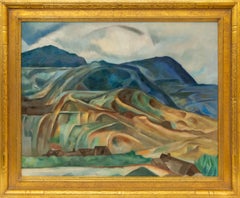
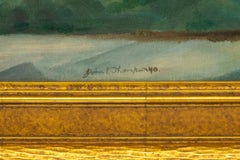
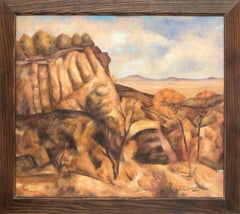
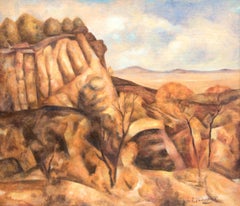
1930s Modernist Oil Painting of a Colorado Landscape, Rocks & Mesa, brown, blue

1930s Modernist Oil Painting of a Colorado Landscape, Rocks & Mesa, brown, blue

By John Edward Thompson

Located in Denver, CO

Oil on canvas laid on board painting titled "Untitled (Colorado Mesa and Trees)" by John E. Thompson (1882-1945). A semi-abstract painting of a Colorado landscape, painted in shades of purples, yellows and browns. Presented in a wood frame, outer dimensions measure 32 x 36 x ⅜ inches. Image sight size is 27 ¼ x 31 ¾ inches. About the Artist: Thompson’s professional career as an artist and art educator is largely associated with Denver and Colorado where he lived and worked for more than thirty years. While he may not have achieved a commanding national profile, his well-informed and unceasing efforts as the Dean of Colorado Artists in the first half of the twentieth century introduced modernity into Colorado art and art education, making it possible for all types of good art to be seen and appreciated. Producing his first drawings at age fourteen for a Professor Berger in his hometown, Thompson thereafter enrolled in the Art Students League of Buffalo, studying with Lucius Hitchcock, one of America’s noted illustrators. During that time he befriended artist George Carlock, nephew of Elbert Hubbard who headed the famous Roycroft Colony near East Aurora, New York, where they sketched and painted on the weekends. Thompson also developed his skill in bag-punching, later earning him extra money while studying in Paris. The four Sherwood Smith money prizes he won for his life-class drawings in Buffalo enabled him to attend the Art Students League in New York for two years, beginning in 1899, where he studied with Frank Vincent DuMond. He also won a scholarship in drawing to the Chase School of Art (also known as the New York School of Art) where he was monitor of Hitchcock’s illustration class. The money he earned from illustration work in New York helped finance his trip to Europe where in the spring of 1902 he studied with Myron Barlow, an American based in Étaples in northern France. The atmosphere of the fishing port -- also an international art colony at the time -- introduced Thompson to the color and life of France. In November 1902 he entered the Académie Julian in Paris, working under Jean-Paul Laurens, Henri Royer and Marcel Baschet who imparted a healthy respect for sound draughtsmanship. Among his classmates were Sheldon Cheney, American author on art and the theater, and Anton Otto Fischer, German-born illustrator and later Howard Pyle’s student in the United States. During his second year abroad Thompson spent his mornings at Julian’s and his afternoons at the Académie La Palette, directed by Jacques-Émile Blanche who attracted many British and American students seeking exposure to the latest avant-garde trends. He benefitted from the critiques of Charles Cottet, Lucien Simon and Edmond Aman-Jean with whom Birger Sandzén also studied in Paris. In the spring of 1904 Thompson left for Holland, spending the next year and a half in the painting village of Laren near Amsterdam where he met Johannes Albert Neuhuys, one of the best known painters of the Laren School, and the celebrated genre painter, Jozef Israӫls, with whom he studied. During that time Thompson had two of his paintings accepted for the 1904 exhibition of the Société des Artistes Français. Returning to Paris in July 1905 he briefly studied again at the Académie Julian and Académie La Palette before breaking with the academic style to pursue independent study at the Louvre and other Paris museums. There he assimilated diverse art forms including classical mosaics and murals, Persian miniatures, Old Master drawings and paintings, as well as the work of Daumier, Renoir, Toulouse-Lautrec and Van Gogh. He visited Gertrude Stein’s salon and viewed the Fauves’ work at the 1905 Salon d’Automne and the Cézanne retrospective at the 1907 Salon that greatly influenced his own creative output. Reexamining all that he had learned from a new perspective, he began developing his own vision, melding Cézanne’s color planes with the traditional art he loved. He considered Cézanne’s work a “belated return of art to the classicism of the old masters” and their concern with structural qualities, form, line and color. Thompson and Carlock became Thomas Hart Benton’s first two American friends after he arrived in Paris in 1907 to study at the Académie Julian, as noted in Tom Benton’s America: An Artist in America. Carlock introduced Thompson to the great English color scientist, Percival Tudor-Hart. Working in his atelier from 1905 to 1908, he received a thorough grounding in composition research and color theory and also learned to think constructively for himself. For a time he painted scintillating color landscapes at Chezy-sur-Marne near Chateau Theirry. Thereafter he lived for six months at the home of the novelist George Sand at Gargilesse-Dampierre where he produced Impressionist style canvases. After 1908 he worked independently, taking painting trips to Martigues, Aix and Marseilles in the south of France. He also traveled to England, Spain and Italy, studying important public art collections in those countries. At the outbreak of World War I he returned to Buffalo, New York, to await a quick end to the hostilities that did not materialize. Eager to paint and intrigued by railroad folders describing the light and rugged country in Colorado, he traveled to the state in 1914 where he spent about seven months at Shaffers Crossing and Pine in the mountains west of Denver. Among the images he produced there was Pine, Colorado. Reflecting his exposure to Post-Impressionism in Europe and stylistically very different from most of the art being produced in Colorado at that time, the painting has a certain freedom and minimum of detail combined with a sound structural base characterizing his work over the next thirty years. In addition to falling in love with the Colorado landscape in 1914, he met his future wife Harriette C. Brown, whom married the following year and returned to Buffalo. His European credentials gained him several students of Polish heritage in Buffalo – Józef Bakoś, Alexander Korda and Walter Mruk. They followed him to Denver after he relocated there with his wife in 1917. Bakoś and Mruk later moved to Santa Fe where along with Fremont Ellis, Willard Nash and Will Shuster they became two of the founding members of Los Cinco Pintores (The Five Painters), the city’s first modernist art group. In the mid-1920s Thompson comprised part of the summer school faculty at the Santa Fe Art School that included Bakoś and Mruk, as well as Andrew Dasburg, B.J.O. Nordfeldt and Walter Ufer. Seeking to educate the public in the fine arts, Thompson and his young students introduced modernism to Colorado in 1919 at the twenty-fifth annual exhibition of the Denver Art Association. It quickly became known as the Denver Armory Show because it generated similarly vituperative polemics in the local press as did the Armory Show held six years earlier in New York. Thompson’s painting, Organization of Rocks and Trees, was ridiculed by Horace Simms in the Rocky Mountain News as reflecting “downright idiocy of conception.” Some critics in the local press even went so far as to label the artist a “Bolshevik.” He successfully weathered the storm, going on to teach for a time in the early 1920s at the Denver Academy of Fine and Applied Arts along with Laura Gilpin, Anne Van Briggle Ritter, Arnold Rönnebeck and Paul St. Gaudens. After he resigned, a group of students – among them Donald Bear, Josephine Hurlburt, Charles F. Ramus and Frank Vavra...

Category

1930s American Modern John Edward Thompson Paintings

Materials

Canvas, Oil, Board
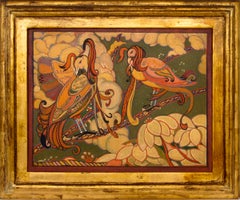
Orientalist Study with Simurgh & Flowers, Framed 1920s Art Nouveau Oil Painting

Orientalist Study with Simurgh & Flowers, Framed 1920s Art Nouveau Oil Painting

By John Edward Thompson

Located in Denver, CO

Orientalist Study, depicts a pair of mythical Persian birds on a flowering branch in rich tones of gold, green, red, orange, blue, vintage 1920s oil painting on canvas. This paintin...

Category

1920s Art Deco John Edward Thompson Paintings

Materials

Oil

John Edward Thompson paintings for sale on 1stDibs.

Find a wide variety of authentic John Edward Thompson paintings available for sale on 1stDibs. You can also browse by medium to find art by John Edward Thompson in oil paint, paint, canvas and more. Much of the original work by this artist or collective was created during the 20th century and is mostly associated with the modern style. Not every interior allows for large John Edward Thompson paintings, so small editions measuring 21 inches across are available. Customers who are interested in this artist might also find the work of William Harnden, Alfred Wands, and Emanuel Glicenstein Romano. John Edward Thompson paintings prices can differ depending upon medium, time period and other attributes. On 1stDibs, the price for these items starts at $925 and tops out at $4,200, while the average work can sell for $3,125.