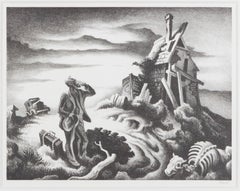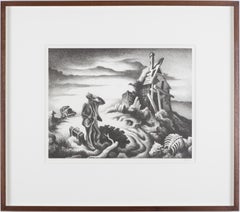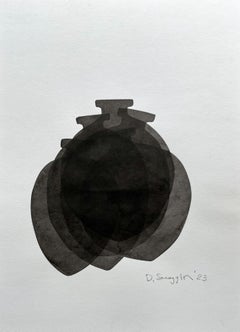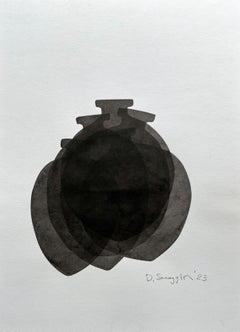
Joseph Webster Golinkin Art

American, 1896-1977
JOSEPH WEBSTER GOLINKIN (1896-1977) Painter, printmaker, naval officer, politician, environmentalist, and philanthropist. He was a true Renaissance man – excelling in everything he pursued. Joseph Golinkin was born in Chicago on September 10, 1896, and studied at the Art Institute of Chicago. He entered the United States Naval Academy and, upon graduation, was commissioned as an Ensign and immediately deployed to serve in World War I. He remained in the Navy until 1922, when he resigned his commission to pursue his original career as an artist. He remained, however, in the active reserve as a Lieutenant Commander. After leaving the Navy, Golinkin moved to New York, where he studied at the Art Students League with Ash Can school artist George Luks. The two artists became fast friends, and Luks introduced him to many other artists. During the 1920s and 1930s, Golinkin exhibited with several other well-known artists, including George Bellows, Joseph Margulies, and David Shotwell. He was also represented by several renowned dealers in New York City, including Ferargil Galleries, Macbeth Gallery, and Van der Straeten. He had one-person shows at the Museum of the City of New York, the Macbeth Gallery, Ferargil Galleries, Gump's in San Francisco, the San Francisco Art Gallery, and the Los Angeles Olympics in 1984. His works are part of many museum collections, including the Metropolitan Museum, New York Public Library, Museum of the City of New York, Library of Congress, and the Art Institute of Chicago. As an artist, Golinkin worked in many mediums, including painting, watercolor, and lithography. While his subjects varied, two would dominate his work – scenes of New York and sports. He produced a large body of prints, drawings, and lithographs surrounding these two subjects. His images of New York include scenes of both city life and the structures, capturing the ambiance of the late 1920s and early 1930s. The sporting events Golinkin depicted include baseball, bicycle racing, bowling, boxing, football, hockey, horse racing, horse shows, golf, polo, tennis, track and field, wrestling, and yacht racing. He was awarded the Gold Medal for Artistic Excellence in Relation to Sport at the X Olympiad in 1932 and again at the XI Olympiad in 1936. Golinkin's sporting scenes have been reproduced as posters for several Olympic Games. His work is also in the collections of the Baseball Hall of Fame, the Palm Beach Polo Club, Madison Square Garden, numerous yacht clubs, and in the personal collections of well-known athletes and sports enthusiasts throughout the world. When the Navy reactivated him in 1938, his artistic career was put on hold. He served with great distinction during WWII, was awarded the Bronze Star, and retired from the Navy in 1958 with the rank of Rear Admiral. His other careers include serving for twelve years as Mayor of Centre Island, New York. As an early environmentalist, he formed a nonpartisan civic association that successfully opposed building a Robert Moses proposed bridge that would have connected Oyster Bay and Rye, New York.
to
8
8
7
5
2
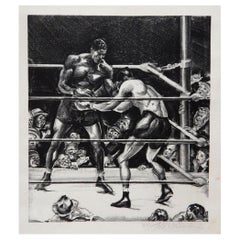
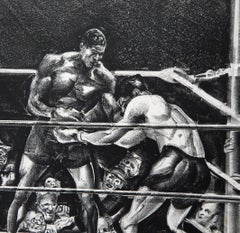
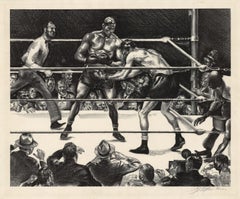
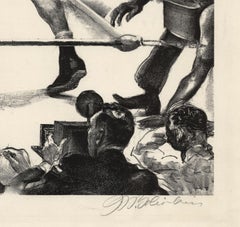
Joe Louis vs. Max Baer at Yankee Stadium

Joe Louis vs. Max Baer at Yankee Stadium

By Joseph Webster Golinkin

Located in New York, NY

LOUIS & BAER AT YANKEE STADIUM. This lithograph from circa 1935 was printed in an edition of 50. This particular impression is signed in pencil and inscribed “25/50.” The image size is 15 7/8 x 19 ¾ inches and the paper (sheet) size is 19 1/8 x 22 7/8 inches. There are two small purple estate stamps on verso. "I define fear as standing across the ring from Joe Louis and knowing he wants to go home early." – Max Baer...

Category

1930s Naturalistic Joseph Webster Golinkin Art

Materials

Lithograph
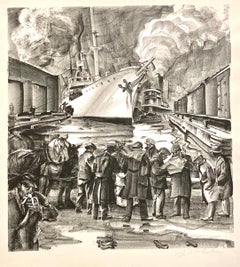
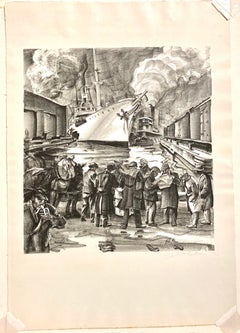
Joseph Webster Golinkin, On the Dock, Banana Boat, New Orleans

Joseph Webster Golinkin, On the Dock, Banana Boat, New Orleans

By Joseph Webster Golinkin

Located in New York, NY

Chicago-born Golinkin studied at the Artist Students League with George Luks. After working as an illustrator for New York papers he joined the Navy in 1939 and retired as a Rear Adm...

Category

1930s Ashcan School Joseph Webster Golinkin Art

Materials

Lithograph
Wrestling [untitled].

Wrestling [untitled].

By Joseph Webster Golinkin

Located in New York, NY

“WRESTLING” is a watercolor by Joseph Golinkin created circa 1940. This piece is painted to the paper's edge and signed in red paint in the upper left. The watercolor paper size is 20 7/8 x 15 ¾ inches. Joseph Webster Golinkin...

Category

1930s Naturalistic Joseph Webster Golinkin Art

Materials

Watercolor, Graphite

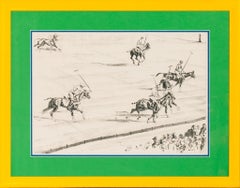
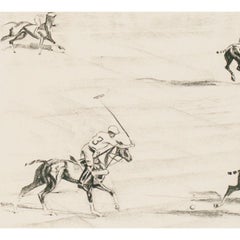
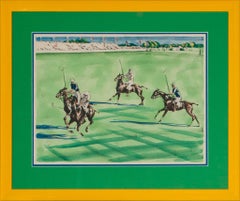
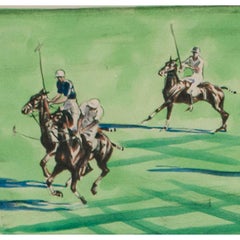
"Polo Scene"
"Polo Scene"

"Polo Scene"

By Joseph Webster Golinkin

Located in Bristol, CT

Classic c1930s polo field scene by Joseph Webster Golinkin (1896-1977) Art Sz: 10 1/4"H x 14 3/4"W Frame Sz: 15 1/2"H x 20"W Joseph Webster Golinkin (September 10, 1896 – Septembe...

Category

1930s Joseph Webster Golinkin Art

Materials

Lithograph
Related Items
Jurassic Aloe Leaves, Botanical Cyanotype on Paper, Blue Plants, Nature Details

Jurassic Aloe Leaves, Botanical Cyanotype on Paper, Blue Plants, Nature Details

By Kind of Cyan

Located in Barcelona, ES

This is an exclusive handprinted limited edition cyanotype of a beautiful Aloe plant. Details: + Title: Jurassic Aloe Leaves + Year: 2022 + Edition Size: 100 + Stamped and Certifica...

Category

2010s Naturalistic Joseph Webster Golinkin Art

Materials

Photographic Film, Emulsion, Watercolor, Archival Paper, Photographic Pa...

Zia, State II
Zia, State II

R.C. Gorman Zia, State II, 1979

$3,400

H 35 in W 42 in D 1.35 in

Zia, State II

By R.C. Gorman

Located in San Francisco, CA

This artwork titled "Zia" State II, 1979 Is an original colors lithograph on Buff Arches paper by renown Navajo artist Rudolph Carl Gorman, 1932-2005. It is signed, dated and number...

Category

Late 20th Century Realist Joseph Webster Golinkin Art

Materials

Lithograph
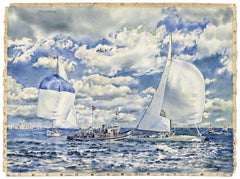
Arnold Ronnebeck 1930s Lithograph – Grand Lake Colorado Yacht Races, WPA Era

Arnold Ronnebeck 1930s Lithograph – Grand Lake Colorado Yacht Races, WPA Era

By Arnold Rönnebeck

Located in Denver, CO

This striking vintage 1930s black-and-white lithograph by celebrated Colorado artist Arnold Ronnebeck (1885–1947) captures the dynamic energy of the Grand Lake...

Category

1930s American Modern Joseph Webster Golinkin Art

Materials

Lithograph

19th century color lithograph figures cemetery willow tree memorial headstone

19th century color lithograph figures cemetery willow tree memorial headstone

By Nathaniel Currier

Located in Milwaukee, WI

The present hand-colored lithograph was produced as part of the funeral and mourning culture in the United States during the 19th century. Images like this were popular as ways of remembering loved ones, an alternative to portraiture of the deceased. This lithograph shows a man, woman and child in morning clothes next to an urn-topped stone monument. Behind are additional putto-topped headstones beneath weeping willows, with a steepled church beyond. The monument contains a space where a family could inscribe the name and death dates of a deceased loved one. In this case, it has been inscribed to a young Civil War soldier: William W. Peabody Died at Fairfax Seminary, VA December 18th, 1864 Aged 18 years The young Mr. Peabody probably died in service for the Union during the American Civil War. Farifax Seminary was a Union hospital and military headquarters in Alexandria, Virginia. The hospital served nearly two thousand soldiers during the war time. Five hundred were also buried on the Seminary's grounds. 13.75 x 9.5 inches, artwork 23 x 19 inches, frame Published before 1864 Inscribed bottom center "Lith. & Pub. by N. Currier. 2 Spruce St. N.Y." Framed to conservation standards using 100 percent rag matting and TruVue Conservation Clear glass, housed in a gold gilded moulding. Nathaniel Currier was a tall introspective man with a melancholy nature. He could captivate people with his piercing stare or charm them with his sparkling blue eyes. Nathaniel was born in Roxbury, Massachusetts on March 27th, 1813, the second of four children. His parents, Nathaniel and Hannah Currier, were distant cousins who lived a humble yet spartan life. When Nathaniel was eight years old, tragedy struck. Nathaniel’s father unexpectedly passed away leaving Nathaniel and his eleven-year-old brother Lorenzo to provide for the family. In addition to their mother, Nathaniel and Lorenzo had to care for six-year-old sister Elizabeth and two-year-old brother Charles. Nathaniel worked a series of odd jobs to support the family, and at fifteen, he started what would become a life-long career when he apprenticed in the Boston lithography shop of William and John Pendleton. A Bavarian gentleman named Alois Senefelder invented lithography just 30 years prior to young Nat Currier’s apprenticeship. While under the employ of the brothers Pendleton, Nat was taught the art of lithography by the firm’s chief printer, a French national named Dubois, who brought the lithography trade to America. Lithography involves grinding a piece of limestone flat and smooth then drawing in mirror image on the stone with a special grease pencil. After the image is completed, the stone is etched with a solution of aqua fortis leaving the greased areas in slight relief. Water is then used to wet the stone and greased-ink is rolled onto the raised areas. Since grease and water do not mix, the greased-ink is repelled by the moisture on the stone and clings to the original grease pencil lines. The stone is then placed in a press and used as a printing block to impart black on white images to paper. In 1833, now twenty-years old and an accomplished lithographer, Nat Currier left Boston and moved to Philadelphia to do contract work for M.E.D. Brown, a noted engraver and printer. With the promise of good money, Currier hired on to help Brown prepare lithographic stones of scientific images for the American Journal of Sciences and Arts. When Nat completed the contract work in 1834, he traveled to New York City to work once again for his mentor John Pendleton, who was now operating his own shop located at 137 Broadway. Soon after the reunion, Pendleton expressed an interest in returning to Boston and offered to sell his print shop to Currier. Young Nat did not have the financial resources to buy the shop, but being the resourceful type he found another local printer by the name of Stodart. Together they bought Pendleton’s business. The firm ‘Currier & Stodart’ specialized in "job" printing. They produced many different types of printed items, most notably music manuscripts for local publishers. By 1835, Stodart was frustrated that the business was not making enough money and he ended the partnership, taking his investment with him. With little more than some lithographic stones, and a talent for his trade, twenty-two year old Nat Currier set up shop in a temporary office at 1 Wall Street in New York City. He named his new enterprise ‘N. Currier, Lithographer’ Nathaniel continued as a job printer and duplicated everything from music sheets to architectural plans. He experimented with portraits, disaster scenes and memorial prints, and any thing that he could sell to the public from tables in front of his shop. During 1835 he produced a disaster print Ruins of the Planter's Hotel, New Orleans, which fell at two O’clock on the Morning of the 15th of May 1835, burying 50 persons, 40 of whom Escaped with their Lives. The public had a thirst for newsworthy events, and newspapers of the day did not include pictures. By producing this print, Nat gave the public a new way to “see” the news. The print sold reasonably well, an important fact that was not lost on Currier. Nat met and married Eliza Farnsworth in 1840. He also produced a print that same year titled Awful Conflagration of the Steamboat Lexington in Long Island Sound on Monday Evening, January 18, 1840, by which melancholy occurrence over One Hundred Persons Perished. This print sold out very quickly, and Currier was approached by an enterprising publication who contracted him to print a single sheet addition of their paper, the New York Sun. This single page paper is presumed to be the first illustrated newspaper ever published. The success of the Lexington print launched his career nationally and put him in a position to finally lift his family up. In 1841, Nat and Eliza had their first child, a son they named Edward West Currier. That same year Nat hired his twenty-one year old brother Charles and taught him the lithography trade, he also hired his artistically inclined brother Lorenzo to travel out west and make sketches of the new frontier as material for future prints. Charles worked for the firm on and off over the years, and invented a new type of lithographic crayon which he patented and named the Crayola. Lorenzo continued selling sketches to Nat for the next few years. In 1843, Nat and Eliza had a daughter, Eliza West Currier, but tragedy struck in early 1847 when their young daughter died from a prolonged illness. Nat and Eliza were grief stricken, and Eliza, driven by despair, gave up on life and passed away just four months after her daughter’s death. The subject of Nat Currier’s artwork changed following the death of his wife and daughter, and he produced many memorial prints and sentimental prints during the late 1840s. The memorial prints generally depicted grief stricken families posed by gravestones (the stones were left blank so the purchasers could fill in the names of the dearly departed). The sentimental prints usually depicted idealized portraits of women and children, titled with popular Christian names of the day. Late in 1847, Nat Currier married Lura Ormsbee, a friend of the family. Lura was a self-sufficient woman, and she immediately set out to help Nat raise six-year-old Edward and get their house in order. In 1849, Lura delivered a son, Walter Black Currier, but fate dealt them a blow when young Walter died one year later. While Nat and Lura were grieving the loss of their new son, word came from San Francisco that Nat’s brother Lorenzo had also passed away from a brief illness. Nat sank deeper into his natural quiet melancholy. Friends stopped by to console the couple, and Lura began to set an extra place at their table for these unexpected guests. She continued this tradition throughout their lives. In 1852, Charles introduced a friend, James Merritt Ives, to Nat and suggested he hire him as a bookkeeper. Jim Ives was a native New Yorker born in 1824 and raised on the grounds of Bellevue Hospital where his father was employed as superintendent. Jim was a self-trained artist and professional bookkeeper. He was also a plump and jovial man, presenting the exact opposite image of his new boss. Jim Ives met Charles Currier through Caroline Clark, the object of Jim’s affection. Caroline’s sister Elizabeth was married to Charles, and Caroline was a close friend of the Currier family. Jim eventually proposed marriage to Caroline and solicited an introduction to Nat Currier, through Charles, in hopes of securing a more stable income to support his future wife. Ives quickly set out to improve and modernize his new employer’s bookkeeping methods. He reorganized the firm’s sizable inventory, and used his artistic skills to streamline the firm’s production methods. By 1857, Nathaniel had become so dependent on Jims’ skills and initiative that he offered him a full partnership in the firm and appointed him general manager. The two men chose the name ‘Currier & Ives’ for the new partnership, and became close friends. Currier & Ives produced their prints in a building at 33 Spruce Street where they occupied the third, fourth and fifth floors. The third floor was devoted to the hand operated printing presses that were built by Nat's cousin, Cyrus Currier, at his shop Cyrus Currier & Sons in Newark, NJ. The fourth floor found the artists, lithographers and the stone grinders at work. The fifth floor housed the coloring department, and was one of the earliest production lines in the country. The colorists were generally immigrant girls, mostly German, who came to America with some formal artistic training. Each colorist was responsible for adding a single color to a print. As a colorist finished applying their color, the print was passed down the line to the next colorist to add their color. The colorists worked from a master print displayed above their table, which showed where the proper colors were to be placed. At the end of the table was a touch up artist who checked the prints for quality, touching-in areas that may have been missed as it passed down the line. During the Civil War, demand for prints became so great that coloring stencils were developed to speed up production. Although most Currier & Ives prints were colored in house, some were sent out to contract artists. The rate Currier & Ives paid these artists for coloring work was one dollar per one hundred small folios (a penny a print) and one dollar per one dozen large folios. Currier & Ives also offered uncolored prints to dealers, with instructions (included on the price list) on how to 'prepare the prints for coloring.' In addition, schools could order uncolored prints from the firm’s catalogue to use in their painting classes. Nathaniel Currier and James Merritt Ives attracted a wide circle of friends during their years in business. Some of their more famous acquaintances included Horace Greeley, Phineas T. Barnum, and the outspoken abolitionists Rev. Henry Ward, and John Greenleaf Whittier (the latter being a cousin of Mr. Currier). Nat Currier and Jim Ives described their business as "Publishers of Cheap and Popular Pictures" and produced many categories of prints. These included Disaster Scenes, Sentimental Images, Sports, Humor, Hunting Scenes, Politics, Religion, City and Rural Scenes, Trains, Ships, Fire Fighters, Famous Race Horses, Historical Portraits, and just about any other topic that satisfied the general public's taste. In all, the firm produced in excess of 7500 different titles, totaling over one million prints produced from 1835 to 1907. Nat Currier retired in 1880, and signed over his share of the firm to his son Edward. Nat died eight years later at his summer home 'Lion’s Gate' in Amesbury, Massachusetts. Jim Ives remained active in the firm until his death in 1895, when his share of the firm passed to his eldest son, Chauncey. In 1902, faced will failing health from the ravages of Tuberculosis, Edward Currier sold his share of the firm to Chauncey Ives...

Category

Mid-19th Century Romantic Joseph Webster Golinkin Art

Materials

Watercolor, Lithograph

Estes Park Colorado American Modernist Watercolor Landscape Painting, WPA 1930s

Estes Park Colorado American Modernist Watercolor Landscape Painting, WPA 1930s

By James Russell Sherman

Located in Denver, CO

Vintage 1930s watercolor and ink painting of Estes Park, Colorado, by American artist James Russell Sherman (1906-1989). This captivating work features a detailed view of storefronts...

Category

1930s American Modern Joseph Webster Golinkin Art

Materials

Watercolor

Azure Clouds,  Blue Tones Cyanotype Print Landscape, Contemporary Skyscape

Azure Clouds, Blue Tones Cyanotype Print Landscape, Contemporary Skyscape

By Kind of Cyan

Located in Barcelona, ES

This is an exclusive handprinted limited edition cyanotype. "Azure Clouds" is an cyanotype of the semi-abstract patterns of clouds in the sky, showing shades of blue. Details: + Tit...

Category

2010s Naturalistic Joseph Webster Golinkin Art

Materials

Watercolor, Rag Paper

1960's French Portrait Jaw Dropped Man Caricature

1960's French Portrait Jaw Dropped Man Caricature, C.1960s

$500Sale Price|20% Off

H 12.5 in W 9.75 in D 0.1 in

1960's French Portrait Jaw Dropped Man Caricature

Located in Cirencester, Gloucestershire

French Character Portrait French school, Mid 20th Century Gouache paint on unframed paper signed lower corner Image : 12.5 x 9.75 inches Superbly decorative 1960's French portrai...

Category

Mid-20th Century Impressionist Joseph Webster Golinkin Art

Materials

Paper, Ink, Watercolor, Gouache

Cairo Citadel Palm, Cyanotype on Paper, Desert Botanical Tree in Blue Tones

Cairo Citadel Palm, Cyanotype on Paper, Desert Botanical Tree in Blue Tones

By Kind of Cyan

Located in Barcelona, ES

This is an exclusive handprinted limited edition cyanotype. This cyanotype shows a desert palm tree located in the majestic mediterranean city of Cairo, Egypt. Details: + Title: C...

Category

2010s Naturalistic Joseph Webster Golinkin Art

Materials

Photographic Film, Other Medium, Emulsion, Watercolor, Archival Paper, P...

Mother and Children
Mother and Children

Edna HibelMother and Children, c.1970

$1,400

H 40 in W 29 in D 2 in

Mother and Children

By Edna Hibel

Located in San Francisco, CA

This artwork "Mother and Children" c.1970, is a colors lithograph on paper by American artist Edna Hibel, 1917-2014. It is signed and numbered II 3/10 Ed. 200 in pencil by the artist. The The artwork (sheet ) size is 34 x 23 inches, framed size is 40 x 29 inches. Custom framed in original wooden decorated grey/silver frame. It is in excellent condition. About the artist: Edna Hibel, a painter of sentimental pictures of children, has had a more than 60-year career as painter and lithographer and promoter of peace through exhibitions of her artwork. She was born in 1917 in Boston, Massachusetts. Her parents were Abraham and Lena Hibel, and she was raised in the Boston area and educated at Brookline High School where she met her future husband, Theodore Plotkin. She began to paint when she was nine years old and learned watercolor during summers at the shore where her family vacationed in Maine and Hull, Massachusetts. Hibel studied at the Boston Museum School of Fine Arts, from 1935-39, receiving a Sturtevant Traveling Fellowship to Mexico. In Boston, in 1966, she began lithography, continuing in 1970 in Zurich, where she still works every year. She has created lithographic works with up to 32 stones (or colors) on paper, silk, wood veneer and porcelain. The latter pieces are called lithographs on porcelain and result from a complicated process, that she keeps a secret, whereby she transfers stone lithographic color separations onto Bavarian hard paste porcelain. Hibel has created the "Arte Ovale" series and various plaques with this technique. She organized the Edna Hibel Museum of Art, in Jupiter, Florida, to display and promote her work and also created a United Nations stamp, "Mother Earth." In 1995, she was commissioned by the Foundation of the U.S. National Archives to commemorate the 75th anniversary of women receiving the universal right to vote. At the ceremony, Ms. Lucy Baines Johnson referred to Hibel as the "Heart and Conscience of America." In November, 2001, the World Cultural Council based in Mexico City gave her the Leonardo da Vinci World Award of Arts. Hibel's work has been exhibited in museums and galleries in more than 20 countries including Russia, Brazil, China, Costa Rica, and the United States, and under the royal patronage of Count and Countess Bernadotte of Germany, Count Thor Bonde of Sweden, Prince and the late Princess Rainier of Monaco and Her Majesty Queen Elizabeth II of England. Pope John Paul II gave her a medal of honor as did the late Belgian King Baudouin. She also received honorary Doctoral degrees including from Eureka College, and Northwood University of Florida, Michigan and Texas. She also has received many humanitarian honors for her charitable efforts for children's and medical charities. Her exhibitions "Golden Bridge" and " Peace Through Wisdom" were efforts to promote peace and cultural understanding between China, the United States, Yugoslavia and Russia, and a television documentary titled "Hibel's Russian Palette" was based on her trips and art shows in Leningrad, now St. Petersburg. In 2001, Edna received a Lifetime Achievement Award from "Women in the Visual Arts," an organization of artists in the South Florida area. Works in Permanent Collections: Harvard University Boston University Museum of Fine Arts, Boston Springfield Museum of Arts, Massachusetts University of New Hampshire Fleischmann Collection, Cincinnati Detroit Art Institute Milwaukee Art Museum Phoenix Art Museum La Jolla Museum, California Lowe Gallery, University of Miami, Florida Columbus Museum of Arts and Crafts, Georgia WarrenHall Coutts, Ill, Memorial Museum of Art, El Dorado, Kansas Palais des Nations,Geneva, Switzerland United Nations Headquarters, New York City Norton Gallery, West Palm Beach, Florida de Saisset Museum, Santa Clara, California Russian Academy of Art, St. Petersburg, Russia Hibel Museum of Art, Lake Worth, Florida One Artist Exhibitions: Shacknow Museum of Fine Arts, Plantation, Florida, 2000 Cornell Museum of Art and History, Delray Beach, Florida, 1999 (and 1993) Klutznick National Jewish Museum, Washington, D.C., 1999 The Museum of Printing History, Houston, Texas, 1999 (and 1998) Mitsukoshi Fine Art Gallery, Tokyo, Japan, 1995 (and 1994) Lyme Academy of Fine Art, Old Lyme, Connecticut, 1994 Grenchen Art Museum, and Galerie BrechbUhl, Grenchen, Switzerland, 1992 Soviet Union Academy of Art, and Exhibition Hall of the Russian Union of Artists, Leningrad (St. Petersburg), Russia, U.S.S.R., 1990 Northern Indiana Arts Association Gallery, Munste~ Indiana, 1990 Galerie Vindobona, Bad Kissingen,West Germany, 1988 The National Museum of Women in the Arts, Washington, D.C., 1989 St. Peter An...

Category

Late 20th Century American Impressionist Joseph Webster Golinkin Art

Materials

Lithograph

Norwegian Pine Grove - The inner glow of the trees -

Norwegian Pine Grove - The inner glow of the trees -

Located in Berlin, DE

Themistokles von Eckenbrecher (1842 Athens - 1921 Goslar), Norwegian pine grove, 1901. Watercolor on blue-green paper, 30 x 22 cm. Signed, dated and inscribed in his own hand "TvE. Fagermes [i.e. Fagermes]. 26.6.[19]01." - Slight crease throughout at left margin, otherwise in good condition. About the artwork Themistokles von Eckenbrecher often traveled to Norway to study the nature that fascinated him there. On June 26, 1901, near the southern Norwegian town of Fagernes, in the summer evening sun, he saw a small pine grove, which he immediately captured in a watercolor. He exposed the trees growing on a small hill in front of the background, so that the pines completely define the picture and combine to form a tense motif. The tension comes from the contrast of form and color. The trunks, growing upward, form a vertical structure that is horizontally penetrated by the spreading branches and the pine needles, which are rendered as a plane. This structural tension is further intensified by the color contrast between the brown-reddish iridescent trunks and branches and the green-toned needlework. Themistokles von Eckenbrecher, however, does not use the observed natural scene as an inspiring model for a dance of color and form that detaches itself from the motif and thus treads the path of abstracting modernism. Its inner vitality is to be brought to light and made aesthetically accessible through the work of art. It is precisely in order to depict the inner vitality of nature that von Eckenbrecher chooses the technique of watercolor, in which the individual details, such as the needles, are not meticulously worked out, but rather a flowing movement is created that unites the contrasts. The trees seem to have formed the twisted trunks out of their own inner strength as they grew, creatingthose tense lineations that the artist has put into the picture. The inner strength continues in the branches and twigs, culminating in the upward growth of the needles. At the same time, the trunks, illuminated by the setting sun, seem to glow from within, adding an almost dramatic dimension to the growing movement. Through the artwork, nature itself is revealed as art. In order to make nature visible as art in the work, von Eckenbrecher exposes the group of trees so that they are bounded from the outside by an all-encompassing contour line and merge into an areal unity that enters into a figure-ground relationship with the blue-greenish watercolor paper. The figure-ground relationship emphasizes the ornamental quality of the natural work of art, which further enforces the artwork character of the group of trees. With the presentation of Themistokles von Eckenbrecher's artistic idea and its realization, it has become clear that the present watercolor is not a study of nature in the sense of a visual note by the artist, which might then be integrated into a larger work context, but a completely independent work of art. This is why von Eckenbrecher signed the watercolor. In addition, it is marked with a place and a date, which confirms that this work of nature presented itself to him in exactly this way at this place at this time. At the same time, the date and place make it clear that the natural work of art has been transferred into the sphere of art and thus removed from the time of the place of nature. About the artist Themistocles' parents instilled a life of travel in their son, who is said to have spoken eleven languages. His father, who was interested in ancient and oriental culture, was a doctor and had married Francesca Magdalena Danelon, an Italian, daughter of the British consul in Trieste. During a stay in Athens - Gustav von Eckenbrecher was a friend of Heinrich von Schliemann and is said to have given him crucial clues as to the location of Troy - Themistokles saw the light of day in 1842. After an interlude in Berlin, where Themistokles was educated at the English-American School, the journey began again. From 1850 to 1857 the family lived in Constantinople, after which the father opened a practice in Potsdam, where Themistokles, who wanted to become a painter, was taught by the court painter Carl Gustav Wegener. In 1861 the von Eckenbrechers left Potsdam and settled in Düsseldorf. There Themistokles received two years of private tuition from Oswald Aschenbach, who greatly admired the talented young artist. After his artistic training, he undertook extensive travels, often accompanied by Prince Peter zu Sayn-Wittgenstein, which took him to northern and eastern Europe, but above all to the Middle East and even to South America. The paintings that resulted from these journeys established his artistic reputation and led to his participation in large panoramas such as the 118 x 15 metre Entry of the Mecca Caravan into Cairo, painted for the City of Hamburg in 1882. 1882 was also the start of a total of 21 study trips to Scandinavia, most of them to Norway, and the unique Norwegian landscape with its rugged fjords became a central motif in his work. Along with Anders Askevold and Adelsteen Normann...

Category

Early 1900s Naturalistic Joseph Webster Golinkin Art

Materials

Watercolor

1960's French Portrait Hunched Old Man Caricature

1960's French Portrait Hunched Old Man Caricature, C.1960s

$244Sale Price|20% Off

H 11 in W 10 in D 0.1 in

1960's French Portrait Hunched Old Man Caricature

Located in Cirencester, Gloucestershire

French Character Portrait French school, Mid 20th Century Gouache paint on unframed paper Image : 11 x 10 inches Superbly decorative 1960's French portrait painting. Ideal for man...

Category

Mid-20th Century Impressionist Joseph Webster Golinkin Art

Materials

Paper, Ink, Watercolor, Gouache

Life study of a male nude in repose - European School, late 18th Century

Life study of a male nude in repose - European School, late 18th Century

Located in Middletown, NY

European School, late 18th century. Red chalk with primo pensiero in graphite on cream laid paper, 8 1/2 x 11 1/2 inches (215 x 293 mm). Scattered light handling wear and multiple s...

Category

Late 18th Century Naturalistic Joseph Webster Golinkin Art

Materials

Chalk, Laid Paper, Pencil, Graphite

Previously Available Items
Arm Scissors
Arm Scissors

Arm Scissors

By Joseph Webster Golinkin

Located in New York, NY

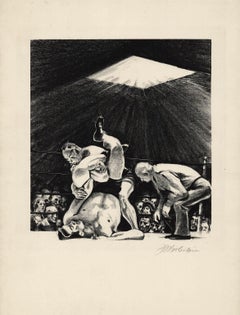
Joseph Golinkin created the lithograph entitled “Arm Scissors” circa 1938. This piece is signed in pencil, lower right, and titled and inscribed “3/50” at the lower left paper edge. The printed image size is 13.25 x 11.88 inches and the overall paper (sheet) size is 23 x 16 inches. Beautifully composed “Arm Scissors” also exudes the excitement of the moment through the spectator’s expressions and the crouched referee. JOSEPH WEBSTER GOLINKIN...

Category

1930s Naturalistic Joseph Webster Golinkin Art

Materials

Lithograph

Joseph Webster Golinkin art for sale on 1stDibs.

Find a wide variety of authentic Joseph Webster Golinkin art available for sale on 1stDibs. If you’re browsing the collection of art to introduce a pop of color in a neutral corner of your living room or bedroom, you can find work that includes elements of green and other colors. You can also browse by medium to find art by Joseph Webster Golinkin in lithograph, paint, watercolor and more. Not every interior allows for large Joseph Webster Golinkin art, so small editions measuring 14 inches across are available. Customers who are interested in this artist might also find the work of Charles De Wolf Brownell, Henri Gadbois, and Harry Rogers. Joseph Webster Golinkin art prices can differ depending upon medium, time period and other attributes. On 1stDibs, the price for these items starts at $750 and tops out at $11,250, while the average work can sell for $2,220.

Artists Similar to Joseph Webster Golinkin

Jean Louis Prévost
Charles De Wolf Brownell
Dr. Robert John Thornton
John and Elizabeth Gould
Pierre-Joseph Redouté
Johan Christoph Volkhamer
Jean Baptiste Francois Buillard