Koloman Moser Prints and Multiples

Austrian, 1868-1918

Born in Vienna in 1868, Koloman Moser briefly attended trade school, honoring his father’s wish to see him in commerce. But he soon surrendered to his artistic inclinations, enrolling in 1885 in Vienna’s Academy of Fine Arts, where he studied painting.

When his father died unexpectedly in 1888, leaving the family in financial straits, Moser (1868–1918) helped out by doing illustrations for books and magazines. Meanwhile, he continued his painting studies, at the academy and then at the School of Arts and Crafts, starting in 1892. That was also the year that Moser, along with other young artists revolting against the Viennese art world’s devotion to naturalism, formed the Siebner Club, the precursor to the Vienna Secession.

Moser’s introduction during his last term at school to Gustav Klimt’s Allegory of Sculpture proved a turning point for the young artist. Christian Witt-Dörring, guest curator of the 2018–19 exhibition “Koloman Moser: Universal Artist between Gustav Klimt and Josef Hoffmann” at the MAK in Vienna, noted a change in the artist’s drawing style. “Primarily inspired by the art of Japan, [Klimt] introduces new paper sizes, fragmented image details, and an emphasis on the line as opposed to the surface,” wrote Witt-Dörring in the exhibition’s catalogue.

A year later, in 1897, Moser together with Klimt, Carl Moll, Joseph Olbrich and Josef Hoffmann founded the Vienna Secession, a union of artists and designers determined to upend Austria’s artistic conservatism. The members were committed to making total works of art: Gesamtkunstwerken. Looking to the English Arts and Crafts Movement, with its guiding principle of unity of the arts, the group attempted to bring art back into everyday life and introduce a local modernism to fin-de-siècle Vienna. Moser, whose membership in the club also afforded him entry into upper-class Viennese society, turned his back on oil painting and forged ahead with Gesamtkunstwerk.

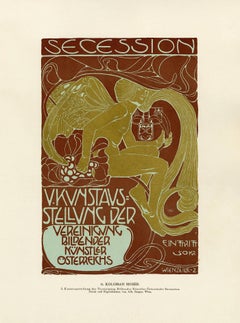
Moser created everything from exhibition design to facade ornamentation for the Secession Building, to graphic materials. Moser also produced posters and advertisements in his “modern style” for various companies. In 1898, he presented his first decor pieces, including hand-knotted rugs and cushion covers. In 1899, Moser began what would become a lifelong professorship at the School of Arts and Crafts. His repertoire now expanded to include furniture, ceramics and patterns like his trademark checkerboard design. He also moved into scenography and fashion and established himself as an interior designer.

The artist decorated his own home in 1902, after which he received a series of important commissions, notably the villa of textile industrialist Fritz Waerndorfer. It was Waerndorfer who provided the financial support that enabled Moser and Hoffmann in 1903 to found the Wiener Werkstätte, a platform for fully realizing their ideal of Gesamtkunstwerk. Two years later, Moser married Edith Mautner von Markhof, the daughter to one of Austria’s great industrial barons, and his work thrived. 

In 1907, the Wiener Werkstätte ran into financial trouble. Losing faith in the unity of the arts and disillusioned with the group’s dependency on wealthy patrons like Waerndorfer, Moser left the Werkstätte. He returned to his original discipline, painting, which he continued to practice until his untimely death from cancer, in 1918.

Today, Koloman Moser’s work, from his metal vases to his jewelry to his interiors, remains sought-after and revered. Browse Moser's radically modern creations at 1stDibs.
to
11
Overall Width
to
Overall Height
to
11
45
1,564
1,074
932
659
10
1
1
6
5
11
7
6
6
6
6
4
2
2
1
1
1
1
1
10
1
11
Artist: Koloman Moser
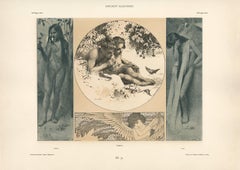
Gerlach's Allegorien Plate #37: "Music" Lithograph

Gerlach's Allegorien Plate #37: "Music" Lithograph

By Koloman Moser

Located in Palm Beach, FL

Koloman Moser (1868 –1918), AUSTRIAN Instead of applying his flair and art education solely to painting, Koloman Moser embodied the idea of Gesamt Kunstwerk (all-embracing art w...

Category

1890s Vienna Secession Koloman Moser Prints and Multiples

Materials

Lithograph

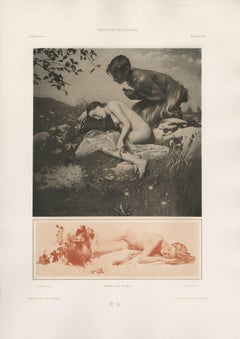
Gerlach's Allegorien Plate #30: "Love" Lithograph

Gerlach's Allegorien Plate #30: "Love" Lithograph

By Koloman Moser

Located in Palm Beach, FL

Koloman Moser (1868 –1918), AUSTRIAN Instead of applying his flair and art education solely to painting, Koloman Moser embodied the idea of Gesamt Kunstwerk (all-embracing art w...

Category

1890s Vienna Secession Koloman Moser Prints and Multiples

Materials

Lithograph

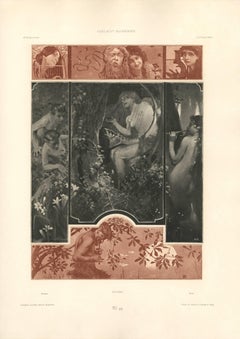
Gerlach's Allegorien Plate #89: "Bookplate Spring" Lithograph

Gerlach's Allegorien Plate #89: "Bookplate Spring" Lithograph

By Koloman Moser

Located in Palm Beach, FL

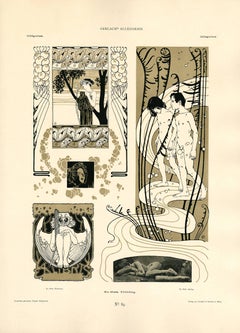
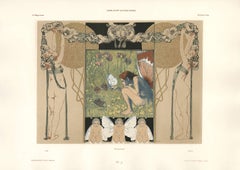
Koloman Moser (1868 –1918), AUSTRIAN Instead of applying his flair and art education solely to painting, Koloman Moser embodied the idea of Gesamt Kunstwerk (all-embracing art work) by designing architecture, furniture, jewelry, graphics, and tapestries meant to coordinate every detail of an environment. His work transcended the imitative decorative arts of earlier eras and helped to define Modernism for generations to come. Moser achieved a remarkable balance between intellectual structure (often geometric) and hedonistic luxury. Collaborating with Gustav Klimt and Josef Hoffmann, the artist was an editor and active contributor to Ver Sacrum, (Sacred Spring), the journal of the Viennese Secession that was so prized for its aesthetics and high quality production that it was considered a work of art. The magazine featured drawings and designs in the Jugendstil style (Youth) along with literary contributions from distinguished writers from across Europe. It quickly disseminated both the spirit and the style of the Secession. In 1903 Moser and Hoffmann founded and led the Wiener Werkstatte (Viennese Workshop) a collective of artisans that produced elegant decorative arts items, not as industrial prototypes but for the purpose of sale to the public. The plan, as idealistic then as now, was to elevate the lives of consumers by means of beautiful and useful interior surroundings. Moser’s influence has endured throughout the century. His design sensibility is evident from the mid-century modern furniture of the 1950s and ‘60s to the psychedelic rock posters...

Category

1890s Vienna Secession Koloman Moser Prints and Multiples

Materials

Lithograph

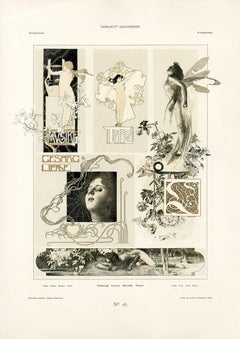
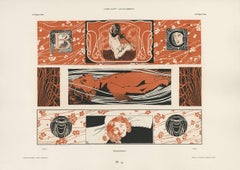
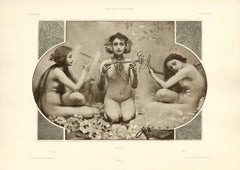
Gerlach's Allegorien Plate #20: "Song, Love, Music, Dance" Lithograph

Gerlach's Allegorien Plate #20: "Song, Love, Music, Dance" Lithograph

By Koloman Moser

Located in Palm Beach, FL

Koloman Moser (1868 –1918), AUSTRIAN Instead of applying his flair and art education solely to painting, Koloman Moser embodied the idea of Gesamt Kunstwerk (all-embracing art w...

Category

1890s Vienna Secession Koloman Moser Prints and Multiples

Materials

Lithograph

Gerlach's Allegorien Plate #51: "Summer" Lithograph

Gerlach's Allegorien Plate #51: "Summer" Lithograph

By Koloman Moser

Located in Palm Beach, FL

Koloman Moser (1868 –1918), AUSTRIAN Instead of applying his flair and art education solely to painting, Koloman Moser embodied the idea of Gesamt Kunstwerk (all-embracing art w...

Category

1890s Vienna Secession Koloman Moser Prints and Multiples

Materials

Lithograph

Gerlach's Allegorien Plate #35: "Love & Wine" Lithograph

Gerlach's Allegorien Plate #35: "Love & Wine" Lithograph

By Koloman Moser

Located in Palm Beach, FL

Koloman Moser (1868 –1918), AUSTRIAN Instead of applying his flair and art education solely to painting, Koloman Moser embodied the idea of Gesamt Kunstwerk (all-embracing art work) by designing architecture, furniture, jewelry, graphics, and tapestries meant to coordinate every detail of an environment. His work transcended the imitative decorative arts of earlier eras and helped to define Modernism for generations to come. Moser achieved a remarkable balance between intellectual structure (often geometric) and hedonistic luxury. Collaborating with Gustav Klimt and Josef Hoffmann, the artist was an editor and active contributor to Ver Sacrum, (Sacred Spring), the journal of the Viennese Secession that was so prized for its aesthetics and high quality production that it was considered a work of art. The magazine featured drawings and designs in the Jugendstil style (Youth) along with literary contributions from distinguished writers from across Europe. It quickly disseminated both the spirit and the style of the Secession. In 1903 Moser and Hoffmann founded and led the Wiener Werkstatte (Viennese Workshop) a collective of artisans that produced elegant decorative arts items, not as industrial prototypes but for the purpose of sale to the public. The plan, as idealistic then as now, was to elevate the lives of consumers by means of beautiful and useful interior surroundings. Moser’s influence has endured throughout the century. His design sensibility is evident from the mid-century modern furniture of the 1950s and ‘60s to the psychedelic rock posters...

Category

1890s Vienna Secession Koloman Moser Prints and Multiples

Materials

Lithograph

Gerlach's Allegorien Plate #94: "Heads" Lithograph

Gerlach's Allegorien Plate #94: "Heads" Lithograph

By Koloman Moser

Located in Palm Beach, FL

Koloman Moser (1868 –1918), AUSTRIAN Instead of applying his flair and art education solely to painting, Koloman Moser embodied the idea of Gesamt Kunstwerk (all-embracing art work) by designing architecture, furniture, jewelry, graphics, and tapestries meant to coordinate every detail of an environment. His work transcended the imitative decorative arts of earlier eras and helped to define Modernism for generations to come. Moser achieved a remarkable balance between intellectual structure (often geometric) and hedonistic luxury. Collaborating with Gustav Klimt and Josef Hoffmann, the artist was an editor and active contributor to Ver Sacrum, (Sacred Spring), the journal of the Viennese Secession that was so prized for its aesthetics and high quality production that it was considered a work of art. The magazine featured drawings and designs in the Jugendstil style (Youth) along with literary contributions from distinguished writers from across Europe. It quickly disseminated both the spirit and the style of the Secession. In 1903 Moser and Hoffmann founded and led the Wiener Werkstatte (Viennese Workshop) a collective of artisans that produced elegant decorative arts items, not as industrial prototypes but for the purpose of sale to the public. The plan, as idealistic then as now, was to elevate the lives of consumers by means of beautiful and useful interior surroundings. Moser’s influence has endured throughout the century. His design sensibility is evident from the mid-century modern furniture of the 1950s and ‘60s to the psychedelic rock posters...

Category

1890s Vienna Secession Koloman Moser Prints and Multiples

Materials

Lithograph

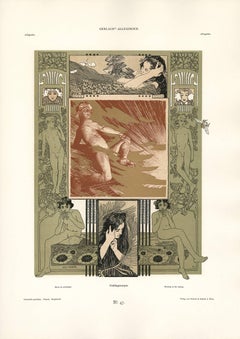
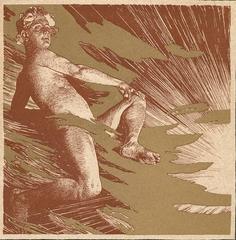
Gerlach's Allegorien Plate #47: "Morning in the Spring" Lithograph

Gerlach's Allegorien Plate #47: "Morning in the Spring" Lithograph

By Koloman Moser

Located in Palm Beach, FL

Koloman Moser (1868 –1918), AUSTRIAN Instead of applying his flair and art education solely to painting, Koloman Moser embodied the idea of Gesamt Kunstwerk (all-embracing art work) by designing architecture, furniture, jewelry, graphics, and tapestries meant to coordinate every detail of an environment. His work transcended the imitative decorative arts of earlier eras and helped to define Modernism for generations to come. Moser achieved a remarkable balance between intellectual structure (often geometric) and hedonistic luxury. Collaborating with Gustav Klimt and Josef Hoffmann, the artist was an editor and active contributor to Ver Sacrum, (Sacred Spring), the journal of the Viennese Secession that was so prized for its aesthetics and high quality production that it was considered a work of art. The magazine featured drawings and designs in the Jugendstil style (Youth) along with literary contributions from distinguished writers from across Europe. It quickly disseminated both the spirit and the style of the Secession. In 1903 Moser and Hoffmann founded and led the Wiener Werkstatte (Viennese Workshop) a collective of artisans that produced elegant decorative arts items, not as industrial prototypes but for the purpose of sale to the public. The plan, as idealistic then as now, was to elevate the lives of consumers by means of beautiful and useful interior surroundings. Moser’s influence has endured throughout the century. His design sensibility is evident from the mid-century modern furniture of the 1950s and ‘60s to the psychedelic rock posters...

Category

1890s Vienna Secession Koloman Moser Prints and Multiples

Materials

Paper

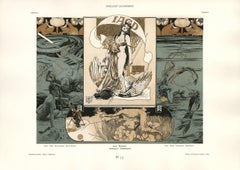
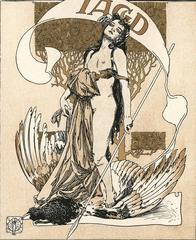
Gerlach's Allegorien Plate #75: "Hunting, Fishing, Rowing, Cycling"

Gerlach's Allegorien Plate #75: "Hunting, Fishing, Rowing, Cycling"

By Koloman Moser

Located in Palm Beach, FL

Koloman Moser (1868 –1918), AUSTRIAN Instead of applying his flair and art education solely to painting, Koloman Moser embodied the idea of Gesamt Kunstwerk (all-embracing art work) by designing architecture, furniture, jewelry, graphics, and tapestries meant to coordinate every detail of an environment. His work transcended the imitative decorative arts of earlier eras and helped to define Modernism for generations to come. Moser achieved a remarkable balance between intellectual structure (often geometric) and hedonistic luxury. Collaborating with Gustav Klimt and Josef Hoffmann, the artist was an editor and active contributor to Ver Sacrum, (Sacred Spring), the journal of the Viennese Secession that was so prized for its aesthetics and high quality production that it was considered a work of art. The magazine featured drawings and designs in the Jugendstil style (Youth) along with literary contributions from distinguished writers from across Europe. It quickly disseminated both the spirit and the style of the Secession. In 1903 Moser and Hoffmann founded and led the Wiener Werkstatte (Viennese Workshop) a collective of artisans that produced elegant decorative arts items, not as industrial prototypes but for the purpose of sale to the public. The plan, as idealistic then as now, was to elevate the lives of consumers by means of beautiful and useful interior surroundings. Moser’s influence has endured throughout the century. His design sensibility is evident from the mid-century modern furniture of the 1950s and ‘60s to the psychedelic rock posters...

Category

1890s Vienna Secession Koloman Moser Prints and Multiples

Materials

Lithograph

Gerlach's Allegorien Plate #44: "Music" Lithograph

Gerlach's Allegorien Plate #44: "Music" Lithograph

By Koloman Moser

Located in Palm Beach, FL

Koloman Moser (1868 –1918), AUSTRIAN Instead of applying his flair and art education solely to painting, Koloman Moser embodied the idea of Gesamt Kunstwerk (all-embracing art work) by designing architecture, furniture, jewelry, graphics, and tapestries meant to coordinate every detail of an environment. His work transcended the imitative decorative arts of earlier eras and helped to define Modernism for generations to come. Moser achieved a remarkable balance between intellectual structure (often geometric) and hedonistic luxury. Collaborating with Gustav Klimt and Josef Hoffmann, the artist was an editor and active contributor to Ver Sacrum, (Sacred Spring), the journal of the Viennese Secession that was so prized for its aesthetics and high quality production that it was considered a work of art. The magazine featured drawings and designs in the Jugendstil style (Youth) along with literary contributions from distinguished writers from across Europe. It quickly disseminated both the spirit and the style of the Secession. In 1903 Moser and Hoffmann founded and led the Wiener Werkstatte (Viennese Workshop) a collective of artisans that produced elegant decorative arts items, not as industrial prototypes but for the purpose of sale to the public. The plan, as idealistic then as now, was to elevate the lives of consumers by means of beautiful and useful interior surroundings. Moser’s influence has endured throughout the century. His design sensibility is evident from the mid-century modern furniture of the 1950s and ‘60s to the psychedelic rock posters...

Category

1890s Vienna Secession Koloman Moser Prints and Multiples

Materials

Lithograph

Related Items
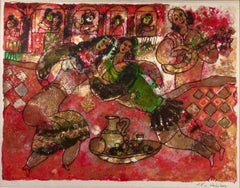
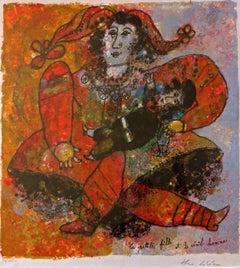
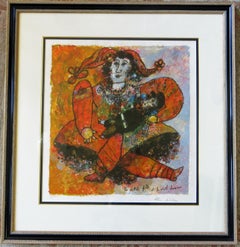
Rachel, Large Framed Expressionist Lithograph by Theo Tobiasse

Rachel, Large Framed Expressionist Lithograph by Theo Tobiasse

By Théo Tobiasse

Located in Long Island City, NY

Artist: Theo Tobiasse, French (1927 - 2012) Title: Rachel Year: 1984 Medium: Lithograph, signed and numbered in pencil Edition: 86/125 Image: 38 x 26 inches Size: 42 x 28.5 in....

Category

1980s Expressionist Koloman Moser Prints and Multiples

Materials

Lithograph

Cabaret - Signed Lithograph

Cabaret - Signed Lithograph

By Edvard Munch

Located in Paris, IDF

Edvard MUNCH (1863 - 1944) Cabaret Lithograph Signed on the plate Proof, HC On Arches vellum, 50 x 65 cm (c. 19.7 x 25.6 in) INFORMATION: Published by Art.Paris based on the origin...

Category

1910s Expressionist Koloman Moser Prints and Multiples

Materials

Lithograph

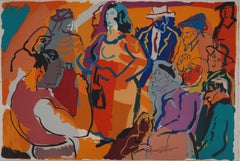
Armand Nakache - Original Handsigned Lithograph - Ecole de Paris

Armand Nakache - Original Handsigned Lithograph - Ecole de Paris

By Armand Nakache

Located in Collonge Bellerive, Geneve, CH

Armand Nakache Original Handsigned Lithograph Dimensions: 76 x 54 cm Edition: HC XXI/XXX HandSigned and Numbered Ecole de Paris au seuil de la mutation des Arts Sentiers Editions ...

Category

1960s Expressionist Koloman Moser Prints and Multiples

Materials

Lithograph

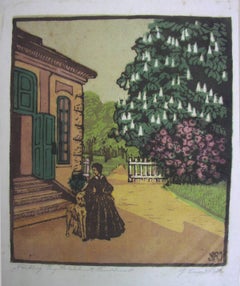
Fruhling

Josef Siccard-RedlFruhling, 1910

$800

H 12.05 in W 10.075 in

Fruhling

By Josef Siccard-Redl

Located in New York, NY

Siccard-Redl, Josef. Fruhling, Ca 1910. Color wood engraving, Signed and titled in pencil by the artist. Little is known of this artist other than he worked in Vienna during the ...

Category

1910s Vienna Secession Koloman Moser Prints and Multiples

Materials

Engraving

Polish French Figurative Abstract Art Brut Expressionist Lithograph Maryan

Polish French Figurative Abstract Art Brut Expressionist Lithograph Maryan

By Pinchas Maryan

Located in Surfside, FL

Pinchas Burstein, known as Maryan Lithograph (after the drawing). 1960 Dimensions: 12 3/8 x 9 3/8 inches (315 x 240mm). Gold or bronze ink on black paper Signed in the plate, not b...

Category

1960s Expressionist Koloman Moser Prints and Multiples

Materials

Paper, Lithograph

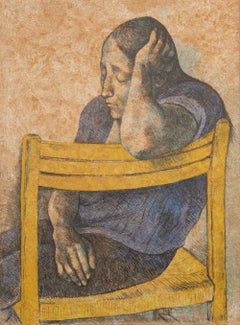
Apeles Fenosa Spanish Sculptor Mourlot Lithograph Abstract Expressionist Figures

Apeles Fenosa Spanish Sculptor Mourlot Lithograph Abstract Expressionist Figures

By Apelles Fenosa

Located in Surfside, FL

This is from a hand signed, limited edition (edition of 125) folio or full page lithographs some having a poem verso. The individual sheets are not signed or numbered. This listing ...

Category

1970s Expressionist Koloman Moser Prints and Multiples

Materials

Lithograph

Un Dia de Marzo, 1981 by Juan Garcia Ripolles

Un Dia de Marzo, 1981 by Juan Garcia Ripolles

By Juan García Ripollés

Located in Long Island City, NY

Artist: Juan Garcia Ripolles, Spanish (1932 - ) Title: Un Dia de Marzo... Year: 1981 Medium: Lithograph, signed and numbered in pencil Edition: 16 Image Size: 14 x 16.5 inches Size: ...

Category

1980s Expressionist Koloman Moser Prints and Multiples

Materials

Lithograph

Polish French Figurative Abstract Art Brut Expressionist Lithograph Maryan

Polish French Figurative Abstract Art Brut Expressionist Lithograph Maryan

By Pinchas Maryan

Located in Surfside, FL

Pinchas Burstein, known as Maryan Lithograph (after the drawing). 1960 Dimensions: 12 3/8 x 9 3/8 inches (315 x 240mm). There is printed text on the back, as issued. Signed in the...

Category

1960s Expressionist Koloman Moser Prints and Multiples

Materials

Paper, Lithograph

Circle of Life
Circle of Life

Circle of Life

By Rudolf Bauer

Located in Fairlawn, OH

Circle of Life Lithograph on tan paper, c. 1910's Signed in pencil lower right; signed in the plate lower right (see photo) Annotated "No. 50" in pencil lower left (see photo) ...

Category

1910s Expressionist Koloman Moser Prints and Multiples

Materials

Lithograph

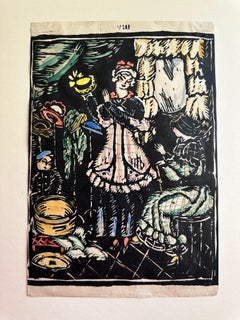
Untitled Woodcut
Untitled Woodcut

reni schaschlUntitled Woodcut, 1916

$2,800Sale Price|20% Off

H 11.5 in W 7.75 in

Untitled Woodcut

Located in Wilton, CT

Original hand-colored woodcut from a portfolio of Secessionist fashion illustrations. Signed in the lower right margin by the artist, Reni Schaschl (1895-1979), a talented member of...

Category

1910s Vienna Secession Koloman Moser Prints and Multiples

Materials

Woodcut

Mädchen am Fenster. 1906-08.

Mädchen am Fenster. 1906-08.

By Oskar Kokoschka

Located in New York, NY

Mädchen am Fenster. 1906-08. Color lithograph printed on smooth card stock. Full margins. , signed by the artist in pencil, on the recto. Published by the Wiener Werkstätte, Vienna, with the printed postcard text on verso. Among Kokoschka's earliest prints were a series of 14 postcards, the current work and the following lot that he produced for the Wiener Werkstätte. Wingler/Welz 4. Oskar Kokoschka was an Austrian artist, poet and playwright best known for his intense expressionistic portraits...

Category

Early 1900s Vienna Secession Koloman Moser Prints and Multiples

Materials

Lithograph

Previously Available Items
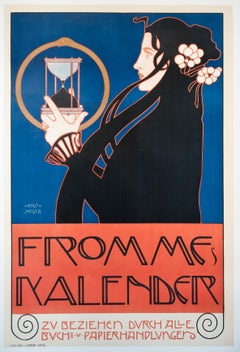
Fromme's Kalender Art Nouveau Lithograph Poster Koloman Moser Vienna Secession

Fromme's Kalender Art Nouveau Lithograph Poster Koloman Moser Vienna Secession

By Koloman Moser

Located in Palm Beach, FL

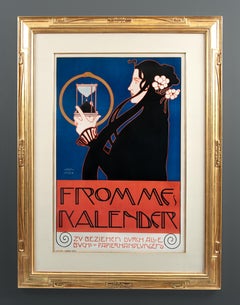
Lithograph printed by Albert Berger, Vienna. This design "was considered very advanced in 1899, with its large scale portrayal of the motif and the almost complete renunciation of interior drawing. The silhouette of the body is in mysterious contrast to the realistically portrayed head and hands. The unwavering gaze of the woman underlines the symbolism of the design: the Norn [ancient Norse goddess of fate] with the hour-glass and snake-ring embodies the eternal circle of life and the running out of time" (Vienna Secession, Denscher, p. 45). As the poster was originally used in 1899, the waning sand in the hourglass quite naturally can be assumed to be the coming of the end of the century. KOLOMAN MOSER: Instead of applying his flair and art education to paintings, Koloman Moser embodied the idea of Gesamt Kunstwerk (all-embracing art work) by designing architecture, furniture, jewelry, graphics, and tapestries meant to coordinate every detail of an environment. His work transcended the imitative decorative arts of earlier eras and helped to define Modernism for generations to come. Moser achieved a remarkable balance between intellectual structure (often geometric) and hedonistic luxury. Collaborating with Gustav Klimt and Josef Hoffmann, the artist was an editor and active contributor to Ver Sacrum, (Sacred Spring), the journal of the Viennese Secession that was so prized for its aesthetics and high quality production that it was considered a work of art. The magazine featured drawings and designs in the Jugendstil (Youth Style) along with literary contributions from distinguished writers from across Europe. It quickly disseminated both the spirit and the style of the Secession. In 1903 Moser and Hoffmann founded and led the Wiener Werkstatte (Viennese Workshop) a collective of artisans that produced elegant decorative arts items, not as industrial prototypes but for the purpose of sale to the public. The plan, as idealistic then as now, was to elevate the lives of consumers by means of beautiful and useful interior surroundings. Moser’s influence has endured throughout the century. His design sensibility is evident from the mid-century modern furniture of the 1950s and ‘60s to the psychedelic rock posters...

Category

1890s Art Nouveau Koloman Moser Prints and Multiples

Materials

Paper, Lithograph

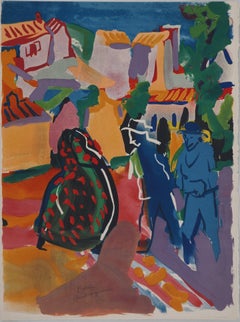
Koloman Moser prints and multiples for sale on 1stDibs.
Find a wide variety of authentic Koloman Moser prints and multiples available for sale on 1stDibs. You can also browse by medium to find art by Koloman Moser in lithograph, paper and more. Much of the original work by this artist or collective was created during the 19th century and is mostly associated with the Expressionist style. Not every interior allows for large Koloman Moser prints and multiples, so small editions measuring 12 inches across are available. Customers who are interested in this artist might also find the work of Carl Otto Czeschka, Gustav Klimt, and Oskar Kokoschka. Koloman Moser prints and multiples prices can differ depending upon medium, time period and other attributes. On 1stDibs, the price for these items starts at $2,750 and tops out at $55,000, while the average work can sell for $2,750.