Mörsil, Sweden.
A small village in Jämtland, surrounded by forests, mountains and the long winters of northern Sweden.
It was here that Swedish artist and illustrator Billy Good spent his youth.
And it is difficult to imagine a greater contrast to the painting he would create in 1949.
There is nothing quiet about it.
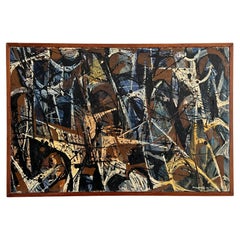
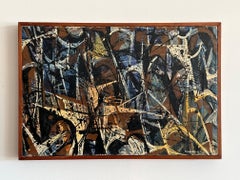
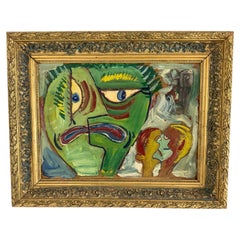
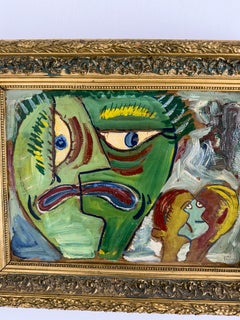
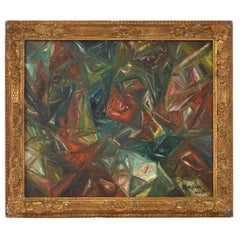
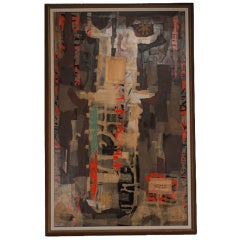
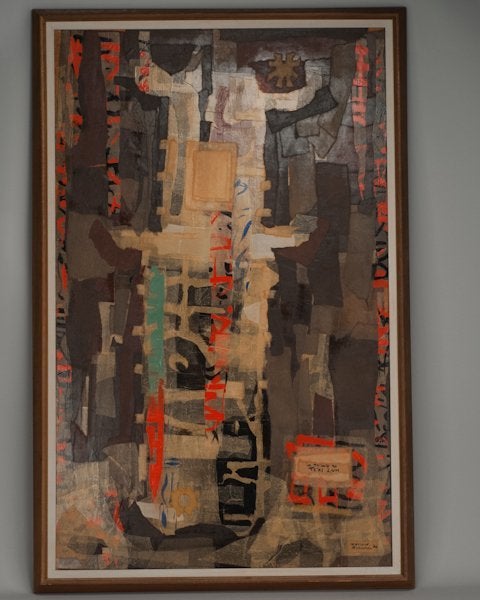
A monumental green face fills almost the entire composition. One eye looks outward while the other drifts sideways. A heavy red and blue mouth curves across the face, while dark lines divide its features into almost architectural planes.
Then, in the lower corner, another figure appears.
Small. Almost hidden.
A pale face surrounded by red and yellow looks upward toward the enormous green presence beside it.
The relationship between the two remains unexplained.
That ambiguity is part of the painting’s extraordinary character.
Painted in 1949, the work belongs to a fascinating moment in European art. The Second World War had ended only four years earlier, and artists across Europe were increasingly moving away from traditional representation toward abstraction, expressionism and fragmented interpretations of the human figure.
Good’s painting seems to inhabit that same restless visual world.
The face remains recognisable, yet it has been deliberately distorted.
Perspective disappears.
Colour becomes emotional rather than naturalistic.
Green, yellow, red and blue collide across the surface, held together by powerful dark contours.
Behind this striking modernist painting lies the story of an artist whose life and work are surprisingly little known today.
Billy Good grew up in Mörsil in Jämtland before leaving for Stockholm during the 1940s, where he established himself as an illustrator and advertising artist.
People, and particularly faces, appear to have remained a fascination throughout his life.
Decades later, Good returned artistically to the community of his youth.
He created 58 portraits of people connected with Mörsil, characters he remembered from growing up there during the 1920s and 1930s.
He then transformed those portraits into something remarkable: a complete deck of playing cards.
The blacksmith.
The doctor.
The skier.
The accordion player.
People from a small Swedish community became characters in Good’s own visual world.
He also portrayed figures beyond Mörsil. Among his known graphic works is a portrait of Swedish football legend Nacka Skoglund, one of the country’s great sporting icons of the twentieth century.
Seen against this background, the 1949 painting...
Category
Mid-20th Century Swedish Mid-Century Modern Leonard Maurer Furniture