Lesser Ury Art

to
8
1
1
1
Overall Width
to
Overall Height
to
1
11
4
7
9
1
8
3
8
5
4
2
2
2
2
2
1
1
1
1
1
1
1
1
1
7
5
5
2
2
12
10,027
2,758
1,380
1,375
1
11
1
Artist: Lesser Ury
Trees on the Shore of Grunewaldsee, from: Berlin Impressions - German Berlin
By Lesser Ury
Located in London, GB
This original etching and drypoint is hand signed in pencil by the artist "L. Ury" at the lower left margin. It is numbered 20 from the standard edition of 100. There was also an edi...
Category

1920s Impressionist Lesser Ury Art

Materials

Drypoint, Etching
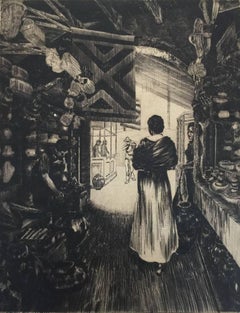
Leipzigerstraße in the Rain - German Impressionism Berlin
By Lesser Ury
Located in London, GB
This original etching is hand signed in pencil by the artist "L. Ury" at the lower left margin. It is a signed proof from outside the edition of 30, printed and published by Fritz Gu...
Category

1920s Impressionist Lesser Ury Art

Materials

Etching

Amsterdam Canal - German Impressionism Dutch Landscape Amsterdam Cityscape
By Lesser Ury
Located in London, GB
This oil on canvas is hand signed by the artist "L. Ury" at the lower right corner. It was realised in 1912 whilst the artist was in Holland. Provenance: Max and Rosa Joel, Berlin ...
Category

1910s Impressionist Lesser Ury Art

Materials

Canvas, Oil

Beim Kornpuppenbinden (Corn Husking)
By Lesser Ury
Located in New York, NY
Lesser Ury (German, 1861–1931), Beim Kornpuppenbinden, drypoint, 1923, signed in pencil lower right and numbered 45/100, from the edition of 100. Reference: Rosenbach 17, only state...
Category

1920s Expressionist Lesser Ury Art

Materials

Drypoint

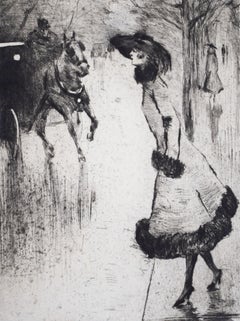
Lady with a Poodle on a Rainy Street (Carriage to the Left) - Impressionist
By Lesser Ury
Located in London, GB
This original etching is hand signed in pencil by the artist "L. Ury" at the lower left margin. It is a signed proof from an edition of unknown size. It is a particularly rare subjec...
Category

1920s Impressionist Lesser Ury Art

Materials

Etching

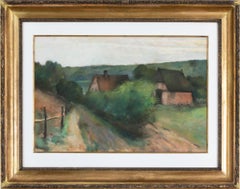
Landscape by Lesser Ury - Pastel on paper
By Lesser Ury
Located in London, GB
*PLEASE NOTE UK BUYERS WILL ONLY PAY 5% VAT ON THIS PURCHASE. Landscape by Lesser Ury (1861-1931) Pastel on paper 50 x 70 cm (19 ³/₄ x 27 ¹/₂ inches) Signed lower left Executed in 1...
Category

1910s Lesser Ury Art

Materials

Paper, Pastel

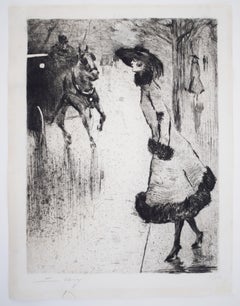
Lady Hailing a Carriage - German Impressionism Berlin
By Lesser Ury
Located in London, GB
This original etching and drypoint is hand signed in pencil by the artist "L. Ury" at the lower left margin. It is also hand numbered in pencil from the edition of 150, at the lower ...
Category

1910s Impressionist Lesser Ury Art

Materials

Drypoint, Etching
Walk Along the Landwehr Canal, from: Berlin Impressions - German Impressionism
By Lesser Ury
Located in London, GB
This original etching and drypoint is hand signed in pencil by the artist "L. Ury" at the lower left margin. It is an artist’s proof aside from the standard edition of 100. There was...
Category

1920s Impressionist Lesser Ury Art

Materials

Drypoint, Etching
Dutch Themes - 7 Etchings German Impressionism
By Lesser Ury
Located in London, GB
This complete set of seven etchings and drypoint is hand signed in pencil by the artist "L. Ury" at the lower right margin of each print. It was printed circa 1920 in a limited edit...
Category

1920s Impressionist Lesser Ury Art

Materials

Etching

In the Café. [Man in a Top hat in front of a Coffee House Window...]
By Lesser Ury
Located in London, GB
This original etching and drypoint is hand signed in pencil by the artist "L. Ury" at the lower left margin. It was published in an edition of 110 hand signed impressions by Propyläe...
Category

1920s Impressionist Lesser Ury Art

Materials

Drypoint, Etching
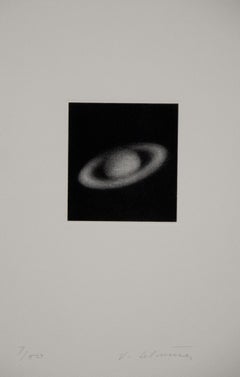
Lesser Ury - Auf dem kanal, impressionist, pastel, german, waterscape, canal
By Lesser Ury
Located in London, GB
Lesser Ury (1861-1931) Auf dem Kanal 1912 pastel on board 49.2 x 34.9 cm signed and dated 'L.Ury.1912.' (lower left) Price: $25,000 USD Provenance: Sale: Christie's London, 30 June 2000, lot 42 Collection of Simone and Jean Tiroche (acquired at the above sale) Thence by descent Sale: Christie's London, 19 June 2013, lot 199 Private collection, UK (acquired from the above sale) Notes: Dr Sibylle Gross has confirmed the authenticity of this work. Lesser Ury, a German-Jewish Impressionist...
Category

1910s Impressionist Lesser Ury Art

Materials

Pastel, Board

The Sculptor’s Studio Das Bildhauer Atelier
By Lesser Ury
Located in London, GB
LESSER URY 1861-1931 Międzychód, Poland 1861 - 1931 Berlin (German) Title: The Sculptor’s Studio Das Bildhauer Atelier, 1883 Technique: Hand Signed and Dated Oil on Canvas Pape...
Category

1880s Lesser Ury Art

Materials

Oil

Related Items
American Contemporary Art by Elena Borstein - Lavander Gate Storm
By Elena Borstein
Located in Paris, IDF
Pastel on paper Elena Borstein currently lives and works in New York City and the Adirondack Mountains. Born in Hartford, Connecticut, She received her B.S. Degree from Skidmore Col...
Category

1990s Contemporary Lesser Ury Art

Materials

Paper, Pastel

Impressionist Parisian Street Scene in Autumn contemporary
By Antoine Blanchard
Located in Hillsborough, NC
Beautifully painted, this is a contemporary work in the style of French impressionist artist Antoine Blanchard. In rich impasto brushstokes, the Parisian cityscape shows the vitality...
Category

20th Century Impressionist Lesser Ury Art

Materials

Canvas, Oil

L'Avant-Foyer de l'Opera /// French Impressionist Etching Figurative Lady Man
By Tony Minartz
Located in Saint Augustine, FL
Artist: Tony Minartz (French, 1873-1944) Title: "L'Avant-Foyer de l'Opera" Portfolio: Revue de l'Art Ancien & Moderne *Issued unsigned Year: 1903 Medium: Original Etching on cream laid paper Limited edition: Unknown Printer: Unknown Publisher: Revue de l'Art Ancien & Moderne, Paris, France Framing: Recently framed in a traditional gold and black moulding with 100% cotton rag matting Framed size: 18.63" x 16.38" Sheet size: 12" x 9" Image size: 9" x 7.25" Condition: In excellent condition Notes: Printed in one color: bistre. This review was founded in 1897 in the continuity of the review Les Beaux-Arts published between 1861 and 1865; Jules Comte, the founder, entitled his first issue Les Beaux-Arts - Revue nouvelle then changed the title to La Revue de l'art ancien et moderne. Jules Comte directed the review until his death in 1912. Raymond Woog took over , who was provisional director until the start of the war in July 1914. In 1919, André Dezarrois took over this review and was its director until December 1937, date of last issue (published in January 1938). In the meantime, it publishes the Bulletin of ancient and modern art, which has gained a certain notoriety in the community. Biography: Tony Minartz, pseudonym of Antoine Guillaume, born 8 April 1873 to Cannes and died in that city on 13 December 1944 Is a painter, draftsman , illustrator and engraver French. Painter autodidact , Tony Minartz starts to become known in 1896 by exhibiting paintings at the Salon of the National Society of Fine Arts , and then decorates the Pompadour theater of painted panels for fashion shows " Grand Guignol ", directed by L. Darthenay. In 1903, Henri Béraldi , with whom he worked, praised him in The Journal of ancient and modern art, writing that "it was thirty years ago," and he has received advice from Paul Renouard to be formed the technique of etching ; Béraldi adds that his favorite subjects are "Paris at night Paris at night, always." Minartz also gives them some high-remarkable in The Journal of ancient and modern art until 1910: balls, cafe concerts, Parisian in their most beautiful dresses, but also music-halls, music halls, restaurants, large and small theaters, are the preferred settings of his compositions. Its fertile period seems to end in 1914. In addition to the National Salon, Minartz exhibited in Paris at the gallery Bartholomew (1903), the Independent Living (1905, 1906) and the gallery Devambez (1909) and received the Academic Palms . He occasionally collaborates with periodic illustrated as The Almanac Sports (Ollendorff, 1899), or satirical as Gil Blas...
Category

Early 1900s Impressionist Lesser Ury Art

Materials

Etching, Laid Paper, Intaglio

Original Nice-Themal spa Berthemont - Les -Bains antique French vintage poster
By Emmanuel Bellini
Located in Spokane, WA
Original French travel poster: Nice - Thermal health spa original vintage poster created by artist Emmanuel Bellini. Original linen backed, large French travel size: Nice - Therm...
Category

1950s Impressionist Lesser Ury Art

Materials

Lithograph

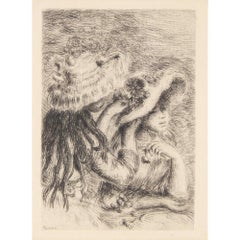
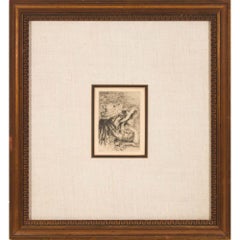
“Le Chapeau Epingle”
By Pierre-Auguste Renoir
Located in Southampton, NY
Original etching and drypoint on wove paper. This is the third version and the second edition printed in 1921 of Le Chapeau Epingle. Condition is very good...
Category

1880s Impressionist Lesser Ury Art

Materials

Archival Paper, Etching

Harvest Time with Croft, Haystacks, River in early 20th C Scottish Landscape
By Joseph Morris Henderson
Located in Hillsborough, NC
'Harvest Time' with Croft and Haystacks Impressionist oil on canvas painting is by popular Scottish artist Joseph Morris Henderson, RSA (1863-1936) known for Landscapes and Seascapes. Henderson exhibited in the London Royal Academy, the Royal Scottish Academy, Glasgow Institute of Fine Art, and in galleries across the UK. This painting is especially bright, of golden fields and haystacks, and impressionist figures by a rural white croft house...
Category

Early 20th Century Impressionist Lesser Ury Art

Materials

Canvas, Oil

Une Femme Assise by Lucien Pissarro - Etching
By Lucien Pissarro
Located in London, GB
Une Femme Assise by Lucien Pissarro (1863-1944) Etching 23 x 13 cm (9 x 5 ¹/₈ inches) Stamped lower right, L.P. and numbered lower left, 10/20 Provenance: John Bensusan Butt Private...
Category

1890s Impressionist Lesser Ury Art

Materials

Etching

The Gate, Chelsea
By Theodore Casimir Roussel
Located in New York, NY
Theodore Roussel (1847-1926), The Gate, Chelsea; etching and drypoint, 1889-1890, signed on the tab and inscribed imp [also signed in the plate lowere right]. Reference: Hausberg 33, fourth state (of 4), from the total printing of about 43 impressions. In excellent condition, trimmed by the artist all around on the plate mark except for the tab, 8 1/8 x 6 1/2 inches. A fine impression, printed on a light cream wove paper with plate tone (wiped to brighten the gate and doorway area) and substantial burr in the drypoint work. According to Hausberg, “The gate and house behind it still stand today at No. 4 Cheyne Walk...
Category

1880s Impressionist Lesser Ury Art

Materials

Drypoint, Etching
Summer Trees by River and Path
By Camille Pissarro
Located in Hillsborough, NC
Impressionist oil on canvas in lovely pastel green-blue shades, this summertime painting of trees, river and path is in the In the style of Camille Pissaro and other French impressio...
Category

1920s Impressionist Lesser Ury Art

Materials

Canvas, Oil

Summer Trees by River and Path
H 11 in W 8 in D 1.5 in
Touch of Fall watercolor and pastel painting by Nell Blaine
By Nell Blaine
Located in Hudson, NY
Signed "Nell Blaine" upper left in pencil. Signed, titled, dated verso on sheet. Signed, titled, dated verso on backing panel. The artist. Exhibited at Fischbach Gallery, NYC, in 1994 (Gallery label verso, and wall label affixed verso). Purchased by private collectors c.1994. By descent. Tibor de Nagy Gallery, NYC (the artist's estate representative), exhibited 2020 (label verso). Exhibited at Fischbach Gallery, NYC, in 1994 (Gallery label verso, and wall label affixed verso). Tibor de Nagy Gallery, NYC (the artist's estate representative), exhibited 2020 (label verso). From her November 15, 1996 NYT obituary: Nell Blaine, a widely respected New York landscape painter and watercolorist, died yesterday at Mount Sinai Hospital. She was 74 and had homes in Manhattan and Gloucester, Mass. Ms. Blaine, who had been hospitalized since July, had been confined to a wheelchair since 1959, when she contracted polio. Ms. Blaine was born in Richmond, Va., in 1922, and first studied at the Richmond School of Art, now part of Virginia Commonwealth University. She moved to New York in 1942 to study painting with Hans Hofmann and later studied etching and engraving at Atelier 17 with Stanley William Hayter. During her first years in New York, her work, which had previously been tightly realist, turned abstract, inspired by Mondrian, Leger and Jean Helion. At one time she was the youngest member of the American Abstract Artists. She was also a founding member of the Jane Street Gallery, one of Manhattan's earliest artists' cooperatives, and had her first solo show there in 1945. Just as Ms. Blaine was becoming known as a promising abstract painter, and gaining the admiration of such critics as Clement Greenberg, she started to shift back to representation. Inspired in part by a trip with Larry Rivers in 1950 to Paris, where she was especially impressed by the work of Vuillard and Bonnard, she immersed herself in the tradition of 19th-century European painting. From the mid-1950's, she cultivated an increasingly painterly and colorful style, usually working directly from nature, or still life, with particular emphasis on the forms and hues of flowers. Her work retained a sense of all-over structure and pulsating energy that she nonetheless credited to abstract art. ''It all goes back to Mondrian,'' she would say. In the 1950's, Ms. Blaine was prominent among a circle of New York artists and poets that included John Ashbery, Frank O'Hara, Kenneth Koch, Mr. Rivers, Jane Freilicher, Leland Bell, Louisa Matthiasdottir, Robert De Niro Sr. and Rudy Burckhardt. She had her first solo show of representational work at the Tibor de Nagy Gallery in 1953 and was represented by the Poindexter Gallery until it closed in 1978, and, in recent years, by the Fischbach Gallery. During the 1950's she supported herself as a commercial artist, designing brochures for art galleries. In 1955, she designed the original logo, column heads and layout for The Village Voice. In 1957, Ms. Blaine was featured in Life magazine as one of five leading young female artists in America. In 1959, after several months of traveling and painting in Greece, she contracted severe bulbar polio on the island of Mykonos. ''To Nell Blaine,'' an exhibition organized at Poindexter to raise money for her hospital bills, included the work of 79 artists, including Saul Steinberg, Robert Motherwell, Elaine and Willem de Kooning, Philip Guston, Mr. Rivers, Ms. Freilicher and Robert Rauschenberg. After eight months in a New York hospital, including five months in an iron lung...
Category

1990s Abstract Impressionist Lesser Ury Art

Materials

Paper, Pastel, Watercolor

A la Corrida
Located in Fairlawn, OH
A la Corrida Color aquatint, c. 1900 Signed "Osterlind" lower right in red pencil Annotated: "No. 96" in pencil lower left Edition: about 100 Published by Sagot, Paris: their blindst...
Category

Early 1900s Impressionist Lesser Ury Art

Materials

Aquatint

Rare 1922 German Jewish Judaica Zion Woodcut Woodblock Print Hermann Fechenbach
By Hermann Israel Fechenbach
Located in Surfside, FL
Title: Zion Subject: Various biblical images depicting Creation and prayer 1922 Medium: woodcut Frame: 14" x 18" Image: 12.5" x 16.75" Provenance: owned and signed verso by Peter Keil. Central panel shows the Jewish star over a crown, with inscription in Hebrew: "When God comforts Zion, He will comfort all its ruins and make its deserts look like Eden," and "You have sanctified the seventh day, the goal of creation of Heaven and Earth." This is flanked by a Palestinian farmer pioneer on the left and a Jew praying on the right. The lower tier shows six vignettes of the days of creation from Genesis. Hermann Fechenbach was born in 1897 in Württemberg, Germany. He grew up in Bad Mergentheim where his parents had an inn, which served as a meeting place for the local Jewish community. He left school early and through family connections with clothing retailers received training in window dressing. His skill with brush writing was quickly recognised by a big firm in Dortmund where he was responsible for the displays in 10 large windows. He received his conscription papers in 1916 and recalls “being as patriotic as any other fool”. In August 1917 he was involved in a grenade attack in which he was the sole survivor. With serious injuries to both legs he struggled to safety and was eventually transported to a front line “slaughterhouse” where the first of a series of amputations was performed which led to the loss of his left leg. As a result of his injuries his father dropped his opposition to him becoming an artist. His formal art education started in 1918 with training at a Stuttgart handcraft school for invalids. He attended the Academies in Stuttgart and Munich to learn painting and restoration for 3 years. He was influenced at this time by Max Liebermann. He has been compared to Kathe Kollwitz and was a contemporary of Jakob Steinhardt and hermann Struck. In 1923 he went to Florence for a year. While in Florence he started to produce a series of miniature wood engravings to illustrate the stories of Genesis. This was followed by periods in Pisa, Venice, Vienna and Amsterdam. In 1924 he returned to Stuttgart to paint in the contemporary style “Die Neue Sachlichkeit”. (The New Objectivity was a movement in German art that arose during the 1920s Weimar republic as a reaction against expressionism. The term was coined by Gustav Friedrich Hartlaub, the director of the Kunsthalle in Mannheim, who used it as the title of an art exhibition staged in 1925 to showcase artists who were working in a post-expressionist spirit. These artists—who included Max Beckmann, Otto Dix, George Grosz, Christian Schad, Rudolf Schlichter and Jeanne Mammen) Every spring and autumn he exhibited at the “Kunstgebit” which served as the showcase for all serious artists of the period. His professional status “Kunstmaler und Grafiker” was recognised by Berlin in 1926. Practically all his work from this period was sold following exhibition. In 1926 he collaborated with an architect friend to build a bungalow in Hohenheim, a non-Jewish area and a suburb of Stuttgart. Hermann alternately lived in his country bungalow and his town studio, producing portraits for sale or barter and wood engravings for his own pleasure. In 1930 he married a non-Jewish professional photographer – Greta Batze. They had a studio in Stuttgart, which was used to teach art to a group of 12 students. In 1933 the Nazi influence removed his name from the official state register together with the right to exhibit. By spending most of his time in his bungalow out of the Jewish quarter the Fechenbachs escaped being registered by the Nazis for some years. They were ostracised and abused by their non-Jewish neighbours. Hermann made weekly visits to friends in town to teach them the practical skills they would need assuming they were to escape from Germany. His energies were directed towards protection and survival. Ultimately the Nazi persecution forced the Fechenbachs to flee their homeland. They moved to Palestine for 3 months in 1938, but found the political and physical environment unsustainable. Greta arrived in England penniless in January 1939 to work as a domestic servant and to find a guarantor for her husband. Hermann arrived in May 1939. They moved to Blackheath a few months later. Hermann resumed his painting and engraving as a means of earning a living. He raised enough money to get his parents out of Germany to join his brothers in Argentina but was unable to save his twin sister Rosa who died in a Nazi concentration camp. In 1940 Hermann was interned in Bury as a suspect alien. He protested about his treatment by starting a hunger strike. Because of his persistence he was moved to a prison in Liverpool. From Liverpool he was moved to the Hutchinson Camp in the Isle of Man with fellow artist Kurt Schwitters. Arrangements were made for Greta to be accommodated near by. While interned he commenced work on “Refugee Impressions”, a series of linocut prints (no wood was available). In 1941 when released from internment the Fechenbachs came under the sponsorship of Dr. Bela Horovitz, the Austrian art publisher who in turn made an introduction to Professor Tancred Borenius. They were offered lodgings with a family in Oxford. Hermann had his first public exhibition for many years in a small gallery in Oxford in 1942. A second exhibition of oils, pencil drawings, coloured linocut and woodblock prints held later in the year was opened by the mayor of Oxford and critically acclaimed. In 1944 the first London exhibition took place at the Anglo-Palestinian club in Piccadilly. There were two exhibitions at the Ben Uri Art gallery during this period. In 1948 a second exhibition at the Anglo Palestinian club was inaugurated by a member of the Rothschild family and several members of Parliament. This was a great success. In 1944 the Fechenbachs moved to a top floor studio flat in Colet Gardens. Open exhibitions were held each Spring at the Embankment from 1946 to 1951. Movietone News produced a short feature on the artist, which was shown in cinemas in England and Germany. In 1969 he published the Genesis story in a hard back volume containing 137 prints. He started to research the fate of the entire Jewish community of Bad Mergentheim during the period of the second world war, liaising with historian Dr. Paul Sauer and Professor Max Miller, historian and theologian. In 1972 Kohlhammer published his partly autobiographical book “The last Jews of Mergentheim”. He exhibited at the Anglo-Palestinian Club & the Ben Uri Gallery in the 1940s. His works only came to prominence during the last year of his life when he exhibited at Blond Fine Art. Peter Keil part of the Junge Wilde. In 1978, the Junge Wilde painting style arose in the German-speaking world in opposition to established avant garde, minimal art and conceptual art. It was linked to the similar Transavanguardia movement in Italy, USA (neo-expressionism) and France (Figuration Libre). They were also known as the Neue Wilde. Artists included; Austria: Siegfried Anzinger, Erwin Bohatsch, Herbert Brandl, Gunter Damisch, Hubert Scheibl, Hubert Schmalix...
Category

1980s Impressionist Lesser Ury Art

Materials

Woodcut

Previously Available Items
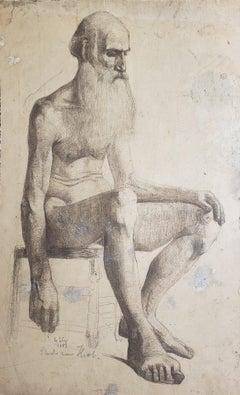
Study of Job
By Lesser Ury
Located in New York, NY
Signed, dated, and titled, lower left: L Ury/ 1883/ Studie zum Hiob Provenance: Mr. and Mrs. Dennis Berger, New York, until 2005; thence by descent. Literature: Illustrated in...
Category

Late 19th Century Impressionist Lesser Ury Art

Materials

Charcoal, Board

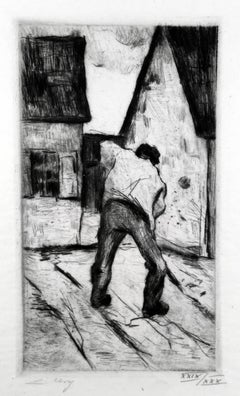
Grabender Bauer (Farmer Digging)
By Lesser Ury
Located in New York, NY
Lesser Ury (German, 1861–1931), , drypoint, Grabender Bauer (Farmer Digging), c. 1920, signed in pencil lower right and numbered xxix/xxx, from the edition of 30 on Japan (another 10...
Category

1920s Expressionist Lesser Ury Art

Materials

Drypoint

Lesser Ury art for sale on 1stDibs.

Find a wide variety of authentic Lesser Ury art available for sale on 1stDibs. You can also browse by medium to find art by Lesser Ury in drypoint, engraving, etching and more. Much of the original work by this artist or collective was created during the 20th century and is mostly associated with the Impressionist style. Not every interior allows for large Lesser Ury art, so small editions measuring 10 inches across are available. Customers who are interested in this artist might also find the work of Pierre Auguste Renoir, Louis Oscar Griffith, and Frank Benson. Lesser Ury art prices can differ depending upon medium, time period and other attributes. On 1stDibs, the price for these items starts at $600 and tops out at $181,500, while the average work can sell for $5,100.

Artists Similar to Lesser Ury

Still Thinking About These?

All Recently Viewed