Pati Bannister Prints and Multiples

to
9
Overall Width
to
Overall Height
to
9
1,563
1,074
931
648
9
8
1
9
8
6
4
4
4
3
2
2
2
2
1
1
1
1
1
1
1
1
1
9
9
Artist: Pati Bannister
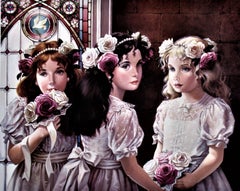
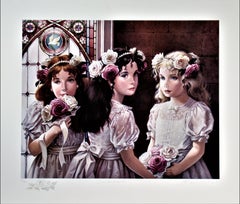
Bridesmaids
Bridesmaids

Bridesmaids

By Pati Bannister

Located in San Francisco, CA

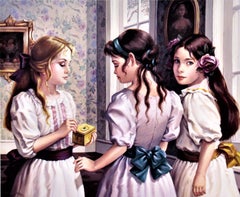
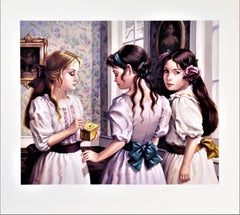
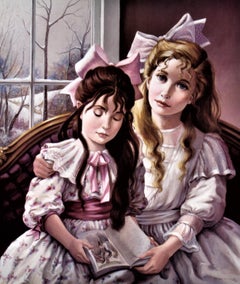
This artwork titled "Bridesmaids" 1995, is a color off set lithograph by British/American artist Pati Bannister, 1929-2013. It is hand signed, titled and numbered 41/950 in pencil by the artist. Published by Masters Publishing INC, New York. The image size is 18 x 22.5 inches, sheet size is 23.25 x 26 inches. It is in excellent condition. About the artist: Pati Bannister was born in Highgate, England, overlooking London in 1929. Growing up, both of her parents were artists. Her mother painted watercolor landscapes, while her father painted portraits. To help further her natural talents, she took art lessons as a young girl and ultimately went to work for J. Arthur Rank, the movie maker, as an animator.​ At 22 years old, she came to the United States as a governess for a family in Connecticut. Later she became a flight attendant in Florida where she met her future husband, Glynn. Little did she know, he would become the strongest influence in her life as he inspired her to pursue and share her artistic abilities with the public. ​In 1958, Pati and Glynn moved to New Orleans and she started painting portraits in Jackson Square. Eventually, she opened two art galleries located in the French Quarter. In the late 1960's, they moved to the Mississippi Gulf Coast...

Category

Late 20th Century Romantic Pati Bannister Prints and Multiples

Materials

Lithograph

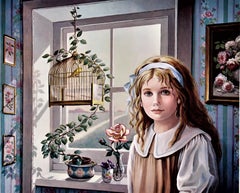
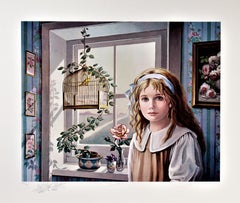
Songbird
Songbird

Songbird

By Pati Bannister

Located in San Francisco, CA

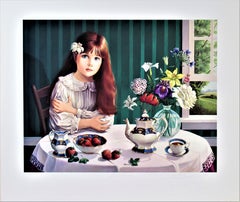
This artwork titled "Strawberies" 1990 is a color off set lithograph by British/American artist Pati Bannister, 1929-2013. It is hand signed, titled and numbered 45/485 in pencil by ...

Category

Late 20th Century Romantic Pati Bannister Prints and Multiples

Materials

Lithograph

Show and Tell
Show and Tell

Show and Tell

By Pati Bannister

Located in San Francisco, CA

This artwork titled "Show and Tell" 1999, is a color off set lithograph by British/American artist Pati Bannister, 1929-2013. It is hand signed, titled and numbered 476/950 in pencil by the artist. Published by Masters Publishing INC, New York. The image size is 17.5 x 21 inches, sheet size is 23.25 x 26 inches. It is in excellent condition. About the artist: Pati Bannister was born in Highgate, England, overlooking London in 1929. Growing up, both of her parents were artists. Her mother painted watercolor landscapes, while her father painted portraits. To help further her natural talents, she took art lessons as a young girl and ultimately went to work for J. Arthur Rank, the movie maker, as an animator.​ At 22 years old, she came to the United States as a governess for a family in Connecticut. Later she became a flight attendant in Florida where she met her future husband, Glynn. Little did she know, he would become the strongest influence in her life as he inspired her to pursue and share her artistic abilities with the public. ​In 1958, Pati and Glynn moved to New Orleans and she started painting portraits in Jackson Square. Eventually, she opened two art galleries located in the French Quarter. In the late 1960's, they moved to the Mississippi Gulf Coast...

Category

Late 20th Century Romantic Pati Bannister Prints and Multiples

Materials

Lithograph

Apple Orchard
Apple Orchard

Apple Orchard

By Pati Bannister

Located in San Francisco, CA

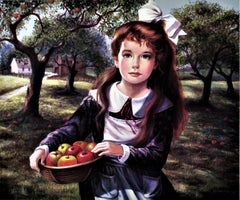
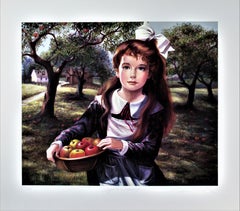
This artwork titled "Apple Orchard" 1998, is a color off set lithograph by British/American artist Pati Bannister, 1929-2013. It is hand signed, titled a...

Category

Late 20th Century Romantic Pati Bannister Prints and Multiples

Materials

Lithograph

Winter's tale
Winter's tale

Winter's tale

By Pati Bannister

Located in San Francisco, CA

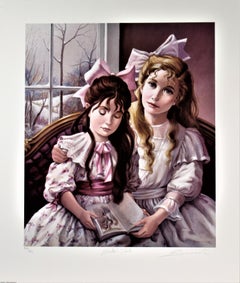
This artwork titled "Winter's Tales" 1995 is a color off set lithograph by British/American artist Pati Bannister, 1929-2013. It is hand signed, titled and numbered 409/950 in pencil...

Category

Late 20th Century Romantic Pati Bannister Prints and Multiples

Materials

Lithograph

Strawberries
Strawberries

Strawberries

By Pati Bannister

Located in San Francisco, CA

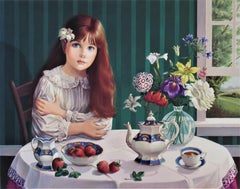
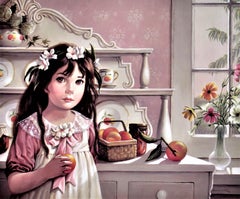
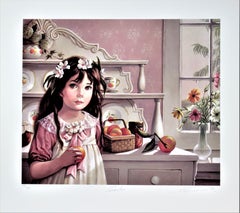
This artwork titled "Strawberies" c.1985, published 1996 is a color off set lithograph by British/American artist Pati Bannister, 1929-2013. It is hand signed, titled and numbered 656/950 in pencil by the artist. Published by Masters Publishing INC, New York. The image size is 16.5 x 21 inches, sheet size is 22.25 x 26 inches. It is in excellent condition. About the artist: Pati Bannister was born in Highgate, England, overlooking London in 1929. Growing up, both of her parents were artists. Her mother painted watercolor landscapes, while her father painted portraits. To help further her natural talents, she took art lessons as a young girl and ultimately went to work for J. Arthur Rank, the movie maker, as an animator.​ At 22 years old, she came to the United States as a governess for a family in Connecticut. Later she became a flight attendant in Florida where she met her future husband, Glynn. Little did she know, he would become the strongest influence in her life as he inspired her to pursue and share her artistic abilities with the public. ​In 1958, Pati and Glynn moved to New Orleans and she started painting portraits in Jackson Square. Eventually, she opened two art galleries located in the French Quarter. In the late 1960's, they moved to the Mississippi Gulf Coast...

Category

Late 20th Century Romantic Pati Bannister Prints and Multiples

Materials

Lithograph

Peaches
Peaches

Peaches

By Pati Bannister

Located in San Francisco, CA

This artwork titled "Peaches" 1996 is a color off set lithograph by British/American artist Pati Bannister, 1929-2013. It is hand signed, titled and numbered 548/950 in pencil by the artist. Published by Masters Publishing INC, New York. The image size is 17.5 x 21 inches, sheet size is 23.5 x 26 inches. It is in excellent condition. About the artist: Pati Bannister was born in Highgate, England, overlooking London in 1929. Growing up, both of her parents were artists. Her mother painted watercolor landscapes, while her father painted portraits. To help further her natural talents, she took art lessons as a young girl and ultimately went to work for J. Arthur Rank, the movie maker, as an animator.​ At 22 years old, she came to the United States as a governess for a family in Connecticut. Later she became a flight attendant in Florida where she met her future husband, Glynn. Little did she know, he would become the strongest influence in her life as he inspired her to pursue and share her artistic abilities with the public. ​In 1958, Pati and Glynn moved to New Orleans and she started painting portraits in Jackson Square. Eventually, she opened two art galleries located in the French Quarter. In the late 1960's, they moved to the Mississippi Gulf Coast...

Category

Late 20th Century Romantic Pati Bannister Prints and Multiples

Materials

Lithograph

Thanksgiving
Thanksgiving

Thanksgiving

By Pati Bannister

Located in San Francisco, CA

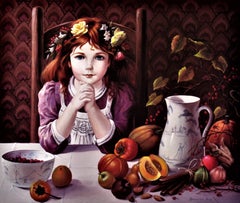
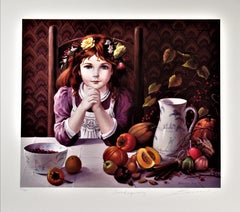
This artwork titled "Thanksgiving" 1995 is a color off set lithograph by British/American artist Pati Bannister, 1929-2013. It is hand signed, titled and numbered 587/950 in pencil by the artist. Published by Masters Publishing INC, New York. The image size is 17.75 x 21 inches, sheet size is 23.75 x 26 inches. It is in excellent condition. About the artist: Pati Bannister was born in Highgate, England, overlooking London in 1929. Growing up, both of her parents were artists. Her mother painted watercolor landscapes, while her father painted portraits. To help further her natural talents, she took art lessons as a young girl and ultimately went to work for J. Arthur Rank, the movie maker, as an animator.​ At 22 years old, she came to the United States as a governess for a family in Connecticut. Later she became a flight attendant in Florida where she met her future husband, Glynn. Little did she know, he would become the strongest influence in her life as he inspired her to pursue and share her artistic abilities with the public. ​In 1958, Pati and Glynn moved to New Orleans and she started painting portraits in Jackson Square. Eventually, she opened two art galleries located in the French Quarter. In the late 1960's, they moved to the Mississippi Gulf Coast...

Category

Late 20th Century Romantic Pati Bannister Prints and Multiples

Materials

Lithograph

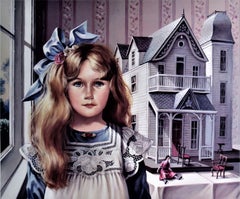
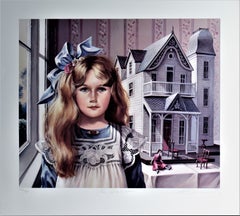
The Dollhouse
The Dollhouse

The Dollhouse

By Pati Bannister

Located in San Francisco, CA

This artwork titled "The Dollhouse" 1997, is a color off set lithograph by British/American artist Pati Bannister, 1929-2013. It is hand signed, titled and numbered 662/950 in pencil by the artist. Published by Masters Publishing INC, New York. The image size is 17.5 x 21 inches, sheet size is 23 x 26 inches. It is in excellent condition. About the artist: Pati Bannister was born in Highgate, England, overlooking London in 1929. Growing up, both of her parents were artists. Her mother painted watercolor landscapes, while her father painted portraits. To help further her natural talents, she took art lessons as a young girl and ultimately went to work for J. Arthur Rank, the movie maker, as an animator.​ At 22 years old, she came to the United States as a governess for a family in Connecticut. Later she became a flight attendant in Florida where she met her future husband, Glynn. Little did she know, he would become the strongest influence in her life as he inspired her to pursue and share her artistic abilities with the public. ​In 1958, Pati and Glynn moved to New Orleans and she started painting portraits in Jackson Square. Eventually, she opened two art galleries located in the French Quarter. In the late 1960's, they moved to the Mississippi Gulf Coast...

Category

Late 20th Century Romantic Pati Bannister Prints and Multiples

Materials

Lithograph

Related Items
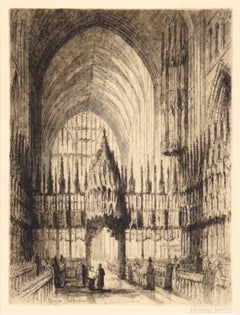
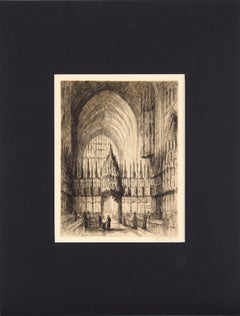
Chester Cathedral - Drypoint Etching in Ink on Paper

Chester Cathedral - Drypoint Etching in Ink on Paper

Located in Soquel, CA

Chester Cathedral - Drypoint Etching in Ink on Paper Dramatic drypoint etching by J. Alphege Brewer (British, 1881-1946). This composition shows the interior of Chester Cathedral in Brewer's characteristic style - highly detailed and with strong contrast. The scene encompasses the cathedral from floor to ceiling, capturing the immense size of the building. There are several people in the scene which contribute to the sense of scale. Signed by hand "J. Alphege Brewer" in the lower right corner. Titled "Chester Cathedral" in plate, lower left corner. Includes original card with artist's name. Presented in a new black mat with foamcore backing. Mat size: 16"H x 12"W Paper size: 10.75"H x 7.75"W James Alphege Brewer was well known in the early 20th century as a producer of color etchings of European cathedrals and other scenes of church, college, and community. He was born July 24, 1881, in the Kensington section of London, England, the son of Henry W. Brewer, noted artist of historical architecture and prominent convert to the Catholic Church, and the grandson of John Sherren Brewer, Jr., “the brilliant editor of the Calendar of Letters of Henry VIII.” His great uncle was E. Cobham Brewer, the polymath who compiled Brewer’s Dictionary of Phrase and Fable. Among his older siblings were the artist Henry C. Brewer and the organist and writer John Francis Brewer. Brewer attended the Westminster School of Art in London, where his brother Henry also trained. In 1910, he married Florence Emma Lucas, an accomplished painter in oil and watercolor, whose father was the noted landscape artist George Lucas and whose great uncle was David Lucas, the famous engraver for John Constable. Florence's brothers Edwin and George assisted Brewer in the printing of Brewer's etchings. Brewer exhibited at the Royal Academy (RA) and the Royal Institute of Painters in Watercolour (RI), at the Paris Salon of the Académie des Beaux-Arts, and in the shows of the Royal Cambrian Academy (RCA). He became an associate of the Royal Cambrian Academy in 1929 and a full member in the last two years of his life. He was also a member of the Hampstead Society of Artists, the Society of Graphic Art, and the Ealing Arts Club, where he was first Honorary Art Secretary and then Honorary Art Chairman. Most of Brewer's larger etchings were published by Alfred Bell...

Category

Early 20th Century Romantic Pati Bannister Prints and Multiples

Materials

Paper, Ink, Drypoint

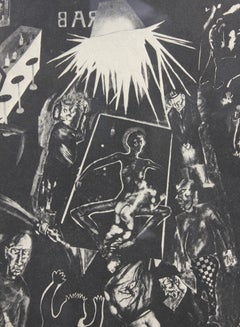
"Woman Walks into Bar" 53/450

Sue Coe"Woman Walks into Bar" 53/450, 1984

$1,200

H 30.75 in W 23 in D 1.5 in

"Woman Walks into Bar" 53/450

By Sue Coe

Located in Houston, TX

Known for addressing difficult issues, this lithograph by Sue Coe tackles the difficult subject of rape culture. It is numbered in the lower left corner and signed and dated in the l...

Category

1980s Abstract Pati Bannister Prints and Multiples

Materials

Lithograph

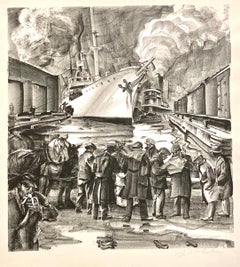
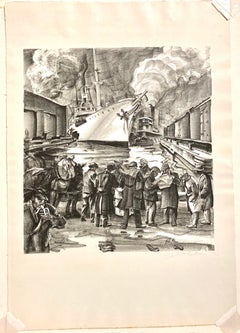
Joseph Webster Golinkin, On the Dock, Banana Boat, New Orleans

Joseph Webster Golinkin, On the Dock, Banana Boat, New Orleans

By Joseph Webster Golinkin

Located in New York, NY

Chicago-born Golinkin studied at the Artist Students League with George Luks. After working as an illustrator for New York papers he joined the Navy in 1939 and retired as a Rear Adm...

Category

1930s Ashcan School Pati Bannister Prints and Multiples

Materials

Lithograph

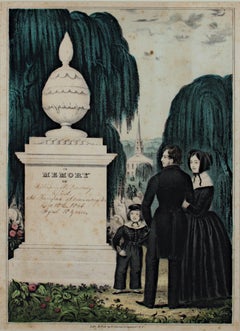
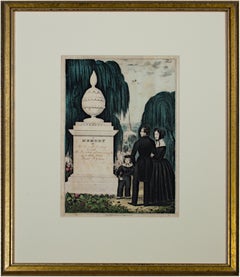
19th century color lithograph figures cemetery willow tree memorial headstone

19th century color lithograph figures cemetery willow tree memorial headstone

By Nathaniel Currier

Located in Milwaukee, WI

The present hand-colored lithograph was produced as part of the funeral and mourning culture in the United States during the 19th century. Images like this were popular as ways of remembering loved ones, an alternative to portraiture of the deceased. This lithograph shows a man, woman and child in morning clothes next to an urn-topped stone monument. Behind are additional putto-topped headstones beneath weeping willows, with a steepled church beyond. The monument contains a space where a family could inscribe the name and death dates of a deceased loved one. In this case, it has been inscribed to a young Civil War soldier: William W. Peabody Died at Fairfax Seminary, VA December 18th, 1864 Aged 18 years The young Mr. Peabody probably died in service for the Union during the American Civil War. Farifax Seminary was a Union hospital and military headquarters in Alexandria, Virginia. The hospital served nearly two thousand soldiers during the war time. Five hundred were also buried on the Seminary's grounds. 13.75 x 9.5 inches, artwork 23 x 19 inches, frame Published before 1864 Inscribed bottom center "Lith. & Pub. by N. Currier. 2 Spruce St. N.Y." Framed to conservation standards using 100 percent rag matting and TruVue Conservation Clear glass, housed in a gold gilded moulding. Nathaniel Currier was a tall introspective man with a melancholy nature. He could captivate people with his piercing stare or charm them with his sparkling blue eyes. Nathaniel was born in Roxbury, Massachusetts on March 27th, 1813, the second of four children. His parents, Nathaniel and Hannah Currier, were distant cousins who lived a humble yet spartan life. When Nathaniel was eight years old, tragedy struck. Nathaniel’s father unexpectedly passed away leaving Nathaniel and his eleven-year-old brother Lorenzo to provide for the family. In addition to their mother, Nathaniel and Lorenzo had to care for six-year-old sister Elizabeth and two-year-old brother Charles. Nathaniel worked a series of odd jobs to support the family, and at fifteen, he started what would become a life-long career when he apprenticed in the Boston lithography shop of William and John Pendleton. A Bavarian gentleman named Alois Senefelder invented lithography just 30 years prior to young Nat Currier’s apprenticeship. While under the employ of the brothers Pendleton, Nat was taught the art of lithography by the firm’s chief printer, a French national named Dubois, who brought the lithography trade to America. Lithography involves grinding a piece of limestone flat and smooth then drawing in mirror image on the stone with a special grease pencil. After the image is completed, the stone is etched with a solution of aqua fortis leaving the greased areas in slight relief. Water is then used to wet the stone and greased-ink is rolled onto the raised areas. Since grease and water do not mix, the greased-ink is repelled by the moisture on the stone and clings to the original grease pencil lines. The stone is then placed in a press and used as a printing block to impart black on white images to paper. In 1833, now twenty-years old and an accomplished lithographer, Nat Currier left Boston and moved to Philadelphia to do contract work for M.E.D. Brown, a noted engraver and printer. With the promise of good money, Currier hired on to help Brown prepare lithographic stones of scientific images for the American Journal of Sciences and Arts. When Nat completed the contract work in 1834, he traveled to New York City to work once again for his mentor John Pendleton, who was now operating his own shop located at 137 Broadway. Soon after the reunion, Pendleton expressed an interest in returning to Boston and offered to sell his print shop to Currier. Young Nat did not have the financial resources to buy the shop, but being the resourceful type he found another local printer by the name of Stodart. Together they bought Pendleton’s business. The firm ‘Currier & Stodart’ specialized in "job" printing. They produced many different types of printed items, most notably music manuscripts for local publishers. By 1835, Stodart was frustrated that the business was not making enough money and he ended the partnership, taking his investment with him. With little more than some lithographic stones, and a talent for his trade, twenty-two year old Nat Currier set up shop in a temporary office at 1 Wall Street in New York City. He named his new enterprise ‘N. Currier, Lithographer’ Nathaniel continued as a job printer and duplicated everything from music sheets to architectural plans. He experimented with portraits, disaster scenes and memorial prints, and any thing that he could sell to the public from tables in front of his shop. During 1835 he produced a disaster print Ruins of the Planter's Hotel, New Orleans, which fell at two O’clock on the Morning of the 15th of May 1835, burying 50 persons, 40 of whom Escaped with their Lives. The public had a thirst for newsworthy events, and newspapers of the day did not include pictures. By producing this print, Nat gave the public a new way to “see” the news. The print sold reasonably well, an important fact that was not lost on Currier. Nat met and married Eliza Farnsworth in 1840. He also produced a print that same year titled Awful Conflagration of the Steamboat Lexington in Long Island Sound on Monday Evening, January 18, 1840, by which melancholy occurrence over One Hundred Persons Perished. This print sold out very quickly, and Currier was approached by an enterprising publication who contracted him to print a single sheet addition of their paper, the New York Sun. This single page paper is presumed to be the first illustrated newspaper ever published. The success of the Lexington print launched his career nationally and put him in a position to finally lift his family up. In 1841, Nat and Eliza had their first child, a son they named Edward West Currier. That same year Nat hired his twenty-one year old brother Charles and taught him the lithography trade, he also hired his artistically inclined brother Lorenzo to travel out west and make sketches of the new frontier as material for future prints. Charles worked for the firm on and off over the years, and invented a new type of lithographic crayon which he patented and named the Crayola. Lorenzo continued selling sketches to Nat for the next few years. In 1843, Nat and Eliza had a daughter, Eliza West Currier, but tragedy struck in early 1847 when their young daughter died from a prolonged illness. Nat and Eliza were grief stricken, and Eliza, driven by despair, gave up on life and passed away just four months after her daughter’s death. The subject of Nat Currier’s artwork changed following the death of his wife and daughter, and he produced many memorial prints and sentimental prints during the late 1840s. The memorial prints generally depicted grief stricken families posed by gravestones (the stones were left blank so the purchasers could fill in the names of the dearly departed). The sentimental prints usually depicted idealized portraits of women and children, titled with popular Christian names of the day. Late in 1847, Nat Currier married Lura Ormsbee, a friend of the family. Lura was a self-sufficient woman, and she immediately set out to help Nat raise six-year-old Edward and get their house in order. In 1849, Lura delivered a son, Walter Black Currier, but fate dealt them a blow when young Walter died one year later. While Nat and Lura were grieving the loss of their new son, word came from San Francisco that Nat’s brother Lorenzo had also passed away from a brief illness. Nat sank deeper into his natural quiet melancholy. Friends stopped by to console the couple, and Lura began to set an extra place at their table for these unexpected guests. She continued this tradition throughout their lives. In 1852, Charles introduced a friend, James Merritt Ives, to Nat and suggested he hire him as a bookkeeper. Jim Ives was a native New Yorker born in 1824 and raised on the grounds of Bellevue Hospital where his father was employed as superintendent. Jim was a self-trained artist and professional bookkeeper. He was also a plump and jovial man, presenting the exact opposite image of his new boss. Jim Ives met Charles Currier through Caroline Clark, the object of Jim’s affection. Caroline’s sister Elizabeth was married to Charles, and Caroline was a close friend of the Currier family. Jim eventually proposed marriage to Caroline and solicited an introduction to Nat Currier, through Charles, in hopes of securing a more stable income to support his future wife. Ives quickly set out to improve and modernize his new employer’s bookkeeping methods. He reorganized the firm’s sizable inventory, and used his artistic skills to streamline the firm’s production methods. By 1857, Nathaniel had become so dependent on Jims’ skills and initiative that he offered him a full partnership in the firm and appointed him general manager. The two men chose the name ‘Currier & Ives’ for the new partnership, and became close friends. Currier & Ives produced their prints in a building at 33 Spruce Street where they occupied the third, fourth and fifth floors. The third floor was devoted to the hand operated printing presses that were built by Nat's cousin, Cyrus Currier, at his shop Cyrus Currier & Sons in Newark, NJ. The fourth floor found the artists, lithographers and the stone grinders at work. The fifth floor housed the coloring department, and was one of the earliest production lines in the country. The colorists were generally immigrant girls, mostly German, who came to America with some formal artistic training. Each colorist was responsible for adding a single color to a print. As a colorist finished applying their color, the print was passed down the line to the next colorist to add their color. The colorists worked from a master print displayed above their table, which showed where the proper colors were to be placed. At the end of the table was a touch up artist who checked the prints for quality, touching-in areas that may have been missed as it passed down the line. During the Civil War, demand for prints became so great that coloring stencils were developed to speed up production. Although most Currier & Ives prints were colored in house, some were sent out to contract artists. The rate Currier & Ives paid these artists for coloring work was one dollar per one hundred small folios (a penny a print) and one dollar per one dozen large folios. Currier & Ives also offered uncolored prints to dealers, with instructions (included on the price list) on how to 'prepare the prints for coloring.' In addition, schools could order uncolored prints from the firm’s catalogue to use in their painting classes. Nathaniel Currier and James Merritt Ives attracted a wide circle of friends during their years in business. Some of their more famous acquaintances included Horace Greeley, Phineas T. Barnum, and the outspoken abolitionists Rev. Henry Ward, and John Greenleaf Whittier (the latter being a cousin of Mr. Currier). Nat Currier and Jim Ives described their business as "Publishers of Cheap and Popular Pictures" and produced many categories of prints. These included Disaster Scenes, Sentimental Images, Sports, Humor, Hunting Scenes, Politics, Religion, City and Rural Scenes, Trains, Ships, Fire Fighters, Famous Race Horses, Historical Portraits, and just about any other topic that satisfied the general public's taste. In all, the firm produced in excess of 7500 different titles, totaling over one million prints produced from 1835 to 1907. Nat Currier retired in 1880, and signed over his share of the firm to his son Edward. Nat died eight years later at his summer home 'Lion’s Gate' in Amesbury, Massachusetts. Jim Ives remained active in the firm until his death in 1895, when his share of the firm passed to his eldest son, Chauncey. In 1902, faced will failing health from the ravages of Tuberculosis, Edward Currier sold his share of the firm to Chauncey Ives...

Category

Mid-19th Century Romantic Pati Bannister Prints and Multiples

Materials

Watercolor, Lithograph
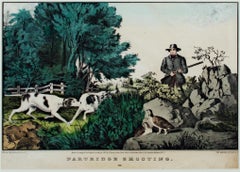
19th century color lithograph watercolor landscape figurative animal print

19th century color lithograph watercolor landscape figurative animal print

By Nathaniel Currier

Located in Milwaukee, WI

The present hand-colored lithograph presents the viewer with a hunting scene in a picturesque landscape. In the foreground, a man approaches two partridges as his two pointers prepare to flush them out. Beyond, a white fence draws our eyes to the homestead in the distance. Images like this one show how people in the United States were trying to identify themselves as a new nation in the North American landscape - as separate from their European counterparts but with similar similar and specific wildlife and magesties of nature. It also identifies hunting in this landscape as an American pastime. 9.25 x 12.5 inches, artwork 18.38 x 22 inches, frame Entitled bottom center "Partridge Shooting...

Category

Mid-19th Century Romantic Pati Bannister Prints and Multiples

Materials

Watercolor, Lithograph
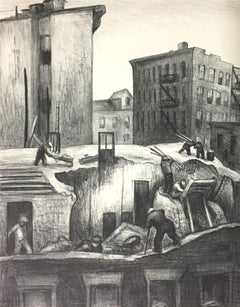
Ann Nooney, (Demolition with Windows, NYC)

Ann Nooney, (Demolition with Windows, NYC)

By Ann Nooney

Located in New York, NY

The dimensions are for the image; there are large margins. This lithograph is signed in pencil. A native New Yorker, Ann Nooney (1900-1970) recorded the urban scene while on the Wo...

Category

1930s American Realist Pati Bannister Prints and Multiples

Materials

Lithograph
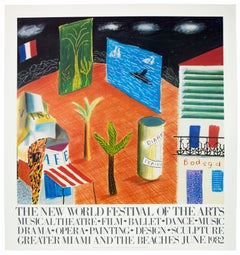
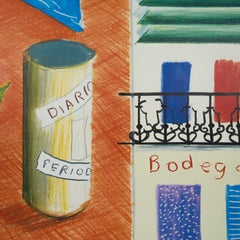
Vintage David Hockney Poster Miami New World Festival of Arts 1982 palm trees

Vintage David Hockney Poster Miami New World Festival of Arts 1982 palm trees

By David Hockney

Located in New York, NY

This vintage David Hockney poster features whimsical imagery and rich, bright color. Palm trees, boats in the ocean, a cafe, and a bodega with an elaborate iron-wrought balcony sit a...

Category

1980s Realist Pati Bannister Prints and Multiples

Materials

Lithograph
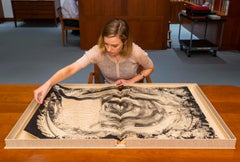
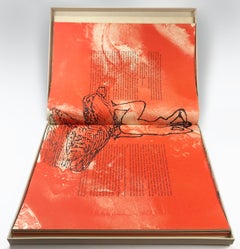
The Departure of the Argonaut Francesco Clemente (bound book) Alberto Savinio

The Departure of the Argonaut Francesco Clemente (bound book) Alberto Savinio

By Francesco Clemente

Located in New York, NY

The Departure of the Argonaut (1918) is the travelogue and wartime diary of Alberto Savinio, one of the seminal figures in twentieth-century Italian arts and letters. Clemente's acco...

Category

1980s Abstract Pati Bannister Prints and Multiples

Materials

Lithograph
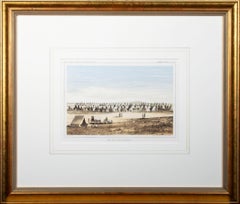
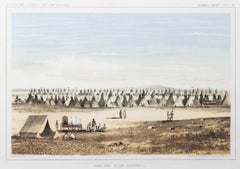
'Camp Red River Hunters' original lithograph by John Mix Stanley
'Camp Red River Hunters' original lithograph by John Mix Stanley
By John Mix Stanley

Located in Milwaukee, WI

In the mid-nineteenth century, the United States government set out to survey and document its newly acquired lands and territories west of the Mississippi. The goals of these surveys were manifold: to produce topographical maps, to document flora and fauna, and to document natural resources to build the emerging US economy. These surveys, and the images from them, also functioned to build the new sense of American identity with the landscape, condensing vistas into the 'picturesque' tradition of European image making. Thus, the entire span of US territory could be seen as a single, cohesive whole. This lithograph comes from one of six surveys commissioned by the Army's Topographic Bureau in 1853, which sought to find the best route to construct a transcontinental railroad. The result was a thirteen-volume report including maps, lithographs, and technical data entitled 'Explorations and Surveys to ascertain the most practicable and economical route for a Railroad from the Mississippi river to the Pacific Ocean.' In particular, the print comes from the northern survey, commanded by Isaac Stevens, which explored the regions between the 47th and 49th parallels. In this image, Stanley shows an encampment of the people known as the Red River of the North hunters. They were generations of European and mixed-race trappers who lived on the frontier and had Indian wives and mixed-race children. They had come to the area for bison hunting, as the herds were still vast on the prairies. In the image, the figures and their encampment are dwarfed by the vast landscape around them, indicating the sublimity of these new American territories. 5.75 x 8.75 inches, image 6.5 x 9.25 inches, stone 17 x 20 inches, frame Artist 'Stanley Del.' lower left Entitled 'Camp Red River Hunters' lower center margin Publisher 'Sarony, Major & Knapp. Lith.s 449 Broadway N.Y.' lower right Inscribed 'U.S.P.R.R. EXP. & SURVEYS — 47th & 49th PARALLELS' upper left Inscribed 'GENERAL REPORT — PLATE XII' upper right Framed to conservation standards using 100 percent rag matting with French accents; glazed with UV5 Plexiglas to inhibit fading; housed in a gold reverse ogee moulding. Print in overall good condition; some localized foxing and discoloration; minor surface abrasions to frame. John Mix Stanley...
Category

1850s Romantic Pati Bannister Prints and Multiples

Materials

Lithograph
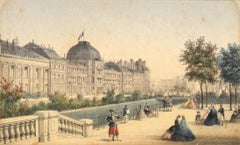
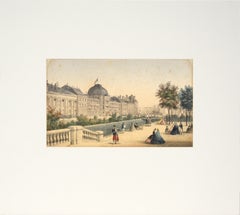
Les Tuileries, Paris - Hand Colored Lithograph 1845-1860
Les Tuileries, Paris - Hand Colored Lithograph 1845-1860
Located in Soquel, CA

Les Tuileries, Paris - Hand Colored Lithograph Delicate hand-colored lithograph of Tuileries Palace in Paris, France printed by Rose-Joseph Lemercier (French, 1803 - 1887). Published, Paris 1843 to 1867 by Hautecoeur Freres (Eugène and Alfred Hautecoeur (French). After Charles Riviere...

Category

Mid-19th Century Romantic Pati Bannister Prints and Multiples

Materials

Paper, Ink, Watercolor

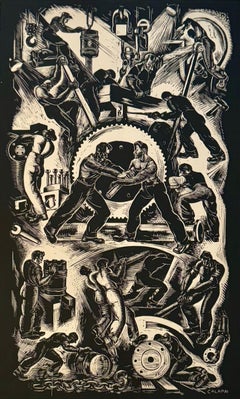
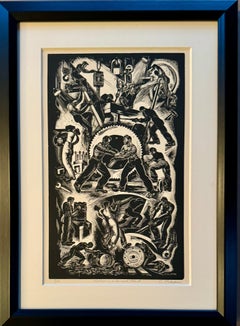
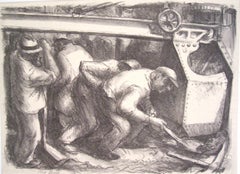
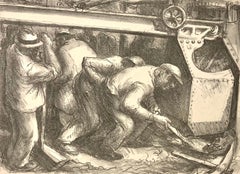
"Labor in a Diesel Plant" Machine Age American Scene Industrial Mid 20th Century

"Labor in a Diesel Plant" Machine Age American Scene Industrial Mid 20th Century

By Letterio Calapai

Located in New York, NY

"Labor in a Diesel Plant" Machine Age American Scene Industrial Mid 20th Century Letterio Calapai (American 1902-1993) ''Labor in A Diesel Plant'' Wood engraving, 1940 17 x 10 1/2...

Category

1940s American Modern Pati Bannister Prints and Multiples

Materials

Lithograph

Pati Bannister prints and multiples for sale on 1stDibs.

Find a wide variety of authentic Pati Bannister prints and multiples available for sale on 1stDibs. You can also browse by medium to find art by Pati Bannister in lithograph and more. Not every interior allows for large Pati Bannister prints and multiples, so small editions measuring 23 inches across are available. Customers who are interested in this artist might also find the work of Hippolyte Bellangé, Nathaniel Currier, and John Mix Stanley. Pati Bannister prints and multiples prices can differ depending upon medium, time period and other attributes. On 1stDibs, the price for these items starts at $675 and tops out at $875, while the average work can sell for $750.