Pierre Fix-Masseau Art

French, 1905-1994
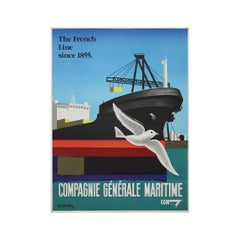
Pierre Fix-Masseau (1905-1994) was a leading poster designer in the Art Deco period whose work reveals a fascination with the high speed and new technology which typified the preoccupations of the age. Transport was one of the most popular themes in Art Deco posters and Fix-Masseau’s work is dominated by ships, cars and trains
to
1
3
1
4
4
Overall Width
to
Overall Height
to
12
1
1
2
5
2
6
1
11
1
8
8
5
3
3
2
2
2
2
1
1
1
1
1
1
1
1
1
1
1
11
4
2
2
1
21
10,491
2,808
2,500
1,414
1
3
8
4
Artist: Pierre Fix-Masseau
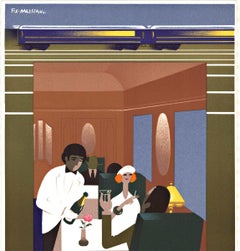
"Orient-Express, " Colored Lithograph Poster signed by Pierre Fix-Masseau

"Orient-Express, " Colored Lithograph Poster signed by Pierre Fix-Masseau

By Pierre Fix-Masseau

Located in Milwaukee, WI

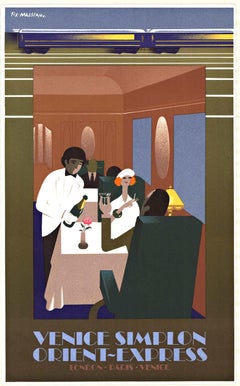
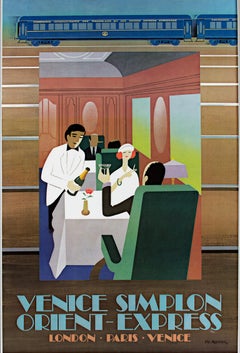
"Orient-Express" is a lithograph poster by Pierre Fix-Masseau. It depicts two people dining and being served drinks on a luxury train. The artist signed the artwork in the image lower right. There was a small tear on the margin that has been repaired. 38 5/8" x 24 1/4" art 40 1/2" x 26" frame French Poster...

Category

1980s Art Deco Pierre Fix-Masseau Art

Materials

Lithograph

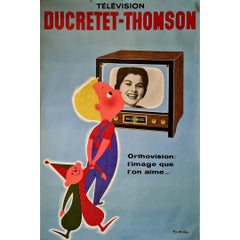
Original 1960s poster by Fix-Masseau - Ducretet Thomson

Original 1960s poster by Fix-Masseau - Ducretet Thomson

By Pierre Fix-Masseau

Located in PARIS, FR

This vibrant original 1960s poster, designed by Fix-Masseau, captures the optimistic spirit of postwar consumer culture through its charming promotion of Ducretet-Thomson televisions...

Category

1960s Pierre Fix-Masseau Art

Materials

Paper, Lithograph

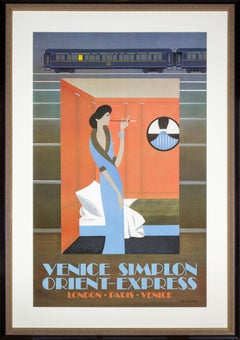
"Orient Express, " Lithograph Poster by Pierre Fix-Masseau

"Orient Express, " Lithograph Poster by Pierre Fix-Masseau

By Pierre Fix-Masseau

Located in Milwaukee, WI

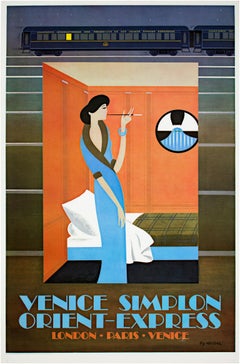
"Orient Express" is a lithograph poster by Pierre Fix-Masseau. The artist signed his name in the lower right of the image. This piece depicts a fashionable woman smoking in one of the rooms of the Venice Simplon...

Category

1980s Art Deco Pierre Fix-Masseau Art

Materials

Lithograph

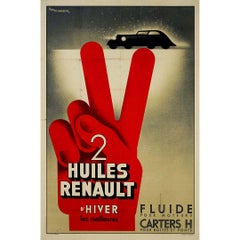
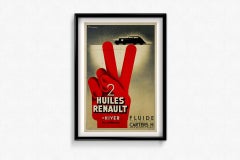
1934 original poster by Pierre Fix-Masseau 2 Huiles Renault d'Hiver

1934 original poster by Pierre Fix-Masseau 2 Huiles Renault d'Hiver

By Pierre Fix-Masseau

Located in PARIS, FR

1934 original poster by Pierre Fix-Masseau stands as a testament to the artistry of the era and the innovative spirit of Renault. Titled "2 Huiles Renault d'Hiver" this poster is a v...

Category

1930s Art Deco Pierre Fix-Masseau Art

Materials

Linen, Paper, Lithograph

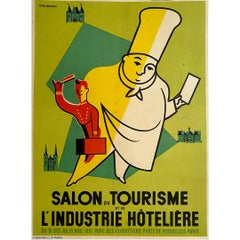
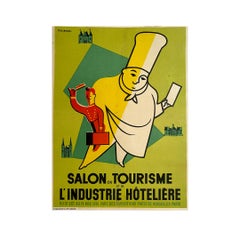
1951 Original poster by Fix-Masseau - Tourism and hotel industry show

1951 Original poster by Fix-Masseau - Tourism and hotel industry show

By Pierre Fix-Masseau

Located in PARIS, FR

Beautiful poster made in 1951 by Pierre Fix-Masseau 🇫🇷 (1904-1995), a renowned French poster and graphic designer, to promote the tourism and hotel industry show. The poster artist Pierre Fix-Masseau was born in 1905 in Paris, rue de Bruxelles, at the foot of the Butte Montmartre. He was the only son of the sculptor Pierre-Félix Masseau...

Category

1950s Pierre Fix-Masseau Art

Materials

Linen, Paper, Lithograph

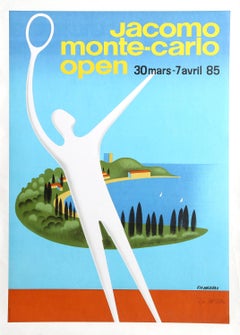
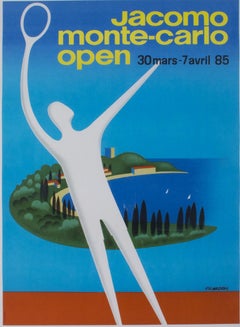
Jacomo, Monte Carlo Open - Pop Art Lithograph Poster by Pierre Fix-Masseau

Jacomo, Monte Carlo Open - Pop Art Lithograph Poster by Pierre Fix-Masseau

By Pierre Fix-Masseau

Located in Long Island City, NY

Artist: Pierre Fix-Masseau, French (1905 - 1994) Title: Jacomo, Monte Carlo Open Year: 1985 Medium: Lithograph Poster, signed in pen Image Size: 30 x 21 inches Size: 33 x 24 in. (83....

Category

1980s Contemporary Pierre Fix-Masseau Art

Materials

Lithograph

Related Items
Tribute to Klimt - Original handsigned lithograph

Tribute to Klimt - Original handsigned lithograph

Located in Paris, IDF

Philippe AUGE (1935-) Tribute to Klimt Original lithograph Handsigned in pencil Limited /275 copies On vellum 63 x 79 cm (c. 24.8 x 31.1 in) Excellent condition

Category

Late 20th Century Art Deco Pierre Fix-Masseau Art

Materials

Lithograph

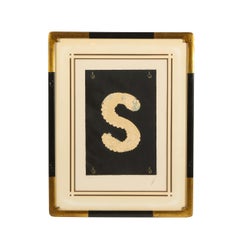
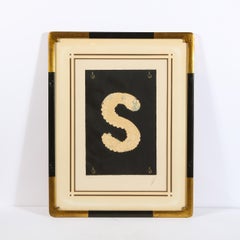
Letter "S" from Alphabet Suite (Signed Erté)

Letter "S" from Alphabet Suite (Signed Erté)

By Erté

Located in New York, NY

From the celebrated Alphabet Suite, this stunning Art Deco lithograph/serigraph was designed by the Russian-born French artist and designer known by the pseudonym Erté, and produced ...

Category

1970s Art Deco Pierre Fix-Masseau Art

Materials

Lithograph

Don Juan
Don Juan

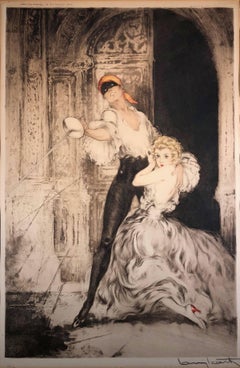
Louis IcartDon Juan, 1928

$2,800Sale Price|20% Off

H 28 in W 20.5 in

Don Juan

By Louis Icart

Located in Missouri, MO

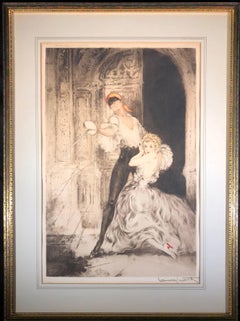
Aquating Engraving Image Size: approx. 20 1/4 x 13 3/8 Framed Size: 28 x 20.5 inches Pencil Signed Lower Right Louis Justin Laurent Icart was born in Toulouse in 1890 and died in Paris in 1950. He lived in New York City in the 1920s, where he became known for his Art-Deco color etchings of glamourous women. He was first son of Jean and Elisabeth Icart and was officially named Louis Justin Laurent Icart. The use of his initials L.I. would be sufficient in this household. Therefore, from the moment of his birth he was dubbed 'Helli'. The Icart family lived modestly in a small brick home on rue Traversière-de-la-balance, in the culturally rich Southern French city of Toulouse, which was the home of many prominent writers and artists, the most famous being Henri de Toulouse-Lautrec. Icart entered the l'Ecole Superieure de Commerce de Toulouse in order to continue his studies for a career in business, particularly banking (his father's profession). However, he soon discovered the play writings of Victor Hugo (1802-1885), which were to change the course of his life. Icart borrowed whatever books he could find by Hugo at the Toulouse library, devouring the tales, rich in both romantic imagery and the dilemmas of the human condition. It was through Icart's love of the theater that he developed a taste for all the arts, though the urge to paint was not as yet as strong for him as the urge to act. It was not until his move to Paris in 1907 that Icart would concentrate on painting, drawing and the production of countless beautiful etchings, which have served (more than the other mediums) to indelibly preserve his name in twentieth century art history. Art Deco, a term coined at the 1925 Paris Exposition des Arts Decoratifs, had taken its grip on the Paris of the 1920s. By the late 1920s Icart, working for both publications and major fashion and design studios, had become very successful, both artistically and financially. His etchings reached their height of brilliance in this era of Art Deco, and Icart had become the symbol of the epoch. Yet, although Icart has created for us a picture of Paris and New York life in the 1920s and 1930s, he worked in his own style, derived principally from the study of eighteenth-century French masters such as Jean Antoine Watteau, François Boucher and Jean Honoré Fragonard. In Icart's drawings, one sees the Impressionists Degas...

Category

1920s Art Deco Pierre Fix-Masseau Art

Materials

Engraving, Aquatint

Le "FLIP" Soap original vintage French antique poster

Le "FLIP" Soap original vintage French antique poster, c. 1920

$1,279Sale Price|20% Off

H 47.5 in W 31.5 in D 0.12 in

Le "FLIP" Soap original vintage French antique poster

Located in Spokane, WA

Original French vintage poster. le "Flip" Soap. This fun image shows the tube of 'Flip" pushing away the shaving bowl, towel, and shaving brush. I...

Category

1920s Art Deco Pierre Fix-Masseau Art

Materials

Lithograph

Marc Chagall - Inspiration - Original Lithograph from "Chagall Lithographe" v. 2

Marc Chagall - Inspiration - Original Lithograph from "Chagall Lithographe" v. 2

By Marc Chagall

Located in Collonge Bellerive, Geneve, CH

Marc Chagall Original Lithograph from Chagall Lithographe 1957-1962. VOLUME II. 1963 Dimensions: 32 x 24 cm From the unsigned edition of 10000 copies without margins Reference: Mourlot 398 Condition : Excellent Marc Chagall (born in 1887) Marc Chagall was born in Belarus in 1887 and developed an early interest in art. After studying painting, in 1907 he left Russia for Paris, where he lived in an artist colony on the city’s outskirts. Fusing his own personal, dreamlike imagery with hints of the fauvism and cubism popular in France at the time, Chagall created his most lasting work—including I and the Village (1911)—some of which would be featured in the Salon des Indépendants exhibitions. After returning to Vitebsk for a visit in 1914, the outbreak of WWI trapped Chagall in Russia. He returned to France in 1923 but was forced to flee the country and Nazi persecution during WWII. Finding asylum in the U.S., Chagall became involved in set and costume design before returning to France in 1948. In his later years, he experimented with new art forms and was commissioned to produce numerous large-scale works. Chagall died in St.-Paul-de-Vence in 1985. The Village Marc Chagall was born in a small Hassidic community on the outskirts of Vitebsk, Belarus, on July 7, 1887. His father was a fishmonger, and his mother ran a small sundries shop in the village. As a child, Chagall attended the Jewish elementary school, where he studied Hebrew and the Bible, before later attending the Russian public school. He began to learn the fundamentals of drawing during this time, but perhaps more importantly, he absorbed the world around him, storing away the imagery and themes that would feature largely in most of his later work. At age 19 Chagall enrolled at a private, all-Jewish art school and began his formal education in painting, studying briefly with portrait artist Yehuda Pen. However, he left the school after several months, moving to St. Petersburg in 1907 to study at the Imperial Society for the Protection of Fine Arts. The following year, he enrolled at the Svanseva School, studying with set designer Léon Bakst, whose work had been featured in Sergei Diaghilev's Ballets Russes. This early experience would prove important to Chagall’s later career as well. Despite this formal instruction, and the widespread popularity of realism in Russia at the time, Chagall was already establishing his own personal style, which featured a more dreamlike unreality and the people, places and imagery that were close to his heart. Some examples from this period are his Window Vitebsk (1908) and My Fianceé with Black Gloves (1909), which pictured Bella Rosenfeld, to whom he had recently become engaged. The Beehive Despite his romance with Bella, in 1911 an allowance from Russian parliament member and art patron Maxim Binaver enabled Chagall to move to Paris, France. After settling briefly in the Montparnasse neighborhood, Chagall moved further afield to an artist colony known as La Ruche (“The Beehive”), where he began to work side by side with abstract painters such as Amedeo Modigliani and Fernand Léger as well as the avant-garde poet Guillaume Apollinaire. At their urging, and under the influence of the wildly popular fauvism and cubism, Chagall lightened his palette and pushed his style ever further from reality. I and the Village (1911) and Homage to Apollinaire (1912) are among his early Parisian works, widely considered to be his most successful and representative period. Though his work stood stylistically apart from his cubist contemporaries, from 1912 to 1914 Chagall exhibited several paintings at the annual Salon des Indépendants exhibition, where works by the likes of Juan Gris, Marcel Duchamp and Robert Delaunay were causing a stir in the Paris art world. Chagall’s popularity began to spread beyond La Ruche, and in May 1914 he traveled to Berlin to help organize his first solo exhibition, at Der Sturm Gallery. Chagall remained in the city until the highly acclaimed show opened that June. He then returned to Vitebsk, unaware of the fateful events to come. War, Peace and Revolution In August 1914 the outbreak of World War I precluded Chagall’s plans to return to Paris. The conflict did little to stem the flow of his creative output, however, instead merely giving him direct access to the childhood scenes so essential to his work, as seen in paintings such as Jew in Green (1914) and Over Vitebsk (1914). His paintings from this period also occasionally featured images of the war’s impact on the region, as with Wounded Soldier (1914) and Marching (1915). But despite the hardships of life during wartime, this would also prove to be a joyful period for Chagall. In July 1915 he married Bella, and she gave birth to a daughter, Ida, the following year. Their appearance in works such as Birthday (1915), Bella and Ida by the Window (1917) and several of his “Lovers” paintings give a glimpse of the island of domestic bliss that was Chagall’s amidst the chaos. To avoid military service and stay with his new family, Chagall took a position as a clerk in the Ministry of War Economy in St. Petersburg. While there he began work on his autobiography and also immersed himself in the local art scene, befriending novelist Boris Pasternak, among others. He also exhibited his work in the city and soon gained considerable recognition. That notoriety would prove important in the aftermath of the 1917 Russian Revolution when he was appointed as the Commissar of Fine Arts in Vitebsk. In his new post, Chagall undertook various projects in the region, including the 1919 founding of the Academy of the Arts. Despite these endeavors, differences among his colleagues eventually disillusioned Chagall. In 1920 he relinquished his position and moved his family to Moscow, the post-revolution capital of Russia. In Moscow, Chagall was soon commissioned to create sets and costumes for various productions at the Moscow State Yiddish Theater...

Category

1960s Surrealist Pierre Fix-Masseau Art

Materials

Lithograph

Fritz Scholder, "Walking Dog" Lithograph, 1977

Fritz Scholder, "Walking Dog" Lithograph, 1977

By Fritz Scholder

Located in Los Angeles, CA

Fritz Scholder (1937 2005) Walking Dog 1977 Lithograph, Edition 80/100 Hand signed "Scholder" lower right, numbered lower left. Full sheet size, 22 inches x 30 inches. Printer: Tam...

Category

Late 20th Century Contemporary Pierre Fix-Masseau Art

Materials

Lithograph

The Vamps by Erté set of four framed lithographs and original folder with tassel

The Vamps by Erté set of four framed lithographs and original folder with tassel

By Erté

Located in Boca Raton, FL

"The Vamps" by Erté. Set of four framed color lithographs ("Circe", "L'Empanachee," "Seductress" and "Temptress") and original folder (unframed). All four lithographs are beautifully framed under glass with a wood moulding...

Category

20th Century Art Deco Pierre Fix-Masseau Art

Materials

Lithograph

Marc Chagall - The Red Rider - Original Lithograph

Marc Chagall - The Red Rider - Original Lithograph

By Marc Chagall

Located in Collonge Bellerive, Geneve, CH

Marc Chagall - Original Lithograph The Red Rider From the unsigned, unnumbered lithograph printed in the literary review XXe Siecle 1957 See Mourlot 191 Dimensions: 32 x 24 cm Publisher: G. di San Lazzaro. Marc Chagall (born in 1887) Marc Chagall was born in Belarus in 1887 and developed an early interest in art. After studying painting, in 1907 he left Russia for Paris, where he lived in an artist colony on the city’s outskirts. Fusing his own personal, dreamlike imagery with hints of the fauvism and cubism popular in France at the time, Chagall created his most lasting work—including I and the Village (1911)—some of which would be featured in the Salon des Indépendants exhibitions. After returning to Vitebsk for a visit in 1914, the outbreak of WWI trapped Chagall in Russia. He returned to France in 1923 but was forced to flee the country and Nazi persecution during WWII. Finding asylum in the U.S., Chagall became involved in set and costume design before returning to France in 1948. In his later years, he experimented with new art forms and was commissioned to produce numerous large-scale works. Chagall died in St.-Paul-de-Vence in 1985. The Village Marc Chagall was born in a small Hassidic community on the outskirts of Vitebsk, Belarus, on July 7, 1887. His father was a fishmonger, and his mother ran a small sundries shop in the village. As a child, Chagall attended the Jewish elementary school, where he studied Hebrew and the Bible, before later attending the Russian public school. He began to learn the fundamentals of drawing during this time, but perhaps more importantly, he absorbed the world around him, storing away the imagery and themes that would feature largely in most of his later work. At age 19 Chagall enrolled at a private, all-Jewish art school and began his formal education in painting, studying briefly with portrait artist Yehuda Pen. However, he left the school after several months, moving to St. Petersburg in 1907 to study at the Imperial Society for the Protection of Fine Arts. The following year, he enrolled at the Svanseva School, studying with set designer Léon Bakst, whose work had been featured in Sergei Diaghilev's Ballets Russes. This early experience would prove important to Chagall’s later career as well. Despite this formal instruction, and the widespread popularity of realism in Russia at the time, Chagall was already establishing his own personal style, which featured a more dreamlike unreality and the people, places and imagery that were close to his heart. Some examples from this period are his Window Vitebsk (1908) and My Fianceé with Black Gloves (1909), which pictured Bella Rosenfeld, to whom he had recently become engaged. The Beehive Despite his romance with Bella, in 1911 an allowance from Russian parliament member and art patron Maxim Binaver enabled Chagall to move to Paris, France. After settling briefly in the Montparnasse neighborhood, Chagall moved further afield to an artist colony known as La Ruche (“The Beehive”), where he began to work side by side with abstract painters such as Amedeo Modigliani and Fernand Léger as well as the avant-garde poet Guillaume Apollinaire. At their urging, and under the influence of the wildly popular fauvism and cubism, Chagall lightened his palette and pushed his style ever further from reality. I and the Village (1911) and Homage to Apollinaire (1912) are among his early Parisian works, widely considered to be his most successful and representative period. Though his work stood stylistically apart from his cubist contemporaries, from 1912 to 1914 Chagall exhibited several paintings at the annual Salon des Indépendants exhibition, where works by the likes of Juan Gris, Marcel Duchamp and Robert Delaunay were causing a stir in the Paris art world. Chagall’s popularity began to spread beyond La Ruche, and in May 1914 he traveled to Berlin to help organize his first solo exhibition, at Der Sturm Gallery. Chagall remained in the city until the highly acclaimed show opened that June. He then returned to Vitebsk, unaware of the fateful events to come. War, Peace and Revolution In August 1914 the outbreak of World War I precluded Chagall’s plans to return to Paris. The conflict did little to stem the flow of his creative output, however, instead merely giving him direct access to the childhood scenes so essential to his work, as seen in paintings such as Jew in Green (1914) and Over Vitebsk (1914). His paintings from this period also occasionally featured images of the war’s impact on the region, as with Wounded Soldier (1914) and Marching (1915). But despite the hardships of life during wartime, this would also prove to be a joyful period for Chagall. In July 1915 he married Bella, and she gave birth to a daughter, Ida, the following year. Their appearance in works such as Birthday (1915), Bella and Ida by the Window (1917) and several of his “Lovers” paintings give a glimpse of the island of domestic bliss that was Chagall’s amidst the chaos. To avoid military service and stay with his new family, Chagall took a position as a clerk in the Ministry of War Economy in St. Petersburg. While there he began work on his autobiography and also immersed himself in the local art scene, befriending novelist Boris Pasternak, among others. He also exhibited his work in the city and soon gained considerable recognition. That notoriety would prove important in the aftermath of the 1917 Russian Revolution when he was appointed as the Commissar of Fine Arts in Vitebsk. In his new post, Chagall undertook various projects in the region, including the 1919 founding of the Academy of the Arts. Despite these endeavors, differences among his colleagues eventually disillusioned Chagall. In 1920 he relinquished his position and moved his family to Moscow, the post-revolution capital of Russia. In Moscow, Chagall was soon commissioned to create sets and costumes for various productions at the Moscow State Yiddish Theater, where he would paint a series of murals titled Introduction to the Jewish Theater as well. In 1921, Chagall also found work as a teacher at a school for war orphans. By 1922, however, Chagall found that his art had fallen out of favor, and seeking new horizons he left Russia for good. Flight After a brief stay in Berlin, where he unsuccessfully sought to recover the work exhibited at Der Sturm before the war, Chagall moved his family to Paris in September 1923. Shortly after their arrival, he was commissioned by art dealer and publisher Ambroise Vollard to produce a series of etchings for a new edition of Nikolai Gogol's 1842 novel Dead Souls. Two years later Chagall began work on an illustrated edition of Jean de la Fontaine’s Fables, and in 1930 he created etchings for an illustrated edition of the Old Testament, for which he traveled to Palestine to conduct research. Chagall’s work during this period brought him new success as an artist and enabled him to travel throughout Europe in the 1930s. He also published his autobiography, My Life (1931), and in 1933 received a retrospective at the Kunsthalle in Basel, Switzerland. But at the same time that Chagall’s popularity was spreading, so, too, was the threat of Fascism and Nazism. Singled out during the cultural "cleansing" undertaken by the Nazis in Germany, Chagall’s work was ordered removed from museums throughout the country. Several pieces were subsequently burned, and others were featured in a 1937 exhibition of “degenerate art” held in Munich. Chagall’s angst regarding these troubling events and the persecution of Jews in general can be seen in his 1938 painting White Crucifixion. With the eruption of World War II, Chagall and his family moved to the Loire region before moving farther south to Marseilles following the invasion of France. They found a more certain refuge when, in 1941, Chagall’s name was added by the director of the Museum of Modern Art (MOMA) in New York City to a list of artists and intellectuals deemed most at risk from the Nazis’ anti-Jewish campaign. Chagall and his family would be among the more than 2,000 who received visas and escaped this way. Haunted Harbors Arriving in New York City in June 1941, Chagall discovered that he was already a well-known artist there and, despite a language barrier, soon became a part of the exiled European artist community. The following year he was commissioned by choreographer Léonide Massine to design sets and costumes for the ballet Aleko, based on Alexander Pushkin’s “The Gypsies” and set to the music of Pyotr Ilyich Tchaikovsky. But even as he settled into the safety of his temporary home, Chagall’s thoughts were frequently consumed by the fate befalling the Jews of Europe and the destruction of Russia, as paintings such as The Yellow Crucifixion...
Category

1950s Surrealist Pierre Fix-Masseau Art

Materials

Lithograph

Original Op Art Abstract Color Screenprint "Planetary Folklore" Signed #2/250
Original Op Art Abstract Color Screenprint "Planetary Folklore" Signed #2/250

By Victor Vasarely

Located in Portland, OR

A Op Art abstract color screenprint, "Planetary Folklore" 1968, by Victor Vasarely (1906-1997). This very striking work by Vasarely is comprised of various colorful geometric shapes, the work is signed lower right "Vasarely" and numbered lower left "2/250. This is an early and crisp impression in excellent condition and housed under glass in a gilt & silvered hardwood frame. This very eye-catching work by one of the 20th century's leading Op artists is ready to hang on your wall. 14" x 14.50" at sight without frame Numered 2/250 A Franco-Hungarian painter, Victor Vasarely (1906-1997) first studied medicine before turning to art. In Budapest, he frequented artists from the Hungarian Bauhaus...

Category

1960s Op Art Pierre Fix-Masseau Art

Materials

Lithograph, Handmade Paper, Color, Screen

L'inspiré Self Portrait Marc Chagall Valentina Vava Lithograph 1963 Mourlot 398

L'inspiré Self Portrait Marc Chagall Valentina Vava Lithograph 1963 Mourlot 398

By Marc Chagall

Located in Eversholt, Bedfordshire

Inspiration or L'inspiré - The artist and his wife, self-portrait. This is a self-portrait of the great artist, depicting him as lost in thought before one of his paintings, which is apparently related to his home country Russia, as suggested by the small figure in the lower right of the work. Chagall’s wife Valentina (“Vava”), who was also from Russia, is looking over his shoulder, full of longing. The small surreal elements that are characteristic of Chagall’s paintings are also present here: the silhouettes of the houses that seems to stick out of the painting and a figure with a flute or trombone standing on its head. Chagall Lithographe, Volume II of the catalogue raisonné of Chagall's lithographic work, see Mourlot 398, 1957-1962, Paris 1963, imprinted by Imprimerie Mourlot for the publisher André Sauret. A lithographic plate from the catalog that was published in 10,000 copies. Condition : Excellent Set inside a cream mount bearing brass cartellino Visible sheet size length 23cm, Height 31.50cm In a carved and gilded frame Frame size Length 44cm, Height 55.5cm The reverse with a paper label in Japanese Provenance : Private Collection, purchased with Lovers in Grey

Category

1960s Modern Pierre Fix-Masseau Art

Materials

Lithograph

The Lovers
The Lovers

Peter MaxThe Lovers

$1,250Sale Price|24% Off

H 25 in W 32 in D 2 in

The Lovers

By Peter Max

Located in Berlin, MD

Peter Max (German / American 1937 - Present) The Lovers. Abstract of two nude women on a bed in vibrant colors. The print is on thick woven paper and is...

Category

Late 20th Century Pop Art Pierre Fix-Masseau Art

Materials

Lithograph

Previously Available Items
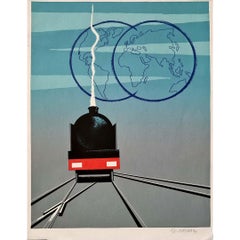
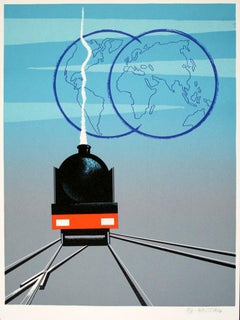
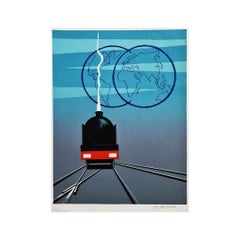
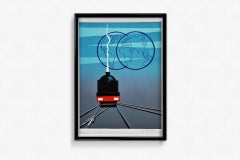
Original lithography made by Pierre Fix-Masseau - The train - Art Deco

Original lithography made by Pierre Fix-Masseau - The train - Art Deco

By Pierre Fix-Masseau

Located in PARIS, FR

Beautiful lithography made by Pierre Fix-Masseau 🇫🇷 (1904-1995), a famous French poster and graphic designer. It is as an apprentice of the master designer Art Deco A.M Cassandre that he begins his career, from 1926 to 1928. This experience had a considerable influence on him, as he continued to work in the Art Deco style throughout his career. Fix-Masseau created his own distinctive style, combining the influence of his master with his own perspective on intricate detail. He is best known for his railroad and automobile posters...

Category

1990s Art Deco Pierre Fix-Masseau Art

Materials

Paper, Lithograph

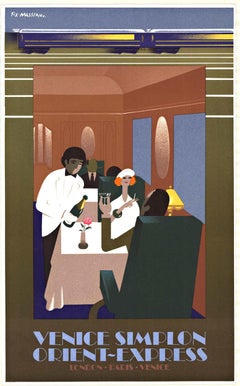
Orignal "Venice Simplon Orient Express  Dining Car" small format vintage poster

Orignal "Venice Simplon Orient Express Dining Car" small format vintage poster

By Pierre Fix-Masseau

Located in Spokane, WA

Original poster: Orient Express, Venice Simplon by Fix-Masseau. Fix-Masseau’s career as an artist began in the 1930s, and he maintained his signature deco style throughout its duration. This elegant poster advertises the VSOE train line with the spotlight on the availability of fine dining. The 1920s and 1930s were the heyday of the legendary train - elaborate meals, decadent company, and fine wines characterized this era of rail travel. Royalty, celebrities, courtesans, and spies intermingled as they traveled in opulence throughout Europe. The waiter is pouring wine in this re-launch of the Venice Simplon Orient Express railroad poster. You can feel the elegance of this fine dining car! This original poster is printed on fine thick paper and is not linen backed. It is ready to frame ‘as-is”. This original Orient Express poster...

Category

1980s Art Deco Pierre Fix-Masseau Art

Materials

Lithograph

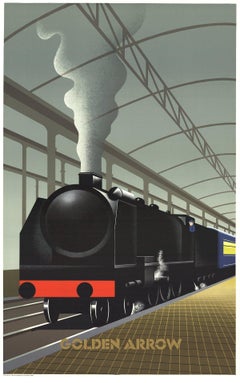
1989 Pierre Fix-Masseau 'Golden Arrow' Art Deco Black, Red, Yellow France Lithogra

1989 Pierre Fix-Masseau 'Golden Arrow' Art Deco Black, Red, Yellow France Lithogra

By Pierre Fix-Masseau

Located in Brooklyn, NY

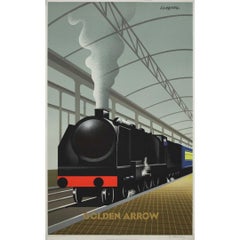
Paper Size: 39.25 x 24.5 inches ( 99.695 x 62.23 cm ) Image Size: 38 x 23.5 inches ( 96.52 x 59.69 cm ) Framed: No Condition: A-: Near Mint, very light signs of handling Shi...

Category

1980s Pierre Fix-Masseau Art

Materials

Lithograph

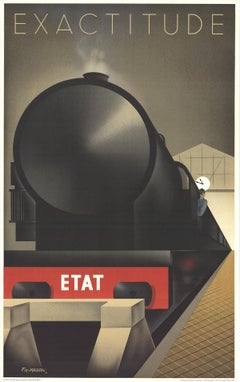
Exactitude
Exactitude

Pierre Fix-MasseauExactitude

Sold

H 42 in W 27.5 in D 1.25 in

Exactitude

By Pierre Fix-Masseau

Located in Petworth, West Sussex

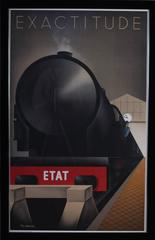
Exactitude Poster designed by Fix Masseau (1905-1994) of this classic Art Deco image. This is an official lithograph re-issue of the 1932 design printed by Bedos Measurements are in...

Category

1930s Art Deco Pierre Fix-Masseau Art

Materials

Lithograph

Pierre Fix-masseau art for sale on 1stDibs.

Find a wide variety of authentic Pierre Fix-Masseau art available for sale on 1stDibs. If you’re browsing the collection of art to introduce a pop of color in a neutral corner of your living room or bedroom, you can find work that includes elements of blue and other colors. You can also browse by medium to find art by Pierre Fix-Masseau in lithograph and more. Much of the original work by this artist or collective was created during the 20th century and is mostly associated with the Art Deco style. Not every interior allows for large Pierre Fix-Masseau art, so small editions measuring 12 inches across are available. Customers who are interested in this artist might also find the work of Edouard Benedictus, SEGUY, E[ugene] A[lain]., and George Barbier. Pierre Fix-Masseau art prices can differ depending upon medium, time period and other attributes. On 1stDibs, the price for these items starts at $450 and tops out at $2,430, while the average work can sell for $1,350.

Artists Similar to Pierre Fix-Masseau