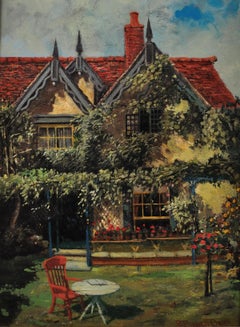
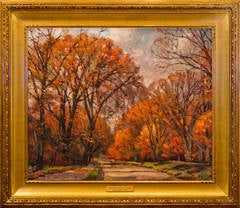
Robert Emmett Owen Art

American, 1878-1957

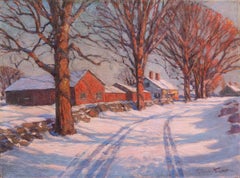
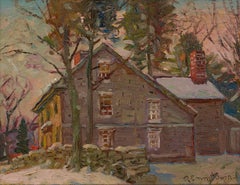
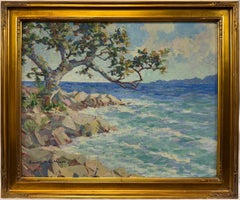
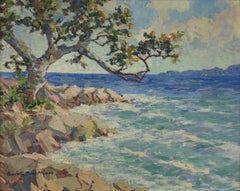
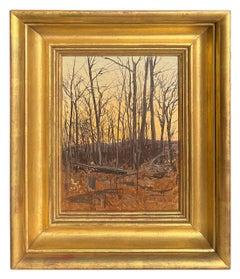
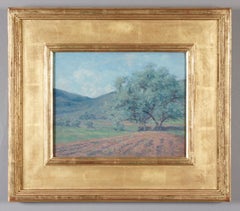
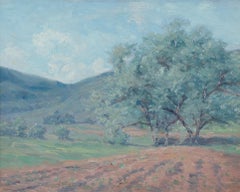
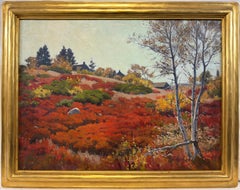
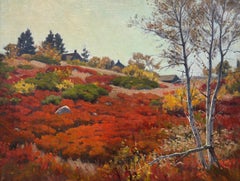
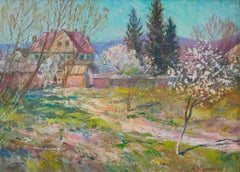
Robert Emmett Owen was a successful American artist and painter, best known for his impressionist views of rural landscapes. His color-filled paintings capture the moods and seasonal splendor of the New England countryside.

Robert was born in North Adams, Massachusetts, in 1878. He began his art studies at Drury Academy, in his hometown and quickly gained notice. At the age of 19 years, in 1897, he had several drawings accepted for publication by Life Magazine. The following year, he received a scholarship to the Eric Pape School of Art, in Boston, Massachusetts, where he worked in the art department of The Boston Globe, to pay for his studies.

He moved to New York City, in 1901, where he rapidly achieved fame, as an illustrator and worked for various publications, including Harper’s Bazaar, Frank Leslie’s Popular Monthly and Cosmopolitan, while continuing his training at the Art Students League, the Chase School and the National Academy of Design.

In 1910, Robert moved to Bagnall, Connecticut, to concentrate on landscapes full time. He had the opportunity there, to paint outdoors in all seasons. He also received numerous commissions from many prominent citizens. In 1919, Temple Gwathmey, former president of the New York Stock Exchange, commissioned a series of twenty paintings and in 1923, Stephen H.P. Pell commissioned a series of images for Fort Ticonderoga, eight of which were reproduced as full-page illustrations in Harper’s Bazaar. He also received commissions from Percy Rockefeller and Edward Stettinus, former US Secretary of State.

Robert moved back to New York City, in 1920 and opened his own gallery, while continuing to do magazine illustrations. The gallery, called the Robert Emmett Owen New England Landscape Gallery, only exhibited and sold his own work. It moved several times, during the next 21 years, always remaining successful, until Robert closed it in 1941, when the United States entered the Second World War and moved to New Rochelle, New York, to be the artist-in-residence at the Thomas Paine Memorial Museum.

His work was well liked by both critics and the public and examples are held by the Frick Art Museum, in New York, the Bruce Museum, in Connecticut and the Greenwich Public Library. Robert died in New Rochelle, in 1957.

to
1
1
Overall Width
to
Overall Height
to
2
1
1
2
2
2
1
1
1
1
2
2
2
4
10,998
2,845
2,494
1,429
2
2
Artist: Robert Emmett Owen
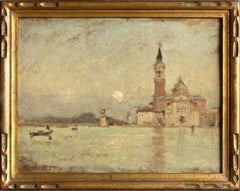
'Winter Sunset' AIC, ASL, NAD, PAFA, New York, Boston, New England, Connecticut

'Winter Sunset' AIC, ASL, NAD, PAFA, New York, Boston, New England, Connecticut

By Robert Emmett Owen

Located in Santa Cruz, CA

Signed lower right, 'R. Emmett Owen' for Robert Emmett Owen (American, 1878-1957) and painted circa 1915. Displayed in a substantial, carved, giltwood frame Framed dimensions: 30 x 1...

Category

1910s Impressionist Robert Emmett Owen Art

Materials

Oil, Board

Old House, New Canaan

Old House, New Canaan

By Robert Emmett Owen

Located in New York, NY

Robert Emmett Owen, best known for his New England landscapes featuring old farmhouses, winding roads, and covered bridges, began his career contributing pen-and-ink drawings to Life...

Category

20th Century Robert Emmett Owen Art

Materials

Oil, Board

Related Items
Framed Realist Oil of Trees in Hilly Landscape on Canvasboard

Framed Realist Oil of Trees in Hilly Landscape on Canvasboard

Located in Philadelphia, PA

William S. Butz (American, active Woodstock, N.Y., 1911-39) Field with Trees in Hilly Landscape Oil on canvasboard, 8 3/4 x 11 inches Framed: 15 x 17 inches (approx.) Signed on verso...

Category

1920s Realist Robert Emmett Owen Art

Materials

Oil, Board

“Bermuda Coast” Henrietta Dunn Mears American Impressionist Oil on Board Signed

“Bermuda Coast” Henrietta Dunn Mears American Impressionist Oil on Board Signed

By Henrietta Dunn Mears

Located in Yardley, PA

A vibrant Bermuda seascape depicting the rocky shoreline with turquoise waters breaking against sunlit boulders beneath a sweeping tree. Mears uses bold, textured brushstrokes and a ...

Category

20th Century American Impressionist Robert Emmett Owen Art

Materials

Oil, Board

Dusk Forest Scene, Catskills by Lockwood DeForest (American, 1850-1932)

Dusk Forest Scene, Catskills by Lockwood DeForest (American, 1850-1932)

By Lockwood DeForest

Located in New York, NY

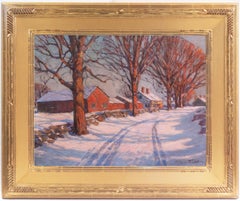
"Dusk Forest Scene, Catskills," 1875 by Hudson River School painter Lockwood DeForest (American, 1850-1932) is oil on artists card-stock and measures 9.5 x 7 inches. The work is signed by DeForest, and dated May 13, 1875 at lower right. The work is framed in an elegant, period appropriate frame, and ready to hang. Lockwood DeForest was born in New York in 1850 to a prominent family. He grew up in Greenwich Village and on Long Island at the family summer estate in Cold Spring Harbor. As was customary for a cultivated family in the Gilded Age, the DeForests made frequent trips abroad. Excursions to the great museums, which were prominent on the DeForests agenda, deepened the young Lockwood's familiarity with European painting and sculpture. Though he had begun drawing and painting somewhat earlier, it was during a visit to Rome in 1868 that nineteen-year-old DeForest first began to study art seriously, taking painting lessons from the Italian landscapist Hermann David Salomon Corrodi (1844–1905). More importantly, on the same trip, Lockwood met one of America’s most celebrated painters, (and his maternal great- uncle by marriage) Frederic Edwin Church (1826–1900), who quickly became his mentor. DeForest accompanied Church on sketching trips around Italy and continued this practice when they both returned to America in 1869. Early on in his career, de Forest made a habit of recording the date and often the place of his oil sketches, as to create a visual diary of his travels. Lockwood’s profession as a landscape painter can be primarily attributed to Frederic E. Church and his belief in the young artist’s talent. DeForest often visited Church in the Hudson River community of Catskill where, in addition to sketching trips and afternoons of painting, he assisted with the architectural drawings and planning of Olana. In 1872, DeForest took a studio at the Tenth Street Studio Building in New York. During these formative years DeForest counted among his friend’s artists such as Sanford Robinson Gifford (1823–80), George Henry Yewell (1830–1923), John Frederick Kensett (1816–72), Jervis McEntee (1828–91), and Walter Launt Palmer (1854–1932). Over the next decade DeForest experienced success as a painter. He exhibited for the first time at the National Academy of Design in 1872, and made two more painting trips abroad, in 1875–76 and 1877–78, traveling to the major continental capitals but also the Middle East and North Africa. His trip to the Middle East and the library at Church’s home, Olana, established his interest in design during his mid-twenties. From about 1878 to 1902, landscape painting was overshadowed by his activities and preoccupation with East Indian architecture and décor, a style that became quite fashionable in late nineteenth century America. From 1879-1883, de Forest founded Associated Artists along with Louis Comfort Tiffany, Candace Wheeler...

Category

19th Century Hudson River School Robert Emmett Owen Art
Materials

Oil, Board

“Eastern White Pines, c. 1910”, New England Landscape, Signed Oil Painting

“Eastern White Pines, c. 1910”, New England Landscape, Signed Oil Painting

By Charles Warren Eaton

Located in Yardley, PA

“Eastern White Pines, c. 1910” by Charles Warren Eaton (American, 1857-1937). A wonderful example of Eaton’s renowned compositions of Eastern white pine trees in his mature style. A...

Category

Early 20th Century American Realist Robert Emmett Owen Art

Materials

Canvas, Oil, Board

“Crossroads, c. 1940” WPA Polish-American Expressionist Modernist Oil Signed

“Crossroads, c. 1940” WPA Polish-American Expressionist Modernist Oil Signed

By Sol Wilson

Located in Yardley, PA

“Crossroads, c. 1940” by Sol Wilson (Polish-American, 1896-1974). This expressive painting by Wilson depicts a moody village crossroads rendered with his signature textured brushwor...

Category

1940s Expressionist Robert Emmett Owen Art

Materials

Oil, Board

“Untitled (Low Country Home)” American Impressionist Spanish Moss South Carolina

“Untitled (Low Country Home)” American Impressionist Spanish Moss South Carolina

Located in Yardley, PA

An exceptional work by George Waller Parker (1888-1957) of a home in the South Carolina Lowcountry. Perhaps the best example of Parker’s work to be offered in recent decades, this w...

Category

Early 20th Century American Impressionist Robert Emmett Owen Art

Materials

Oil, Board

Landscape. 2001. By Edgars Vinters. Oil on cardboard. 40x50 cm

Landscape. 2001. By Edgars Vinters. Oil on cardboard. 40x50 cm

By Edgars Vinters

Located in Riga, LV

Edgars Vinters (1919-2014) Edgars Vinters is working in oil, watercolor and monotype techniques. He paints landscapes in different seasons and flowers. In 1970 the significant place...

Category

Early 2000s Impressionist Robert Emmett Owen Art

Materials

Oil, Cardboard

Down at Vepplanks
Down at Vepplanks

Down at Vepplanks

By Victor Coleman Anderson

Located in New York, NY

Signed lower left: VICTOR C ANDERSON; titled and signed on verso: DOWN AT VEPPLANKS / by / V. C. ANDERSON

Category

Late 19th Century American Impressionist Robert Emmett Owen Art

Materials

Oil, Board

American Impressionist Oil Painting Provincetown Cape Cod Massachusetts

American Impressionist Oil Painting Provincetown Cape Cod Massachusetts

By Gerrit Beneker

Located in Portland, OR

Fine & important American New England Impressionist landscape oil painting on board by Gerrit Albertus Beneker (1882-1934), Provincetown Massachusetts, 1915. A beautiful scene of "Th...

Category

1910s American Impressionist Robert Emmett Owen Art

Materials

Oil, Board

View of Caillac in Lot department

View of Caillac in Lot department

Located in BELEYMAS, FR

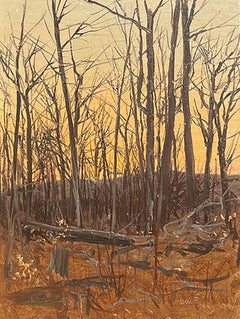
Joseph LÉPINE (Rochefort 1867 – Paris 1943) The Church of Caillac - Lot Oil on cardboard H. 33 cm; W. 41 cm Signed lower left Joseph Lépine quickly moved to Bordeaux, where he studied under Louis-Alexandre Cabié, a well-known landscape painter in the region and teacher of many early 20th-century artists. Despite the master's warnings, he sought to confront the Parisian modernity of the late 19th century and discover Impressionist and even early Post-Impressionist styles. There, he became a student of the neoclassical painters Courtois and Girardot, both former students of the great Jean-Léon Gérôme. In 1897, he exhibited at the Salon, where he sent landscapes of Provence. He became a member of the Société des Artistes Indépendants in 1905, the same year that the Fauves Matisse, Derain, and Vlaminck participated in and became known at the Salon d'Automne. A purchase by the French government of the 1908 Salon des Indépendants, "Vieille boutique," now housed at the Menton Museum, officially launched his career. He exhibited that year in London at the Royal Albert Hall, at the invitation of the Allied Artists' Association, demonstrating the painter's distinguished status within the international art scene. In Paris, the artist met several well-known painters of the time in the Montmartre and Montparnasse neighborhoods, including Matisse and Signac. His painting is based in particular on his approach to material, light, and color, whose juxtapositions present a play of saturation and composition based on apparent reserves. After the First World War, Lépine returned more to his home region, where he painted landscapes around Bordeaux and up the Dordogne River to the charming landscapes of the lower Corrèze. He painted Beaulieu-sur-Dordogne, Argentat, and also the Lot region, with the built-up escarpments of Saint Circq Lapopie. The city of Bordeaux and the French government acquired two of his works, representing a landscape near Verdelais and a view of the Saint-Michel Church in Bordeaux, in 1939 and 1941. Considered today a very important figure in Bordeaux painting...

Category

1920s French School Robert Emmett Owen Art
Materials

Oil, Cardboard

Chinese Contemporary Art by Su Yu - Qiang Lang

Chinese Contemporary Art by Su Yu - Qiang Lang

By Su Yu

Located in Paris, IDF

Oil on canvas Su Yu is a Chinese artist born in 1987 who lives and works in Beijing. He was an old student of prestigious art teachers as Shi Liang & Chen Danqing at Oil Paintin...

Category

2010s Realist Robert Emmett Owen Art
Materials

Oil, Cardboard

Previously Available Items
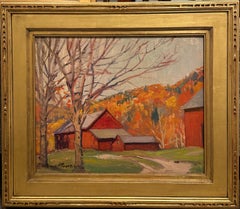
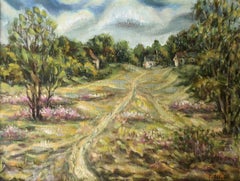
American Impressionist Robert Emmett Owen New England Landscape

American Impressionist Robert Emmett Owen New England Landscape

By Robert Emmett Owen

Located in Rockport, MA

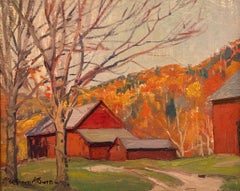
This oil painting by American artist Robert Emmet Owen captures a New England autumn with Owen’s signature warmth and impressionistic style. Rendered in rich, vibrant tones, the comp...

Category

20th Century American Impressionist Robert Emmett Owen Art
Materials

Oil

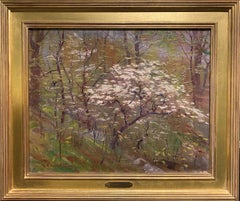
Dog Wood Tree
Dog Wood Tree

Robert Emmett OwenDog Wood Tree

Sold

H 21.5 in W 25.5 in

Dog Wood Tree

By Robert Emmett Owen

Located in Milford, NH

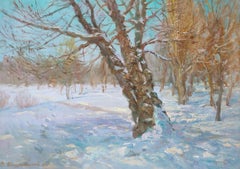
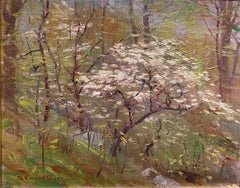
A fine impressionist landscape by American artist Robert Emmett Owen (1878-1957). Owen began his art training at the Drury Academy in his hometown of North Adams, Massachusetts. In 1897, while supporting himself by working at a local establishment, he contributed pen and ink drawings to Life Magazine, initiating what would be a long and productive career as an illustrator. The next year, he received a scholarship to study at the Eric Pape School of Art in Boston. After three years of training in Boston, Owen achieved further success from his commercial work, selling drawings to the Boston Globe, National Magazine, and Brown Book Magazine. Later, his work would appear in Scribner’s Magazine, Harper’s Monthly, and other publications. In 1901, Owen moved to New York and continued his training at the Art Students League, the Chase School, and the National Academy of Design. Among his instructors were Frederick Mulhaupt and Leonard Ochtman. In New York, Owen became aware of the art of leading American impressionists and began to create works that reflected the influence in particular of Willard Metcalf, J. Alden Weir, and Childe Hassam. Owen eventually opened his own gallery on Madison Avenue, where he exhibited and sold his own work for over twenty years. He became very well known for his impressionist views of rural landscapes. His color-filled paintings capture the moods and seasonal splendor of the New England countryside. Oil on canvas, signed lower left, artist placard on frame, title inscribed on verso stretcher “Dog Wood Tree...

Category

Early 20th Century American Impressionist Robert Emmett Owen Art
Materials

Canvas, Oil

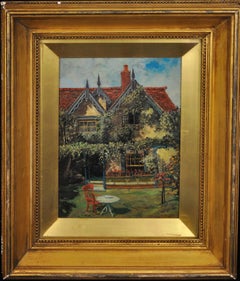
A New England Cottage Garden.Original Painting.Robert Emmett Owen. American Home

A New England Cottage Garden.Original Painting.Robert Emmett Owen. American Home

By Robert Emmett Owen

Located in Sutton Poyntz, Dorset

This original oil painting by Robert Emmett Owen , dating from the early part of the 20th century, is presented and supplied in its’ original frame (which is shown in these photographs). The frame dimensions are 50cm high x 42cm wide. The visible painting dimensions are 29cm high x 21cm wide (11.4inches high x 8.3inches wide). The painting is signed lower right. Robert Emmett Owen was a successful American artist, best known for his impressionist views of rural landscapes. His colour filled paintings capture the moods and seasonal splendor of the New England countryside. He was born in North Adams, Massachusetts in 1878. He began his art studies at Drury Academy in his hometown and quickly gained notice. At age 19, in 1897, he had several drawings accepted for publication by Life Magazine. The following year he received a scholarship to the Eric Pape School of Art in Boston, where he worked in the art department of the Boston Globe to pay for his studies. Owen moved to New York City in 1901 where he rapidly achieved renown as an illustrator and worked for various publications including Harper’s Bazaar, Frank Leslie’s Popular Monthly, Scribner’s and Cosmopolitan while continuing his training at the Art Students League, the Chase School, and the National Academy of Design. In 1910 Owen moved to Bagnall, Connecticut, to concentrate on landscapes full time. He had the opportunity there to paint outdoors in all seasons. He also received numerous commissions from many prominent citizens. In 1919, Temple Gwathmey, former president of the New York Stock Exchange, commissioned a series of twenty paintings, and in 1923, Stephen H. P. Pell commissioned a series of images for Fort Ticonderoga, eight of which were reproduced as full-page illustrations in Harper’s. Owen also received commissions from Percy Rockefeller and Edward Stettinus, former Secretary of State. Owen moved back to New York City in 1920, and opened his own gallery while continuing to do magazine illustrations. The gallery, called the Robert Emmett Owen New England Landscape Gallery, only exhibited and sold his own work. It moved several times during the next 21 years, always remaining successful until Owen closed it in 1941 when the United States entered the Second World War and moved to New Rochelle, New York to be the artist-in-residence at the Thomas Paine Memorial Museum. His work was well liked by both critics and the public and examples are held by the Frick Art Museum, New York, the Bruce Museum, Connecticut and the Greenwich Public Library. Owen died in New Rochelle in 1957. This painting is a feast for the eyes, depicting a New England cottage...

Category

Early 20th Century Impressionist Robert Emmett Owen Art
Materials

Canvas, Oil

Autumn Lane

Robert Emmett OwenAutumn Lane

Sold

H 25.25 in W 30.24 in

Autumn Lane

By Robert Emmett Owen

Located in Lambertville, NJ

Oil on canvas

Category

Robert Emmett Owen Art
Robert Emmett Owen art for sale on 1stDibs.

Find a wide variety of authentic Robert Emmett Owen art available for sale on 1stDibs.