Trevor Young Paintings

American

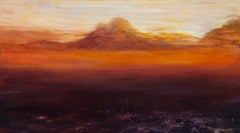
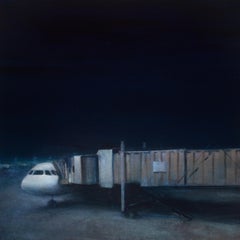
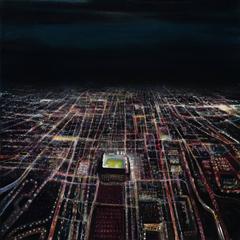
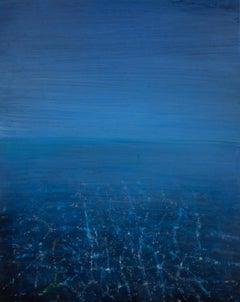
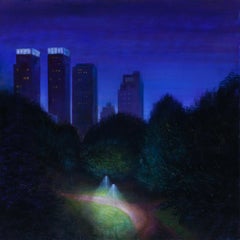
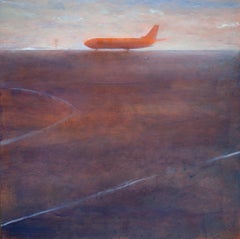
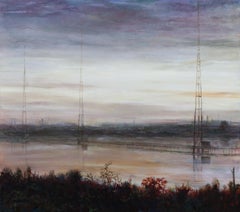
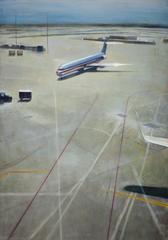
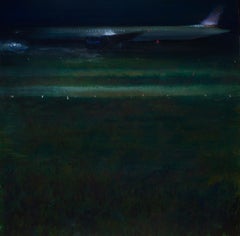
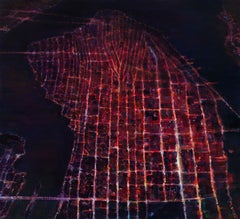
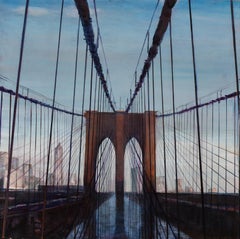
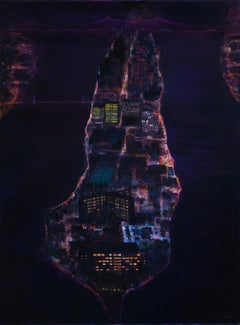
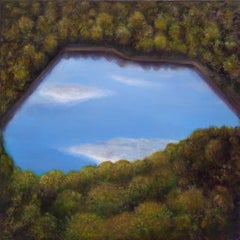
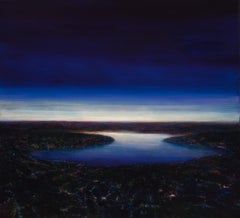
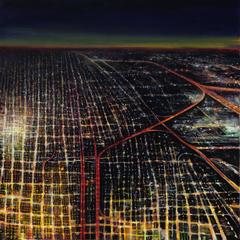
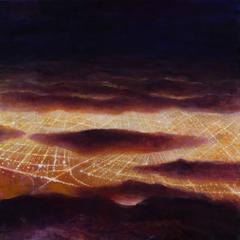
Trevor Young is a quintessentially American painter. He makes no bones about his affection for the trappings of car culture, life on the road and 1960s West Coast art. His main subject is modernism’s footprint on the outposts of Americana, places typified by harsh artificial light and hard shadows on concrete. For Young, despite the contemporary art world’s preferences for irony, disjunction and tongue-in-cheek intellectual gamesmanship, painting is at its best when it attempts to offer an unpretentious accounting of where and how we live our day-to-day lives. The celebrations of urban sprawl offered by artists like Ed Ruscha, who famously took no-nonsense aerial photographs of 34 Los Angeles parking lots in 1967 and created sleek, stripped-down paintings of Standard Oil stations, are an obvious point of reference in Young’s work. But Young’s choices seem more personal than Ruscha’s and his technique is certainly more painterly. His images of gas stations are uneasy amalgamations, cobbled together from his memories of road trips, photographs and pure invention and rendered with a sense of atmosphere and drama seemingly at odds with his use of hard lines and simple geometric shapes. Young activates every square inch of his canvases, blocking in large passages of negative space with skeins of scruffy countervailing strokes. He is not a fussy painter, nor is he out to prove his mastery to an audience. Like Edward Hopper, Young tends to eschew a lot of paint’s seductive properties, preferring to create hard edges and large, gently undulating planes of subdued color. He draws the viewer into an unpopulated, uncluttered world with a clear horizon line, but one that is also filled with hiccups, discontinuities and compromises. For Young, the cold comfort offered by outposts of convenience like gas stations, airports, cheap hotel rooms is not so easily dismissed. Young shares the strange buoyant optimism of his hero, Jonathan Richman. Spending time with Young’s paintings, one can’t help but feel the echoes of that thrill.

to
3
1
2
10
Overall Width
to
Overall Height
to
16
9
4
3
11
8
7
4
4
4
4
3
3
2
2
2
2
2
1
1
1
1
1
1
16
16
13
12
4
16
780
728
710
684
16
Artist: Trevor Young
Passing Protrusion
By Trevor Young
Located in Fairfield, CT
Represented by George Billis Gallery, NYC & LA -- Trevor Young is a quintessentially American painter. He makes no bones about his affection for the trappings of car culture, life on...
Category

21st Century and Contemporary American Realist Trevor Young Paintings

Materials

Canvas, Oil

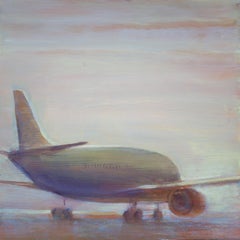
Resting Fuselage
By Trevor Young
Located in Fairfield, CT
Represented by George Billis Gallery, NYC & LA --Trevor Young is a quintessentially American painter. He makes no bones about his affection for the trappings of car culture, life on ...
Category

21st Century and Contemporary American Realist Trevor Young Paintings

Materials

Linen, Oil, Panel

End of Inning
By Trevor Young
Located in Fairfield, CT
Represented by George Billis Gallery, NYC & LA -- Trevor Young is a quintessentially American painter. He makes no bones about his affection for the trappings of car culture, lif...
Category

21st Century and Contemporary American Realist Trevor Young Paintings

Materials

Canvas, Oil

First Light
By Trevor Young
Located in Fairfield, CT
Trevor Young is a quintessentially American painter. He makes no bones about his affection for the trappings of car culture, life on the road, and 1960s West Coast art. His main subj...
Category

2010s American Realist Trevor Young Paintings

Materials

Oil, Panel

In the Park
By Trevor Young
Located in Fairfield, CT
Trevor Young is a quintessentially American painter. He makes no bones about his affection for the trappings of car culture, life on the road, and 1960s West Coast art. His main subj...
Category

2010s American Realist Trevor Young Paintings

Materials

Canvas, Oil

Red Hardbody
By Trevor Young
Located in Fairfield, CT
Represented by George Billis Gallery, NYC & LA --Trevor Young is a quintessentially American painter. He makes no bones about his affection for the trappings of car culture, life on the road, and 1960s West Coast art. His main subject is modernism’s footprint on the outposts of Americana—places typified by harsh artificial light and hard shadows on concrete. The show makes clear that for Young, despite the contemporary art world’s preferences for irony, disjunction, and tongue-in-cheek intellectual gamesmanship, painting is at its best when it attempts to offer an unpretentious accounting of where and how we live our day-to-day lives. The celebrations of urban sprawl offered by artists like Ed Ruscha—who famously took no-nonsense aerial photographs of thirty four LA parking lots in 1967, and created sleek, stripped down paintings of Standard Oil stations—are an obvious point of reference in Young’s work. But Young’s choices seem more personal than Ruscha’s, and his technique is certainly more painterly: His images of gas stations are uneasy amalgamations, cobbled together from his own memories of road trips, photographs, and pure invention, and rendered with a sense of atmosphere and drama seemingly at odds with his use of hard lines and simple geometric shapes. Painters today tend to lean on pastiche, on art-historical mashups and code-switching. This typically results in images with no unified style and no concern for pictorial space, illusionistic or otherwise. For many contemporary painters, the picture plane is simply a flat, delimited arena in which different types of visual syntax collide, floating freely. This is a non-strategy in which artists make an end run around some of the thornier problems of composition, perception, and cognition. Young bucks this trend. He activates every square inch of his canvases, blocking in large passages of negative space with skeins of scruffy countervailing strokes. He is not a fussy painter, nor is he out to prove his own mastery to an audience. Like Edward Hopper, Young tends to eschew a lot of paint’s seductive properties, preferring to create hard edges and large, gently undulating planes of subdued color. He draws the viewer into an unpopulated, uncluttered world with a clear horizon line—but one that is also filled with hiccups, discontinuities, and compromises. In Service in the Rear, for example, a shelter for gas pumps in the foreground—closest to the viewer and, therefore, logically a dominant compositional element—is rendered as a hazy silhouette that flagrantly disobeys the rules of linear perspective. This is intentional: The structure is only important to Young in the way that it draws the viewer’s eye below and past it, to the glowing, low-slung building dominating the lefthand side of the picture. Thus Young shows his talent for creating visual tension and drama—and for sidestepping the viewer’s expectations. Young understands that some might regard his brand of painting as obsolete. He also understands the troubled legacy of modernism, and what the triumph of universal technology has meant for cultures around the globe. Still, for Young, the cold comfort offered by outposts of convenience—gas stations, airports, cheap hotel rooms—is not so easily dismissed. Young shares the strange buoyant optimism of his hero, Jonathan Richman, who, in his early ‘70s proto-punk single, Roadrunner, exults in the simple act of driving past the Stop’n’Shop with the radio on...
Category

21st Century and Contemporary American Realist Trevor Young Paintings

Materials

Oil, Panel

Meadowland Erections
By Trevor Young
Located in Fairfield, CT
Represented by George Billis Gallery, NYC & LA -- Trevor Young is a quintessentially American painter. He makes no bones about his affection for the trappings of car culture, life on the road, and 1960s West Coast art...
Category

21st Century and Contemporary American Realist Trevor Young Paintings

Materials

Canvas, Oil

Departure Beat
By Trevor Young
Located in Fairfield, CT
Represented by George Billis Gallery, NYC & LA -- Trevor Young is a quintessentially American painter. He makes no bones about his affection for the trappings of car culture, lif...
Category

21st Century and Contemporary American Realist Trevor Young Paintings

Materials

Canvas, Oil

Active Runway
By Trevor Young
Located in Fairfield, CT
Represented by George Billis Gallery, NYC & LA --Trevor Young is a quintessentially American painter. He makes no bones about his affection for the trappings of car culture, life on ...
Category

21st Century and Contemporary American Realist Trevor Young Paintings

Materials

Oil, Panel

Red Borough
By Trevor Young
Located in Fairfield, CT
Trevor Young is a quintessentially American painter. He makes no bones about his affection for the trappings of car culture, life on the road, and 1960s West Coast art. His main subj...
Category

2010s American Realist Trevor Young Paintings

Materials

Canvas, Oil

Suspension
By Trevor Young
Located in Fairfield, CT
Trevor Young is a quintessentially American painter. He makes no bones about his affection for the trappings of car culture, life on the road, and 1960s West Coast art. His main subj...
Category

2010s American Realist Trevor Young Paintings

Materials

Canvas, Oil

Roosevelt
By Trevor Young
Located in Fairfield, CT
Trevor Young is a quintessentially American painter. He makes no bones about his affection for the trappings of car culture, life on the road, and 1960s West Coast art. His main subj...
Category

2010s American Realist Trevor Young Paintings

Materials

Canvas, Oil

Natural Body
By Trevor Young
Located in Fairfield, CT
Trevor Young is a quintessentially American painter. He makes no bones about his affection for the trappings of car culture, life on the road, and 1960s West Coast art. His main subj...
Category

2010s American Realist Trevor Young Paintings

Materials

Canvas, Oil

Placid Comeback
By Trevor Young
Located in Fairfield, CT
Represented by George Billis Gallery, NYC & LA -- Trevor Young is a quintessentially American painter. He makes no bones about his affection for the trappings of car culture, life on...
Category

21st Century and Contemporary American Realist Trevor Young Paintings

Materials

Canvas, Oil

Yellow Grid
By Trevor Young
Located in Fairfield, CT
Represented by George Billis Gallery, NYC & LA -- Trevor Young is a quintessentially American painter. He makes no bones about his affection for the trappings of car culture, lif...
Category

21st Century and Contemporary American Realist Trevor Young Paintings

Materials

Canvas, Oil

Sodium Vapors
By Trevor Young
Located in Fairfield, CT
Represented by George Billis Gallery, NYC & LA -- Trevor Young is a quintessentially American painter. He makes no bones about his affection for the trappings of car culture, lif...
Category

21st Century and Contemporary American Realist Trevor Young Paintings

Materials

Canvas, Oil

Related Items
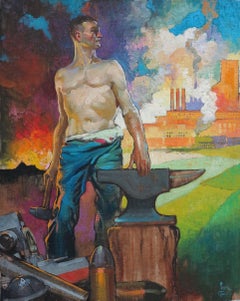
Allegory of Defense Industry (figurative male illustration)
By Frank Godwin
Located in Wilton Manors, FL
Frank Godwin (1889-1959). Allegory of Defense Industry, 1919. Oil on canvas. Signed lower right. Image measures 20.75 x 26.25 inches. The canvas measures 24 x 36 inches in total. Ann...
Category

Early 20th Century American Realist Trevor Young Paintings

Materials

Canvas, Oil

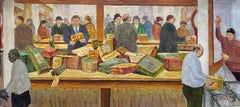
Post Office Parcel Post Window - Depression Era
By Arnold Friedman
Located in Miami, FL
Arnold Friedman worked as a clerk for decades at the Station Y, the branch at 3rd Avenue and East 67th Street in New York City. This present work was done two years after his retirem...
Category

1930s American Realist Trevor Young Paintings

Materials

Oil, Wood Panel

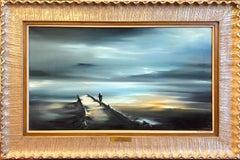
Mid Century Seascape and Figural Original oil painting on Linen
By Robert Watson
Located in Soquel, CA
Mid Century Seascape and Figural Original oil painting on Linen 1956 Solitary figure on wharf by California artist Robert Watson, painted 1956 (1923 - 2004)The following, is from To...
Category

1950s American Realist Trevor Young Paintings

Materials

Linen, Oil

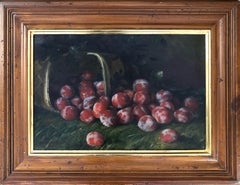
Les Gros Prunes, plums still life
By Adam Lehr
Located in New York, NY
This still life of Plums is a top notch example of 19th century still life painting! Beautiful quality and striking but also spare and honest in nature which is what typified Americ...
Category

Early 1900s American Realist Trevor Young Paintings

Materials

Canvas, Oil

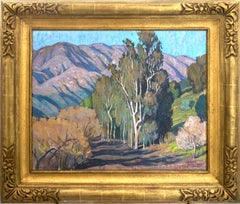
Pathway to the San Gabrielino Trail; Neglected and Protected
By Tim Solliday
Located in Pasadena, CA
Provenance Acquired by the gallery directly from the artist Painted en plein air in the San Gabriel Mountains near the artist's home in the early summer of 2013. Signed "T. Solliday...
Category

2010s American Realist Trevor Young Paintings

Materials

Canvas, Oil

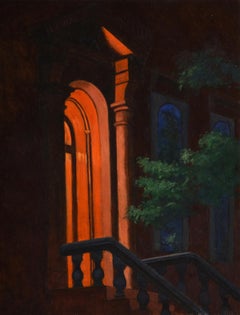
Night Doorway, dark, mysterious urban architectural oil painting
By Gregory Frux
Located in Brooklyn, NY
Night Doorway, Oil on panel, nocturne Park Slope, Brooklyn Dr. Rowland S. Russell PhD. writes about his experience directly witnessing Greg's practice as a “plein air” artist: Whet...
Category

2010s American Realist Trevor Young Paintings

Materials

Oil, Panel

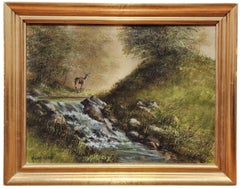
A Friend in the Forest, Landscape with Deer
By Richard Weers
Located in Grand Rapids, MI
Richard Weers (American, 1932-2022) Signed: Richard Weers (Lower, Left) " A Friend in the Forest " Oil on Canvas 12" x 16" Housed in a 1 1/2" Gol...
Category

Late 20th Century American Realist Trevor Young Paintings

Materials

Canvas, Oil

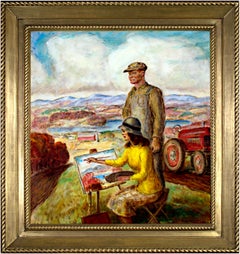
'Sketching Wisconsin' original oil painting, Signed
By John Steuart Curry
Located in Milwaukee, WI
John Steuart Curry "Sketching Wisconsin," 1946 oil on canvas 31.13 x 28 inches, canvas 39.75 x 36.75 x 2.5 inches, frame Signed and dated lower right Overall excellent condition Presented in a 24-karat gold leaf hand-carved wood frame John Steuart Curry (1897-1946) was an American regionalist painter active during the Great Depression and into World War II. He was born in Kansas on his family’s farm but went on to study art in Chicago, Paris and New York as young man. In Paris, he was exposed to the work of masters such as Peter Paul Rubens, Eugène Delacroix and Jacques-Louis David. As he matured, his work showed the influence of these masters, especially in his compositional decisions. Like the two other Midwestern regionalist artists that are most often grouped with him, Grant Wood (American, 1891-1942) and Thomas Hart Benton (American, 1889-1975), Curry was interested in representational works containing distinctly American subject matter. This was contrary to the popular art at the time, which was moving closer and closer to abstraction and individual expression. Sketching Wisconsin is an oil painting completed in 1946, the last year of John Steuart Curry’s life, during which time he was the artist-in-residence at the University of Wisconsin in Madison. The painting is significant in Curry’s body of work both as a very revealing self-portrait, and as a landscape that clearly and sensitively depicts the scenery of southern Wisconsin near Madison. It is also a portrait of the artist’s second wife, Kathleen Gould Curry, and is unique in that it contains a ‘picture within a picture,’ a compositional element that many early painting masters used to draw the eye of the viewer. This particular artwork adds a new twist to this theme: Curry’s wife is creating essentially the same painting the viewer is looking at when viewing Sketching Wisconsin. The triangular composition of the figures in the foreground immediately brings focus to a younger Curry, whose head penetrates the horizon line and whose gaze looks out towards the viewer. The eye then moves down to Mrs. Curry, who, seated on a folding stool and with her hand raised to paint the canvas on the easel before her, anchors the triangular composition. The shape is repeated in the legs of the stool and the easel. Behind the two figures, stripes of furrowed fields fall away gently down the hillside to a farmstead and small lake below. Beyond the lake, patches of field and forest rise and fall into the distance, and eventually give way to blue hills. Here, Curry has subverted the traditional artist’s self-portrait by portraying himself as a farmer first and an artist second. He rejects what he sees as an elitist art world of the East Coast and Europe. In this self-portrait he depicts himself without any pretense or the instruments of his profession and with a red tractor standing in the field behind him as if he was taking a break from the field work. Here, Curry’s wife symbolizes John Steuart Curry’s identity as an artist. Compared with a self-portrait of the artist completed a decade earlier, this work shows a marked departure from how the artist previously presented and viewed himself. In the earlier portrait, Curry depicted himself in the studio with brushes in hand, and with some of his more recognizable and successful canvases behind him. But in Sketching Wisconsin, Curry has taken himself out of the studio and into the field, indicating a shift in the artist’s self-conception. Sketching Wisconsin’s rural subject also expresses Curry’s populist ideals, that art could be relevant to anyone. This followed the broad educational objectives of UW’s artist-in-residence program. Curry was appointed to his position at the University of Wisconsin in 1937 and was the first person to hold any such position in the country, the purpose of which was to serve as an educational resource to the people of the state. He embraced his role at the University with zeal and not only opened the doors of his campus studio in the School of Agriculture to the community, but also spent a great deal of time traveling around the state of Wisconsin to visit rural artists who could benefit from his expertise. It was during his ten years in the program that Curry was able to put into practice his belief that art should be meaningful to the rural populace. However, during this time he also struggled with public criticism, as the dominant forces of the art market were moving away from representation. Perhaps it was Curry’s desire for public acceptance during the latter part of his career that caused him to portray himself as an Everyman in Sketching Wisconsin. Beyond its importance as a portrait of the artist, Sketching Wisconsin is also a detailed and sensitive landscape that shows us Curry’s deep personal connection to his environment. The landscape here can be compared to Wisconsin Landscape of 1938-39 (the Metropolitan Museum of Art), which presents a similar tableau of rolling hills with a patchwork of fields. Like Wisconsin Landscape, this is an incredibly detailed and expressive depiction of a place close to the artist’s heart. This expressive landscape is certainly the result of many hours spent sketching people, animals, weather conditions and topography of Wisconsin as Curry traveled around the state. The backdrop of undulating hills and the sweeping horizon, and the emotions evoked by it, are emphatically recognizable as the ‘driftless’ area of south-central Wisconsin. But while the Metropolitan’s Wisconsin Landscape conveys a sense of uncertainty or foreboding with its dramatic spring cloudscape and alternating bands of light and dark, Sketching Wisconsin has a warm and reflective mood. The colors of the foliage indicate that it is late summer and Curry seems to look out at the viewer approvingly, as if satisfied with the fertile ground surrounding him. The landscape in Sketching Wisconsin is also revealing of what became one of Curry’s passions while artist-in-residence at UW’s School of Agriculture – soil conservation. When Curry was a child in Kansas, he saw his father almost lose his farm and its soil to the erosion of The Dust Bowl. Therefore, he was very enthusiastic about ideas from UW’s School of Agriculture on soil conservation methods being used on Wisconsin farms. In Sketching Wisconsin, we see evidence of crop rotation methods in the terraced stripes of fields leading down the hillside away from the Curry’s and in how they alternate between cultivated and fallow fields. Overall, Sketching Wisconsin has a warm, reflective, and comfortably pastoral atmosphere, and the perceived shift in Curry’s self-image that is evident in the portrait is a positive one. After his rise to favor in the art world in the 1930’s, and then rejection from it due to the strong beliefs presented in his art, Curry is satisfied and proud to be farmer in this self-portrait. Curry suffered from high blood...
Category

1940s American Realist Trevor Young Paintings

Materials

Canvas, Oil

"Texas Hill Country Landscape With Cattle" oil painting of wildflowers, cactus
By Don Warren
Located in Austin, TX
Canvas Size: 12 x 16 in. Frame Size: 20.5 x 24.5 in. Signed, lower left: "Don Warren" A serene, classic, and cheerful scene in the Texas Hill Country by Don Warren. The foreground i...
Category

1970s American Realist Trevor Young Paintings

Materials

Canvas, Oil

"The Eastern Moon"
By Peter Sculthorpe
Located in Lambertville, NJ
Jim’s of Lambertville is proud to offer this artwork. Signed lower right. Complemented by a hand carved and gilt frame. Peter Sculthorpe (b. 1948) Peter Sculthorpe was born in ...
Category

21st Century and Contemporary American Realist Trevor Young Paintings

Materials

Linen, Oil

"The Eastern Moon"
"The Eastern Moon"
$13,150
H 14 in W 24 in D 2 in
Evening Fog, Beautiful Glowing Maritime, Moody Seascape
Located in Grand Rapids, MI
William H. Kinnicutt (American, 1865 - 1934) Signed: W. H. Kinnicutt (Lower, Right) " Evening Fog ", circa 1900 - 1910 Oil on Canvas 20" x 16" Housed in a 3" Carved Frame Overa...
Category

Early 20th Century American Realist Trevor Young Paintings

Materials

Canvas, Oil

"Bustling Alley at Dusk" Oil Painting
By Christopher Clark
Located in Denver, CO
Christopher Clark's (US based) "Bustling Alley at Dusk" is an original, handmade oil painting that depicts a dreamy cityscape that features turn of the century buildings lining an alley where throngs of people gather at cafes and walk past in the light of the setting sun. Bio/artist statement: Christopher has been an artist since early childhood, when he would watch Bob Ross on PBS and mimic the famed oil painter’s art with crayons. He considers himself a self-educated artist, with his studies ranging from personal training with contemporary masters, to classical academic art technique, with much inspiration from 19th Century art and the Impressionist Movement. Christopher lived in Italy for a time, immersing himself in Italian culture and art, which continues to influence his painting. His fan base has grown considerably since his return to the US, gaining the attention of Lucasfilm and Marvel Fine Art, which both signed him as an officially licensed artist in 2016. Other clients include George Lucas, Major League Baseball, Louisville Slugger, and Fender Guitars. Christopher’s painting skills are not his only talent in the arts. He has won several national swing dance championship competitions, and also studies tango and blues dancing. He has played guitar since the age of 12, and during his time as lead guitarist for a rock band, he opened for Blue Oyster Cult...
Category

2010s American Realist Trevor Young Paintings

Materials

Oil, Wood Panel

Previously Available Items
Flowing Away
By Trevor Young
Located in Fairfield, CT
Represented by George Billis Gallery, NYC & LA --Trevor Young is a quintessentially American painter. He makes no bones about his affection for the trappings of car culture, life on ...
Category

21st Century and Contemporary American Realist Trevor Young Paintings

Materials

Oil, Panel

Trevor Young paintings for sale on 1stDibs.

Find a wide variety of authentic Trevor Young paintings available for sale on 1stDibs. If you’re browsing the collection of paintings to introduce a pop of color in a neutral corner of your living room or bedroom, you can find work that includes elements of blue and other colors. You can also browse by medium to find art by Trevor Young in oil paint, paint, fabric and more. Not every interior allows for large Trevor Young paintings, so small editions measuring 8 inches across are available. Customers who are interested in this artist might also find the work of Alex Roulette, Anthony Ackrill, and Edward Minoff. Trevor Young paintings prices can differ depending upon medium, time period and other attributes. On 1stDibs, the price for these items starts at $1,400 and tops out at $10,900, while the average work can sell for $8,500.