By Lynd Ward
Located in Myrtle Beach, SC
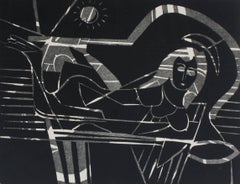
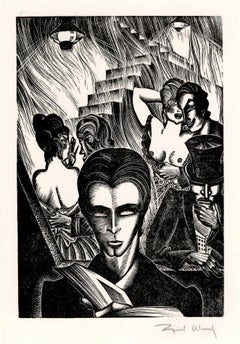
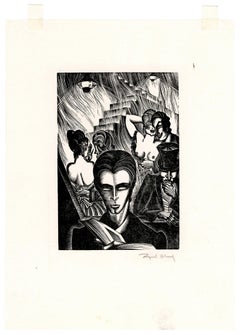
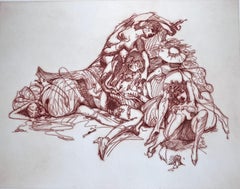
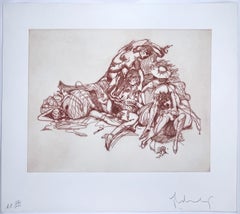
Lynd Ward, 'Madman's Drum, Plate 41', wood engraving, 1930, edition small. Signed in pencil. A fine, richly-inked impression, on off-white tissue-thin Japan paper; the full sheet with margins (1 5/8 to 2 1/2 inches); a small paper blemish in the upper right margin, away from the image, otherwise in excellent condition. A scarce, artist-printed, hand-signed proof impression before the published edition. Matted to museum standards, unframed.
Image size 5 1/2 x 3 3/4 inches (140 x 95 mm); sheet size 9 5/8 x 7 1/8 inches (244 x 181 mm).
From Lynd Ward’s book of illustrations without words, 'Madman’s Drum', Jonathan Cape and Harrison Smith, New York, 1930.
Reproduced in 'Storyteller Without Words, the Wood Engravings of Lynd Ward', Harry N. Abrams, New York, 1974.
ABOUT THE ARTIST
Lynd Ward is acknowledged as one of America’s foremost wood engravers and book illustrators of the first half of the twentieth century. His innovative use of narrative printmaking as a stand-alone storytelling vehicle was uniquely successful in reaching a broad audience. The powerful psychological intensity of his work, celebrated for its dynamic design, technical precision, and compelling dramatic content, finds resonance in the literature of Poe, Melville, and Hawthorne. Like these classic American writers, Ward was concerned with the themes of man’s inner struggles and the role of the subconscious in determining his destiny. An artist of social conscience during the Great Depression and World War II, he infused his graphic images with his unique brand of social realism, deftly portraying the problems that challenged the ideals of American society.
The son of a Methodist preacher, Lynd Ward, moved from Chicago to Massachusetts at an early age. He graduated from the Teachers College of Columbia University, New York, in 1926, where he studied illustration and graphic arts. He married May Yonge McNeer in 1936 and left for Europe for their honeymoon in Eastern Europe. After four months, they settled in Leipzig, where Ward studied at the National Academy of Graphic Arts and Bookmaking. Inspired by Belgian expressionist artist Frans Masereel's graphic novel ‘The Sun,’ and another graphic novel by the German artist Otto Nückel, ‘Destiny,’ he determined to create his own "wordless" novel. Upon his return to America, Ward completed his first book, ‘God's Man: A Novel in Woodcuts,’ published in 1929. ‘Gods’ Man’ was a great success for its author and publisher and was reprinted four times in 1930, including a British edition. This book and several which followed it, ‘Madman’s Drum,’ 1930, ‘Wild Pilgrimage...
Category
1930s American Modern Weyman Lew Art