Wilhelm Hunt Diederich Art

to
1
Overall Width
to
Overall Height
to
1
1
1
1
1
1
2
10,733
2,827
2,495
1,414
1
Artist: Wilhelm Hunt Diederich
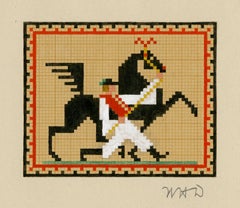
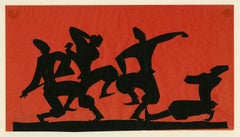
Cossack Dancers
Cossack Dancers

Cossack Dancers

By Wilhelm Hunt Diederich

Located in Myrtle Beach, SC

Wilhelm Hunt Diederich, 'Cossack Dancers', cut paper silhouette, c. 1920. Signed 'WHD' in pencil, lower left image. Black, wove, cut paper, laid on ...

Category

1920s American Modern Wilhelm Hunt Diederich Art

Materials

Laid Paper

Related Items
Milwaukee Handicraft Project WPA

Milwaukee Handicraft Project WPA

Located in Los Angeles, CA

Milwaukee Handicraft Project, Applied Design Blockprinted Textiles Volume VI Supplement, c. 1935 - 1942, twelve block printed designs on linen, images are various sizes, each is mounted in its original folder which measures 24 x 19 inches, all bear the Milwaukee Handicraft Project label, various designers, including Barbara Warren (1915 - 2005) ("Checkered Flower" and perhaps others), includes original portfolio binder The Milwaukee Handicraft Project (MHP) was the most prolific and successful of the decorative arts projects of the Works Progress Administration (WPA). It served as a model for many other similar projects across the United States and attracted the attention of thought leaders as diverse as Frank Lloyd Wright and First Lady Eleanor Roosevelt. Designed with the dual goals of providing work for underprivileged women and the creation of well-designed household objects, the MHP began in 1935 under the direction of Elsa Ulbricht...

Category

1930s American Modern Wilhelm Hunt Diederich Art

Materials

Textile, Linen, Linocut, Woodcut

The Lantern
The Lantern

Romare BeardenThe Lantern, 1979

$5,500

H 23.75 in W 14 in

The Lantern

By Romare Bearden

Located in New York, NY

Color lithograph, 1979. An artist's proof impression, aside from the numbered edition of 175. Signed by the artist in pencil, lower right. Inscribed "AP" (artist's proof) in pencil...

Category

1970s American Modern Wilhelm Hunt Diederich Art

Materials

Lithograph, Color

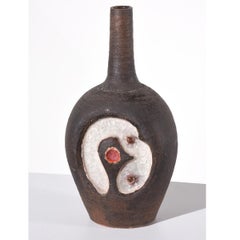
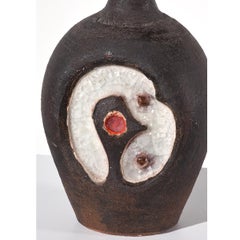
Aldo Londi Vase Abstract "Glass Fused Ceramic Vase"

Aldo Londi Vase Abstract "Glass Fused Ceramic Vase"

Located in Detroit, MI

"Glass Fused Ceramic Vase" is vintage Mid-Century Modern. This handsome vase has an elongated neck with a white glass-fused inlay portion on the front body...

Category

Mid-20th Century American Modern Wilhelm Hunt Diederich Art

Materials

Ceramic, Glass

Nude and Swan
Nude and Swan

Nude and Swan

Located in New York, NY

Woodcut on paper, 1921. Signed by the artist, numbered 13/24, dated, titled "Lead'r" and dedicated "To Rose - Nat - be careful" in pencil, lower margin. The dedicatees named by E...

Category

1920s American Modern Wilhelm Hunt Diederich Art

Materials

Woodcut

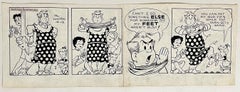
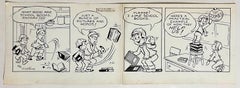
Rare 1950s Vintage Syndicated Ink Drawing Cartoon Strip Susie Q Smith Comic Art

Rare 1950s Vintage Syndicated Ink Drawing Cartoon Strip Susie Q Smith Comic Art

Located in Surfside, FL

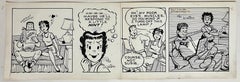
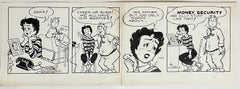
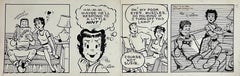
SUSIE Q. SMITH Medium: Newspaper comics Distributed by: King Features Syndicate First Appeared: 1945 Creators: Linda and Jerry Walter 5.5 X 19.5 Dated August 13, 1954 in top right corner. Like her contemporaries, Aggie Mack, Candy and Patsy Walker (before her conversion to a superhero), Susie Q. Smith was a female Archie-type — not exactly an imitator, because Archie, who had started only four years earlier, hadn't yet become popular enough to spawn imitators, but part of his genre. She attended high school, where her teachers often seemed unreasonable to her, interacted with the opposite gender in a typically adolescent way, and her parents didn't completely understand her. And she was cute and perky as only a teenage girl can be. Susie was the star of a comic strip distributed by King Features, the biggest of the comic strip syndicates, whose other offerings have ranged from Jackys Diary to Prince Valiant. King launched the strip in both daily and Sunday form in 1945. Daily, she was only in a panel at first, but it expanded into a full, multi-panel strip on February 7, 1953. In a very odd turn of events, in 1953 the Walters chose to leave King Features behind and hitch their wagon at the McNaught Syndicate. The creators were Harold "Jerry" Walter and his wife, Linda. Jerry was also responsible for Jellybean Jones, who has nothing to do with Jughead Jones's young sister, a modern-day addition to the Archie cast of characters. Together, they did The Lively Ones during the 1960s. Though each was capable of doing both major jobs in comic strip production, their usual working method was for Jerry to dream up the ideas and write the dialog, while Linda did the artwork. The Walters also collaborated on a series of Susie Q. Smith comic books for Dell Comics. Instead of reprinting newspaper strips, these ran new stories by the Walters. Between 1951 and '54, four issues were published as part of the Four Color Comics series, where many minor comic strips, including Dotty Dripple, Timmy and Rusty Riley had found a home. It had no other media spin-offs. Susie Q. Smith had a respectable run in the newspapers, but it ended in 1959. Jerry Walter (1915 - 2007) was an abstract expressionist artist whose output of energetic and colorful paintings were the products of the rich artistic milieu of post-war New York City. He was born Harold Frank Walter in Mount Pleasant, Iowa on November 25, 1915. After graduating from Colgate University in 1937, Walter moved to New York City, where he studied drawing and painting at the New School and the Art Students’ League. Before concentrating seriously on his art, he spent several years as a successful copywriter and idea man for the advertising agencies of J. Walter Thompson, McCann Ericson, and BBDO. During this time, he also worked as a syndicated cartoonist. Collaborating with his wife, Linda, his best-known series was Susie Q. Smith, which first appeared in 1945 and described as a “female Archie type.” Very popular, the cartoon was later the subject of a series of comic books published from 1951 to 1954. After serving in the United States Army for three years during World War II, Walter began to paint seriously. He ascribed his earliest artistic influence to Joan Miró, whose Dog Barking at the Moon (1926) he viewed when he was twelve, the year he published his first cartoon. Walter later wrote that jazz, “the first native expression of so-called modernism” was a strong influence on his work. During the later 1940s, Walters spent time at the Research Studio in Maitland, Florida. Founded in 1937 by artist and architect J. André Smith and supported by the philanthropist Mary Curtis Bok, the Research Studio was a lively colony that hosted prominent artists, including Milton Avery, Ralston Crawford, and Doris Lee. While at the Studio, Walter’s work was purchased by Frank Crowninshield. A founding trustee of the Museum of Modern Art and editor of Vanity Fair, Crowinshield was a noted collector; his collection included important works by Pablo Picasso, Marc Chagall, Henri Matisse, Edgar Degas, George Bellows, and Pierre Bonnard. Returning to New York after his time at the Studio, Walter became an active member of the New York school of the abstract expressionist movement, and in the summer of 1956, Walter exhibited 13 paintings and a selection of drawings at New York’s Chase Gallery. The adroit manipulation of both color and composition evident in his work shows the influence of Abstract Expressionism, particularly Willem de Kooning, Arshile Gorky, and Hans Hofmann. illustrator and female cartoonist Linda Walter was the talented female mind behind the beloved "Susie Q. Smith" comic strip. She played an instrumental role in shaping the cultural landscape through her vibrant illustrations. Known for the timeless charm of the "Susie Q. Smith" comic strip, Linda's artistry brought joy and laughter to countless readers during the 1950s and continues to resonate with fans across generations. She was part of the Woodstock artists community. from Women in Comics: Linda Walter was the artist of newspaper strip Susie Q. Smith, which was written by her husband, Jerry. It was syndicated by King Features Syndicate and ran from 1945 to 1959. The Walters also contributed original Susie Q. Smith stories to Dell's Four Color comic books from 1951 to 1954. From 1964-1965, they created a singled panel comic called The Lively Ones. Vintage Golden Age of Comics era. The Golden Age of Comic Books describes an era in the history of American comic books from 1938 to 1956. During this time, modern comic books were first published and rapidly increased in popularity. The superhero archetype was created. Between 1939 and 1941 Detective Comics (DC) and its sister company, All-American Publications, introduced popular superheroes such as Batman and Robin, Wonder Woman, the Flash, Green Lantern, Doctor Fate, the Atom, Hawkman, Green Arrow and Aquaman. Timely Comics, the 1940s predecessor of Marvel Comics, had million-selling titles featuring the Human Torch, the Sub-Mariner, and Captain America. Another notable series was The Spirit by Will Eisner. Dell Comics' non-superhero characters (particularly the licensed Walt Disney animated-character comics) outsold the superhero comics of the day. The publisher featured licensed movie and literary characters such as Mickey Mouse, Donald Duck, Roy Rogers and Tarzan. Additionally, MLJ's introduction of Archie Andrews in Pep Comics #22 (December 1941) gave rise to teen humor comics, with the Archie Comics...

Category

1950s American Modern Wilhelm Hunt Diederich Art
Materials

Paper, Ink

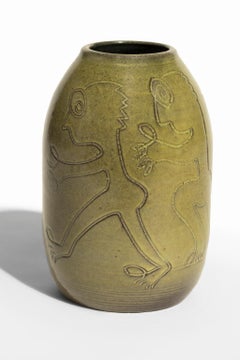
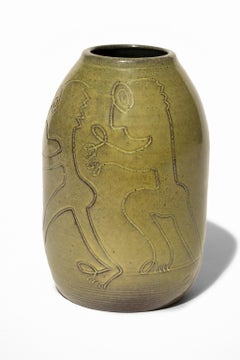
"Untitled" Ceramic Vase with Etched Figures, Green Glaze, Signed on Bottom

"Untitled" Ceramic Vase with Etched Figures, Green Glaze, Signed on Bottom

Located in Detroit, MI

SALE ONE WEEK ONLY Douglas’s etched ceramic vase in a rich earthy green glaze expresses the Mid-Century Modern style of simplicity of lines, forms and color. Despite its formal shap...

Category

Mid-20th Century American Modern Wilhelm Hunt Diederich Art

Materials

Ceramic, Glaze

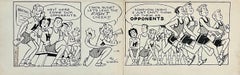
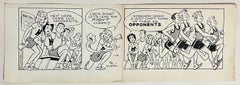
Original Vintage Syndicated Ink Drawing Cartoon Strip Susie Q Smith Comic Art

Original Vintage Syndicated Ink Drawing Cartoon Strip Susie Q Smith Comic Art

Located in Surfside, FL

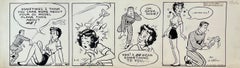
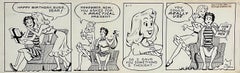
SUSIE Q. SMITH Medium: Newspaper comics Distributed by: King Features Syndicate First Appeared: 1945 Creators: Linda and Jerry Walter 6.5 X 18 Like her contemporaries, Aggie Mack, Candy and Patsy Walker (before her conversion to a superhero), Susie Q. Smith was a female Archie-type — not exactly an imitator, because Archie, who had started only four years earlier, hadn't yet become popular enough to spawn imitators, but part of his genre. She attended high school, where her teachers often seemed unreasonable to her, interacted with the opposite gender in a typically adolescent way, and her parents didn't completely understand her. And she was cute and perky as only a teenage girl can be. Susie was the star of a comic strip distributed by King Features, the biggest of the comic strip syndicates, whose other offerings have ranged from Jackys Diary to Prince Valiant...

Category

1950s American Modern Wilhelm Hunt Diederich Art

Materials

Paper, Ink

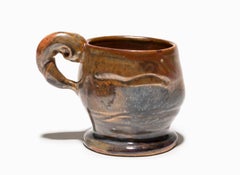
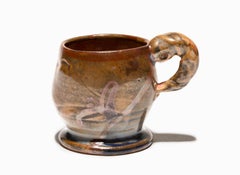
John Glick Plum Street Pottery Reduction Fired Shino Glaze Cup Published in Book

John Glick Plum Street Pottery Reduction Fired Shino Glaze Cup Published in Book

Located in Detroit, MI

“Untitled” ceramic, is an example of the kind of work by which John Glick became so famous. He was seduced by the effects of the reduction kiln, which decreased the levels of oxygen during firing, inducing the flame to pull oxygen out of the clay and glazes changing the colors of the glazes depending on their iron and copper content. In this way he achieved the rich gradients of ochre and umber and variations in stippling and opacity. This piece is signed on the bottom and can be found on page 92, plate #125 in “John Glick: A Legacy in Clay.” John was an American Abstract Expressionist ceramicist born in Detroit, MI. Though open to artistic experimentation, Glick was most influenced by the styles and aesthetics of Asian pottery—an inspiration that shows in his use of decorative patterns and glaze choices. He has said that he is attracted to simplicity, as well as complexity: my work continually reflects my re-examination that these two poles can coexist… or not, in a given series. Glick also took influences from master potters of Japan, notably Shoji Hamada and Kanjrio Kawai, blending their gestural embellishments of simple forms with attitudes of Abstract Expressionism. He was particularly drown to the work of Helen Frankenthaler whose soak-stain style resonated with Glick’s multi-layered glaze surfaces, which juxtaposed veils of atmospheric color with gestural marks and pattern. He spent countless hours developing and making his own tools in order to achieve previously unseen results in his work with clay and glaze. Glick’s “Plum Tree Pottery...

Category

1990s American Modern Wilhelm Hunt Diederich Art

Materials

Stoneware, Glaze

Second Avenue, New York City

Second Avenue, New York City

Located in New York, NY

Oil on thick card stock, 1960. Signed by the artist in oil, lower right recto. Provenance: the artist, Montclair, NJ; Margaret Kelly, Bloomsburg, PA; private collection; Illinois, ...

Category

1960s American Modern Wilhelm Hunt Diederich Art

Materials

Oil

Herb Babcock "Glass Vase" Blown Glass White & Blue Background Red Splashes

Herb Babcock "Glass Vase" Blown Glass White & Blue Background Red Splashes

Located in Detroit, MI

"Blown Glass" vase is a light beautiful wisp of blown glass infused with a milky white and blue fog of color and bold splashes of red. The vase has a long elegant neck and round body. Herb Babcock known as a Michigan Glass Artist began as a metal sculptor. He studied glass blowing in 1969 and created a series of Glass Image Vessels in 1974. Eventually he began to combine metal and glass in sculpture. The Pillared Series, which includes glass, steel and stone, began in 1989. Herb received both his BFA and his MFA in Sculpture: his bachelor’s degree from the Cleveland Institute of Art and his master’s from the Cranbrook Academy of Art Bloomfield Hills, Michigan. Cranbrook was designed by architect and faculty member, Eliel Saarinen who collaborated with Charles and Ray Eames on chair and furniture design. Numerous creative artists who are alumni of Cranbrook include: Harry Bertoia, Florence Knoll, Jack Lenor Larsen, Donald Lipski, Duane Hanson, Nick Cave, Hani Rashid, George Nelson, Urban Jupena (Nationally recognized fiber artist), Artis Lane (the first African-American artist to have her sculpture, "Sojourner Truth," commissioned for the Emancipation Hall in the Capital Visitor Center in Washington DC), Cory Puhlman (televised Pastry Chef extraordinaire), Thom O’Connor (Lithographs), Paul Evans (Brutalist-inspired sculpted metal furnishings), Eugene Caples (small bronze images/abstract), and Morris Brose...

Category

1970s American Modern Wilhelm Hunt Diederich Art

Materials

Glass

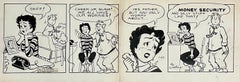
Vintage Golden Age Syndicated Ink Drawing Cartoon Strip Susie Q Smith Comic Art

Vintage Golden Age Syndicated Ink Drawing Cartoon Strip Susie Q Smith Comic Art

Located in Surfside, FL

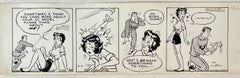
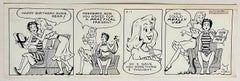
SUSIE Q. SMITH Medium: Newspaper comics Distributed by: King Features Syndicate First Appeared: 1945 Creators: Linda and Jerry Walter 6.5 X 19.5 Like her contemporaries, Aggie Mack, Candy and Patsy Walker (before her conversion to a superhero), Susie Q. Smith was a female Archie-type — not exactly an imitator, because Archie, who had started only four years earlier, hadn't yet become popular enough to spawn imitators, but part of his genre. She attended high school, where her teachers often seemed unreasonable to her, interacted with the opposite gender in a typically adolescent way, and her parents didn't completely understand her. And she was cute and perky as only a teenage girl can be. Susie was the star of a comic strip distributed by King Features, the biggest of the comic strip syndicates, whose other offerings have ranged from Jackys Diary to Prince Valiant. King launched the strip in both daily and Sunday form in 1945. Daily, she was only in a panel at first, but it expanded into a full, multi-panel strip on February 7, 1953. In a very odd turn of events, in 1953 the Walters chose to leave King Features behind and hitch their wagon at the McNaught Syndicate. The creators were Harold "Jerry" Walter and his wife, Linda. Jerry was also responsible for Jellybean Jones, who has nothing to do with Jughead Jones's young sister, a modern-day addition to the Archie cast of characters. Together, they did The Lively Ones during the 1960s. Though each was capable of doing both major jobs in comic strip production, their usual working method was for Jerry to dream up the ideas and write the dialog, while Linda did the artwork. The Walters also collaborated on a series of Susie Q. Smith comic books for Dell Comics. Instead of reprinting newspaper strips, these ran new stories by the Walters. Between 1951 and '54, four issues were published as part of the Four Color Comics series, where many minor comic strips, including Dotty Dripple, Timmy and Rusty Riley had found a home. It had no other media spin-offs. Susie Q. Smith had a respectable run in the newspapers, but it ended in 1959. Jerry Walter (1915 - 2007) was an abstract expressionist artist whose output of energetic and colorful paintings were the products of the rich artistic milieu of post-war New York City. He was born Harold Frank Walter in Mount Pleasant, Iowa on November 25, 1915. After graduating from Colgate University in 1937, Walter moved to New York City, where he studied drawing and painting at the New School and the Art Students’ League. Before concentrating seriously on his art, he spent several years as a successful copywriter and idea man for the advertising agencies of J. Walter Thompson, McCann Ericson, and BBDO. During this time, he also worked as a syndicated cartoonist. Collaborating with his wife, Linda, his best-known series was Susie Q. Smith, which first appeared in 1945 and described as a “female Archie type.” Very popular, the cartoon was later the subject of a series of comic books published from 1951 to 1954. After serving in the United States Army for three years during World War II, Walter began to paint seriously. He ascribed his earliest artistic influence to Joan Miró, whose Dog Barking at the Moon (1926) he viewed when he was twelve, the year he published his first cartoon. Walter later wrote that jazz, “the first native expression of so-called modernism” was a strong influence on his work. During the later 1940s, Walters spent time at the Research Studio in Maitland, Florida. Founded in 1937 by artist and architect J. André Smith and supported by the philanthropist Mary Curtis Bok, the Research Studio was a lively colony that hosted prominent artists, including Milton Avery, Ralston Crawford, and Doris Lee. While at the Studio, Walter’s work was purchased by Frank Crowninshield. A founding trustee of the Museum of Modern Art and editor of Vanity Fair, Crowinshield was a noted collector; his collection included important works by Pablo Picasso, Marc Chagall, Henri Matisse, Edgar Degas, George Bellows, and Pierre Bonnard. Returning to New York after his time at the Studio, Walter became an active member of the New York school of the abstract expressionist movement, and in the summer of 1956, Walter exhibited 13 paintings and a selection of drawings at New York’s Chase Gallery. The adroit manipulation of both color and composition evident in his work shows the influence of Abstract Expressionism, particularly Willem de Kooning, Arshile Gorky, and Hans Hofmann. illustrator and female cartoonist Linda Walter was the talented female mind behind the beloved "Susie Q. Smith" comic strip. She played an instrumental role in shaping the cultural landscape through her vibrant illustrations. Known for the timeless charm of the "Susie Q. Smith" comic strip, Linda's artistry brought joy and laughter to countless readers during the 1950s and continues to resonate with fans across generations. She was part of the Woodstock artists community. from Women in Comics: Linda Walter was the artist of newspaper strip Susie Q. Smith, which was written by her husband, Jerry. It was syndicated by King Features Syndicate and ran from 1945 to 1959. The Walters also contributed original Susie Q. Smith stories to Dell's Four Color comic books from 1951 to 1954. From 1964-1965, they created a singled panel comic called The Lively Ones. Vintage Golden Age of Comics era. The Golden Age of Comic Books describes an era in the history of American comic books from 1938 to 1956. During this time, modern comic books were first published and rapidly increased in popularity. The superhero archetype was created. Between 1939 and 1941 Detective Comics (DC) and its sister company, All-American Publications, introduced popular superheroes such as Batman and Robin, Wonder Woman, the Flash, Green Lantern, Doctor Fate, the Atom, Hawkman, Green Arrow and Aquaman. Timely Comics, the 1940s predecessor of Marvel Comics, had million-selling titles featuring the Human Torch, the Sub-Mariner, and Captain America. Another notable series was The Spirit by Will Eisner. Dell Comics' non-superhero characters (particularly the licensed Walt Disney animated-character comics) outsold the superhero comics of the day. The publisher featured licensed movie and literary characters such as Mickey Mouse, Donald Duck, Roy Rogers and Tarzan. Additionally, MLJ's introduction of Archie Andrews in Pep Comics #22 (December 1941) gave rise to teen humor comics, with the Archie Comics...

Category

1950s American Modern Wilhelm Hunt Diederich Art
Materials

Paper, Ink

Previously Available Items
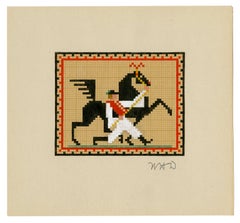
Hungarian Dancing Horse

Hungarian Dancing Horse

By Wilhelm Hunt Diederich

Located in Myrtle Beach, SC

Wilhelm Hunt Diederich 'Hungarian Dancing Horse', gouache and India ink on graph paper, c. 1920. Signed 'WHD' in pencil on the support sheet, lower righ...

Category

1920s American Modern Wilhelm Hunt Diederich Art
Materials

India Ink, Gouache

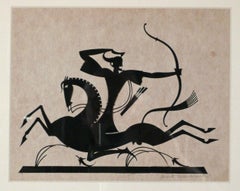
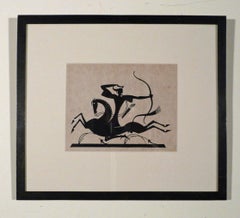
SILHOUETTE OF A GREEK ARCHER ON HORSEBACK

SILHOUETTE OF A GREEK ARCHER ON HORSEBACK

By Wilhelm Hunt Diederich

Located in Portland, ME

Diederich, William Hunt (American, born Hungary, 1884-1953). SILHOUETTE OF A GREEK ARCHER ON HORSEBACK. Black paper cutout mounted on cream-colored paper, circa 1920. Signed in pencil. Image about 6 1/2 x 8 1/2 inches, plus ample margins. A few losses to the curved grasses under the horse, else in very good condition. The image depicts a highly stylized horse in full gallop, with the helmeted rider facing backward, his curved bow held out as he reaches toward his quiver of arrows. This is Diederich at his best: art deco stylization, sense of movement, and fineness of lines. An exceptional example of this artist's work. The ink drawing which was the basis for this cut-out was used as the cover illustration for the Diederich exhibition at the Wigmore Gallery, New York, NY, in 2005. Diederich was the grandson of William Morris Hunt.

Category

1920s Wilhelm Hunt Diederich Art

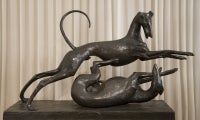
GREYHOUNDS

Wilhelm Hunt DiederichGREYHOUNDS, 1913

Sold

H 41 in W 68 in D 25 in

GREYHOUNDS

By Wilhelm Hunt Diederich

Located in New York, NY

Category

Wilhelm Hunt Diederich Art
Materials

Bronze

Wilhelm Hunt Diederich art for sale on 1stDibs.

Find a wide variety of authentic Wilhelm Hunt Diederich art available for sale on 1stDibs. If you’re browsing the collection of art to introduce a pop of color in a neutral corner of your living room or bedroom, you can find work that includes elements of red and other colors. You can also browse by medium to find art by Wilhelm Hunt Diederich in laid paper, paper and more. Much of the original work by this artist or collective was created during the 1920s and is mostly associated with the modern style. Not every interior allows for large Wilhelm Hunt Diederich art, so small editions measuring 14 inches across are available. Customers who are interested in this artist might also find the work of Kenneth B Walsh, Erika Baktay, and André Breton. Wilhelm Hunt Diederich art prices can differ depending upon medium, time period and other attributes. On 1stDibs, the price for these items starts at $2,400 and tops out at $2,400, while the average work can sell for $2,400.