William Anastasi Art

to
1
Overall Width
to
Overall Height
to
1
1
1
1
1
1
1
1
11,246
2,855
2,494
1,443
1
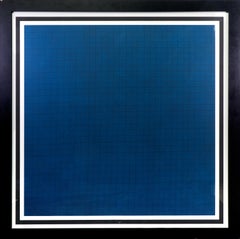
Artist: William Anastasi
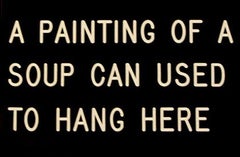
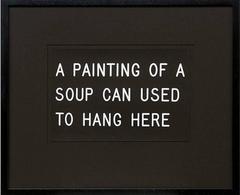
A Painting of a Soup Can Used to Hang Here

A Painting of a Soup Can Used to Hang Here

By William Anastasi

Located in Phoenix, AZ

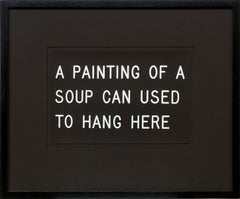
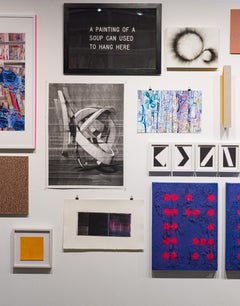
silkscreen, unframed, edition 231 of 250 In 1968 Andy Warhol exhibited at the Philadelphia Museum of Fine Arts. Since Warhol's show was seminal in the development of Pop Art, there was a lingering presence that could not be denied, even after the work was no longer in the space. Anastasi went to a sign maker and had a plaque made that read, "A Painting of a Soup Can Used to Hang Here". The reference to the soup can and the fact the sign was not made by the artist was the development of Warhol’s subject matter as well as a Duchamp reference. It was pure genius. An edition of this work was produced years later. William Anastasi is one of the founders of both Conceptual and Minimal Art. A “classmate” of Andy Warhol, Sol LeWitt, and Hans Haacke...

Category

1990s William Anastasi Art

Materials

Screen
Related Items
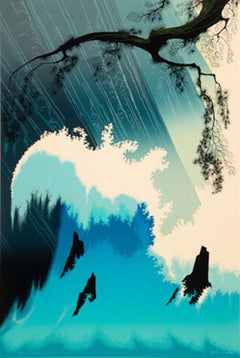
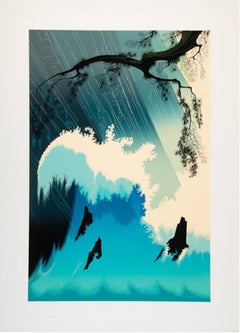
Thunder Bay
Thunder Bay

Roy AhlgrenThunder Bay, 1986

$400

H 19 in W 15 in D 0.01 in

Thunder Bay

By Roy Ahlgren

Located in San Francisco, CA

This artwork titled "Thunder Bay" 1986 is a color serigraph on Wove paper by noted American artist Roy Ahlgren, 1927-2011 It is hand signed, titled, dated and numbered 14/95 in penci...

Category

Mid-20th Century Op Art William Anastasi Art

Materials

Screen

Pop Art Surreal Large Colorful Screenprint with Mod Balls of Color Serigraph

Pop Art Surreal Large Colorful Screenprint with Mod Balls of Color Serigraph

Located in Surfside, FL

Titled: After the Beginning, one of his most desirable large serigraph silkscreen works. It depicts inter galactic outer space with planets, orbs of bright day glo, neon color in a s...

Category

1990s Surrealist William Anastasi Art

Materials

Screen

Oslo, Pop Art Abstract Screenprint by Risaburo Kimura

Oslo, Pop Art Abstract Screenprint by Risaburo Kimura

By Risaburo Kimura

Located in Long Island City, NY

Artist: Risaburo Kimura, Japanese (1924 - ) Title: Oslo Year: 1973 Medium: Silkscreen on BFK Rives, Signed, titled and numbered in pencil Edition: 250, AP 20 Size: 30 in. x 22 in. (7...

Category

1970s Abstract Impressionist William Anastasi Art

Materials

Screen

TAKASHI MURAKAMI: Who's afraid of red, yellow... Superflat, Japanese Pop Art

TAKASHI MURAKAMI: Who's afraid of red, yellow... Superflat, Japanese Pop Art

By Takashi Murakami

Located in Madrid, Madrid

Takashi Murakami - WHO'S AFRAID OF RED, YELLOW, BLUE AND DEATH Date of creation: 2011 Medium: Offset lithograph with silver and silkscreen with spot UV varnishing Edition: 300 Size:...

Category

2010s Pop Art William Anastasi Art

Materials

Paper, Varnish, Offset, Screen

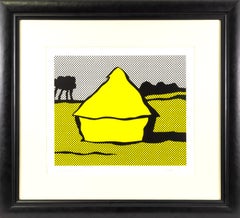
Roy Lichtenstein 'Haystack #4' Signed Lithograph and Screenprint 1969

Roy Lichtenstein 'Haystack #4' Signed Lithograph and Screenprint 1969

By Roy Lichtenstein

Located in Miami, FL

ROY LICHTENSTEIN (1923-1997) Roy Lichtenstein's 'Haystack #4' is a lithograph and screenprint in colors on Arjomari paper. It is signed, dated, and numbered 73/100 in pencil in the ...

Category

1960s Contemporary William Anastasi Art

Materials

Screen, Lithograph

Sky Light XXIII, Geometric Abstract OP Art Screenprint by Evelyn B. Johnson

Sky Light XXIII, Geometric Abstract OP Art Screenprint by Evelyn B. Johnson

By Evelyn B. Johnson

Located in Long Island City, NY

This abstract screenprint was created in 1981 by American Optical artist Evelyn B. Johnson. It is signed and numbered 17/25 in pencil, and the plate size is 25.5 x 25.5 inches. It is...

Category

1980s Op Art William Anastasi Art

Materials

Screen

Emil Schumacher Limited Edition Serigraph Terraraph Print Abstract Art Informel

Emil Schumacher Limited Edition Serigraph Terraraph Print Abstract Art Informel

By Emil Schumacher 1

Located in Surfside, FL

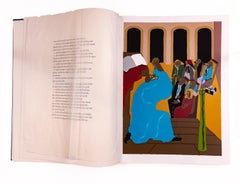
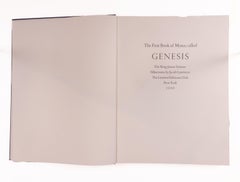
Heavily textured abstract print in a serigraph and terragraph technique. It has a raised texture to the surface, A beautiful piece. This listing is for the one print, the cover justification sheet and the photograph are just included for provenance. This is from the limited edition of 100. Hand signed and numbered on colophon page. (They are not signed and numbered on each print) Arches paper. Dimensions: 15.75 X 15.25 These have a texture that feels like a painting. Done in Jaffa Israel based on the Hebrew Bible. Jewish, Judaica interest. Emil Schumacher is among the best-known exponents of Art Informel in Germany. His painting style, which he initially developed in the 1950s under the influence of Wols, is marked by dark, brownish black or brilliant thick red colours and a graffiti like sign language that endow the pictures the expressive character of old cracked masonry. Emil Schumacher (29 August 1912 in Hagen, Westfalen – 4 October 1999 in San José, Ibiza) was a German artist and painter. He was an important representative of abstract expressionism in post-war Germany. As an 18-year-old, Emil Schumacher undertakes a four-week-long bicycle tour to Paris, France. 1932–1935: Studies graphic design at the School of Applied Arts in Dortmund intending to become a graphic designer in advertising. 1935–1939: Independent artist without participating in exhibits. He undertakes study trips by bicycle to the Netherlands and Belgium. 1939–1945: Service obligation as draftsman in an arms factory, the Akkumulatoren–Werke of Hagen. Since 1945: Immediately after end of war, new start as independent artist. 1947: First solo exhibit in the Studio für neue Kunst. Co-founder of the artist group Junger Westen. 1954: Participates in the Willem Sandberg exhibition Deutsche Kunst nach 45 (German Art after 1945) at the Stedelijk Museum Amsterdam: for the first time after World War II, Contemporary German Art is shown abroad. 1955: Participates in the exhibition Peintures et sculptures non-figuratives en Allemagne d’aujourd’hui in Paris. This is the first time, 10 years after the war's end, that René Drouin shows contemporary German art at the Cercle Volney in France. 1956: While searching for new media and materials, Schumacher creates his first 'Tastobjekte' (tactile objects). Conrad von Soest Preis (Conrad-von-Soest Award), Münster, Germany. 1958: Travels to Spain, Italy and Tunisia. Participates in the XXIX. Venice Biennale, Italy. 1958–1960: Professorship at the Hochschule für bildende Künste Hamburg (University of Fine Arts) in Hamburg, Germany. 1959: Participates in the documenta II in Kassel, Germany, as well as the V. São Paulo Art Biennial, Brazil. First solo exhibit in New York at the Samuel M. Kootz Gallery. 1962: Travels to Libya and Tunisia. Summer stay in Anguillara, Lago di Bracciano, Italy. 1963: Solo exhibit as German contribution to the VII. São Paulo Art Biennial, Brazil. Travels to Brazil, Argentina, Uruguay, Peru and Bolivia. Once again summer stay in Anguillara, paintings that originated during the stay are shown in the Galeria La Medusa in Rome. 1964: Participates in the documenta III in Kassel, Germany. 1965: Travels through Yugoslavia, to Montenegro, the Herzegovina, and Bosnia. 1966–77: Professorship at the Academy of Fine Arts, Karlsruhe. 1967–68: Guest professorship at the Minneapolis School of Art, Minneapolis, USA. In Minneapolis, a series of works on paper are created. This series called Minneapolis Suite was exhibited at the Lefebre Gallery in New York and at the Galerie de Montréal in Montréal, Canada. Extensive travels through the USA. 1969: Winter stay on the Island of Djerba in Tunisia. Here, the Djerba gouaches were created over the course of the following years. 1971: Since 1971, frequent stays on Ibiza during spring and summer. 1974: Autumn stay in Cunardo, Lago Maggiore where the first ceramic works are created in Ceramica Ibis. 1983: Travels to Morocco where Suite Maroc, encompassing 36 pages, is created. 1985: Guest of Honor of the German Academy of Rome, Villa Massimo, Italy. 1988: In October 1988, a 10-day stay in Iraq. Design and creation of a 20 m long ceramic wall mural in the new building of the Landtag of North Rhine-Westphalia. 1991: Guest professorship at the Concorso Superiore Internazionale del Disegno of the Fondazione Antonio Ratti, Como, Italy. 1996: Schumacher designs a 20 m long and 3 m high mosaic wall for the Colosseo (Rome Metro) in Rome, Italy. 1998: Commission for mural in the Reichstag building, Berlin (executed in 1999). 1999: Member of the Academy of the Arts of Saxony (Sächsische Akademie der Künste), Dresden, Germany. Publication of the Israeli book 'GENESIS' with 18 Serigraphies in the edition Har-El, Jaffa/ Jerusalem / Israel. Awards 1948: Kunstpreis junger westen from the city of Recklinghausen, Germany. 1955 Art award from the city of Iserlohn, Germany. 1958: Karl Ernst Osthaus Preis (Karl-Ernst-Osthaus Award), 1958: Guggenheim Award (National Section), New York. 1959: Award from the Japanese Cultural Minister in celebration of the V. International Art Exhibition, Tokyo. 1962: Premio Cardazzo, XXX Venice Biennale, Italy. 1962: First prize silver medal, Bang Danh-Du Award in celebration of the 1st International Arts Exhibition, Saigon, Vietnam. 1963: Großer Kunstpreis (Great Art Award) of North Rhine-Westphalia, Düsseldorf, Germany. 1966: Prize of the Governor of Tokyo, in celebration of the 5th International Biennale Exhibition of Prints, Tokyo, 1968: Member of the Academy of Arts Berlin, Germany. 1974: Award of the city of Ibiza in celebration of the Graphic-Biennial 1974. 1978: August Macke Prize of the city of Meschede 1983: Receives Grand Cross of Merit with Star from the Order of Merit of the Federal Republic of Germany. French art critic Michel Tapié named the influential European movement that during the 1950s paralleled Abstract Expressionism in the U.S, Art Informel. Art Informel is and expressionist, artist-oriented abstraction rooted in the works of Wassily Kandinsky, Paul Klee, Jean Dubuffet, and Tachiste and Surrealist automatism. A style primarily of painting that developed in 1945/46 as reaction to geometric abstraction prevailing in post war Paris in the following of the École de Paris. Informel painting emphasises the spontaneous act of painting, the unconscious side of artistic creativity. The process of painting is often more important than what comes out of it. Informel is an international style and can be subdivided into various schools. Tachism [French: "tache" = blot], Action painting, Abstract Expressionism and Art Brut [French = "raw art"] are also considered Informel. By that definition, leading exponents of Informel in the US were Jackson Pollock and Willem de Kooning and in France Wols, Jean Fautrier and Jean Dubuffet. In Germany Informel was at its height in the 1950s and 1960s. The leading exponents of German Informel are Hans Hartung, Emil Schumacher, Karl Fred Dahmen, K.O. Götz, Gerhard Hoehme...

Category

20th Century Abstract Expressionist William Anastasi Art

Materials

Screen

Emil Schumacher Limited Edition Serigraph Terraraph Print Abstract Art Informel

Emil Schumacher Limited Edition Serigraph Terraraph Print Abstract Art Informel

By Emil Schumacher 1

Located in Surfside, FL

Heavily textured abstract print in a serigraph and terragraph technique. It has a raised texture to the surface, A beautiful piece. This listing is for the one print, the cover justification sheet and the photograph are just included for provenance. This is from the limited edition of 100. Hand signed and numbered on colophon page. (They are not signed and numbered on each print) Arches paper. Dimensions: 15.75 X 15.25 These have a texture that feels like a painting. Done in Jaffa Israel based on the Hebrew Bible. Jewish, Judaica interest. Emil Schumacher is among the best-known exponents of Art Informel in Germany. His painting style, which he initially developed in the 1950s under the influence of Wols, is marked by dark, brownish black or brilliant thick red colours and a graffiti like sign language that endow the pictures the expressive character of old cracked masonry. Emil Schumacher (29 August 1912 in Hagen, Westfalen – 4 October 1999 in San José, Ibiza) was a German artist and painter. He was an important representative of abstract expressionism in post-war Germany. As an 18-year-old, Emil Schumacher undertakes a four-week-long bicycle tour to Paris, France. 1932–1935: Studies graphic design at the School of Applied Arts in Dortmund intending to become a graphic designer in advertising. 1935–1939: Independent artist without participating in exhibits. He undertakes study trips by bicycle to the Netherlands and Belgium. 1939–1945: Service obligation as draftsman in an arms factory, the Akkumulatoren–Werke of Hagen. Since 1945: Immediately after end of war, new start as independent artist. 1947: First solo exhibit in the Studio für neue Kunst. Co-founder of the artist group Junger Westen. 1954: Participates in the Willem Sandberg exhibition Deutsche Kunst nach 45 (German Art after 1945) at the Stedelijk Museum Amsterdam: for the first time after World War II, Contemporary German Art is shown abroad. 1955: Participates in the exhibition Peintures et sculptures non-figuratives en Allemagne d’aujourd’hui in Paris. This is the first time, 10 years after the war's end, that René Drouin shows contemporary German art at the Cercle Volney in France. 1956: While searching for new media and materials, Schumacher creates his first 'Tastobjekte' (tactile objects). Conrad von Soest Preis (Conrad-von-Soest Award), Münster, Germany. 1958: Travels to Spain, Italy and Tunisia. Participates in the XXIX. Venice Biennale, Italy. 1958–1960: Professorship at the Hochschule für bildende Künste Hamburg (University of Fine Arts) in Hamburg, Germany. 1959: Participates in the documenta II in Kassel, Germany, as well as the V. São Paulo Art Biennial, Brazil. First solo exhibit in New York at the Samuel M. Kootz Gallery. 1962: Travels to Libya and Tunisia. Summer stay in Anguillara, Lago di Bracciano, Italy. 1963: Solo exhibit as German contribution to the VII. São Paulo Art Biennial, Brazil. Travels to Brazil, Argentina, Uruguay, Peru and Bolivia. Once again summer stay in Anguillara, paintings that originated during the stay are shown in the Galeria La Medusa in Rome. 1964: Participates in the documenta III in Kassel, Germany. 1965: Travels through Yugoslavia, to Montenegro, the Herzegovina, and Bosnia. 1966–77: Professorship at the Academy of Fine Arts, Karlsruhe. 1967–68: Guest professorship at the Minneapolis School of Art, Minneapolis, USA. In Minneapolis, a series of works on paper are created. This series called Minneapolis Suite was exhibited at the Lefebre Gallery in New York and at the Galerie de Montréal in Montréal, Canada. Extensive travels through the USA. 1969: Winter stay on the Island of Djerba in Tunisia. Here, the Djerba gouaches were created over the course of the following years. 1971: Since 1971, frequent stays on Ibiza during spring and summer. 1974: Autumn stay in Cunardo, Lago Maggiore where the first ceramic works are created in Ceramica Ibis. 1983: Travels to Morocco where Suite Maroc, encompassing 36 pages, is created. 1985: Guest of Honor of the German Academy of Rome, Villa Massimo, Italy. 1988: In October 1988, a 10-day stay in Iraq. Design and creation of a 20 m long ceramic wall mural in the new building of the Landtag of North Rhine-Westphalia. 1991: Guest professorship at the Concorso Superiore Internazionale del Disegno of the Fondazione Antonio Ratti, Como, Italy. 1996: Schumacher designs a 20 m long and 3 m high mosaic wall for the Colosseo (Rome Metro) in Rome, Italy. 1998: Commission for mural in the Reichstag building, Berlin (executed in 1999). 1999: Member of the Academy of the Arts of Saxony (Sächsische Akademie der Künste), Dresden, Germany. Publication of the Israeli book 'GENESIS' with 18 Serigraphies in the edition Har-El, Jaffa/ Jerusalem / Israel. Awards 1948: Kunstpreis junger westen from the city of Recklinghausen, Germany. 1955 Art award from the city of Iserlohn, Germany. 1958: Karl Ernst Osthaus Preis (Karl-Ernst-Osthaus Award), 1958: Guggenheim Award (National Section), New York. 1959: Award from the Japanese Cultural Minister in celebration of the V. International Art Exhibition, Tokyo. 1962: Premio Cardazzo, XXX Venice Biennale, Italy. 1962: First prize silver medal, Bang Danh-Du Award in celebration of the 1st International Arts Exhibition, Saigon, Vietnam. 1963: Großer Kunstpreis (Great Art Award) of North Rhine-Westphalia, Düsseldorf, Germany. 1966: Prize of the Governor of Tokyo, in celebration of the 5th International Biennale Exhibition of Prints, Tokyo, 1968: Member of the Academy of Arts Berlin, Germany. 1974: Award of the city of Ibiza in celebration of the Graphic-Biennial 1974. 1978: August Macke Prize of the city of Meschede 1983: Receives Grand Cross of Merit with Star from the Order of Merit of the Federal Republic of Germany. French art critic Michel Tapié named the influential European movement that during the 1950s paralleled Abstract Expressionism in the U.S, Art Informel. Art Informel is and expressionist, artist-oriented abstraction rooted in the works of Wassily Kandinsky, Paul Klee, Jean Dubuffet, and Tachiste and Surrealist automatism. A style primarily of painting that developed in 1945/46 as reaction to geometric abstraction prevailing in post war Paris in the following of the École de Paris. Informel painting emphasises the spontaneous act of painting, the unconscious side of artistic creativity. The process of painting is often more important than what comes out of it. Informel is an international style and can be subdivided into various schools. Tachism [French: "tache" = blot], Action painting, Abstract Expressionism and Art Brut [French = "raw art"] are also considered Informel. By that definition, leading exponents of Informel in the US were Jackson Pollock and Willem de Kooning and in France Wols, Jean Fautrier and Jean Dubuffet. In Germany Informel was at its height in the 1950s and 1960s. The leading exponents of German Informel are Hans Hartung, Emil Schumacher, Karl Fred Dahmen, K.O. Götz, Gerhard Hoehme...

Category

20th Century Abstract Expressionist William Anastasi Art

Materials

Screen

Jose Bedia "Armed Animal & Mother of War" 2019 framed woodcut screenprint 78x78

Jose Bedia "Armed Animal & Mother of War" 2019 framed woodcut screenprint 78x78

By Jose Bedia

Located in Miami, FL

Jose Bedia (Cuban, 1959) 'Animal and mother' (Diptych), 2019 Woodcut and serigraph on Feltmark cotton paper 300 g. over streched canvas and framed Overall size: 199 x 199 cm. (78.3 ...

Category

2010s Contemporary William Anastasi Art

Materials

Screen, Woodcut, Canvas

Landscape in Green, Purple and Yellow - Abstract Screenprint by Joseph Grippi

Landscape in Green, Purple and Yellow - Abstract Screenprint by Joseph Grippi

By Joseph Grippi

Located in Long Island City, NY

Landscape in Green, Purple and Yellow Joseph Grippi, American (1924–2001) Screenprint, signed in pencil Image Size: 19 x 31 inches Size: 21.5 x 33 in. (54.61 x 83.82 cm)

Category

1970s William Anastasi Art

Materials

Screen

Oculist witnesses (après Marcel Duchamp) glass sculpture with silver screenprint

Oculist witnesses (après Marcel Duchamp) glass sculpture with silver screenprint

By Richard Hamilton

Located in New York, NY

"The Arts Council of Great Britain asked Richard Hamilton to organise a Duchamp retrospective at the Tate Gallery in 1966. The almost complete works of Marcel Duchamp opened on 18 Ju...

Category

1960s Abstract William Anastasi Art

Materials

Metal

Vladimir Vlady Kibalchich Russian Artist Original Hand Signed engraving 1991 n7

Vladimir Vlady Kibalchich Russian Artist Original Hand Signed engraving 1991 n7

By Vladimir Vlady Kibalchich

Located in Miami, FL

Vladimir Vlady Kibalchich (Russia, 1920-2005) 'Untitled', 1991 engraving on paper Velin Arches 300 g. 22.1 x 15.2 in. (56 x 38.5 cm.) Edition of 50 ID: VLA-307 Hand-signed by author

Category

1990s Contemporary William Anastasi Art

Materials

Paper, Engraving, Screen

Previously Available Items
A Painting of a Soup Can Used to Hang Here (233/250)

A Painting of a Soup Can Used to Hang Here (233/250)

By William Anastasi

Located in Phoenix, AZ

silkscreen, unframed, edition 233 of 250 19.5 x 27 x 0.75 inches framed In 1968 Andy Warhol exhibited at the Philadelphia Museum of Fine Arts. Since Warhol's show was seminal in the development of Pop Art, there was a lingering presence that could not be denied, even after the work was no longer in the space. Anastasi went to a sign maker and had a plaque made that read, "A Painting of a Soup Can Used to Hang Here". The reference to the soup can and the fact the sign was not made by the artist was the development of Warhol’s subject matter as well as a Duchamp reference. It was pure genius. An edition of this work was produced years later. William Anastasi is one of the founders of both Conceptual and Minimal Art. A “classmate” of Andy Warhol, Sol LeWitt, and Hans Haacke...

Category

1990s Pop Art William Anastasi Art

Materials

Screen

A Painting of a Soup Can Used to Hang Here (235/250), 1991

A Painting of a Soup Can Used to Hang Here (235/250), 1991

By William Anastasi

Located in Phoenix, AZ

silkscreen, framed, edition 235 of 250 In 1968 Andy Warhol exhibited at the Philadelphia Museum of Fine Arts. Since Warhol's show was seminal in the development of Pop Art, there was a lingering presence that could not be denied, even after the work was no longer in the space. Anastasi went to a sign maker and had a plaque made that read, "A Painting of a Soup Can Used to Hang Here". The reference to the soup can and the fact the sign was not made by the artist was the development of Warhol’s subject matter as well as a Duchamp reference. It was pure genius. An edition of this work was produced years later. William Anastasi is one of the founders of both Conceptual and Minimal Art. A “classmate” of Andy Warhol, Sol LeWitt, and Hans Haacke...

Category

1990s Conceptual William Anastasi Art

Materials

Screen

William Anastasi art for sale on 1stDibs.

Find a wide variety of authentic William Anastasi art available for sale on 1stDibs. You can also browse by medium to find art by William Anastasi in screen print and more. Much of the original work by this artist or collective was created during the 1990s and is mostly associated with the Pop Art style. Not every interior allows for large William Anastasi art, so small editions measuring 14 inches across are available. Customers who are interested in this artist might also find the work of Richard Avedon, James Rizzi, and Jonathan Winters. William Anastasi art prices can differ depending upon medium, time period and other attributes. On 1stDibs, the price for these items starts at $2,000 and tops out at $2,000, while the average work can sell for $2,000.

Artists Similar to William Anastasi