Medieval Urns

4 Results
MEDIEVAL STYLE

The Middle Ages in Europe followed the end of the Roman Empire, and in this time of change, which preceded the Renaissance, furniture was simple and utilitarian, with most homes having only the necessities like chests and benches. Much of medieval furniture, which was often made in oak or walnut, was built for the elite, particularly the emerging merchant class who owned multiple homes.

Life for many in the medieval era was unstable, and furniture was designed to be functional and portable. Peasants worked the fields for affluent landowners and didn’t have access to literature in the way that nobles and people of the church did (women less so than men). The furniture in their modest dwellings was typically limited to cookware and a handful of stools. Foldable chairs, while uncommon in homes of the early Middle Ages and emblematic of wealth, like all other furnishings of the time, allowed for easy transportation of a household. Trestle tables with detachable legs and collapsible beds were designed to be simply moved from place to place.

Medieval blanket chests were among the most important furniture objects and could further serve as tables or even beds. Some ancient traditions were carried forward to build this sturdy furniture, such as turnery. Although the furniture was minimally designed, embellishments like carvings added elegance to the heavy wood pieces. These details sometimes reflected trends in religious art like rose windows.

By the later Middle Ages, storage pieces like chests of drawers were often adorned with high relief carvings, such as geometric and floral motifs. By the 14th and 15th centuries, design had developed to include more involved pieces like cupboards and desks, while benches frequently doubled as chests with hinged seats. Beds also changed in this era from basic boards to four-post designs with large drapes to keep the sleeper warm. These beds and other medieval bedroom furniture were significant status symbols, passed down through families and used as places to conduct business and receive visitors.

Surviving examples of medieval furniture are very rare, yet its distinctive aesthetics influenced later styles like William and Mary and Arts and Crafts.

Find a collection of medieval seating, garden elements, decorative objects and other furniture on 1stDibs.

to
4
3
1
196
171
142
130
68
65
43
37
33
31
30
29
23
22
19
17
7
6
2
2
1
1
1
3
1
3
2
2
1
1
Height
to
Width
to
4
4
4
Style: Medieval
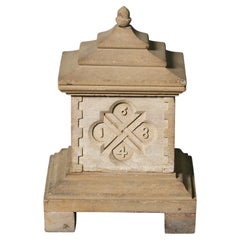
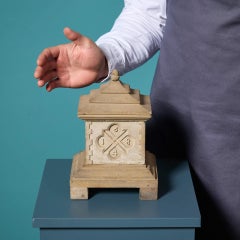
Antique Hand Carved Stone Sarcophagus

Antique Hand Carved Stone Sarcophagus

Located in Wormelow, Herefordshire

An Antique Hand Carved Stone Sarcophagus. This unusual yet charming architectural model has been carved from York Stone with exceptional attention to detail. Standing on block feet...

Category

17th Century English Antique Medieval Urns

Materials

Stone

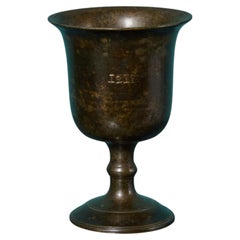
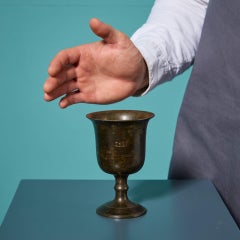
Antique Bronze Goblet Dated 1218

Antique Bronze Goblet Dated 1218

Located in Wormelow, Herefordshire

An antique bronze goblet engraved with the date 1218. This unusual and charming piece has a bell shaped bowl on a ringed and stepped circular foot. The face of the bowl has been en...

Category

15th Century and Earlier English Antique Medieval Urns

Materials

Bronze

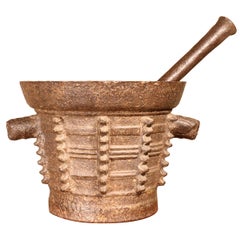
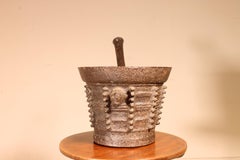
Mortar and Pilar End 15th Century Gothic Period

Mortar and Pilar End 15th Century Gothic Period

Located in Brussels, Brussels

Iron mortar with its original pestle end 15th beginning 16th century Gothic period, France Beautiful original object with a beautiful patina and in good condition   

Category

16th Century French Antique Medieval Urns

Materials

Iron

Related Items
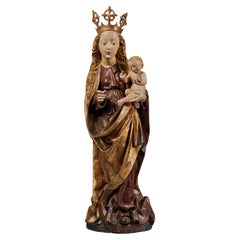
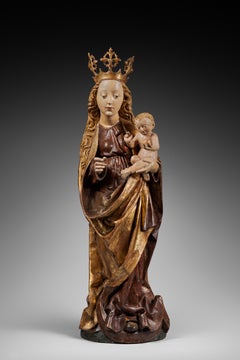
Polychrome carved wood Virgin and Child from the 15th Century

Polychrome carved wood Virgin and Child from the 15th Century

Located in Saint-Ouen, FR

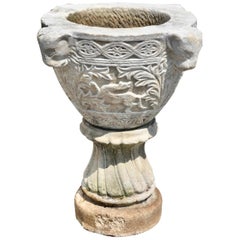
POLYCHROME CARVED WOOD VIRGIN AND CHILD FROM THE 15TH CENTURY   ORIGIN: SOUTH GERMANY, SWABIA, NUREMBERG REGION PERIOD: 15th CENTURY   Height: 94,6cm Width : 28 cm Depth : 18 cm   Lime wood Original Polychromy Good state of conservation     From 1430 onwards, sculpture underwent a profound stylistic renewal which continued until 1530, the so-called late Gothic period. In the Germanic countries, original sculptures flourished in an expressive and sensitive vein.
This renewal was inspired by the art of Nicholas of Leiden, who was active in Strasbourg in the 1460's. His style broke with the refined and delicate art of the international Gothic style in force throughout Europe around 1400. The figures became more authentic and realistic. The bodies became denser. Clothes are animated by deep, broken folds, the fabrics are heavy and have a great decorative value. In addition, the polychromy is intended to be illusionistic. The painting makes it possible to restore the texture of the materials, the richness of the textiles and the natural skin tone of the characters.   The dissemination of images through engraving and the great mobility of the artists led to the success of this style, which conquered the Upper Rhine, Swabian, Tyrolean and Franconian regions, contributing to the formation of a common stylistic identity in these regions. The economic boom in the flourishing German cities was conducive to the development of original production. Attracted by this prosperity, numerous workshops were set up in order to meet the orders of religious communities, the Church and the laity, including a clientele of middle-class rockers.      This precious Virgin and Child is depicted standing on a crescent moon, her head encircled by a crown of tall flowers. Her long wavy hair spreads over her shoulders, framing her beautiful oval face. Under fine eyebrows drawn with a brushstroke, her almond-shaped, slightly drooping eyes look at the Child with infinite softness. She is dressed in a long red dress with a rounded neckline, belted under the chest. The heavy fabric of her dress spreads out in broken folds at her feet. On her shoulders she wears a golden cloak. The drapery has deep folds. She holds out her right hand while she holds the Christ Child with her left.   Christ, with his well-defined hair, is naked. His cheeks are highlighted with red, he holds an apple in his left hand and with the other hand makes a sign of blessing towards the faithful.   Virgins with Child on a crescent moon were very popular in the second half of the 15th century, especially as the central subject of altarpieces in southern Germany and Austria. The crescent moon on which Mary is standing is reminiscent of the Woman of the Apocalypse. Often equated with the Virgin Mary.    This episode is taken from the Book of Revelation (12:1-6)   1 Then a great sign appeared in heaven: a woman clothed with the sun, with the moon under her feet and a crown of twelve stars on her head. ; 2 She was pregnant, and she cried out because she was in labor, in pain from giving birth. ; 3 Then another sign appeared in heaven: it was a great fiery red dragon, with seven heads and ten horns, and seven royal crowns on his heads. ; 4 His tail swept down a third of heaven's stars and threw them to the earth. The dragon stood in front of the woman who was about to give birth so that when she gave birth, he might devour her child. ; 5 She gave birth to a son, a male child who is to rule all the nations with an iron rod. Her child was snatched up to God and his throne. ; 6 Then the woman fled into the desert, where God has prepared a place for her. There she will be taken care of for one thousand two hundred sixty days.   Some theologians see in this woman a reference to the Virgin Mary and in the child, Jesus.    
This remarkable work is a very fine example of sculpture from Swabian workshops in the last decades of the 15th century. It presents all the characteristic stylistic elements: a highly girdled silhouette, an abundant drapery with angular folds, but also a great physical presence accentuated by the polychromy that restores the anatomical details. This group is made of a wooden log. The deep folds of the drapery highlight the movement of the Virgin holding the child.       Bibliography :   Sophie Guillot de Suduiraut, Dévotion et Séduction, Sculptures souabes des musées de France, vers 1460-1530, Paris musée du Louvre-Éditions somogy, 2015   “Revelation 12 -   Common English Bible...

Category

15th Century and Earlier German Antique Medieval Urns
Materials

Wood

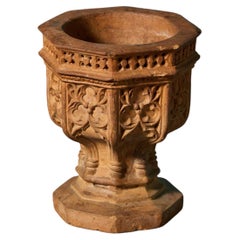
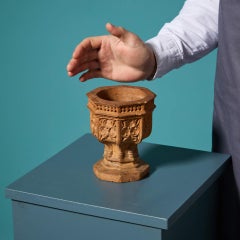
19th Century Victorian Terracotta Model Of A Gothic Font

19th Century Victorian Terracotta Model Of A Gothic Font

Located in Wormelow, Herefordshire

A 19th century Victorian terracotta model of a gothic font. An English architectural model of a font in the ecclesiastical style dated to circa 1850. The octagonal design has a repeating trefoil design on all sides. A pleasing object modelled after an unknown church font...

Category

19th Century English Antique Medieval Urns

Materials

Terracotta

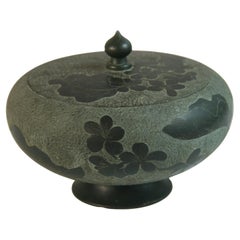
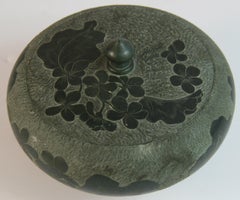
Antique Japanese Carved  Embossed Green Stone Covered Vase late19th C

Antique Japanese Carved Embossed Green Stone Covered Vase late19th C

Located in Douglas Manor, NY

1697 Antique Japanese carved green stone containter with precicely fitted lid

Category

1890s Antique Medieval Urns

Materials

Stone

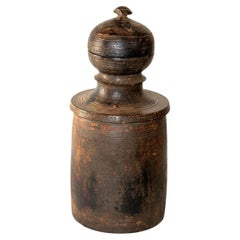
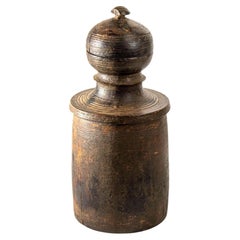
Antique Tekhi Wooden Pot from Nepal, Hand-Carved Hardwood, 1900s

Antique Tekhi Wooden Pot from Nepal, Hand-Carved Hardwood, 1900s

Located in Moreno Valley, CA

Antique Wooden Pot or Tekhi, from Nepal, 13" Tall, circa 1900s Early 20th century wood pot from Nepal, this particular style of wooden container, pot has a r...

Category

Early 20th Century Nepalese Medieval Urns

Materials

Hardwood

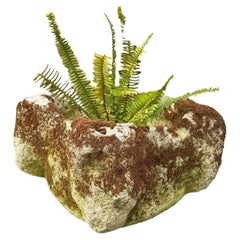
Hand Carved Stone Vide poche Basin Jardinière Bowl Planter Vessel Sink Antiques

Hand Carved Stone Vide poche Basin Jardinière Bowl Planter Vessel Sink Antiques

Located in West Hollywood, CA

Hand Carved Stone Vide poche Basin Jardinière bowl planter vessel sink Antiques . 17th C. Possibly earlier Gothic Container . A Water Trough Benitier in a ...

Category

17th Century French Antique Medieval Urns

Materials

Stone, Limestone

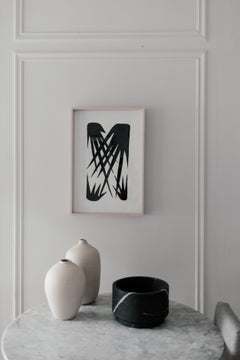
Black Marble Low Pedestal Cylinder

Black Marble Low Pedestal Cylinder

$240 / item

H 5.91 in Dm 9.85 in

Black Marble Low Pedestal Cylinder

By Casa Mineral

Located in Mexico City, MX

Monterrey black marble carved cylinder. Handmade in Mexico by local craftsmen. Production time: 6-8 weeks for items without marble / 13-14 weeks for marble pieces. Shipping +10 addi...

Category

2010s Mexican Medieval Urns

Materials

Marble

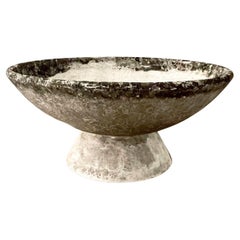
Willy Guhl Saucer Planter on Stand

Willy Guhl Saucer Planter on Stand

By Willy Guhl

Located in Los Angeles, CA

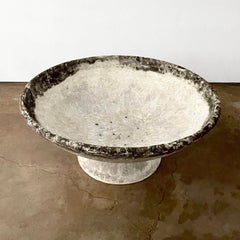
31" Willy Guhl saucer planter on stand for Eternit Floating saucer planter on base Sculptural garden vessel The base can be flipped upside down for use ...

Category

Mid-20th Century Swiss Medieval Urns

Materials

Concrete

Antique 19th Century Italian Grand Tour Siena Marble Model of a Sarcophagus

Antique 19th Century Italian Grand Tour Siena Marble Model of a Sarcophagus

By Benedetto Boschetti

Located in New York, NY

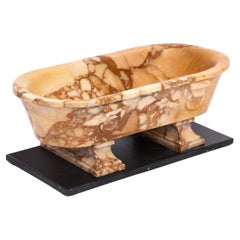
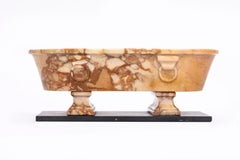
A Magnificent Antique 19th Century Italian Grand Tour Hand-Carved Siena Marble Model of a Sarcophagus on a Black Marble Base. This gorgeous grand tour piece is modeled after the Fon...

Category

1840s Italian Antique Medieval Urns
Materials

Marble, Siena Marble

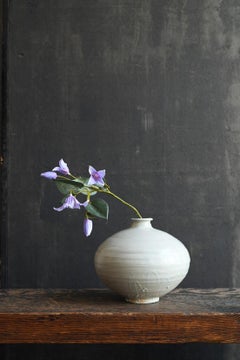
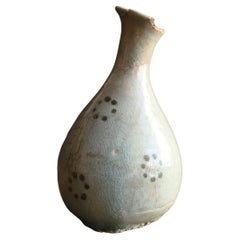
Joseon Dynasty white porcelain jar / 15th-19th century / excavated flower vase

Joseon Dynasty white porcelain jar / 15th-19th century / excavated flower vase

Located in Sammu-shi, Chiba

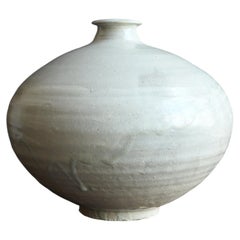
This is a white porcelain jar from the Joseon (Korean) dynasty, made on the Korean Peninsula. Judging from the construction of its mouth and its overall form, it is believed to date ...

Category

19th Century South Korean Antique Medieval Urns
Materials

Porcelain, Pottery

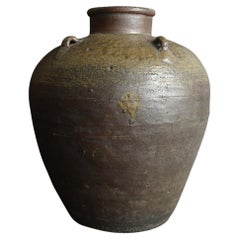
Japanese antique Bizen ware vase / 15th-16th century / Wabi-sabi vase/Tsubo

Japanese antique Bizen ware vase / 15th-16th century / Wabi-sabi vase/Tsubo

Located in Sammu-shi, Chiba

This Bizen ware jar was fired in the Bizen region of Okayama Prefecture. Bizen ware is one of Japan's Six Ancient Kilns and is known as one of the oldest pottery styles in Japan. Its...

Category

16th Century Japanese Antique Medieval Urns

Materials

Pottery

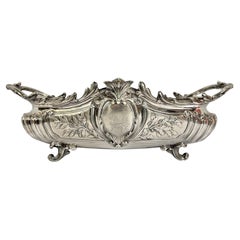
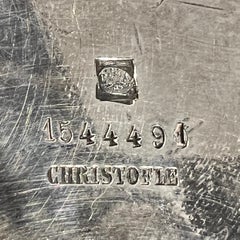
Antique Christofle Silvered Bronze Jardiniere Centerpiece

Antique Christofle Silvered Bronze Jardiniere Centerpiece

By Christofle

Located in New York, NY

Antique (19th century) French silvered bronze centerpiece bowl or jardiniere by Christofle, 20 by 13 3/4 by 6 inches, features engraved crests paying tribute to the CERCLE NATIONAL D...

Category

Early 20th Century French Medieval Urns

Materials

Bronze

Previously Available Items
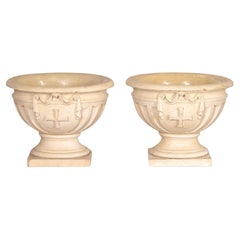
Pair of 18th Century Coade Stone Gothic Stoops

Pair of 18th Century Coade Stone Gothic Stoops

Sold

H 10.63 in W 13 in D 10.63 in

Pair of 18th Century Coade Stone Gothic Stoops

Located in Gloucestershire, GB

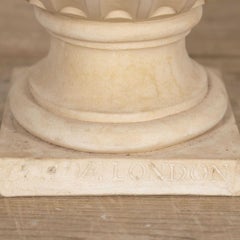
Pair of finely cast 18th Century Coade Stone gothic stoops. In super condition, stamped 'Coade London', these are glazed internally, for holding water which is an unusual design for...

Category

18th Century British Antique Medieval Urns
Materials

Terracotta

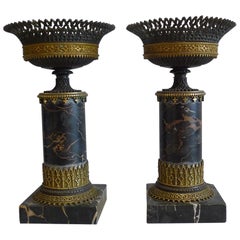
Pair of Gothic Urns in Ormolu, Patinated Bronze and Marble

Pair of Gothic Urns in Ormolu, Patinated Bronze and Marble

Located in London, GB

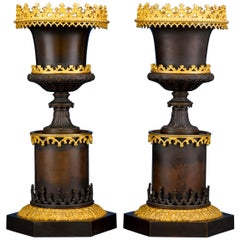
A Classic and quite beautiful pair of Gothic urns. French and early 19th century with pierced tracery patinated bronze urn tops with an ormolu waist falling to the gadrooned patinate...

Category

1830s French Antique Medieval Urns
Materials

Marble, Bronze, Ormolu

Gothic Two-Color Bronze Urns

Gothic Two-Color Bronze Urns

Sold

H 12 in Dm 5 in

Gothic Two-Color Bronze Urns

Located in New Orleans, LA

A striking pair of bronze urns, created in the dramatic Gothic style. Resembling classical Greco-Roman vases set upon pedestals, the urns are crafted in a two-toned design, with deep...

Category

19th Century French Antique Medieval Urns

Materials

Bronze, Ormolu

Medieval urns for sale on 1stDibs.
Find a broad range of unique Medieval urns for sale on 1stDibs. Many of these items were first offered in the Early 20th Century, but contemporary artisans have continued to produce works inspired by this style. If you’re looking to add vintage urns created in this style to your space, the works available on 1stDibs include decorative objects, building and garden elements and other home furnishings, frequently crafted with ceramic, iron and other materials. If you’re shopping for used Medieval urns made in a specific country, there are Europe, France, and United Kingdom pieces for sale on 1stDibs. It’s true that these talented designers have at times inspired knockoffs, but our experienced specialists have partnered with only top vetted sellers to offer authentic pieces that come with a buyer protection guarantee. Prices for urns differ depending upon multiple factors, including designer, materials, construction methods, condition and provenance. On 1stDibs, the price for these items starts at $950 and tops out at $6,800 while the average work can sell for $4,235.