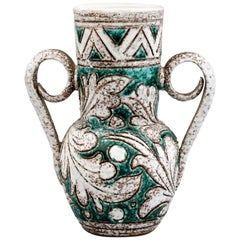
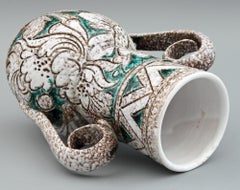
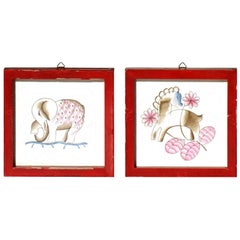
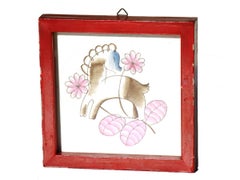
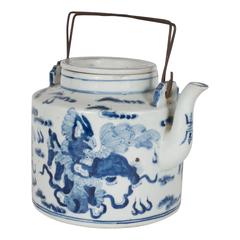
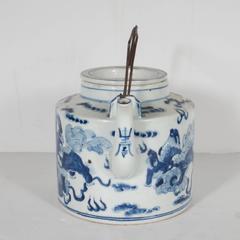
During the early 17th century, the Dutch East India Company imported millions of pieces of Chinese porcelain to the Netherlands in order to meet a seemingly insatiable demand among the aristocratic class. Following the death of the Chinese emperor Wanli in 1620, the supply of Chinese porcelain to Europe was cut off and Dutch potters started to imitate it. This gorgeous vase is believed to be among those reproductions from the 18th or 19th century. It is inscribed on the bottom "Qing Dynasty Kangxi" in Mandarin. Kangxi corresponds to the name of the emperor who ruled China between 1654-1722 A.D. ostensibly dating the piece to that time period. This teapot is believed to have been realized in the centuries following, however. It is nonetheless a stunning decorative object, with its sapphire blue renderings of traditional Chinese motifs set against a porcelain white background. It also represents a rare and remarkable piece of Delft history, symbolizing a centuries old dialogue between East and West. The piece is decorated with stylized wave and cloud motifs, and traditional Chinese temple guardian lions...
Category
19th Century Chinese Chinese Export Antique Wrought Iron Pottery