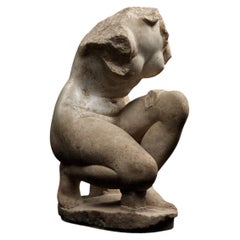
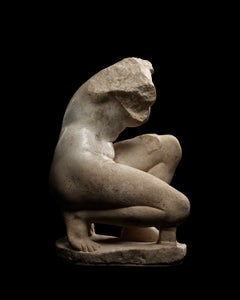
A partial marble statue of the goddess Venus crouching at her bath. The goddess kneels on her proper right knee, with her left raised towards her torso, which curves over both legs. Traces of the arms can be seen on the top of the left leg, where they would have rested to cover her nudity. The marble is carved delicately to create a supple softness across the goddess’s figure: the gentle folds of her stomach and rounded breasts with pert nipples establish the physical sensuality appropriate for the goddess of love. The torso has been meticulously polished, lending greater emphasis to the fleshly modelling, while the stone of the legs has been left rough. A single curled lock of hair remains where it falls over the left shoulder, although the head and both arms are now missing. Depictions of the goddess in this pose are typically known as ‘Crouching Aphrodite’ or the ‘Venus of Vienna’, and are modelled after a 2nd-century B.C. Greek original attributed to Doedalsas of Bithynia.
Venus was the Roman goddess of love, beauty, pleasure, and procreation – the Roman variant of the Greek goddess Aphrodite. Venus was central to many religious festivals, and was revered in Roman religion under numerous cult titles. Some believed her to be a daughter of Jupiter, but according to Hesiod’s Theogony, Venus was created, or ‘born’, of the sea foam after the severed genitals of Uranus fell into the water. This latter explanation appears to be the more popular theory due to the countless artworks depicting Venus rising from the sea...
Category
15th Century and Earlier Italian Classical Roman Antique Antiquities