Located in Downingtown, PA
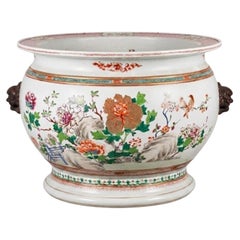
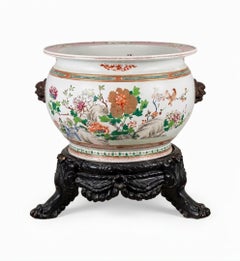
Large Chinese Export Famille Rose Porcelain Fish Bowl, Qianlong, on Carved Stand
Qing Dynasty, Qianlong Period, Circa 1750–1770
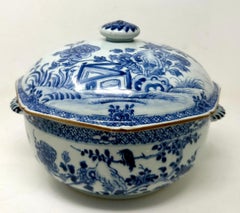
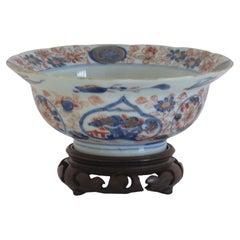
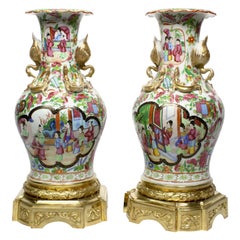
This large fish bowl is painted in the famille rose palette with a continuous fenced garden in which flowering tree peonies, the “King of Flowers” and emblem of wealth and honor, rise among grisaille rockwork stippled in gilt, beside a blue garden fence, flowering prunus and chrysanthemums, with a pair of songbirds perched on a blossoming branch. The principal bloom is boldly drawn in iron-red over a gilt ground and the white peonies are feathered in crimson, the overglaze enamels applied with a painterly touch that lends the flowers a remarkable softness and depth. Two applied molded Buddhist lion-mask handles, finished in reddish-brown, provide an architectural counterpoint to the floral decoration. The shoulder is encircled by a turquoise band of cloud scrolls punctuated with iron-red flowerheads between raised gilt fillets, the waisted neck is painted with sprays of iron-red and gilt scrolling flowers, and the foot carries a green lappet band dotted in gilt between iron-red diaper and zigzag borders.
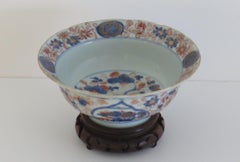
The wide everted rim is painted inside with a pink diaper border reserved with six panels of famille rose flowering branches. Below, the interior is painted with goldfish swimming among green water weeds, accompanied by a small grisaille crab, a shrimp and a shell, with a further goldfish in the well, a scheme intended to be seen through clear water in lively interplay with the living fish kept within. The Chinese word for goldfish, jinyu, sounds the same as the words for gold and jade, so the fish carry the wish of the auspicious phrase jinyu mantang, “may gold and jade fill your hall.” Firing a thick-walled vessel of this size without warping or cracking was a considerable technical achievement for the potters of Jingdezhen.
The bowl is presented on an associated European carved and ebonized wood stand of the nineteenth century, carved with drapery swags and acanthus and raised on lion-paw feet, the pairing of Chinese porcelain and Western carving characteristic of the grand interiors in which such bowls were displayed.
Dimensions
Height: 16¼ inches (41.3 cm)
Width: 23 inches (58.4 cm)
Height on stand: 25 inches (63.5 cm)
Provenance
Private Estate Collection.
Condition
The bowl is in remarkably good antique condition for its size and age, the enamels remaining vibrant with minimal rubbing. A firing crack to the interior, typical of vessels of this large scale, has been invisibly repaired. The stand with wear to the ebonized finish, consistent with age.
References
Christiaan J. A. Jörg, Chinese Ceramics in the Collection of the Rijksmuseum, Amsterdam: The Ming and Qing Dynasties (London, 1997), for a famille rose fish bowl with applied biscuit lion-mask handles, c. 1740–1760, from the collection of the Hague sinologist Jean Theodore Royer (1737–1807), Rijksmuseum, inv. no. AK-NM-6466.
Bonhams, New York, 17 March 2025, lot 51, a pair of famille rose fish bowls, Qianlong, 1740–1760, with biscuit lion-mask handles and goldfish interiors, sold by the Philadelphia Museum of Art.
Bonhams, London, New Bond Street, 8 November 2012, lot 100, a large famille rose fish bowl, Qianlong, painted with peonies and chrysanthemums issuing from rockwork, with applied biscuit animal-head handles and a goldfish interior.
Historical Context
Goldfish were bred as ornamental fish in China from the Song dynasty, and large porcelain bowls...
Category
Mid-18th Century Chinese Georgian Antique Ceramic Furniture