Japanese Paintings

to
11
184
32
261
3
Height
to
Width
to
8
7
1
1
1
29
88
144
3
66
45
9
11
1
10
3
3
7
5
1
1
154
148
122
110
87
14,387
10,099
6,498
5,863
2,891
264
264
264
16
15
2
2
2
Place of Origin: Japanese
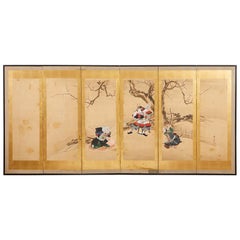
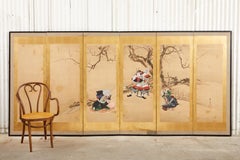
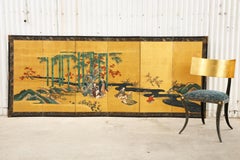
Japanese Edo Six Panel Screen Yoshitsune and Benkei

Japanese Edo Six Panel Screen Yoshitsune and Benkei

Located in Rio Vista, CA

Spectacular 19th century Japanese late Edo period six-panel byobu screen depicting Yoshitsune and Benkei, two heroes of Japanese folklore. Crafted in ink and natural color pigments on mulberry paper with thick gold leaf borders on each panel. The character Yoshitsune is seated under a blossoming cherry tree in full armor holding a fan. The warrior priest or monk Benkei is depicted kneeling on a leopard skin...

Category

19th Century Edo Antique Japanese Paintings

Materials

Brass, Gold Leaf

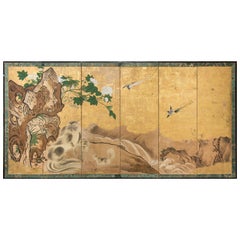
19th Century Japanese Edo Six Panel Kano School Landscape Screen

19th Century Japanese Edo Six Panel Kano School Landscape Screen

Located in Rio Vista, CA

Late Edo period 19th century Japanese six-panel landscape screen featuring a cypress tree over a flowering hibiscus with a pair of hototogisu birds. Kano school painted with ink and ...

Category

19th Century Edo Antique Japanese Paintings

Materials

Silk, Wood, Paper

19th Century Japanese Shunga Hand-Scroll, Katsukawa School

19th Century Japanese Shunga Hand-Scroll, Katsukawa School

Located in Kyoto, JP

Shunga Unknown artist Meiji era, circa 1880 Hand-scroll mounted with 12 paintings Ink, pigment and gofun on silk Dimensions: Each image measures H. 23.2 cm x W. 34.4 cm (9.15” x 13.5”) The hand-scroll measures H. 28 cm x W. 540 cm (11” x 212”) A set of 12 late 19th century Japanese Shunga paintings mounted as a hand-scroll. Two of the leaves bear the signature and seal ‘Setsuzan’, although we are unable to confirm the identity of the artist using this art name. 6 of the 12 images are taken almost directly from Katsukawa Shuncho’s late 18th century woodblock series, ‘Erotic Pictures...

Category

Late 19th Century Meiji Antique Japanese Paintings

Materials

Silk

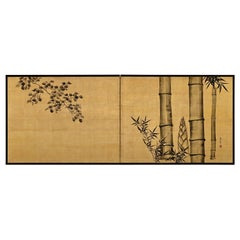
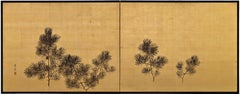
19th Century Japanese Screen for Tea-Ceremony, Ink Bamboo and Plum on Gold Leaf

19th Century Japanese Screen for Tea-Ceremony, Ink Bamboo and Plum on Gold Leaf

Located in Kyoto, JP

Three Friends of Winter Nakajima Raisho (1796-1871) Late Edo period, circa 1850 Ink and gold leaf on paper. This is a double-sided Japanese Furosaki or tea-ceremony screen from the mid 19th century; bamboo and plum on the front, young pines the back. It by Nakajima Raisho, a master painter of the Maruyama school in the late Edo and early Meiji periods. In this work Raisho combines exquisite ink brushwork with large open spaces of brilliant gold-leaf to inspire the viewers imagination. Rather than naturalism, he is searching for the phycological impression of the motifs, resulting in abstraction and stylization. His simplification of the motifs the result of looking to capture the inner nature of the objects. This art motif is known as Sho Chiku Bai, or the Three Friends of Winter. Evergreen pine connotes steadfastness, bamboo suggests both strength and flexibility, while plum blossoms unfurling on snow-laden branches imply hardiness. Combined, this trio is emblematic of Japanese new year. Chinese literati were the first to group the three plants together due to their noble characteristics. Like these resilient plants flowering so beautifully in winter, it was expected of the scholar-gentleman to cultivate a strong character with which he would be able to show the same degree of perseverance and steadfastness even during times of adverse conditions. The screen would have been placed near the hearth of a room used for the Japanese tea ceremony, shielding the fire from draughts and also forming a stimulating and decorative backdrop behind the tea utensils. It would have been used in the Hatsugama, or first tea-ceremony of the new year. Nakajima Raisho (1796-1871) originally studied under Watanabe Nangaku before entering the school of Maruyama Ozui. He was the highest ranking Maruyama school painter at the end of the Edo period and was known as one of the ‘Four Heian Families’ along with Kishi...

Category

Mid-19th Century Edo Antique Japanese Paintings

Materials

Gold Leaf

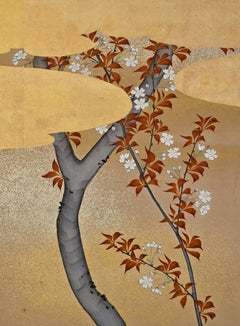
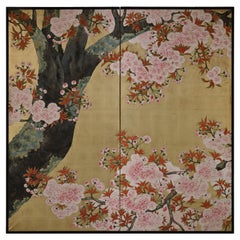
Early 20th Century Japanese Cherry Blossom Screen by Kano Sanrakuki

Early 20th Century Japanese Cherry Blossom Screen by Kano Sanrakuki

Located in Kyoto, JP

Cherry Blossoms Kano Sanrakuki (1898-1981) Showa period, circa 1930 2-panel Japanese Screen Color, gofun and gold leaf on paper Against a backdrop of gold-leafed ground, the lichen covered trunk and branches of the life-sized cherry blossom tree reach out and beyond the confines of the pictorial surface. The overall composition has a feeling of flatness which draws emphasis to the surface and the three-dimensionality of the cherry blossoms. Painstakingly built-up layers of thickly applied shell-white gofun detail the voluminous blossoms and cover large areas of this tour-de-force of Japanese Nihonga painting. By simplifying the background, minimizing the number of colors and depicting the blossoms with such heavy relief, the artist has emphasized the stunning presence of the cherry tree. The type of tree depicted is the Yae-Zakura; a double-layered type of cherry blossom famed for its beauty and strength. When we think of Japanese cherry blossoms, the first thing that comes to mind is Somei Yoshino variety, which has a single flower with five almost white petals. This type is fragile and easily blown away by strong wind or rain. Most of the double-flowered cherry blossoms begin to bloom when the Somei-Yoshino falls, and the flowering period lasts longer than that of the Somei-Yoshino. Kano Sanrakuki originally studied painting at the Kyoto City Arts and Crafts School under the tutelage of Yamamoto Shunkyo...

Category

Early 20th Century Showa Japanese Paintings

Materials

Gold Leaf

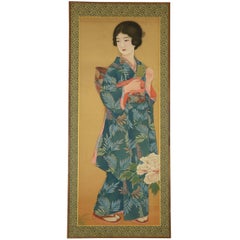
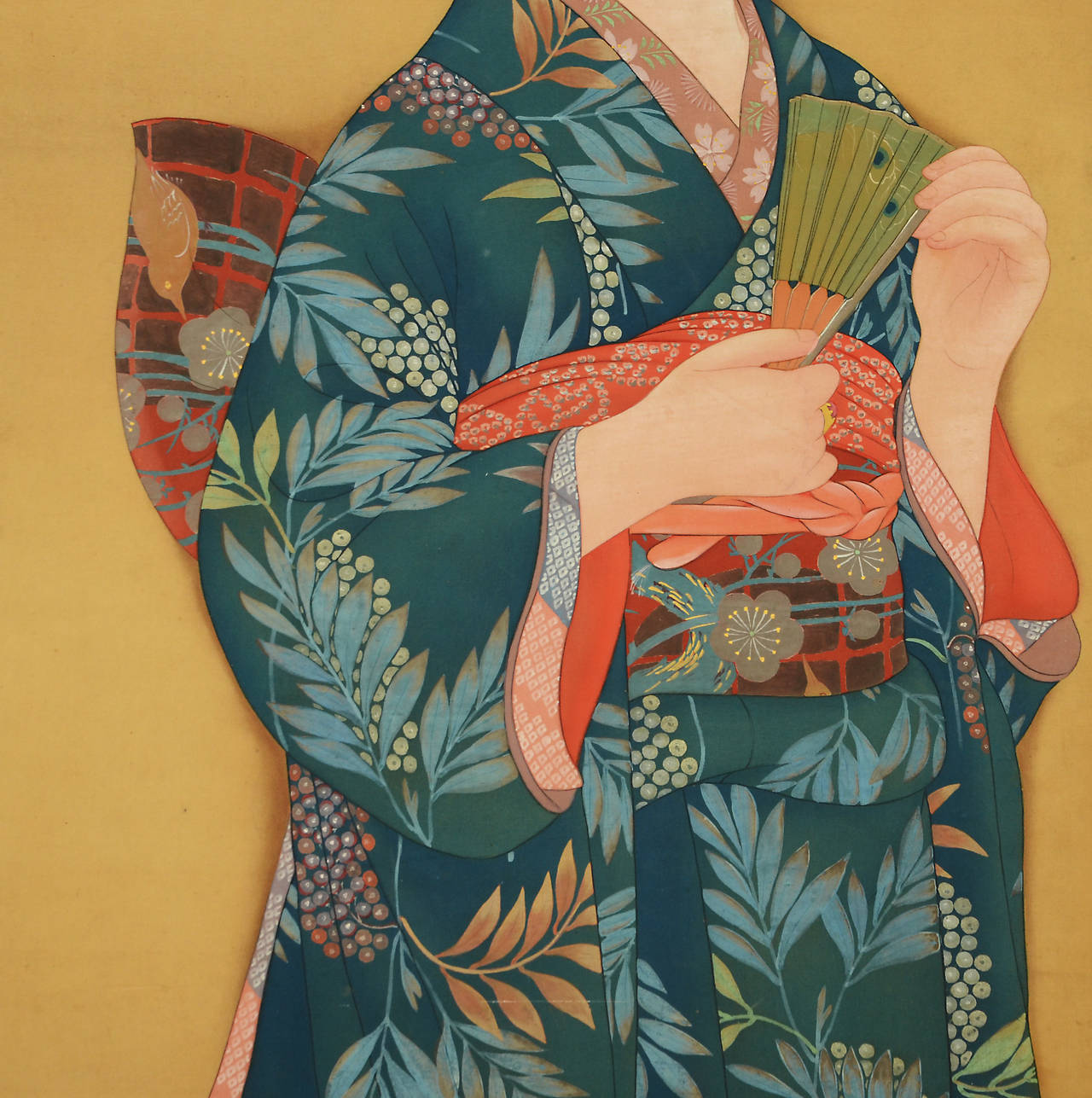
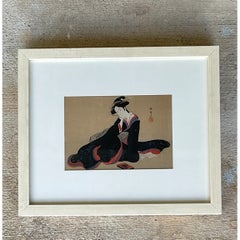
Japanese Bijin-ga Painting of Woman in Period Kimono, Taisho Period, circa 1920

Japanese Bijin-ga Painting of Woman in Period Kimono, Taisho Period, circa 1920

Located in Prahran, Victoria

Rare Japanese Taisho period Bijin-ga style painting of a beautiful woman in period kimono holding a fan, circa 1920. Bijin-ga is a Japanese term used to describe paintings or pict...

Category

1920s Taisho Vintage Japanese Paintings

Materials

Silk

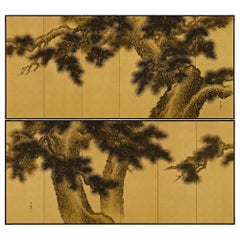
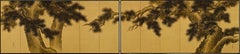
Early 20th Century Japanese Screen Pair - Ink Pine Trees on Gold

Early 20th Century Japanese Screen Pair - Ink Pine Trees on Gold

Located in Kyoto, JP

Imao Keisho (1902-1993) Pine Trees Early 20th Century, Circa 1930 Pair of six-panel Japanese screens. Ink on silk and gold leaf. Dimensions: Each screen H. 67.5” x 148” (172 cm x 376 cm) A pair of monumental six-panel Japanese pine screens by the renowned Nihonga artist Imao Keisho. Here Keisho entirely removed the background and brought the pine trees to the surface of the painting. This simplification of the elements makes the scene exceptionally direct and compelling and injects a very modern...

Category

Early 20th Century Showa Japanese Paintings

Materials

Gold Leaf

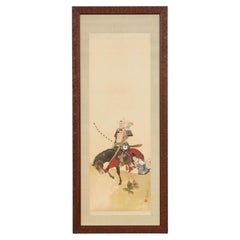
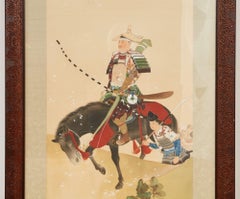
Framed Hand Painted Japanese Scroll of Returning Cavalryman

Framed Hand Painted Japanese Scroll of Returning Cavalryman

Located in Greenwich, CT

Hand-painted Japanese silk scroll entitled 'Early Spring' depicting a cavalryman in intricately detailed armor returning home on his horse with his private infantry support by his si...

Category

1920s Japonisme Vintage Japanese Paintings

Materials

Silk

Japonaise Painting in a Wood Frame, Representing a Woman, Japan, XX Century

Japonaise Painting in a Wood Frame, Representing a Woman, Japan, XX Century

Located in Auribeau sur Siagne, FR

This is an genuine painting, of a woman, with green and orange colors. It has been made in Japan, during the XX Century. It is signed.

Category

20th Century Chinese Export Japanese Paintings

Materials

Wood, Paint

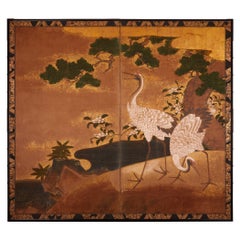
19th Japanese Screen with Cranes and Pine on a Golden Background

19th Japanese Screen with Cranes and Pine on a Golden Background

Located in Marbella, ES

A spectacular antique Japanese six-panel screen, decorated with an elegant scene of cranes beside a pine tree against a gold leaf background. The composition, remarkably balanced and...

Category

19th Century Antique Japanese Paintings

Materials

Gold, Iron

Tano Zenyu Framed Japanese Painting “Shukujitsu” (祝日) 20th Century

Tano Zenyu Framed Japanese Painting “Shukujitsu” (祝日) 20th Century

Located in Debrecen, HU

Tano Zenyu framed Japanese painting, most likely titled Shukujitsu (祝日), meaning “Holiday” or “Festive Day,” presenting an evocative and contemplative figural composition with a sere...

Category

20th Century Modern Japanese Paintings

Materials

Canvas

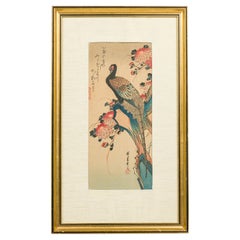
Japanese Painting of a Peacock on Branch, Gold Frame, 19th Century

Japanese Painting of a Peacock on Branch, Gold Frame, 19th Century

Located in Queens, NY

Vintage Asian Japanese style picture in a gold frame of a peacock standing on a branch having flowers with coligraphy and signed in a gold frame

Category

19th Century Anglo-Japanese Antique Japanese Paintings

Materials

Gold

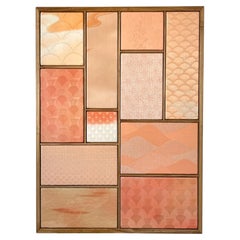
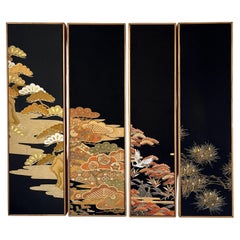
Set of Four Japanese Fusuma Painted Door Panels

Set of Four Japanese Fusuma Painted Door Panels

Located in Rio Vista, CA

Rare set of four Japanese Showa period door panels known as Fusuma in Japanese architecture. Similar to a Shoji room divider but made of an opaque materia...

Category

20th Century Showa Japanese Paintings

Materials

Brass

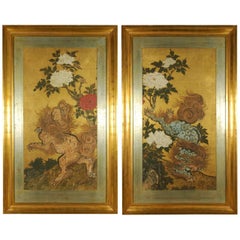
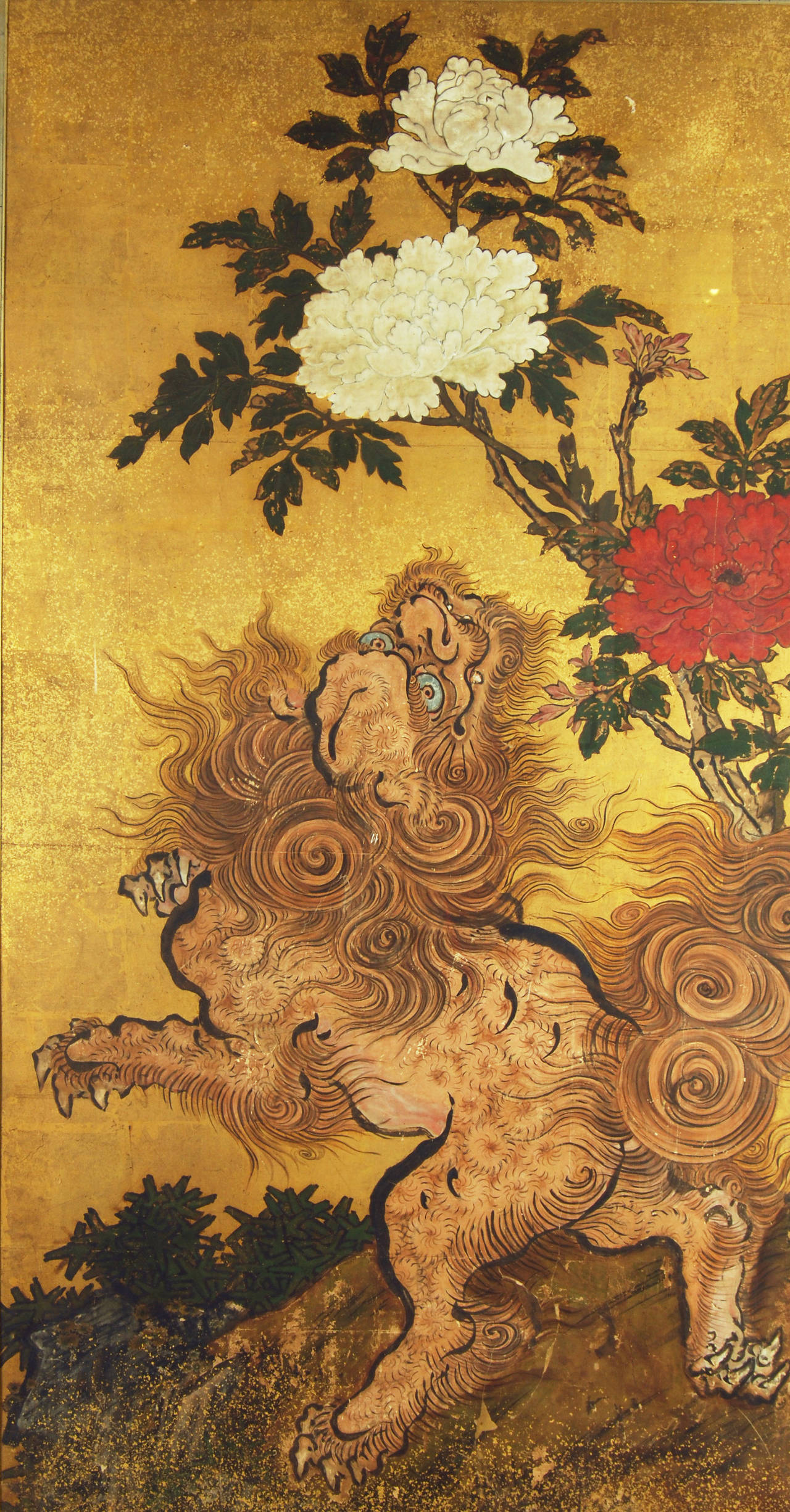
Pair of Antique Japanese Paintings of Karashishi, Edo Period, 18th Century

Pair of Antique Japanese Paintings of Karashishi, Edo Period, 18th Century

Located in Prahran, Victoria

A rare pair of antique Japanese Karashishi paintings in a landscape of rocks and peony flowers on gold leaf ground in fine handmade frames, Edo period, early 18th century. The Karash...

Category

Early 18th Century Edo Antique Japanese Paintings

Materials

Gold Leaf

Meiji Era, Circa 1900 Japanese Screen Pair, Flowers & Birds of Spring & Autumn

Meiji Era, Circa 1900 Japanese Screen Pair, Flowers & Birds of Spring & Autumn

Located in Kyoto, JP

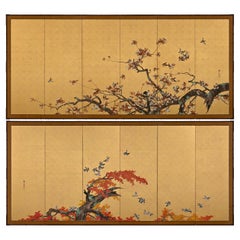
Flowers & Birds of Spring and Autumn Unknown artist. Japan. Meiji period, circa 1900. A pair of six-fold screens. Ink, color, gofun and gold leaf on paper. Signed: Gaga S...

Category

1890s Meiji Antique Japanese Paintings

Materials

Gold Leaf

Japanese Six Panel Screen: Plain Silver Leaf on Paper

Japanese Six Panel Screen: Plain Silver Leaf on Paper

Located in Hudson, NY

(no image) With beautiful oxblood color lacquer frame with 19th century bronze mounts.

Category

Early 20th Century Japanese Paintings

Materials

Bronze, Silver Leaf
Vintage obi textile art " Pines Through Seasons " by ikasu Black Beige Japan

Vintage obi textile art " Pines Through Seasons " by ikasu Black Beige Japan

By Kimono ikasu, Lena Okamoto

Located in Setagaya City, JP

Certified Kimono Meister work / Certificate of Authenticity included. One-of-a-kind Japanese textile art made from vintage kimono fabrics. Sustainable artwork for modern interiors, ...

Category

1950s Japonisme Vintage Japanese Paintings

Materials

Reclaimed Wood, Yarn, Thread, String, Textile, Fabric, Silk, Wood

Japanese Six Panel Kano School Winter Landscape Screen

Japanese Six Panel Kano School Winter Landscape Screen

Located in Rio Vista, CA

Large Japanese Meiji period six-panel screen depicting a winter landscape with a Chinese sage visiting friends in a country villa. Ink and vivid color pigments on mulberry paper mounted to a gilt background. Painted in the 19th century Kano school...

Category

19th Century Meiji Antique Japanese Paintings

Materials

Metal

Japanese Two-Panel Screen Temples Through Misty Forest

Japanese Two-Panel Screen Temples Through Misty Forest

Located in Hudson, NY

Japanese two-panel screen: Temples Through Misty Forest. Chinese School landscape ink painting on gilded silk by Yukimatsu Shunpo, signed and dated 1924. Yukimatsu Shunpo was born in...

Category

1920s Taisho Vintage Japanese Paintings

Materials

Silk, Wood

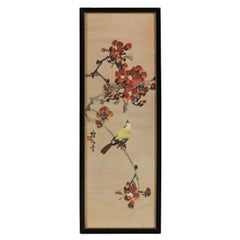
Framed Japanese Watercolor Painting of Bird on Flowering Branch

Framed Japanese Watercolor Painting of Bird on Flowering Branch

Located in Yonkers, NY

This delicate Japanese painting on paper captures a bright yellow bird perched among flowering branches in full bloom. Executed in watercolor with expressive brushwork and fluid ink ...

Category

Mid-20th Century Japanese Paintings

Materials

Glass, Paper

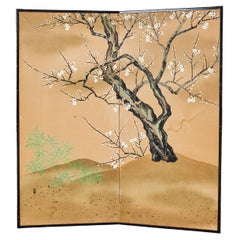
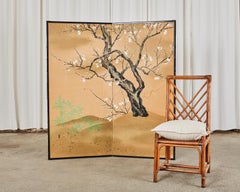
Japanese Showa Two Panel Screen Blossoming Prunus Tree

Japanese Showa Two Panel Screen Blossoming Prunus Tree

Located in Rio Vista, CA

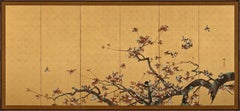
Serene Japanese Showa period two-panel folding byobu screen depicting a large spring blossoming prunus tree or plum tree. Beautifully painted with ink and natural color pigments on m...

Category

20th Century Showa Japanese Paintings

Materials

Brass

Hokusai “Thirty-Six Views of Mount Fuji” (Ura Fuji) Woodblock Print 1950s

Hokusai “Thirty-Six Views of Mount Fuji” (Ura Fuji) Woodblock Print 1950s

Located in Paris, FR

This elegant Japanese woodblock print is inspired by Ura Fuji (“Hidden Fuji”) from the celebrated series Thirty-Six Views of Mount Fuji by Katsushika Hokusai, one of the most iconic ...

Category

Mid-20th Century Edo Japanese Paintings

Materials

Paper

Japanese Six Panel Screen by Garden’s Edge

Japanese Six Panel Screen by Garden’s Edge

Located in Hudson, NY

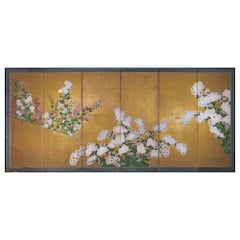
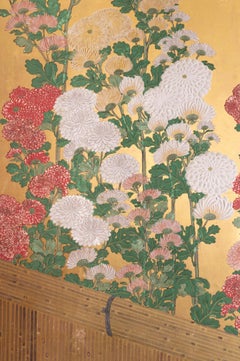
Edo period (18th century) painting of a flowing array of various types of chrysanthemums painted on beautifully faceted heavy gold leaf and behind afinely painted fence. Petals of th...

Category

18th Century Antique Japanese Paintings

Materials

Gold

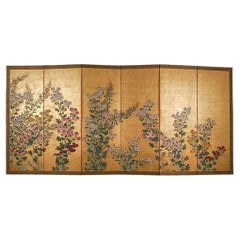
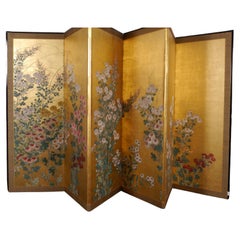
Japanese Six-Panel Screen Byobu With Chrysanthemums And Autumn Grass and Flower

Japanese Six-Panel Screen Byobu With Chrysanthemums And Autumn Grass and Flower

Located in Torino, IT

The 19th Century Six-Panel Japanese folding screen "Byōbu" usually used in the most important Japanese house to stop wind and also to separate different space of the same big room de...

Category

Mid-19th Century Edo Antique Japanese Paintings

Materials

Gold Leaf

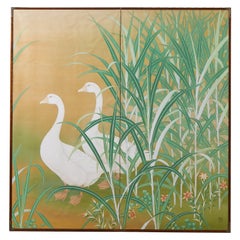
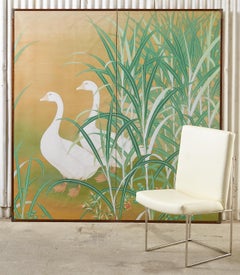
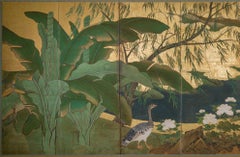
Japanese Meiji Two Panel Screen Geese and Reeds

Japanese Meiji Two Panel Screen Geese and Reeds

Located in Rio Vista, CA

Fantastic Japanese late Meiji period two-panel byobu screen by Hashimoto Koshu. The large screen features two white geese amid brightly colored reeds. The symbolism of geese and reeds was introduced to Japan from China in the 13th century. This was a popular subject for Japanese zen artists of the period. Beautifully crafted with exceptional brush strokes and details. Made with natural pigments in dramatic vivid colors of white, pink, and mint green on a silk background of gilt. Circa 1900 with artist seal on bottom right corner. Koshu studied Western art under...

Category

20th Century Meiji Japanese Paintings

Materials

Silk, Wood, Paper

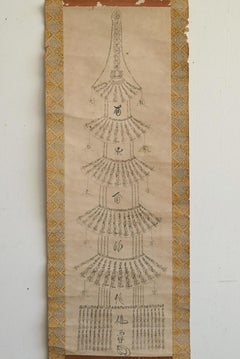
Antique Japanese Buddhist pagoda hanging scroll /Buddhist painting/Edo

Antique Japanese Buddhist pagoda hanging scroll /Buddhist painting/Edo

Located in Sammu-shi, Chiba

This is a slightly different Buddhist painting believed to have been created by a Japanese temple monk during the Edo period (late 17th to 19th century). Rendered in ink on paper, th...

Category

18th Century Edo Antique Japanese Paintings

Materials

Paper

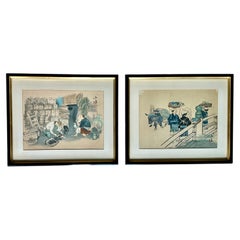
Pair Japanese Woodblock Prints by Sanzo Wada (1883–1967)

Pair Japanese Woodblock Prints by Sanzo Wada (1883–1967)

Located in Palm Springs, CA

Pair of framed vintage Japanese woodblock prints by artist Sanzo Wada (1883–1967) from his series "Occupations of Shōwa Japan in Pictures" (Shōwa shokugyō絵尽). Wood block #1: Titled...

Category

Mid-20th Century Japanese Paintings

Materials

Wood, Paper

Japanese Two-Panel Screen, Deco Landscape with River Fans

Japanese Two-Panel Screen, Deco Landscape with River Fans

Located in Hudson, NY

Japanese two-panel screen, deco landscape with river fans. Modern scene of a 12th century festival in Kyoto in which fans are sent down the Kamo River and caught downstream. Taisho (...

Category

Early 20th Century Taisho Japanese Paintings

Materials

Gold Leaf

Japanese Single Panel Painting Moon and Plum Design 'Winter Scene'

Japanese Single Panel Painting Moon and Plum Design 'Winter Scene'

Located in Hudson, NY

Meiji period (1868-1912) ink painting of plum branches in bloom against a full moon with calligraphy. The calligraphy is a poem about winter. Signature reads: Matsuura Ryosai, Dated:...

Category

Late 19th Century Meiji Antique Japanese Paintings

Materials

Paper

Vintage Japanese Silk Painting, Abstract Mid-Century, Signed

Vintage Japanese Silk Painting, Abstract Mid-Century, Signed

Located in Delray Beach, FL

A striking example of postwar Japanese abstraction, this vintage silk painting presents a meditative composition of luminous color fields rendered in richly layered pigments. Horizon...

Category

Mid-20th Century Mid-Century Modern Japanese Paintings

Materials

Silk, Paint

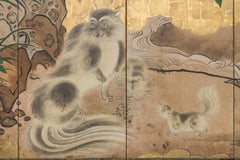
Japanese Screen: Animals and Flowers in a Landscape with Rising Sun

Japanese Screen: Animals and Flowers in a Landscape with Rising Sun

Located in Hudson, NY

Edo period (c. 1800) screen, beautifully painted with excellent details. Kano School painting at its best. An exuberant Audobon landscape being observed by a cat and her kitten. A...

Category

Early 19th Century Edo Antique Japanese Paintings

Materials

Gold Leaf

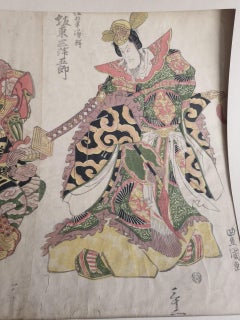
Antique Japanese Woodblock by Utagawa Toyokuni l, 1816

Antique Japanese Woodblock by Utagawa Toyokuni l, 1816

By Utagawa Toyokuni

Located in Amsterdam, Noord Holland

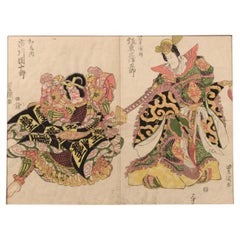
Antique Japanese Woodblock – Utagawa Toyokuni l – 1816 (Honjo, Edo Period 1786-1865 Edo), Diptych, Actors Bandô Mitsugorô (R) and Ichikawa Danjûrô (L) Date: Japanese, Edo period Pro...

Category

19th Century Edo Antique Japanese Paintings

Materials

Paper

Antique Japanese Silk Hanging Scrolls C.1920

Antique Japanese Silk Hanging Scrolls C.1920

$5,975Sale Price / set|20% Off

Antique Japanese Silk Hanging Scrolls C.1920

Located in London, GB

A stunning set of four Japanese silk mounted vertical hanging scrolls. Dating from C.1920 Taisho Period. The watercolour and ink on silk depicts a larg...

Category

1920s Japonisme Vintage Japanese Paintings

Materials

Silk

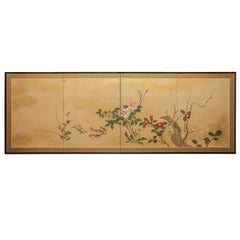
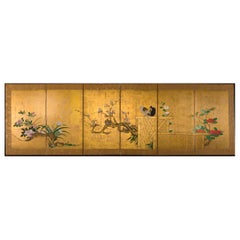
Japanese Four Panel Screen: Early Spring Into Summer

Japanese Four Panel Screen: Early Spring Into Summer

Located in Hudson, NY

Japanese Four Panel Screen: Early Spring Into Summer, Meiji period (1868 -1912) painting of plum in bloom with red camellias on the right and peony and thistle on the left. A clutc...

Category

Early 1900s Meiji Antique Japanese Paintings

Materials

Gold Leaf

Study for a Woman Seated in a Blue Chair by Takashi Kaburagi, Japan 1996

Study for a Woman Seated in a Blue Chair by Takashi Kaburagi, Japan 1996

Located in Debrecen, HU

This rare and highly expressive oil painting on canvas by Japanese art historian, researcher, and artist Takashi Kaburagi was created in 1996 and is officially titled on the reverse ...

Category

1990s Modern Japanese Paintings

Materials

Canvas

Antique Japanese Blockprint Painting Japan Edo or Meiji

Antique Japanese Blockprint Painting Japan Edo or Meiji

Located in Amsterdam, Noord Holland

Antique Japanese Blockprint Painting Japan Edo or Meiji. A very nice blockprint. Additional information: Type: Paintings, Scrolls & Prints Region of Origin: Japan Country of Manufa...

Category

19th Century Antique Japanese Paintings

Set of 6 Large Kakemonos Japanese Mythology, 19th Century Japan circa 1800 Edo

Set of 6 Large Kakemonos Japanese Mythology, 19th Century Japan circa 1800 Edo

Located in Beuzevillette, FR

Beautiful set of 6 large kakemonos from 19th century Japanese mythology. Paper support with a canvas pasted on the paper Wonderful set that is part of Japan's history and beliefs When not hung, the Kakemonos are rolled up. circa 1800 - Japan - Edo Period A kakemono translates as "object to hang". In Japan this refers to a painting or calligraphy, most often done on silk or paper framed in a scroll that was intended to be hung on walls or in public lighting. This particular form, which allows them to be in a roll, dates back to the Tang dynasty in China (this would be related to the copying and preservation of ancient Buddhist texts). A Kami is a deity or spirit worshipped in the Shinto religion. A Yokai is a spirit, ghost, demon, or strange apparition from the creatures of Japanese folklore. Each of these kakemonos represents a unique story: - A kami, a Japanese deity, is shown painting a rainbow. Indeed, he performs the action with his right hand while his left hand holds a kind of basket with three pots of paint. This kami has a rather closed attitude. He is standing in a dark and tormented sky. Below this figure, 8 villagers are dressed in traditional Japanese clothes. Their faces are softened. They are not afraid of the elements made by the kami above their heads. - A character with an unreal look is holding a kind of jar with his two hands, which he spills on human figures above. This being is floating in the air, probably a character from mythology, perhaps Susanoo. Underneath, villagers on umbrellas. They are trying to protect themselves as best they can from what is falling on them. One of them is carrying baskets with fish on her shoulders. A character in the background is thrown forward and falls. - On this kakemono, the god Raijin, dressed in a white and blue outfit, strikes the sky with his two drum hammers to create lightning and its thunderous sound. Surrounded by Tomoe and a long red scarf, Raijin, enraged and with dishevelled hair, creates a dark and violent storm. The villagers seem frightened by this meteorological phenomenon. One of the villagers can be seen fainting in the arms of a man. This scene may seem chaotic, but Japanese legend tells us that once a field is struck by lightning, the harvest is good. - On this kakemono, we see an unreal-looking figure holding a fan, as if he were sweeping away the bad weather, or simply producing gusts of wind. He is probably the kami of wind and air, Shina tsu-hiko. The figures below him seem surprised by so much wind. An umbrella flies away on the left, the women hold their hair and scarf, the clothes are caught in the power of the wind, there is even a woman on the ground on the bottom left. - This Kakemono represents a short moment. This Raiju is a yokai (ghost spirit...

Category

19th Century Edo Antique Japanese Paintings

Materials

Paper

Japanese Two Panel Screen Manchurian Crane and Turtles

Japanese Two Panel Screen Manchurian Crane and Turtles

Located in Hudson, NY

In Japan, cranes symbolize fidelity as they mate for life and turtles symbolize longevity. Additionally, this screen also has the Japanese motif of sho-chiku-bai, or the three friends of winter (pine, plum, and bamboo). So called the three friends of winter because all three flourish during the cold months. This screen was originally fusuma doors...

Category

Mid-19th Century Edo Antique Japanese Paintings

Materials

Paper

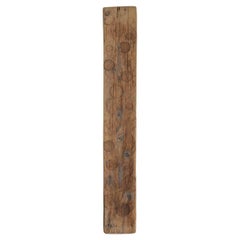
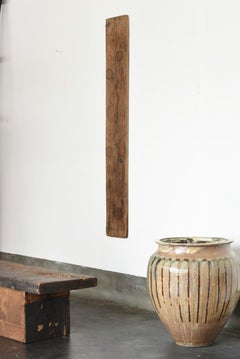
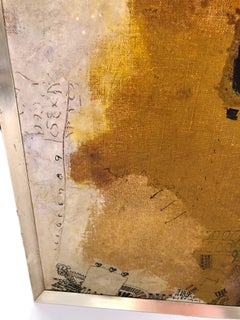
Antique Work Board Used by Japanese Craftsmen/1868-1920/Wabi-Sabi Wall Painting

Antique Work Board Used by Japanese Craftsmen/1868-1920/Wabi-Sabi Wall Painting

Located in Sammu-shi, Chiba

If you want something special, we recommend purchasing items selected by Brood. We sell carefully selected old Japanese items. I've seen tens of thousands of items so far. Based o...

Category

Late 19th Century Meiji Antique Japanese Paintings

Materials

Cedar

Early 20th Century kimono textile art " Rising Sun ~ Renewal ~ " by ikasu Japan

Early 20th Century kimono textile art " Rising Sun ~ Renewal ~ " by ikasu Japan

By Lena Okamoto, Kimono ikasu

Located in Setagaya City, JP

Certified Kimono Meister work / Certificate of Authenticity included. One-of-a-kind Japanese textile art made from vintage kimono fabrics. Sustainable artwork for modern interiors, ...

Category

1960s Japonisme Vintage Japanese Paintings

Materials

Gold Leaf

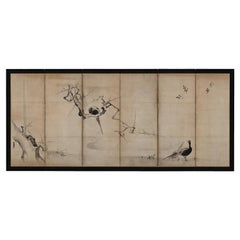
Japanese Edo Six-Panel Haboku Landscapes of Seasons

Japanese Edo Six-Panel Haboku Landscapes of Seasons

Located in Rio Vista, CA

19th century Japanese Edo period six-panel screen painted in Haboku (splashed ink) style. Depicts Four Seasons landscape scenes with two portraits of Chinese sages. One sage is trave...

Category

19th Century Edo Antique Japanese Paintings

Materials

Gold Leaf

Japanese Two-Panel Screen Spring Flowers

Japanese Two-Panel Screen Spring Flowers

Located in Hudson, NY

A vibrant celebration of spring using a colorful ensemble of coxcomb, irises, lilies, hybiscus, and a blossoming cherry tree. Great examples of "tarashikomi" or "painting-in", a Rim...

Category

1930s Showa Vintage Japanese Paintings

Materials

Silk, Paper

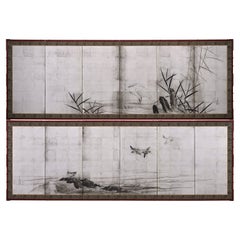
Japanese Silver Screen Pair, Meiji Period, Herons & Plovers, Shijo School

Japanese Silver Screen Pair, Meiji Period, Herons & Plovers, Shijo School

Located in Kyoto, JP

Heron & Plovers Ink and silver leaf on paper Maekawa Bunrei (1837-1917) A pair of low six-panel Japanese screens by Maekawa Bunrei, a later master of the Kyoto based Shijo school of painting. On the right screen a solitary white heron stands motionless in a stream. On the left screen plovers play along a shoreline. The elegant forms are executed employing fluid, minimalistic ink brushstrokes. The soft brushstrokes and the sharp light of the silver leaf lend the scenes a sense of translucence. The sophisticated composition superbly exploits the long, horizontal pictorial surface of the pair of folding screens...

Category

Early 1900s Meiji Antique Japanese Paintings

Materials

Silver Leaf
Japanese Six Panel Screen: Clouds of Golden Mist
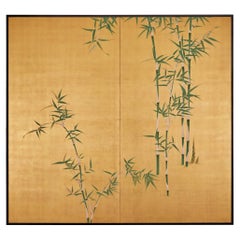
Japanese Six Panel Screen: Clouds of Golden Mist

Located in Hudson, NY

Mineral pigments and gold on mulberry paper. Signature reads: Bunrei-Ga.

Category

Early 20th Century Japanese Paintings

Materials

Gold

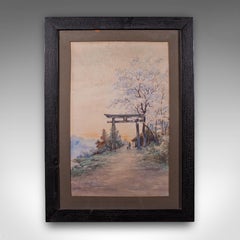
Vintage Torii Gate Landscape Painting, Japanese School, Watercolour, Art, C.1960

Vintage Torii Gate Landscape Painting, Japanese School, Watercolour, Art, C.1960

Located in Hele, Devon, GB

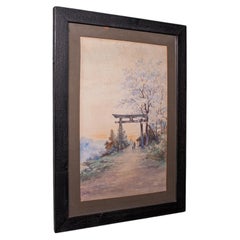
This is a vintage Torii Gate landscape painting. A Japanese School watercolour, dating to the mid 20th century, circa 1960. Inviting Japanese school watercolour, steeped in Japanese...

Category

1960s Mid-Century Modern Vintage Japanese Paintings

Materials

Glass, Paper

Vintage Landscape Painting, Japanese School, Watercolour, Art, Mid Century, 1960

Vintage Landscape Painting, Japanese School, Watercolour, Art, Mid Century, 1960

Located in Hele, Devon, GB

This is a vintage landscape painting. A Japanese School watercolour, signed by the artist Eizo Kato, dating to the mid 20th century, circa 1960. Endearing Japanese school watercolou...

Category

Mid-20th Century Mid-Century Modern Japanese Paintings

Materials

Glass, Paper

Antique kimono textile art " Kobachi ~Coral Collection~ II" by ikasu Japan

Antique kimono textile art " Kobachi ~Coral Collection~ II" by ikasu Japan

By Lena Okamoto, Kimono ikasu

Located in Setagaya City, JP

Certified Kimono Meister work / Certificate of Authenticity included. One-of-a-kind Japanese textile art made from vintage kimono fabrics. Sustainable artwork for modern interiors, ...

Category

Mid-20th Century Japonisme Japanese Paintings

Materials

Silk, Wood, Fabric, Textile, String, Thread, Yarn, Reclaimed Wood

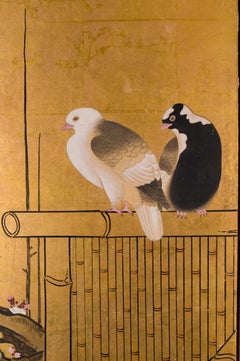
Japanese Framed Silk Painting, Turtledoves and Peaches, Taisho Era, circa 1920

Japanese Framed Silk Painting, Turtledoves and Peaches, Taisho Era, circa 1920

Located in Kyoto, JP

Nakamura Daizaburo Turtledoves in a Peach Tree Taisho period, circa 1920 Framed painting. Mineral pigments, ink and gofun on silk Signed: Daizaburo Dimensions (framed)...

Category

1910s Taisho Vintage Japanese Paintings

Materials

Wood, Silk

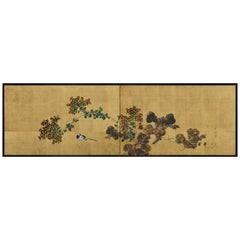
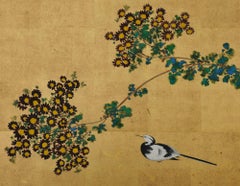
Japanese Screen, Early 20th Century Wagtail & Chrysanthemum by Ishizaki Koyo

Japanese Screen, Early 20th Century Wagtail & Chrysanthemum by Ishizaki Koyo

Located in Kyoto, JP

Ishizaki Koyo (1884-1947) Wagtail & Chrysanthemum Early 20th century Folding screen in two-panels. Ink, pigments and gofun on gold leaf. Sign: Koyo Seal: Koyo This ...

Category

Early 20th Century Taisho Japanese Paintings

Materials

Gold Leaf