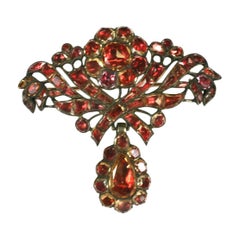
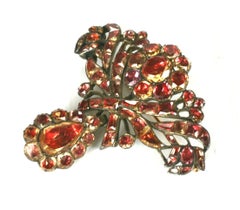
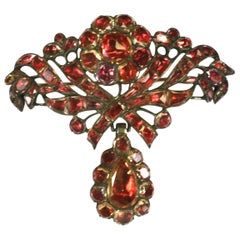
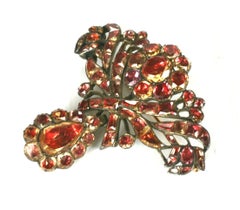
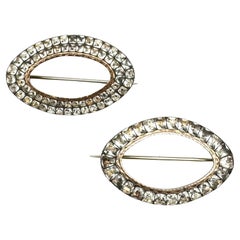
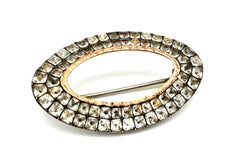
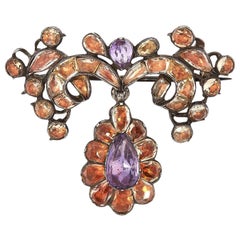
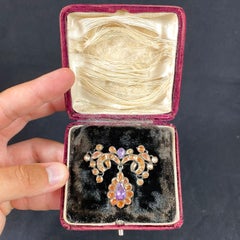
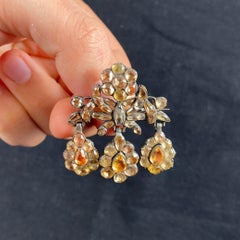
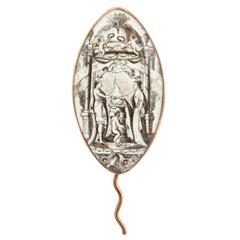
An antique 18th century foiled imperial topaz and amethyst brooch in silver, Portuguese, circa 1770. From the Georgian period, this brooch is designed as two openwork scrolled foliate branches issuing from the center, where hangs an articulated amethyst and topaz pear-shape cluster drop, all stones closed-set in silver. The brooch is secured to reverse with a later-added hinged pin and roller clasp fitting in silver. Accompanied by a fitted case.
Tested as silver, not marked. Dimensions: 4.8 x 4.0 cm. Gross weight: 12.5g.
Both Portugal and Spain had colonies in South America. Brazil was a treasure trove of precious stones, yielding huge quantities of diamonds, topaz, aquamarine and chrysoberyl gems, which were made into jewelry back in Portugal. These gemstones were pieced together and pave-set to create suites of swagged and beribboned necklaces and earrings in floral and bow motifs. In 1735, the mines of Minas Gerais in Brazil yielded a seam of imperial topaz with a slight pinkish hue. The colorful floral and bow jewelry of Portugal made great use of this delightful gemstone, sometimes mixing it with chrysoberyl, or aquamarine. Imperial topaz was always a costly gemstone and it was not always easy to find enough gemstones of perfectly matched colors to go together in a jewel. That is why it is common for these antique Iberian jewels to be set with a foil behind it, which would enhance the gems’ appearance and help color-match the stones to create the prettiest effect.
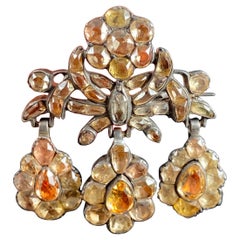
For similar late 1700s Georgian foil-back imperial topaz Portuguese jewels, see d'Orey, Leonor, "Five Centuries of Jewellery", permanent exhibition of the National Museum of Ancient Art, Lisbon, Zwemmer Publishers Limited, 1995, pages 70, 72 and 73.
For similar late 1700s Georgian Portuguese...
Category
Portuguese Georgian Antique 1770s Brooches
MaterialsAmethyst, Topaz, Imperial Topaz, Silver