Cleveland

to
99
979,814
741,606
406
237
179
175
121
82
65
44
43
39
37
28
28
26
23
22
18
15
11
8
8
5
3
3
2
2
1
1
1
60
50
35
30
29
Female Nude Godiva Riding a Rhinoceros Sculpture, 20th Century

Female Nude Godiva Riding a Rhinoceros Sculpture, 20th Century

By John Kearney

Located in Beachwood, OH

John W. Kearney (American, 1924-2014) Godiva on a Rhinoceros Bronze Signed with monogram to base 6.5 x 3 x 8.5 inches Born in Omaha, Nebraska, he studied at the Cranbrook Acadamy of...

Category

Late 20th Century Cleveland

Materials

Bronze

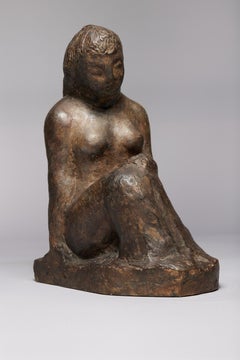
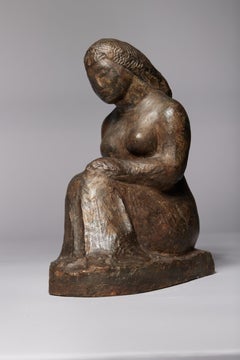
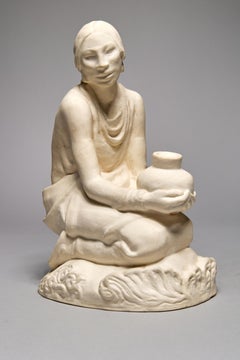
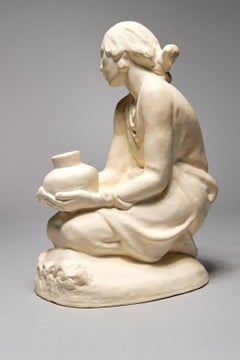
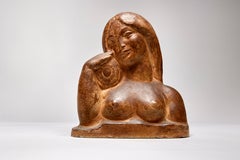
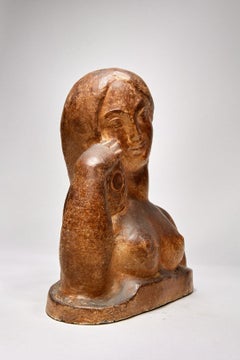
Seated Nude Woman Sculpture, Painted Plaster, Inscribed, Early 20th Century

Seated Nude Woman Sculpture, Painted Plaster, Inscribed, Early 20th Century

By William Zorach

Located in Beachwood, OH

William Zorach (American, 1887-1966) Seated Woman Painted plaster Inscribed underside "V" 12.5 x 9 x 5 inches Provenance: The Tatti Family Collection Bill Zorach was born in Lithuan...

Category

Early 20th Century Cleveland

Materials

Plaster

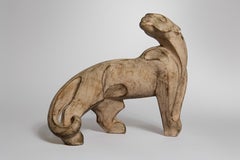
Brutalist Late 20th Century Figurative Panther Sculpture

Brutalist Late 20th Century Figurative Panther Sculpture

Located in Beachwood, OH

Alexsander Danel (Estonian, 1940-2001) Brutalist Panther Sculpture, 1996 Signed 'Danel' and 'Austin Sculpture' to back leg 13.5 x 16.5 inches Alexsander Danel was born in Estonia and graduated from both the Moscow Industrial Arts School and the Moscow Fine Arts Academy. He earned many awards and distinctions in the Soviet Union, including "Best Work of the Year" in 1973 for his monumental work commemorating the history of the Russian Wars, installed in Kirov. Alexsander Danel emigrated to the U.S. in 1976, after spending a year in Rome where he sculpted set designs for Fellini's "Cassanova" and the Napoli Theater production of "Aida". After settling in New York, he completed commissions for Rockefeller Plaza and Radio City Music Hall. In 1992, he held his first one person show exhibiting computer generated...

Category

1990s Cleveland
Materials

Ceramic

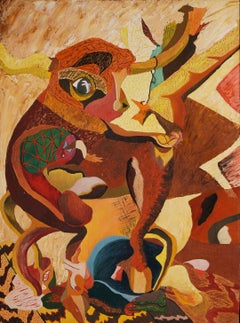
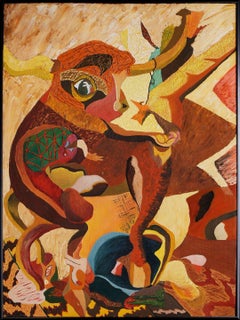
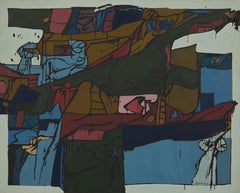
Interior, large, colorful figural abstract red, orange, blue acrylic of couple

Interior, large, colorful figural abstract red, orange, blue acrylic of couple

By Richard Andres

Located in Beachwood, OH

Richard Andres (American, 1927-2013) Interior, 1976 acrylic on canvas signed lower right, signed and titled verso 50 x 59.5 inches Richard Andres was born in Buffalo, New York in 1927. A graduate of the Cleveland Institute of Art in 1950, he was immediately drafted and served for two years in the army as a mural painter. He received his Master of Arts from Kent State in 1961. A frequent exhibitor at galleries and museums and winner of multiple May Show prizes, Andres taught art in the Cleveland Public Schools for 28 years, as well as teaching the University of Buffalo, the Cleveland Institute of Art and the Western Reserve University. Very little in Richard Andres’ childhood would have predicted his love of classical music, mid-century-modern architecture and certainly not his lifelong passion for art and in particular abstract art. Richard’s father, Raymond, had no more than a third-grade education, and his mother, Clara, was one of thirteen children – only three of whom lived into adulthood and none of whom attended high school. They lived, when Richard was a boy, in a dingy area of Buffalo, NY in a walk-up apartment situated above a tavern. Raymond and Clara supplemented the income from their factory jobs in the bar downstairs with Raymond playing ragtime on the piano and Clara serving drinks. This often left Richard and his two older brothers at home alone to fend for themselves. The two older boys, Raymond and Russell, were - unlike Richard- rather rough and tumble and entertained themselves with stickball, boxing and the like. Richard, on the other hand, from a very young age liked to draw, or better yet even, to paint with the small set of watercolors he received for Christmas one year. Paper, however, at the height of the depression, was hard to come by. Luckily, Clara used paper doilies as decoration for the apartment and Richard would contentedly paint and then cut up doilies, gluing the pieces together to create collages. At eight-years-old, he discovered the Albright-Knox Museum (then known as the Albright Art Gallery) and spent several hours a week there studying the paintings. He was particularly fond of Charles Burchfield‘s landscapes, enamored with their ‘messiness’ and thinking that they somehow captured more ‘feeling’ than works he was previously familiar with. For his tenth Christmas, he asked for and received a ‘how-to’ paint book by Elliot O’Hare. Through this self-teaching, he assembled the portfolio needed for acceptance to Buffalo Technical High School where he studied Advertising Arts. In his Junior year, he was encouraged to enter a watercolor painting, “Two Barns,” in the national 1944-45 Ingersoll Art Award Contest and was one of twelve grand prize winners – each one winning one hundred dollars. More importantly the painting was exhibited at the Carnegie Institute Galleries, which resulted in his winning a national scholarship to the Cleveland School of Art (The Cleveland Art Institute). He flourished at the art school under the tutelage of faculty members such as Carl Gaertner, as well as that of visiting artists such as William Sommer and Henry George Keller. He would say in later years that Gaertner, in particular, influenced his attitude toward life as well as art. “Gaertner,” Andres said, “believed that there was no need to be a ‘tortured artist’, that an artist should rather enjoy beauty, family, and life in general.” Free to spend his days as he chose, he wandered the Cleveland Art Museum for most of the hours he was not attending classes or painting; the remaining time was spent drinking coffee at a local hangout with art school friends – which is where he met fellow Henry Keller scholarship winner, Avis Johnson. Richard was immediately smitten with Avis, but being rather shy, it took him the entire summer of 1948 to build up his courage to ask her out. Over that summer he ‘thought about Avis’ and worked in a diner to save money. He also used the hundred-dollar prize money won in High School to visit the first Max Beckmann retrospective in the United States at the City Art Museum in St. Louis. Over a half century later he spoke of that exhibit with a reverence usually reserved for spiritual matters, “I walked in and it was like nothing I had ever seen before... the color...It just glowed.” Returning to campus in the Fall, the first thing he did was go to the coffee shop in hopes of finding Avis. He did, and she, upon seeing him, realized that she was also smitten with him. They quickly became known as ‘the couple’ on campus, and a year later, with Richard being drafted for the Korean war, they were quickly married by a Justice of the Peace, celebrating after with family at Avis’s Cleveland home. As a gift, faculty member John Paul Miller...

Category

1970s Abstract Expressionist Cleveland

Materials

Acrylic

Abstracted Summer Landscape, Creek in the Forest, Cleveland School Artist

Abstracted Summer Landscape, Creek in the Forest, Cleveland School Artist

By August Biehle

Located in Beachwood, OH

August Frederick Biehle American, 1885-1979 Creek in the Forest, c. 1949 Gouache, watercolor and litho crayon on board Signed lower right, dated lower left 18 x 24 inches 23.25 x 29....

Category

1940s Cleveland
Materials

Crayon, Watercolor, Gouache

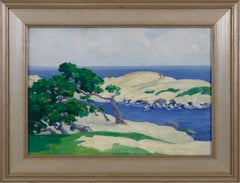
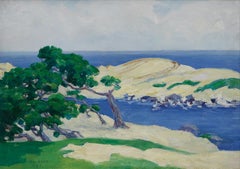
California Landscape, Near Carmel Ocean & Tree View, Cleveland Woman Artist

California Landscape, Near Carmel Ocean & Tree View, Cleveland Woman Artist

By May Ames

Located in Beachwood, OH

May Lydia Ames (American, 1863-1943) Near Carmel, Calif., 1932 Oil on board Signed and dated lower left, signed and titled verso 14 x 20 inches 18.5 x 24.5 inches, framed May Ames w...

Category

1930s American Impressionist Cleveland

Materials

Oil

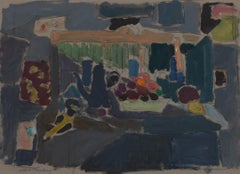
20th century abstract expressionist oil painting by Cleveland School artist

20th century abstract expressionist oil painting by Cleveland School artist

By Richard Andres

Located in Beachwood, OH

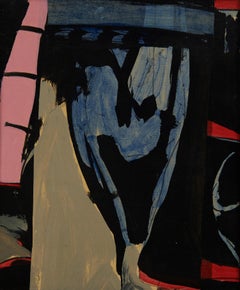
Richard Andres American, 1927-2013 acrylic and ink on paper mounted on canvas 12 x 10 inches Note: Small dent in canvas. See pictures for details. Richard Andres was born in Buffal...

Category

1980s Abstract Expressionist Cleveland

Materials

Ink, Acrylic

Farm in Berlin Heights, Ohio, Vibrant Field Landscape

Farm in Berlin Heights, Ohio, Vibrant Field Landscape

By August F. Biehle

Located in Beachwood, OH

August Frederick Biehle (1885-1979) Farm in Berlin Heights, c. 1930 Oil on masonite Signed lower right 22 x 30 inches 27.75 x 36 inches, framed A versatile painter who worked in a v...

Category

1930s American Modern Cleveland

Materials

Oil

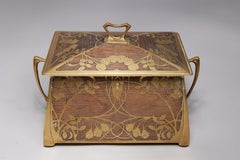
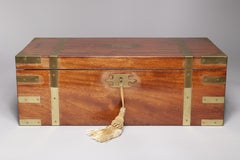
English Brass Bound Mahogany Lap Desk, Late 19th Century

English Brass Bound Mahogany Lap Desk, Late 19th Century

Located in Beachwood, OH

English Brass Bound Mahogany Lap Desk, Late 19th Century 20 inches wide This is an elegant English brass-bound mahogany lap desk, likely dating from the late 19th to early 20th cent...

Category

Late 19th Century Cleveland

Materials

Brass

18th/19th C. Italian Alabaster Sculpture of Infant Hercules Wrestling a Snake

18th/19th C. Italian Alabaster Sculpture of Infant Hercules Wrestling a Snake

Located in Beachwood, OH

18th/19th Century Italian Infant Hercules Wrestling a Snake Alabaster 18 x 18 x 6 inches 40 lb. In Greek mythology, the infant Hercules (Heracles) is famously depicted wrestling wit...

Category

Late 18th Century Italian School Cleveland

Materials

Alabaster

Fisherman's Island, Boothbay, Maine, early 20th century landscape watercolor

Fisherman's Island, Boothbay, Maine, early 20th century landscape watercolor

By Frank Wilcox

Located in Beachwood, OH

Frank Nelson Wilcox (American, 1887-1964) Fisherman's Island, Boothbay, Maine, c. 1925 Watercolor on paper Signed lower left 15 x 20 inches 20.75 x 25.75 inches, framed Frank Nelson Wilcox (October 3, 1887 – April 17, 1964) was a modernist American artist and a master of watercolor. Wilcox is described as the "Dean of Cleveland School painters," though some sources give this appellation to Henry Keller or Frederick Gottwald. Wilcox was born on October 3, 1887 to Frank Nelson Wilcox, Sr. and Jessie Fremont Snow Wilcox at 61 Linwood Street in Cleveland, Ohio. His father, a prominent lawyer, died at home in 1904 shortly before Wilcox' 17th birthday. His brother, lawyer and publisher Owen N. Wilcox, was president of the Gates Legal Publishing Company or The Gates Press. His sister Ruth Wilcox...

Category

1920s American Modern Cleveland

Materials

Watercolor

Lanzorate, Large Abstract Collage, New York Artist

Lanzorate, Large Abstract Collage, New York Artist

By Joseph Glasco

Located in Beachwood, OH

Joseph Glasco (American, 1925-1996) Lanzorate, 1985 Monotype with fabric collage and mixed media on paper Signed and dated lower right, 1/1, titled lower left 31.5 x 48 inches 37 x 5...

Category

1980s Abstract Cleveland

Materials

Fabric, Paper, Monotype

14k Gold: Flow Large Hoop Earrings Transitioning from Circle to Square

14k Gold: Flow Large Hoop Earrings Transitioning from Circle to Square

By Wesley Kloss Fine Jewelry

Located in Cleveland, OH

The Large Flow Hoop begins as a circle and transitions gracefully into a square. Designed to be solid yet light, these earrings are a sleek statement — a timeless reimagining of a cl...

Category

2010s American Contemporary Cleveland

Materials

14k Gold

The Grand Canyon, vibrant mid-20th century western landscape

The Grand Canyon, vibrant mid-20th century western landscape

By Andreas Roth

Located in Beachwood, OH

Andreas Roth (American, 1871-1949) Grand Canyon, 1943 Oil on canvas Signed and dated lower right 24 x 34 inches 29.5 x 39 inches, framed Andreas Roth was a German painter. Son of th...

Category

1940s Cleveland
Materials

Oil

Solid Silver Circle Ring Revolution

Solid Silver Circle Ring Revolution

By Wesley Kloss Fine Jewelry

Located in Cleveland, OH

The Revolution Circle ring steadily cycles from a unique square band to a perfectly circular top and back again. As the square base flows into a lush orga...

Category

2010s American Contemporary Cleveland
Materials

Sterling Silver

Early 20th Century Landscape with Haystacks, Cleveland School Artist
Early 20th Century Landscape with Haystacks, Cleveland School Artist
By Adam Lehr

Located in Beachwood, OH

Adam Lehr (American, 1853-1924) Haystacks, 1918 Oil on canvas Signed and dated lower right 25 x 32 inches 35 x 42 inches, framed Known primarily as a still-life and landscape painte...

Category

1910s Cleveland
Materials

Oil

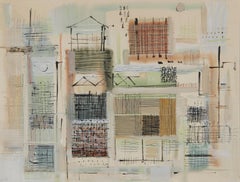
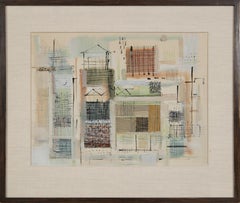
Portrait of Woman with Fuchsia, Early 20th Century Still Life

Portrait of Woman with Fuchsia, Early 20th Century Still Life

By Clarence Holbrook Carter

Located in Beachwood, OH

Clarence Holbrook Carter (American, 1904-2000) Woman with FUCHSIA, 1935 Oil on canvas Signed and dated lower right 31.75 x 27 inches 37 x 32.25 inches, framed Untitled Still Life ver...

Category

1930s American Modern Cleveland
Materials

Oil

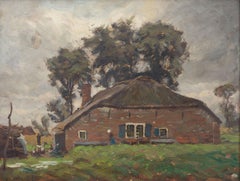
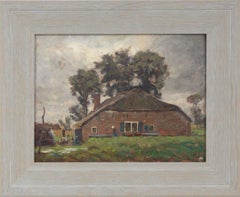
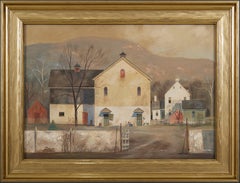
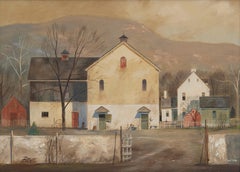
Dutch Farmyard, Pennsylvania Landscape w/ Houses and Mountains

Dutch Farmyard, Pennsylvania Landscape w/ Houses and Mountains

By Paul Riba

Located in Beachwood, OH

Paul Riba (American 1912-1977) Dutch Farmyard, Pennsylvania Tempera on board Signed lower right 9.75 x 14 inches 12.75 x 16.75 inches, framed Provenance: The Estate of Mary Clark Roc...

Category

Mid-20th Century Cleveland
Materials

Tempera

Early 20th Century Cowan Pottery Ceramic Sculpture of a Native American

Early 20th Century Cowan Pottery Ceramic Sculpture of a Native American

By F. Luis Mora

Located in Beachwood, OH

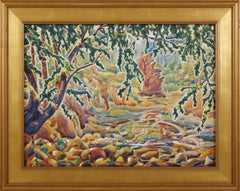
F. Luis Mora (American, 1874-1940) Native American, c. 1930s Ceramic Stamped on bottom, Cowan Pottery 9 x 7 x 5 inches Francis Luis Mora was one of the better-known American artists...

Category

1930s Cleveland
Materials

Ceramic

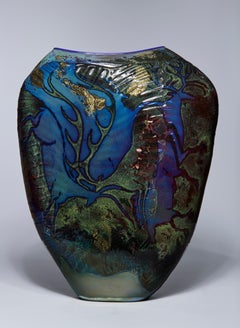
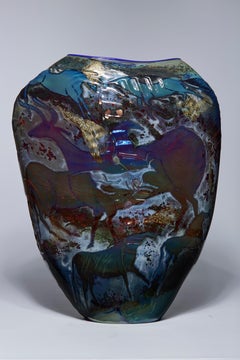
Petroglyph Vessel, Large Contemporary Figural Glass Blown Form

Petroglyph Vessel, Large Contemporary Figural Glass Blown Form

By William Morris (b. 1957)

Located in Beachwood, OH

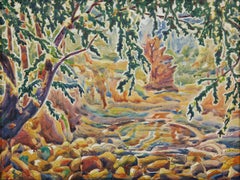
William Morris (American, b. 1957) Petroglyph Vessel Blown glass Signed on bottom 26 x 20 x 7 inches William Morris was born in Carmel, California in 1957. He is an American glass a...

Category

Late 20th Century Cleveland
Materials

Blown Glass

Western Mountainous Landscape, Slovenian-American Artist

Western Mountainous Landscape, Slovenian-American Artist

By Harvey Gregory Prusheck

Located in Beachwood, OH
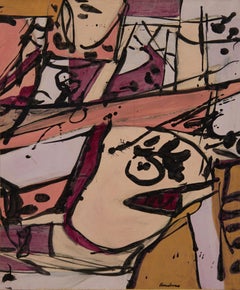
Harvey Gregory Prusheck (Slovenian/American, 1887-1940) Western Landscape Oil on board Monogram lower left 9.5 x 8 inches 11.75 x 10.5 inches, framed Harvey Gregory Prusheck was a S...

Category

Early 20th Century Cleveland

Materials

Oil

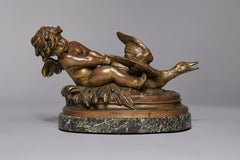
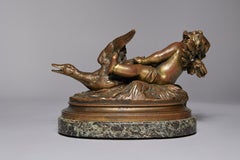
Tiffany & Co. 19th Century Bronze Cherub on Marble Base

Tiffany & Co. 19th Century Bronze Cherub on Marble Base

Located in Beachwood, OH

Tiffany & Co. 19th Century Cherub Bronze on marble base Engraved on back of base Sculpture: 6 x 13.5 x 7 inches Overall: 7.5 x 15.5 x 9 inches Tiffany & Co. is an American luxury je...

Category

19th Century Cleveland

Materials

Marble, Bronze

Plowman, Brecksville, Ohio, Early 20th Century Farm Landscape, Cleveland School

Plowman, Brecksville, Ohio, Early 20th Century Farm Landscape, Cleveland School

By Frank Wilcox

Located in Beachwood, OH

Frank Nelson Wilcox (American, 1887–1964) Plowman, Brecksville, Ohio, c. 1922 Watercolor on paper Signed lower right 22.5 x 27.75 inches 27.75 x 34.5 inches, framed Frank Nelson Wilcox (October 3, 1887 – April 17, 1964) was a modernist American artist and a master of watercolor. Wilcox is described as the "Dean of Cleveland School painters," though some sources give this appellation to Henry Keller or Frederick Gottwald. Wilcox was born on October 3, 1887 to Frank Nelson Wilcox, Sr. and Jessie Fremont Snow Wilcox at 61 Linwood Street in Cleveland, Ohio. His father, a prominent lawyer, died at home in 1904 shortly before Wilcox' 17th birthday. His brother, lawyer and publisher Owen N. Wilcox, was president of the Gates Legal Publishing Company or The Gates Press. His sister Ruth Wilcox was a respected librarian. In 1906 Wilcox enrolled from the Cleveland School of Art under the tutelage of Henry Keller, Louis Rorimer, and Frederick Gottwald. He also attended Keller's Berlin Heights summer school from 1909. After graduating in 1910, Wilcox traveled and studied in Europe, sometimes dropping by Académie Colarossi in the evening to sketch the model or the other students at their easels, where he was influenced by French impressionism. Wilcox was influenced by Keller's innovative watercolor techniques, and from 1910 to 1916 they experimented together with impressionism and post-impressionism. Wilcox soon developed his own signature style in the American Scene or Regionalist tradition of the early 20th century. He joined the Cleveland School of Art faculty in 1913. Among his students were Lawrence Edwin Blazey, Carl Gaertner, Paul Travis, and Charles E. Burchfield. Around this time Wilcox became associated with Cowan Pottery. In 1916 Wilcox married fellow artist Florence Bard, and they spent most of their honeymoon painting in Berlin Heights with Keller. They had one daughter, Mary. In 1918 he joined the Cleveland Society of Artists, a conservative counter to the Bohemian Kokoon Arts Club, and would later serve as its president. He also began teaching night school at the John Huntington Polytechnic Institute at this time, and taught briefly at Baldwin-Wallace College. Wilcox wrote and illustrated Ohio Indian Trails in 1933, which was favorably reviewed by the New York Times in 1934. This book was edited and reprinted in 1970 by William A. McGill. McGill also edited and reprinted Wilcox' Canals of the Old Northwest in 1969. Wilcox also wrote, illustrated, and published Weather Wisdom in 1949, a limited edition (50 copies) of twenty-four serigraphs (silk screen prints) accompanied by commentary "based upon familiar weather observations commonly made by people living in the country." Wilcox displayed over 250 works at Cleveland's annual May Show. He received numerous awards, including the Penton Medal for The Omnibus, Paris (1920), Fish Tug on Lake Erie (1921), Blacksmith Shop (1922), and The Gravel Pit (1922). Other paintings include The Trailing Fog (1929), Under the Big Top (1930), and Ohio Landscape...

Category

1920s American Modern Cleveland

Materials

Watercolor

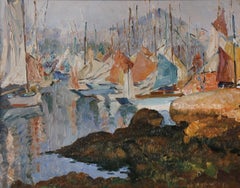
Early 20th Century Harbor Scene Seascape/Landscape Painting

Early 20th Century Harbor Scene Seascape/Landscape Painting

By Abel Warshawsky

Located in Beachwood, OH

Abel Warshawsky, American (1883-1962) Harbor Scene Oil on Canvas Signed lower right 13 x 16.25 canvas 17 x 20 inches framed Early 20th Century Harbor Scene Seascape/Landscape Pain...

Category

Early 20th Century American Impressionist Cleveland

Materials

Oil

Reflections, large abstract expressionist painting by Cleveland School artist

Reflections, large abstract expressionist painting by Cleveland School artist

By Richard Andres

Located in Beachwood, OH

Richard Andres American, 1927-2013 Reflections, 1985 acrylic and ink on paper mounted on canvas signed lower right, signed, dated and titled verso 52.5 x 72.5 inches 53 x 73 inches, ...

Category

1980s Abstract Expressionist Cleveland

Materials

Ink, Acrylic

Early 20th Century Summer Landscape, Cleveland School Artist

Early 20th Century Summer Landscape, Cleveland School Artist

By George Adomeit

Located in Beachwood, OH

George Gustav Adomeit (American, 1879-1967) Summer Landscape Oil on canvas board Signed lower right 13 x 14.25 inches 18.25 x 19.5 inches, framed A major painter of American scene s...

Category

Early 20th Century American Modern Cleveland

Materials

Oil

19th Century Bronze Figure of Crouching Venus or Naked Aphrodite

19th Century Bronze Figure of Crouching Venus or Naked Aphrodite

Located in Beachwood, OH

19th Century Bronze Figure of Crouching Venus or Naked Aphrodite Bronze with dark patination 22.5 x 13 x 11 inches The Crouching Venus is a Hellenisti...

Category

19th Century Cleveland

Materials

Bronze

When the Lights Go On Again, Mid Century Cast Stone, Cleveland School Artist

When the Lights Go On Again, Mid Century Cast Stone, Cleveland School Artist

By Walter Sinz 1

Located in Beachwood, OH

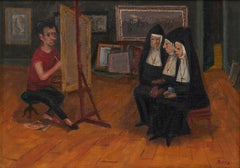
Walter Sinz (American, 1881-1966) When the Lights Go On Again, 1943 Cast Stone 10 x 4.5 x 8 inches Walter A. Sinz was an American sculptor born in Cleveland, Ohio on July 13, 1881. ...

Category

1940s Cleveland
Materials

Cast Stone

Winter Scene, Chrudim, Czech Republic Impressionist Landscape

Winter Scene, Chrudim, Czech Republic Impressionist Landscape

Located in Beachwood, OH

Václav Radimský (Czech, 1867-1946) Winter Scene, Chrudim, 1920 Oil on board Signed lower left 23.5 x 36.25 inches Václav Jan Emanuel Radimský was a Czech impressionist painter who r...

Category

1920s Impressionist Cleveland

Materials

Oil

Fiesta, c. 1973, red, yellow & blue figurative abstract lithograph

Fiesta, c. 1973, red, yellow & blue figurative abstract lithograph

By Alexander Calder

Located in Beachwood, OH

Alexander Calder (American, 1898-1976) Fiesta, c. 1973 Lithograph in colors Signed lower right Edition: E. A. 20 x 28 inches 35.5 x 37.75 inches, framed One of America's best known ...

Category

1970s Modern Cleveland

Materials

Lithograph

Large Floral Still Life, Flowers in Vase, 20th Century Italian-American Artist

Large Floral Still Life, Flowers in Vase, 20th Century Italian-American Artist

By Louis Bosa

Located in Beachwood, OH

Louis Bosa (American, 1905-1981) Floral Still Life Oil on canvas Signed lower right 32 x 20 inches 43 x 31 inches, framed Born in Codroipo, a small village only a few miles from Ven...

Category

20th Century Cleveland

Materials

Oil

Solid Gold Triangle Ring Revolution

Solid Gold Triangle Ring Revolution

By Wesley Kloss Fine Jewelry

Located in Cleveland, OH

The Revolution Triangle ring gracefully cycles from a lower circular band to a triangular  top and back again. As the classic rounded base evolves into a...

Category

2010s American Contemporary Cleveland

Materials

14k Gold

Early 20th Century Ceramic Sculpture of a Polo Player and Horse

Early 20th Century Ceramic Sculpture of a Polo Player and Horse

By Waylande Gregory

Located in Beachwood, OH

Waylande Gregory (American, 1905-1971) Polo Player, c. 1930s Ceramic Inscribed signature on bottom 11 x 8.5 inches Waylande Gregory was considered a major American sculptor during the 1930's, although he worked in ceramics, rather than in the more traditional bronze or marble. Exhibiting his ceramic works at such significant American venues for sculpture as the Whitney Museum of American Art in New York City and at the venerable Pennsylvania Academy of the Fine Arts in Philadelphia, he also showed his ceramic sculptures at leading New York City galleries. Gregory was the first modern ceramist to create large scale ceramic sculptures, some measuring more than 70 inches in height. Similar to the technique developed by the ancient Etruscans, he fired his monumental ceramic sculptures only once. Gregory was born in 1905 in Baxter Springs, Kansas and was something of a prodigy. Growing up on a ranch near a Cherokee reservation, Gregory first became interested in ceramics as a child during a native American burial that he had witnessed. He was also musically inclined. In fact, his mother had been a concert pianist and had given her son lessons. At eleven, he was enrolled as a student at the Kansas State Teacher's College, where he studied carpentry and crafts, including ceramics. Gregory's early development as a sculptor was shaped by the encouragement and instruction of Lorado Taft, who was considered both a major American sculptor as well as a leading American sculpture instructor. In fact, Taft's earlier students included such significant sculptors as Bessie Potter Vonnoh and Janet Scudder. But, Taft and his students had primarily worked in bronze or stone, not in clay; and, Gregory's earliest sculptural works were also not in ceramics. In 1924, Gregory moved to Chicago where he caught the attention of Taft. Gregory was invited by Taft to study with him privately for 18 months and to live and work with him at his famed "Midway Studios." The elegant studio was a complex of 13 rooms that overlooked a courtyard. Taft may have been responsible for getting the young man interested in creating large scale sculpture. However, by the 1920's, Taft's brand of academic sculpture was no longer considered progressive. Instead, Gregory was attracted to the latest trends appearing in the United States and Europe. In 1928 he visited Europe with Taft and other students. "Kid Gregory," as he was called, was soon hired by Guy Cowan, the founder of the Cowan Pottery in Cleveland, Ohio, to become the company's only full time employee. From 1928 to 1932, Gregory served as the chief designer and sculptor at the Cowan Pottery. Just as Gregory learned about the process of creating sculpture from Taft, he literally learned about ceramics from Cowan. Cowan was one of the first graduates of Alfred, the New York School of Clayworking and Ceramics. Alfred had one of the first programs in production pottery. Cowan may have known about pottery production, but he had limited sculptural skills, as he was lacking training in sculpture. The focus of the Cowan Pottery would be on limited edition, table top or mantle sculptures. Two of the most successful of these were Gregory's "Nautch Dancer," (fig. 1) and his "Burlesque Dancer," (fig. 2). He based both sculptures on the dancing of Gilda Gray, a Ziegfield Follies girl. Gilda Gray was of Polish origin and came to the United States as a child. By 1922, she would become one of the most popular stars in the Follies. After losing her assets in the stock market crash of 1929, she accepted other bookings outside of New York, including Cleveland, which was where Gregory first saw her onstage. She allowed Gregory to make sketches of her performances from the wings of the theatre. She explained to Gregory, "I'm too restless to pose." Gray became noted for her nautch dance, an East Indian folk dance. A nautch is a tight, fitted dress that would curl at the bottom and act like a hoop. This sculpture does not focus on Gray's face at all, but is more of a portrait of her nautch dance. It is very curvilinear, really made of a series of arches that connect in a most feminine way. Gregory created his "Burlesque Dancer" at about the same time as "Nautch Dancer." As with the "Nautch Dancer," he focused on the movements of the body rather than on a facial portrait of Gray. Although Gregory never revealed the identity of his model for "Burlesque Dancer," a clue to her identity is revealed in the sculpture's earlier title, "Shimmy Dance." The dancer who was credited for creating the shimmy dance was also Gilda Gray. According to dance legend, Gray introduced the shimmy when she sang the "Star Spangled Banner" and forgot some of the lyrics, so, in her embarrassment, started shaking her shoulders and hips but she did not move her legs. Such movement seems to relate to the "Burlesque Dancer" sculpture, where repeated triangular forms extend from the upper torso and hips. This rapid movement suggests the influence of Italian Futurism, as well as the planar motion of Alexander Archipenko, a sculptor whom Gregory much admired. The Cowan Pottery was a victim of the great depression, and in 1932, Gregory changed careers as a sculptor in the ceramics industry to that of an instructor at the Cranbrook Academy in Bloomfield Hills, Michigan. Cranbrook was perhaps the most prestigious place to study modern design in America. Its faculty included the architect Eliel Saarinen and sculptor Carl Milles. Although Gregory was only at Cranbrook for one and one half years, he created some of his finest works there, including his "Kansas Madonna" (fig. 3). But, after arriving at Cranbrook, the Gregory's had to face emerging financial pressures. Although Gregory and his wife were provided with complimentary lodgings, all other income had to stem from the sale of artworks and tuition from students that he, himself, had to solicit. Gregory had many people assisting him with production methods at the Cowan Pottery, but now worked largely by himself. And although he still used molds, especially in creating porcelain works, many of his major new sculptures would be unique and sculpted by hand, as is true of "Kansas Madonna." The scale of Gregory's works were getting notably larger at Cranbrook than at Cowan. Gregory left the surface of "Kansas Madonna" totally unglazed. Although some might object to using a religious title to depict a horse nursing its colt, it was considered one of Gregory's most successful works. In fact, it had a whole color page illustration in an article about ceramic sculpture titled, "The Art with the Inferiority Complex," Fortune Magazine, December, 1937. The article notes the sculpture was romantic and expressive and the sculpture was priced at $1,500.00; the most expensive sculpture in the article. Gregory was from Kansas, and "Kansas Madonna" should be considered a major sculptural document of Regionalism. Gregory and his wife Yolande moved to New Jersey in the summer of 1933. And the artist began construction on his new home in the Watchung Mountains of Bound Brook (Warren today) in 1938. His enormous, custom kiln was probably constructed at the start of 1938. Gregory's new sculptures were the largest ceramic sculptures in western art, in modern times. To create these works of ceramic virtuosity, the artist developed a "honeycomb" technique, in which an infrastructure of compartments was covered by a ceramic "skin." Science and atomic energy were a theme in Gregory's most significant work, the "Fountain of the Atom" (fig. 4), at the 1939 New York's World Fair. This major work included twelve monumental ceramic figures at the fairground entrance from the newly constructed railway entrance, giving the work great visibility and prominence. The framework of the fountain itself was of steel and glass bricks. It consisted of a bluish green pool which was sixty five feet in diameter. Above it were two concentric circular tiers, or terraces, as Gregory called them; the first wider than the second. On the first terrace were eight "Electrons," comprised of four male and four female terra cotta figures, each approximately 48 inches high. These relate to the valance shell of the atom. Above them on a narrower terrace, were the much larger and heavier terra cotta figures depicting the four elements, each averaging about 78 inches in height and weighing about a ton and a half. Of the four, "Water" and "Air" were male, while "Earth" and "Fire" were female. This terrace represents the nucleus of the atom. In the center of the fountain, above the "Elements," was a central shaft comprised of sixteen glass tubes from which water tumbled down from tier to tier. At the top, a colorful flame burned constantly. The glass block tiers were lit from within, the whole creating a glowing and gurgling effect. Since the fair was temporary, the figures could be removed after its closing. But the credit for the design of the structure of the fountain belongs to collaborator Nembhard Culin, who was responsible for several other structures on the fair grounds as well. Although Gregory created a figure of "Fire" for the "Fountain of the Atom," he also executed a second, slightly smaller but more defined version which he exhibited at various locations (including Cranbrook, Baltimore Museum, etc.) in 1940-1941, during the second year of the fair (fig.5). Measuring 61 inches in height, "Fire" may be a metaphor for sexual energy, as well as atomic energy. Gregory stated, "Fire is represented by an aquiline female figure being consumed in endless arabesques of flame." Portraiture was also a significant focus of Gregory's sculpture. Gregory produced many commissioned portraits of local people as well as celebrities. He created Albert Einstein's portrait from life (fig. 6, ca. 1940) after Einstein had seen Gregory's "Fountain of the Atom." He also sculpted some of the leading figures in entertainment, including 2 sculptures of Henry Fonda, who became a personal friend. Gregory also sculpted a series of idealized female heads, both in terra cotta and in porcelain. These include "Girl with Olive" (ca. 1932) and "Cretan Girl;"(ca. 1937) both are very reductive and almost abstract works that call to mind Constantine Brancusi's "Mademoiselle Pogany" (1912, Philadelphia Museum of Art). But perhaps one of his most original female heads is "Head of a Child" (fig. 7, ca. 1933), a sensitive white glazed terra cotta portrayal with elaborately crafted braded hair, was originally created as one of a pair. Gregory also produced sculptural works for the Works Progress Administration. The WPA was a work relief project that greatly helped artists during the great depression. Founded by the Federal Government in 1935, an estimated 2500 murals were produced. Among these public works were the iconic post office murals. But, among the painted murals were also sculptural relief murals including Gregory's "R.F.D.," 1938, for the Columbus, Kansas Post Office. But, Gregory's largest WPA relief...

Category

1930s Cleveland
Materials

Ceramic

Sailing, Large Abstract Expressionist Mid-Century Oil, Cleveland Artist
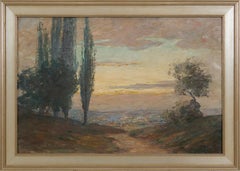
Sailing, Large Abstract Expressionist Mid-Century Oil, Cleveland Artist
By Richard Andres

Located in Beachwood, OH

Richard Andres (American, 1927–2013) Sailing, 1973 oil on canvas signed lower right, signed and titled verso 58 x 72 inches Exhibited: Cleveland Museum of Art, May Show 1973 Richard...
Category

1970s Abstract Expressionist Cleveland
Materials

Oil

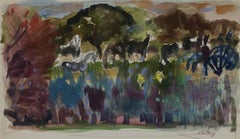
20th century abstract expressionist oil painting by Cleveland School artist
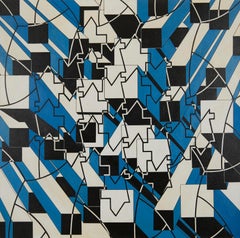
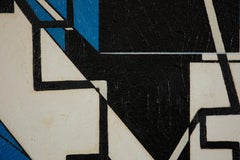
20th century abstract expressionist oil painting by Cleveland School artist
By Richard Andres

Located in Beachwood, OH

Richard Andres American, 1927-2013 Untitled, c. 1980 acrylic and ink on paper mounted on canvas signed lower right 24 x 20 inches 25 x 21 inches, framed Note: Minor abrasion on lowe...
Category

1980s Abstract Expressionist Cleveland

Materials

Ink, Acrylic

High Pastures, Cattle Round Up, Wyoming, 20th Century Western Landscape

High Pastures, Cattle Round Up, Wyoming, 20th Century Western Landscape

By Frank Wilcox

Located in Beachwood, OH

Frank Nelson Wilcox (American, 1887–1964) High Pastures, Cattle Round Up, Wyoming, 1937 Watercolor on paper Signed and dated lower right, titled verso 15 x 20 inches 18.5 x 24 inche...

Category

1930s American Modern Cleveland

Materials

Watercolor

Houses in Zoar, Ohio Landscape, Early 20th Century Cleveland School

Houses in Zoar, Ohio Landscape, Early 20th Century Cleveland School

By August F. Biehle

Located in Beachwood, OH

August Frederick Biehle (1885-1979) Houses in Zoar, c. 1921 Gouache, litho crayon, colored pencil and graphite on paper Signed lower right 14 x 19 inches 20.25 x 25.25 inches, framed...

Category

1920s American Modern Cleveland

Materials

Crayon, Gouache, Color Pencil, Graphite

1940 Large Portrait of a Woman, Kae Dorn Cass, by Cleveland School Artist

1940 Large Portrait of a Woman, Kae Dorn Cass, by Cleveland School Artist

By Rolf Stoll

Located in Beachwood, OH

Rolf Stoll (American, 1892-1978) Kae Dorn Cass, 1940 Oil on canvas Signed upper right 32 x 25 inches 38 x 31 inches, framed Exhibited: The 27th Annual May Show, Cleveland Museum of Art, Cleveland, OH, 1940 This work won first prize for oil painting- Portrait category Provenance: Collection of Kae Dorn Cass's niece Kae Dorn Cass Rolf Stoll Rolf Stoll, a painter of figure subjects, landscapes and floral still lifes, was an important member of the Cleveland art scene during the second quarter of the century. He was also an influential teacher, as well as one of Ohio’s foremost portrait painters. Rolf Stoll was born in Heidelberg, Germany, in 1892. As a boy, he attended a military academy, during which time he developed an interest in art. He received his early formal training at the Academy of Fine Arts in Karlsruhe and at the Academy of Fine Arts in Stuttgart. He emigrated to the United States in 1912, settling in New York City. A decade later, after studying at the school of the National Academy of Design and supporting himself by working as a commercial artist, Stoll decided to leave New York. Upon the recommendation of Warren Pryor, one of his teachers, he decided to move to Cleveland, Ohio. After arriving in Cleveland, Rolf Stoll continued to work as a commercial artist. However, in 1926, he joined the faculty of the Cleveland School of Art, where he taught drawing. Two years later Stoll was appointed head of the school’s portrait painting department. A talented portraitist, Stoll’s sitters included industrialists, community leaders and many prominent members of Cleveland and Ohio society, as well as over twenty faculty members from Case Western Reserve University. Stoll also gave portrait classes at the John Huntington Polytechnic Institute from 1926 to 1953. In his male portraits especially, he was admired for his ability to convey the dignity of his sitter’s professional position without sacrificing individuality. As noted by one contemporary reviewer, Stoll was a “master of rich color, a searching student of human types, a forceful portrayer of all that the face reveals of the mind and the soul.” In addition to his activity as a portraitist, Rolf Stoll painted figure subjects and floral still lifes. He was also known for his views of the Ohio countryside...

Category

1940s Cleveland

Materials

Oil

Early 20th Century Landscape with Covered Bridge, Female Cleveland School Artist

Early 20th Century Landscape with Covered Bridge, Female Cleveland School Artist

By May Ames

Located in Beachwood, OH

May Lydia Ames (American, 1863-1943) Landscape with Covered Bridge Oil on canvas Signed lower left 9.75 x 8 inches 14.5 x 13 inches, framed May Ames was born in Cleveland in 1863 an...

Category

Early 20th Century American Impressionist Cleveland

Materials

Oil

Four Three Two One, 21st Century Contemporary Surrealist Ceramic Sculpture

Four Three Two One, 21st Century Contemporary Surrealist Ceramic Sculpture

By Kristen Newell

Located in Beachwood, OH

Kristen Newell (American, b. 1989) Four Three Two One, 2015 Stoneware, porcelain and acrylic Signed and dated on bottom 16 x 15 x 14 inches Kristen Newell was born in a small town on the coast of Massachusetts, where from a very early age, she demonstrated a strong propensity for the arts. Important additional inspiration came from her family and from the family of a childhood friend, where Kristen found herself surrounded by the work of Paul Manship, her friend’s grandfather and one of America’s greatest sculptors. With increased focus on her art, along with winning numerous awards throughout high school, Newell eagerly enrolled in the arts program at University of Vermont and augmented her studies with a valuable year at the Cleveland Institute of Art. Upon graduation, Newell moved back to Cleveland to begin her art career and started participating in group shows, including River Gallery and the Ohio State...

Category

2010s Contemporary Cleveland

Materials

Porcelain, Stoneware, Acrylic

Crusader, Large Abstract Expressionist Painting, Cleveland School Artist

Crusader, Large Abstract Expressionist Painting, Cleveland School Artist

By Richard Andres

Located in Beachwood, OH

Richard Andres (American, 1927-2013) Crusader, c. 1969 acrylic on canvas signed and titled verso 48.5 X 62.5 inches Richard Andres was born in Buffalo, New York in 1927. A graduate ...

Category

1960s Abstract Expressionist Cleveland

Materials

Acrylic

Abstract Floral Still Life, 20th Century Cleveland School Artist

Abstract Floral Still Life, 20th Century Cleveland School Artist

By August Biehle

Located in Beachwood, OH

August Frederick Biehle (American, 1885-1979) Abstract Floral Still Life Watercolor and pencil on paper Signed lower right 24 x 19 inches 29.5 x 24.5 inches, framed A versatile pain...

Category

Mid-20th Century American Modern Cleveland

Materials

Watercolor, Pencil

The Luxembourg Gardens, Paris, Early 20th Century Impressionist Landscape

The Luxembourg Gardens, Paris, Early 20th Century Impressionist Landscape

By Abel Warshawsky

Located in Beachwood, OH

Abel Warshawsky (American, 1883-1962) The Luxembourg Gardens, Paris, 1909 Oil on panel Signed and dated lower right, titled verso 8.5 x 10.5 inches 13.75 x 16 inches, framed Impressionist painter A.G. Warshawsky was active in Cleveland, Paris and Monterey, California. Although Warshawsky is known as a classic Impressionist, he is also known for using a realistic style in his portraiture. Warshawsky was born in 1883 in Sharon, Pennsylvania to Ezekial and Ida Warshawsky, Jewish immigrants from Poland. The family then moved to Cleveland, Ohio. His brother Alexander (Xander) also became an accomplished painter in his own right. Warshawsky graduated from the Cleveland School of Art in 1900, taught by Louis Rorimer...

Category

Early 1900s Impressionist Cleveland

Materials

Oil