672 results for "ellsworth kelly"

to
322
611
51
69
82
413
153
84
357
145
57
51
62
Overall Height
to
Overall Width
to
125
112
97
89
87
44
13
3
71
39
36
20
16
16
14
13
11
10
9
9
9
9
9
8
8
7
7
6
474
198
8
8
3
64
190
99
55
18
60
51
46
27
19
366
160
133
133
109
Tease 3 (Abstract Painting)

Tease 3 (Abstract Painting)

By Holly Miller

Located in London, GB

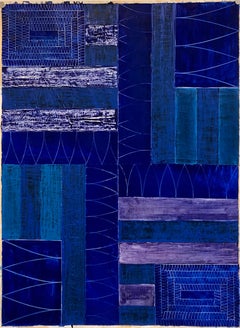
Tease 3 (Abstract Painting) Acrylic and thread on canvas - Unframed The threaded lines suggest a physical barrier that interrupts the shapes and stops them from connecting and at t...

Category

2010s Minimalist Abstract Paintings

Materials

Canvas, Thread, Acrylic

Floating Bust, Brazil, 1997

Floating Bust, Brazil, 1997

By Barnaby Hall

Located in Hudson, NY

ABOUT After 30 years of only exhibiting fine art photography, the Robin Rice Gallery is pleased to present a group exhibition featuring a selection of her gallery photographers and three visual artists new to the space: Erica Hauser, and Matt Kinney. The selected works of these well-established Beacon, NY artists blend with the gallery’s fine art photography. Upon entering the gallery, viewers will encounter figurative sculptures, abstract paintings, and ink wash drawings alongside fine art photography. Since Robin Rice’s move to Beacon, NY, this concept developed organically; the group exhibition is a fusion of artistic mediums inspired by chance encounters between Rice and friends at art events in Beacon. After spending time with creatives who've spent lockdown in studios, Rice carefully chose works most apropos with her edited inventory of framed photography. Through these chance encounters Rice found inspiration to create this exhibition unlike anything seen before at the gallery and curated an immersive experience. Maintaining her expert aesthetic, Rice has brought together a mosaic of mediums that seamlessly fit together like pieces of a puzzle. Kinney's collection of ink wash paintings in Japanese Sumi ink and watercolor paintings on hand-torn paper render fleeting glimpses of figures and animals as well as primal symbols. Tasmania Spiral is a hypnotic work that resembles a gyre. Also in focus is Hauser’s collection of abstract paintings featuring an alluring vintage color palette...

Category

2010s Contemporary Black and White Photography

Materials

Archival Pigment

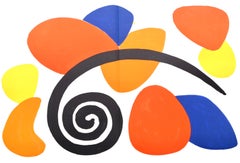
Alexander Calder, Composition with Spirals, from Derriere le miroir, 1968

Alexander Calder, Composition with Spirals, from Derriere le miroir, 1968

By Alexander Calder

Located in Southampton, NY

This exquisite lithograph by Alexander Calder (1898–1976), titled Composition aux Spirales (Composition with Spirals), from the folio Derriere le miroir, No. 173, originates from the 1968 edition published by Maeght Editeur, Paris, and printed by Mourlot Freres, Paris, 1968. Composition aux Spirales exemplifies Calder’s mastery of rhythm and form, translating his sculptural language of balance and motion into vivid, dynamic compositions on paper that capture his signature sense of energy and harmony. Executed as a lithograph on velin paper, this work measures 15 x 22 inches, with centerfold, as issued. Unsigned and unnumbered as issued. The edition exemplifies the superb craftsmanship of Mourlot Freres, Paris. Artwork Details: Artist: Alexander Calder (1898–1976) Title: Composition aux Spirales (Composition with Spirals), from the folio Derriere le miroir, No. 173 Medium: Lithograph on velin paper Dimensions: 15 x 22 inches (38.1 x 55.88 cm), with centerfold, as issued Inscription: Unsigned and unnumbered as issued Date: 1968 Publisher: Maeght Editeur, Paris Printer: Mourlot Freres, Paris Condition: Well preserved, consistent with age and medium Provenance: From the folio Derriere le miroir, No. 173, published by Maeght Editeur, Paris; printed by Mourlot Freres, Paris, 1968 Notes: Excerpted from the folio (translated from French), The illustrations in this issue are original lithographs by Alexander Calder drawn in the workshops of the Arte printing shop. This issue of "Behind the Mirror" has a luxury edition drawn on velin de Lana and limited to CL examples numbered and signed by the artist on the colophon. The text of G. Carandente was translated from Italian by Alain Veinstein. About the Publication: Derriere le miroir (Behind the Mirror) was one of the most important art publications of the 20th century, created and published by Maeght Editeur in Paris from 1946 to 1982. Founded by the visionary art dealer and publisher Aime Maeght, the series served as both an exhibition catalogue and a work of art in its own right, uniting original lithographs by leading modern and contemporary artists with critical essays, poetry, and design of the highest quality. Printed by master lithographers such as Mourlot Freres and Arte, Derriere le miroir became synonymous with the artistic vanguard of postwar Europe. Each issue was devoted to a single artist or theme and published to accompany exhibitions at the Galerie Maeght in Paris, featuring works by Pablo Picasso, Henri Matisse, Georges Braque, Joan Miro, Marc Chagall, Alexander Calder, Fernand Leger, and Alberto Giacometti, among others. The publication reflected Maeght’s belief that art should be both accessible and elevated—an ideal realized through its luxurious production values, meticulous printing, and collaboration with the greatest creative minds of its time. About the Artist: Alexander Calder (1898–1976) was an American sculptor, painter, and printmaker whose pioneering innovations in kinetic art revolutionized 20th-century sculpture and transformed modern visual language. Born in Lawnton, Pennsylvania, into a family of artists, Calder initially trained as a mechanical engineer at the Stevens Institute of Technology before turning to art at the Art Students League in New York—a combination of technical precision and creative imagination that defined his career. Moving to Paris in 1926, he immersed himself in the avant-garde and formed friendships with Pablo Picasso, Alberto Giacometti, Joan Miro, Wassily Kandinsky, Salvador Dali, Marcel Duchamp, and Man Ray, whose ideas profoundly shaped his artistic philosophy. From Picasso, he absorbed structural invention; from Miro, lyrical abstraction; from Kandinsky, spiritual geometry; and from Duchamp and Man Ray, the courage to merge intellect and play. In Paris, Calder created his famous Cirque Calder, a miniature mechanical circus that introduced motion and performance as central components of sculpture, and by the early 1930s, he invented the mobile—a term coined by Duchamp—to describe his delicately balanced, moving sculptures that responded to air currents. Later, Jean Arp would name his stationary counterparts stabiles. These two inventions—sculptures that could either float and spin gracefully or stand monumentally still—transformed art into a dynamic dialogue between movement, balance, and space. Calder’s signature forms, painted in vivid reds, blacks, blues, and yellows, embodied both joy and precision, creating an art that was at once abstract, organic, and deeply human. Like Kandinsky and Miro, he viewed art as a form of rhythm and emotion; like Duchamp, he embraced innovation and humor; and like Giacometti and Dali, he was fascinated by perception, structure, and the unseen forces of motion. His monumental public sculptures—such as La Grande Vitesse (1969) in Grand Rapids and Flamingo (1973) in Chicago—redefined public art as a symbol of civic optimism and modern progress. A key bridge between European modernism and American abstraction, Calder’s influence extended to artists including Jean Tinguely, George Rickey, Donald Judd, Ellsworth Kelly, Richard Serra, and Olafur Eliasson, whose works in kinetic and spatial art continue to echo his vision. His gouaches, prints, and jewelry carried the same balance and movement as his sculptures, revealing a unified language of rhythm across media. Represented in every major modern museum—including MoMA, the Guggenheim, the Tate, and the Centre Pompidou—Calder remains celebrated for merging engineering, color, and poetry into an art of pure equilibrium. Standing alongside Pablo Picasso, Alexander Calder, Alberto Giacometti, Salvador Dali, Joan Miro, Wassily Kandinsky, Marcel Duchamp, and Man Ray, he remains one of the cornerstones of modern art—a visionary whose works breathe with motion, grace, and joy. His highest auction record was achieved by Poisson Volant (Flying Fish) (1957), which sold for $25.9 million at Christie’s, New York, on May 15, 2014, reaffirming Alexander Calder’s enduring legacy as one of the most inventive, dynamic, and collectible artists in the history of modern art. Alexander Calder Composition...

Category

1960s Surrealist Abstract Prints

Materials

Lithograph

Alexander Calder lithograph Derrière le miroir (Calder prints)

Alexander Calder lithograph Derrière le miroir (Calder prints)

By Alexander Calder

Located in NEW YORK, NY

Alexander Calder Lithograph c. 1971 from Derrière le miroir: Lithograph in colors; 15 x 11 inches. Very good overall vintage condition; well-preseved. Unsigned from an edition of un...

Category

1970s Pop Art Prints and Multiples

Materials

Lithograph

Alexander Calder Lithographic cover Derrière le miroir 1973

Alexander Calder Lithographic cover Derrière le miroir 1973

By Alexander Calder

Located in NEW YORK, NY

Alexander Calder Lithographic cover: Derrière le miroir 1973: Lithographic cover sheet; 15 x 11 inches. Very good overall vintage condition. Unsigned from an edition of unknown. Por...

Category

1970s Modern Figurative Prints

Materials

Lithograph

Hiccup (Abstract Painting)

Hiccup (Abstract Painting)

By Holly Miller

Located in London, GB

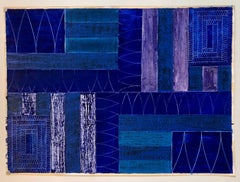
Hiccup (Abstract Painting) Acrylic and thread on canvas - Unframed The threaded lines suggest a physical barrier that interrupts the shapes and stops them from connecting and at th...

Category

2010s Minimalist Abstract Paintings

Materials

Canvas, Thread, Acrylic

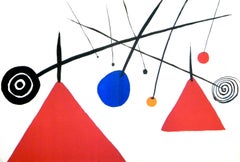
Alexander Calder, Two Pyramids and Spirals, from Derriere le miroir, 1954

Alexander Calder, Two Pyramids and Spirals, from Derriere le miroir, 1954

By Alexander Calder

Located in Southampton, NY

This exquisite lithograph by Alexander Calder (1898–1976), titled Deux pyramides et spirales (Two Pyramids and Spirals), from the folio Derriere le miroir, No. 69–70, originates from...

Category

1950s Modern Abstract Prints

Materials

Lithograph

Abstract, Joan Miro, lithograph, 1973, Sobreteixims I

Abstract, Joan Miro, lithograph, 1973, Sobreteixims I

By Joan Miró

Located in Fairlawn, OH

Sobreteixims I Color lithograph, 1973 Unsigned (as issued) From: Derrière le Miroir, No. 203. Large edition Published by Maeght Éditeur, Paris Lithographs printed by Lourlot, Paris P...

Category

1970s Abstract Abstract Prints

Materials

Lithograph

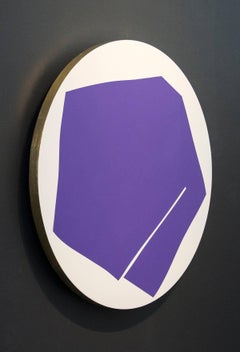
Round Violet with 1 Line - colourful, gold leaf edge, tondo acrylic on panel

Round Violet with 1 Line - colourful, gold leaf edge, tondo acrylic on panel

By Aron Hill

Located in Bloomfield, ON

In this dynamic work by Aron Hill, a deep violet geometric shape sits against a white tondo (circle) framed by a black canvas. The round panel is rimmed in gold leaf which casts a h...

Category

2010s Abstract Abstract Paintings

Materials

Gold Leaf

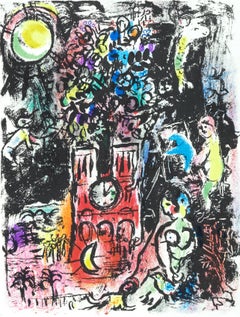
Marc Chagall, The Tree of Jesse, from Derriere le Miroir, 1960

Marc Chagall, The Tree of Jesse, from Derriere le Miroir, 1960

By Marc Chagall

Located in Southampton, NY

This exquisite lithograph by Marc Chagall (1887–1985), titled L’Arbre de Jesse (The Tree of Jesse), originates from the 1960 folio Derriere le Miroir, No. 119, Poetes, peintres, sculpteurs (Poets, Painters, Sculptors), published by Maeght Editeur, Paris, under the direction of Aime Maeght, and printed by Mourlot Freres, Paris. This lyrical composition exemplifies Chagall’s visionary fusion of faith, memory, and color, uniting biblical symbolism with the artist’s poetic sensibility. In L’Arbre de Jesse, Chagall reimagines a sacred theme as a vibrant allegory of spiritual lineage, evoking the mystical harmony between heaven and earth that defines his most celebrated works. Executed on velin paper, this lithograph measures 15 x 11 inches (38.1 x 27.9 cm), as issued. Unsigned and unnumbered, as issued. The edition reflects the exceptional quality and craftsmanship of the Maeght and Mourlot collaborations, which brought Chagall’s radiant imagery to print with unparalleled fidelity. Artwork Details: Artist: Marc Chagall (1887–1985) Title: L’Arbre de Jesse (The Tree of Jesse), from Derriere le Miroir, No. 119, Poetes, peintres, sculpteurs (Poets, Painters, Sculptors), 1960 Medium: Lithograph on velin paper Dimensions: 15 x 11 inches (38.1 x 27.9 cm), as issued Inscription: Unsigned and unnumbered, as issued Date: 1960 Publisher: Maeght Editeur, Paris Printer: Mourlot Freres, Paris Catalogue raisonne references: Mourlot, Fernand, and Marc Chagall. “Chagall Lithographe, Volume II, 1957–1962.” Chagall Lithographe, Sauret, 1963, illustration 297. Cramer, Patrick, and Meret Meyer. Marc Chagall: Catalogue Raisonné Des Livres Illustrés. P. Cramer ed., 1995, illustration 40 Condition: Well preserved, consistent with age and medium Provenance: From the 1960 folio Derriere le Miroir, No. 119, Poetes, peintres, sculpteurs (Poets, Painters, Sculptors), published by Maeght Editeur, Paris About the Publication: Derriere le Miroir (translated as "Behind the Mirror") was an iconic French art periodical published from 1946 to 1982 by Maeght Editeur, one of the most influential art publishers of the 20th century. Founded by Aime Maeght in Paris, the publication was conceived as a visual and literary collaboration between leading modern artists, poets, and critics. Each issue functioned as both an exhibition catalogue and a work of art in itself—featuring original lithographs printed directly from the artists' stones or plates, alongside essays, poems, and critical commentary. Over the course of 36 years, Derriere le Miroir produced more than 250 issues and showcased an extraordinary roster of artists including Henri Matisse, Marc Chagall, Joan Miro, Georges Braque, Alexander Calder, Fernand Leger, Pierre Bonnard, Alberto Giacometti, Eduardo Chillida, Ellsworth Kelly, Francis Bacon, Paul Rebeyrolle, Claude Garache, Antoni Tapies, Bram van Velde, Pierre Alechinsky, Pol Bury, Shusaku Arakawa, and Gerard Titus-Carmel. Printed in the ateliers of Mourlot, Arte, and Imprimerie Moderne du Lion, the periodical set new standards for quality in color lithography, combining fine art printing with elegant typography and poetic text. Beyond its visual brilliance, Derriere le Miroir also became a cultural chronicle of postwar European modernism. Each issue coincided with exhibitions held at Galerie Maeght, providing a collectible and widely accessible record of groundbreaking shows. Its integration of image, text, and philosophy created a dialogue between art and literature that elevated the modern art book to new aesthetic heights. Today, Derriere le Miroir remains one of the most sought-after and historically significant art publications, prized by collectors and scholars alike for its craftsmanship, influence, and its role in defining the visual language of 20th-century modernism. The Maeght Foundation in Saint-Paul-de-Vence continues to honor this legacy through exhibitions and archival preservation of the series, affirming Derriere le Miroir's enduring place in the history of modern art and fine art publishing. About the Artist: Marc Chagall (1887–1985) was a Belarus-born French painter, printmaker, and designer whose visionary use of color and poetic symbolism made him one of the most beloved and influential artists of the 20th century. Rooted in the rich imagery of his Jewish heritage and childhood in Vitebsk, Chagall’s dreamlike compositions fused memory, folklore, faith, and romance with the expressive innovations of modern art. His work evolved alongside and in dialogue with the great modern masters—Pablo Picasso, Henri Matisse, Alexander Calder, Salvador Dali, Joan Miro, Georges Braque, Wassily Kandinsky, Marcel Duchamp, and Man Ray—artists who, like Chagall, redefined artistic language for a new century. Spanning painting, printmaking, stained glass, ceramics, stage design, and illustration, Chagall’s career reflected both his deep spirituality and his boundless imagination. His works are held in major museum collections worldwide, including the Museum of Modern Art, the Guggenheim, the Tate, and the Centre Pompidou. The highest price ever paid for a Marc Chagall artwork is approximately $28.5 million USD, achieved in 2017 at Sotheby’s New York for Les Amoureux (1928). Marc Chagall L’Arbre de Jesse, Chagall Derriere le Miroir, Chagall Maeght...

Category

1960s Expressionist Landscape Prints
Materials

Lithograph

Miro lithograph, Les Mans (The Hinds), Abstraction, 1971

Miro lithograph, Les Mans (The Hinds), Abstraction, 1971

By Joan Miró

Located in Fairlawn, OH

Les Mans (The Hinds) Color lithograph, 1971 Unsigned (as issued) From: Derrière le Miroir, No. 193-194, Peintures sur papier, dessins Large edition Published by Maeght Éditeur, Paris...

Category

1970s Abstract Abstract Prints

Materials

Lithograph

Edge (pink)
Edge (pink)

Edge (pink)

By Zack Smithey

Located in West Hollywood, CA

Zack Smithey’s Edge (Pink) operates at the intersection of geometric abstraction and fluid gesture, a tension that has shaped modern and contemporary art since the mid-20th century. ...

Category

21st Century and Contemporary Abstract Expressionist Abstract Paintings

Materials

Canvas, Oil, Acrylic

Eduardo Chillida, Correlation, from Derriere le Miroir, 1960

Eduardo Chillida, Correlation, from Derriere le Miroir, 1960

By Eduardo Chillida

Located in Southampton, NY

This exquisite lithograph by Eduardo Chillida (1924–2002), titled Correlation, originates from the 1960 folio Derriere le Miroir, No. 119, Poetes, peintres, sculpteurs (Poets, Painters, Sculptors), published by Maeght Editeur, Paris, under the direction of Aime Maeght, and printed by Mourlot Freres, Paris. Correlation exemplifies Chillida’s masterful exploration of form, space, and equilibrium, transforming abstract geometry into a meditative dialogue between line and void. The work reflects the artist’s enduring search for spiritual and structural balance within the material world. Executed on velin paper, this lithograph measures 15 x 11 inches (38.1 x 27.9 cm). Unsigned and unnumbered, as issued. The edition reflects the exceptional quality and craftsmanship of the Maeght and Mourlot collaborations, embodying Chillida’s refined aesthetic of sculptural abstraction translated into graphic form. Artwork Details: Artist: Eduardo Chillida (1924–2002) Title: Correlation, from Derriere le Miroir, No. 119, Poetes, peintres, sculpteurs (Poets, Painters, Sculptors), 1960 Medium: Lithograph on velin paper Dimensions: 15 x 11 inches (38.1 x 27.9 cm) Inscription: Unsigned and unnumbered, as issued Date: 1960 Publisher: Maeght Editeur, Paris Printer: Mourlot Freres, Paris Condition: Well preserved, consistent with age and medium Provenance: From the 1960 folio Derriere le Miroir, No. 119, Poetes, peintres, sculpteurs (Poets, Painters, Sculptors), published by Maeght Editeur, Paris About the Publication: Derriere le Miroir (translated as "Behind the Mirror") was an iconic French art periodical published from 1946 to 1982 by Maeght Editeur, one of the most influential art publishers of the 20th century. Founded by Aime Maeght in Paris, the publication was conceived as a visual and literary collaboration between leading modern artists, poets, and critics. Each issue functioned as both an exhibition catalogue and a work of art in itself—featuring original lithographs printed directly from the artists' stones or plates, alongside essays, poems, and critical commentary. Over the course of 36 years, Derriere le Miroir produced more than 250 issues and showcased an extraordinary roster of artists including Henri Matisse, Marc Chagall, Joan Miro, Georges Braque, Alexander Calder, Fernand Leger, Pierre Bonnard, Alberto Giacometti, Eduardo Chillida, Ellsworth Kelly, Francis Bacon, Paul Rebeyrolle, Claude Garache, Antoni Tapies, Bram van Velde, Pierre Alechinsky, Pol Bury, Shusaku Arakawa, and Gerard Titus-Carmel. Printed in the ateliers of Mourlot, Arte, and Imprimerie Moderne de Lion, the periodical set new standards for quality in color lithography, combining fine art printing with elegant typography and poetic text. Beyond its visual brilliance, Derriere le Miroir also became a cultural chronicle of postwar European modernism. Each issue coincided with exhibitions held at Galerie Maeght, providing a collectible and widely accessible record of groundbreaking shows. Its integration of image, text, and philosophy created a dialogue between art and literature that elevated the modern art book to new aesthetic heights. Today, Derriere le Miroir remains one of the most sought-after and historically significant art publications, prized by collectors and scholars alike for its craftsmanship, influence, and its role in defining the visual language of 20th-century modernism. The Maeght Foundation in Saint-Paul-de-Vence continues to honor this legacy through exhibitions and archival preservation of the series, affirming Derriere le Miroir's enduring place in the history of modern art and fine art publishing. About the Artist: Eduardo Chillida (1924–2002) was a Spanish Basque sculptor and printmaker internationally celebrated for his monumental abstract works that explore the interplay between form, space, and material. Renowned for his mastery of iron, steel, stone, and concrete, Chillida created sculptural compositions that evoke both architectural strength and poetic balance, reflecting his lifelong dialogue between the physical and the spiritual. Emerging in postwar Europe, his art stands alongside that of the great modern masters—Pablo Picasso, Henri Matisse, Alexander Calder, Marc Chagall, Salvador Dali, Joan Miro, Georges Braque, Wassily Kandinsky, Marcel Duchamp, and Man Ray—whose revolutionary approaches to form and perception shaped 20th-century art. Chillida’s work embodies a profound sense of harmony, rooted in the landscapes and philosophies of his native Basque Country, while maintaining a universal resonance. Exhibited internationally and collected by major institutions including MoMA, the Guggenheim, the Tate, and the Centre Pompidou, his sculptures and works on paper continue to command global acclaim. The highest price ever paid for an Eduardo Chillida artwork is approximately $4.1 million USD, achieved in 2022 at Christie’s Paris for Buscando la Luz IV (2001). Eduardo Chillida Correlation, Chillida Derriere le Miroir, Chillida Maeght...

Category

1960s Modern Abstract Prints

Materials

Lithograph

Georges Braque, Landscape at L’Estaque, from Derriere le Miroir, 1964 (after)

Georges Braque, Landscape at L’Estaque, from Derriere le Miroir, 1964 (after)

By Georges Braque

Located in Southampton, NY

This exquisite lithograph after Georges Braque (1882–1963), titled Paysage a l’Estaque (Landscape at L’Estaque), originates from the 1964 folio Derriere le Miroir, Nos. 144–145–146, ...

Category

1960s Cubist Abstract Prints

Materials

Lithograph

Vibrant colors form a stage, constructivism, geometric abstraction with meanings

Vibrant colors form a stage, constructivism, geometric abstraction with meanings

By Vitor Mejuto

Located in Carballo, ES

Vítor Mejuto introduces a geometric synthesis that breaks down painting into its most structural essence. His work, in which line, stain and shape establish a precise chromatic balan...

Category

21st Century and Contemporary Constructivist Abstract Paintings

Materials

Cotton Canvas, Acrylic, Graphite

Antoni Tàpies lithograph Derriere Le Miroir (Antoni Tàpies prints)

Antoni Tàpies lithograph Derriere Le Miroir (Antoni Tàpies prints)

By Antoni Tàpies

Located in NEW YORK, NY

Antoni Tàpies Lithograph c. 1968 from Derrière le miroir: Lithograph in colors; 15 x 11 inches. Very good overall vintage condition. Unsigned from an edition of unknown. Fr...

Category

1960s Contemporary Prints and Multiples

Materials

Lithograph

Ellie Riley "Deep Water I" 4-Foot Acrylic on Canvas, Textured Blue Abstract

Ellie Riley "Deep Water I" 4-Foot Acrylic on Canvas, Textured Blue Abstract

By Ellie Riley

Located in Miami, FL

ELLIE RILEY – "DEEP WATER I" Acrylic on Canvas ⚜ Hand Signed, Titled and Dated on Verso ⚜ Frameless Display A LUMINOUS, HIGH-TEXTURE STUDY IN COLOR AND FORM Ellie Riley’s "Deep Wate...

Category

Early 2000s Abstract Abstract Paintings

Materials

Canvas, Acrylic

Alexander Calder lithograph derrière le miroir

Alexander Calder lithograph derrière le miroir

By Alexander Calder

Located in NEW YORK, NY

Alexander Calder Lithograph c. 1971 from Derrière le miroir: Lithograph in colors; 15 x 11 inches. Very good overall vintage condition; well-preseved. Unsigned from an edition of u...

Category

1970s Abstract Abstract Prints

Materials

Lithograph, Offset

Rise 3
Rise 3

Rise 3

By Holly Miller

Located in London, GB

Acrylic, graphite and thread on canvas - Unframed The threaded lines suggest a physical barrier that interrupts the shapes and stops them from connecting and at the same time a tran...

Category

2010s Minimalist Abstract Paintings

Materials

Canvas, Thread, Acrylic, Graphite

Fernand Leger, Woman with a Vase, 1929 (after)

Fernand Leger, Woman with a Vase, 1929 (after)

By Fernand Léger

Located in Southampton, NY

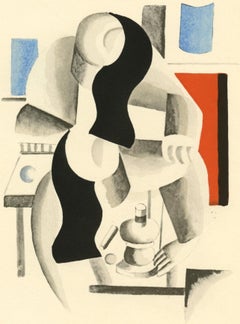
This exquisite lithograph and pochoir after Fernand Leger (1881–1955), titled La Femme au Vase (Woman with a Vase), from the album L'Art Cubiste, Theories et Realisations, Etude Crit...

Category

1920s Cubist Still-life Prints

Materials

Lithograph, Stencil

Version 8, Georg Karl Pfahler

Version 8, Georg Karl Pfahler

By Georg Karl Pfahler

Located in Fairfield, CT

Artist: Georg Karl Pfahler (1926-2002) Title: Version 8 Year: 1969 Edition: 36/100, plus proofs Medium: Silkscreen on wove paper Size: 25.5 x 25.5 inches Condition: Excellent Inscrip...

Category

1960s Pop Art Landscape Prints
Materials

Screen

Joan Kahn Rome Vibrant Bold Color Abstract Expressionist Modernist Oil Painting

Joan Kahn Rome Vibrant Bold Color Abstract Expressionist Modernist Oil Painting

By Joan Kahn

Located in Surfside, FL

Oil paint on heavy tar paper. Hand signed and dated verso. Joan Kahn (USA 1953-) grew up in New York City; Princeton, New Jersey; and Vermont; in an environment that patronized the arts. At home her father, a professor, and mother, a state economist and homemaker, collected nineteenth and twentieth century drawings and prints, Middle eastern rugs, and ceramics, pewter, and old tools. Her grandfather, Max Westfield, was an academically trained portrait painter and her great uncle was a well-known gallery owner and art dealer in pre-World War II Germany. One of the influential experiences of Joan’s youth was visiting her grandfather in his studio in Tennessee where the family had first immigrated. Growing up near New York, and spending a year in Paris during high school, provided formative visits to museums and galleries. Joan was academically talented in grade and high school, but after her father’s death during her first years at university she found herself concentrating on studio and history of art. It was a subject above others absorbed and concentrated her focus. Influential in Joan’s development and later work are the historic movements of the Bauhaus and Modernist design and architecture, geometric art and design of diverse cultures, Color Field Painting. Many artists have had a impact on her work, such as Paul Klee, Piet Mondrian, Sonia Delaunay, Mark Rothko, Ad Reinhardt, Antoni Tapies, David Smith, John McLaughlin, Tony Smith, Louise Nevelson, Robert Mangold, Ellsworth Kelly, Agnes Martin, Valerie Jaudon, Jasper Johns, James Turrell, Robert Irwin, Vija Celmins, Caio Fonseca, Peter Halley, Ed Moses, Juan Usle, and Nancy Haynes...

Category

1980s Abstract Expressionist Abstract Paintings

Materials

Oil

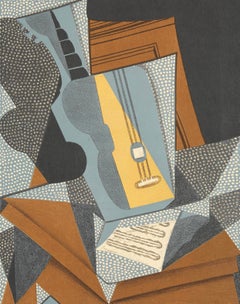
Juan Gris, Guitar, from Au Soleil du Plafond, 1955 (after)

Juan Gris, Guitar, from Au Soleil du Plafond, 1955 (after)

By Juan Gris

Located in Southampton, NY

This exquisite lithograph after Juan Gris (1887–1927), titled Guitare (Guitar), from the folio Au Soleil du Plafond (In the Sunlight of the Ceiling), originates from the 1955 edition...

Category

1950s Cubist Abstract Prints

Materials

Lithograph

Max Bill, Variation 13, from XXe siecle, 1938

Max Bill, Variation 13, from XXe siecle, 1938

By Max Bill

Located in Southampton, NY

This exquisite lithograph by Max Bill (1908–1994), titled Variation 13, from the album XXe siecle, Chroniques du jour, 13 rue Valette (5e), Directeur G. di San Lazzaro, Sommaire du n...

Category

1930s Constructivist Abstract Prints

Materials

Lithograph

"Untitled" Betty Parsons, 1977, Female Mid-century Abstract Expressionist

"Untitled" Betty Parsons, 1977, Female Mid-century Abstract Expressionist

By Betty Parsons

Located in New York, NY

Betty Parsons Untitled, 1977 Signed and dated lower right Gouache on paper 5 1/2 x 3 3/4 inches Renowned as an esteemed and legendary art dealer who for more than three decades was...

Category

1970s Abstract Abstract Drawings and Watercolors

Materials

Paper, Gouache

Eduardo Chillida, Homage to Georges Braque, from Derriere le Miroir, 1964

Eduardo Chillida, Homage to Georges Braque, from Derriere le Miroir, 1964

By Eduardo Chillida

Located in Southampton, NY

This exquisite lithograph by Eduardo Chillida (1924–2002), titled Sans titre (Untitled), originates from the 1964 folio Derriere le Miroir, Nos. 144–145–146, L’Hommage a Georges Braque (Tribute to Georges Braque). Published by Maeght Editeur, Paris, under the direction of Aime Maeght, and printed by Mourlot Freres, Paris, this composition exemplifies Chillida’s mastery of spatial balance and sculptural abstraction. In Sans titre, Chillida translates his distinctive exploration of mass and void into two dimensions, creating an interplay of dense form and open space that mirrors the structural poetry of his sculpture and a heartfelt tribute to Braque, “Learning to fly down here — to Braque, master, friend, inventor of birds.” The composition conveys a sense of weight and stillness, embodying the meditative precision for which Chillida is renowned. Executed on velin paper, this lithograph measures 15 x 22 inches (38.1 x 55.9 cm), with centerfold, as issued. Signed in the plate and unnumbered, as issued. The edition captures Chillida’s unique sensitivity to form and rhythm within a printed medium, reflecting the same architectural strength that defines his sculptural practice. Artwork Details: Artist: Eduardo Chillida (1924–2002) Title: Sans titre (Untitled), from Derriere le Miroir, Nos. 144–145–146, L’Hommage a Georges Braque (Tribute to Georges Braque), 1964 Medium: Lithograph on velin paper Dimensions: 15 x 22 inches (38.1 x 55.9 cm), with centerfold, as issued Inscription: Signed in the plate and unnumbered, as issued Date: 1964 Publisher: Maeght Editeur, Paris Printer: Mourlot Freres, Paris Condition: Well preserved, consistent with age and medium Provenance: From the 1964 folio Derriere le Miroir, Nos. 144–145–146, published by Maeght Editeur, Paris Notes: Excerpted from the folio (translated from French): Taken from this special issue of “Behind the Mirror,” CCCL examples on velin de Rives were numbered, constituting the original edition of L’Hommage a Georges Braque. These deluxe examples also included an etching based on Trois oiseaux sur fond violet. The lithographs for this issue were printed in the ateliers of Maeght Editeur, Levallois. The text was printed by Fequet et Baudier, typographers. Finished printing May 13, 1964. About the Publication: Derriere le Miroir (translated as "Behind the Mirror") was an iconic French art periodical published from 1946 to 1982 by Maeght Editeur, one of the most influential art publishers of the 20th century. Founded by Aime Maeght in Paris, the publication was conceived as a visual and literary collaboration between leading modern artists, poets, and critics. Each issue functioned as both an exhibition catalogue and a work of art in itself—featuring original lithographs printed directly from the artists' stones or plates, alongside essays, poems, and critical commentary. Over the course of 36 years, Derriere le Miroir produced more than 250 issues and showcased an extraordinary roster of artists including Henri Matisse, Marc Chagall, Joan Miro, Georges Braque, Alexander Calder, Fernand Leger, Pierre Bonnard, Alberto Giacometti, Eduardo Chillida, Ellsworth Kelly, Francis Bacon, Paul Rebeyrolle, Claude Garache, Antoni Tapies, Bram van Velde, Pierre Alechinsky, Pol Bury, Shusaku Arakawa, and Gerard Titus-Carmel. Printed in the ateliers of Mourlot, Arte, and Imprimerie Moderne du Lion, the periodical set new standards for quality in color lithography, combining fine art printing with elegant typography and poetic text. Beyond its visual brilliance, Derriere le Miroir also became a cultural chronicle of postwar European modernism. Each issue coincided with exhibitions held at Galerie Maeght, providing a collectible and widely accessible record of groundbreaking shows. Its integration of image, text, and philosophy created a dialogue between art and literature that elevated the modern art book to new aesthetic heights. Today, Derriere le Miroir remains one of the most sought-after and historically significant art publications, prized by collectors and scholars alike for its craftsmanship, influence, and its role in defining the visual language of 20th-century modernism. The Maeght Foundation in Saint-Paul-de-Vence continues to honor this legacy through exhibitions and archival preservation of the series, affirming Derriere le Miroir's enduring place in the history of modern art and fine art publishing. About the Artist: Eduardo Chillida (1924–2002) was a Spanish Basque sculptor and printmaker internationally celebrated for his monumental abstract works that explore the interplay between form, space, and material. Renowned for his mastery of iron, steel, stone, and concrete, Chillida created sculptural compositions that evoke both architectural strength and poetic balance, reflecting his lifelong dialogue between the physical and the spiritual. Emerging in postwar Europe, his art stands alongside that of the great modern masters—Pablo Picasso, Henri Matisse, Alexander Calder, Marc Chagall, Salvador Dali, Joan Miro, Georges Braque, Wassily Kandinsky, Marcel Duchamp, and Man Ray—whose revolutionary approaches to form and perception shaped 20th-century art. Chillida’s work embodies a profound sense of harmony, rooted in the landscapes and philosophies of his native Basque Country, while maintaining a universal resonance. Exhibited internationally and collected by major institutions including MoMA, the Guggenheim, the Tate, and the Centre Pompidou, his sculptures and works on paper continue to command global acclaim. The highest price ever paid for an Eduardo Chillida artwork is approximately $4.1 million USD, achieved in 2022 at Christie’s Paris for Buscando la Luz IV (2001). Eduardo Chillida Sans titre, Chillida Derriere le Miroir, Chillida Maeght...

Category

1960s Modern Abstract Prints

Materials

Lithograph

Constructivist abstraction, blue and yellow color, painted musical opera

Constructivist abstraction, blue and yellow color, painted musical opera

By Vitor Mejuto

Located in Carballo, ES

Vítor Mejuto introduces a geometric synthesis that breaks down painting into its most structural essence. His work, in which line, stain and shape establish a precise chromatic balan...

Category

21st Century and Contemporary Constructivist Abstract Paintings

Materials

Cotton Canvas, Acrylic, Graphite

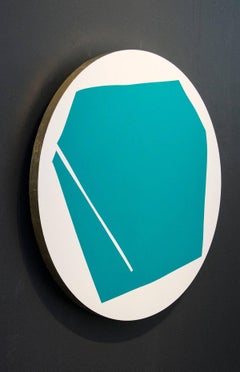
Round Aqua Blue with 1 Line - minimalist abstract, gold leaf, acrylic on panel

Round Aqua Blue with 1 Line - minimalist abstract, gold leaf, acrylic on panel

By Aron Hill

Located in Bloomfield, ON

This graphic-based painting of an aqua polygon on a round, white panel is rimmed with gold leaf. Calgary artist Aron Hill is known for their bold, colourful, and minimalist contemp...

Category

2010s Abstract Abstract Paintings

Materials

Gold Leaf

1981 American Post Minimalist Abstract Art Lithograph Neon Series Keith Sonnier

1981 American Post Minimalist Abstract Art Lithograph Neon Series Keith Sonnier

By Keith Sonnier

Located in Surfside, FL

Keith Sonnier, American (1941-2020) lithograph From Neon series circa 1980-1981 Bears the Waterstreet Press watermarks and Arches paper blind stamp to lower right corner. Pub. Edizioni Lucio Amelio Hand signed with initials in pencil Dimensions: 30 x 21 3/4 inches Post minimalist Abstract by Keith Sonnier Keith Sonnier (1941 – 2020) was a post minimalist sculptor, performance artist, video and light artist. Sonnier was one of the first artists to use light in sculpture in the 1960s. With his use of neon in combination with ephemeral materials he achieved international recognition. Sonnier was part of the Process Art movement. James Keith Sonnier was born July 31, 1941, in Mamou, Louisiana. His family was Cajun and Roman Catholic. His father was a hardware store owner, Joseph Sonnier, and his mother was a florist and singer, Mae Ledoux. He graduated in 1963 from Southwestern Louisiana Institute (now known as the University of Louisiana at Lafayette). In 1966, he graduated with his MFA degree from Rutgers University, where he studied under Allan Kaprow, Robert Watts, and Robert Morris. After graduation from Rutgers, he moved to New York City with Jackie Winsor and some of his former classmates. Sonnier died in Southampton, NY on July 18, 2020. Sonnier began experimenting with neon in 1968. Neon lights became a signature material used in his sculptural works. The common materials Sonnier employed included neon and fluorescent lights; reflective materials; aluminum and copper; and glass and wires. Of the generation of James Turrell and Dan Flavin, He was also associated with the Light and Space movement, a loosely affiliated art movement related to op art, minimalism and geometric abstraction originating in Southern California in the 1960s and influenced by John McLaughlin. It is characterized by a focus on perceptual phenomena, such as light, volume and scale, and the use of materials such as glass, neon, fluorescent lights, resin and cast acrylic, often forming installations conditioned by the work's surroundings. Artists included Ron Cooper...

Category

1980s Post-Minimalist Abstract Prints

Materials

Paper, Lithograph

Synthesized musical harp, poetic abstraction, blue and red canvas

Synthesized musical harp, poetic abstraction, blue and red canvas

By Vitor Mejuto

Located in Carballo, ES

Vítor Mejuto introduces a geometric synthesis that breaks down painting into its most structural essence. His work, in which line, stain and shape establish a precise chromatic balan...

Category

21st Century and Contemporary Constructivist Abstract Paintings

Materials

Cotton Canvas, Acrylic, Graphite

Fernand Leger, The Woman and the Child, from Derriere le miroir, 1955 (after)

Fernand Leger, The Woman and the Child, from Derriere le miroir, 1955 (after)

By Fernand Léger

Located in Southampton, NY

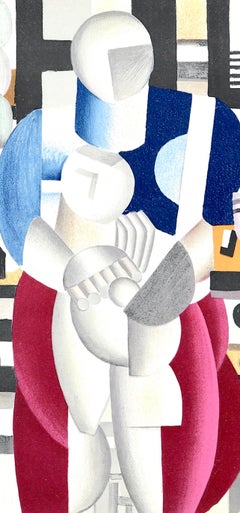
This exquisite lithograph after Fernand Leger (1881–1955), titled La Femme et l’Enfant (The Woman and the Child), from the folio Derriere le miroir, No. 79-81, originates from the 1955 edition published by Maeght Editeur, Paris, and printed by Mourlot Freres, Paris, 1955. This composition exemplifies Leger’s rhythmic balance of color, form, and movement, translating the mechanical vitality of modern life into a harmonious, humanized geometry. Executed as a lithograph on velin paper, this work measures 15 x 11 inches. Signed in the plate and unnumbered as issued. The edition exemplifies the superb craftsmanship of Mourlot Freres, Paris. Artwork Details: Artist: After Fernand Leger (1881–1955) Title: La Femme et l’Enfant (The Woman and the Child), from the folio Derriere le miroir, No. 79-81 Medium: Lithograph on velin paper Dimensions: 15 x 11 inches (38.1 x 27.94 cm) Inscription: Signed in the plate and unnumbered as issued Date: 1955 Publisher: Maeght Editeur, Paris Printer: Mourlot Freres, Paris Condition: Well preserved, consistent with age and medium Provenance: From the folio Derriere le miroir, No. 79-81, published by Maeght Editeur, Paris; printed by Mourlot Freres, Paris, 1955 About the Publication: Derriere le miroir (Behind the Mirror) was one of the most important art publications of the 20th century, created and published by Maeght Editeur in Paris from 1946 to 1982. Founded by the visionary art dealer and publisher Aime Maeght, the series served as both an exhibition catalogue and a work of art in its own right, uniting original lithographs by leading modern and contemporary artists with critical essays, poetry, and design of the highest quality. Printed by master lithographers such as Mourlot Freres and Arte, Derriere le miroir became synonymous with the artistic vanguard of postwar Europe. Each issue was devoted to a single artist or theme and published to accompany exhibitions at the Galerie Maeght in Paris, featuring works by Pablo Picasso, Henri Matisse, Georges Braque, Joan Miro, Marc Chagall, Alexander Calder, Fernand Leger, and Alberto Giacometti, among others. The publication reflected Maeght's belief that art should be both accessible and elevated—an ideal realized through its luxurious production values, meticulous printing, and collaboration with the greatest creative minds of its time. About the Artist: Fernand Leger (1881–1955) was a visionary French painter, sculptor, designer, and filmmaker whose groundbreaking fusion of modern industry, vivid color, and geometric form transformed the course of 20th-century art. Born in Argentan, Normandy, Leger began as an architectural draftsman before studying at the Academie Julian and the Ecole des Beaux-Arts in Paris, where he absorbed the lessons of Paul Cezanne’s structural rigor and the revolutionary ideas of Cubism. Alongside Pablo Picasso and Georges Braque, he became one of the leading innovators of the avant-garde, yet his work stood apart through its embrace of mechanical rhythm, bold contrasts, and industrial modernity—earning him the title “the painter of the machine age.” His art celebrated the beauty of technology, urban life, and the human form rendered in dynamic, interlocking cylinders and planes, evoking the pulse of the modern world. Immersed in the vibrant Parisian art scene, Leger worked in dialogue with peers and contemporaries such as Alexander Calder, Alberto Giacometti, Salvador Dali, Joan Miro, Wassily Kandinsky, Marcel Duchamp, and Man Ray, all of whom shared his commitment to innovation and the reimagining of artistic expression. Beyond painting, Leger’s creative reach extended into film, design, and monumental public art—his 1924 collaboration on Ballet Mecanique with Dudley Murphy and Man Ray remains a landmark of avant-garde cinema. His later works evolved toward greater clarity and monumentality, celebrating the unity of form, color, and humanity through large-scale murals and mosaics that bridged fine art and architecture. Leger’s synthesis of Cubism, Futurism, and abstraction paved the way for movements such as Pop Art and influenced generations of artists including Roy Lichtenstein, Ellsworth Kelly, Robert Indiana, and Alexander Calder, who admired his fusion of structure, energy, and optimism. Today, his works are prized by major museums and collectors worldwide for their bold visual power and enduring modernity. His highest auction record was achieved by La femme en rouge et vert (1914), which sold for 39,241,000 USD at Sotheby’s, New York, on May 7, 2008. After Fernand Leger La Femme et l’Enfant 1955, Leger Derriere le miroir No. 79-81, Leger Mourlot...

Category

1950s Cubist Still-life Prints
Materials

Lithograph

Joan Kahn Indigo Denim Blue Color Abstract Expressionist Modernist Oil Painting

Joan Kahn Indigo Denim Blue Color Abstract Expressionist Modernist Oil Painting

By Joan Kahn

Located in Surfside, FL

Oil paint on heavy paper. (this might possibly be acrylic paint) This does not appear to be signed. Joan Kahn (USA 1953-) grew up in New York City; Princeton, New Jersey; and Vermont; in an environment that patronized the arts. At home her father, a professor, and mother, a state economist and homemaker, collected nineteenth and twentieth century drawings and prints, Middle eastern rugs, and ceramics, pewter, and old tools. Her grandfather, Max Westfield, was an academically trained portrait painter and her great uncle was a well-known gallery owner and art dealer in pre-World War II Germany. One of the influential experiences of Joan’s youth was visiting her grandfather in his studio in Tennessee where the family had first immigrated. Growing up near New York, and spending a year in Paris during high school, provided formative visits to museums and galleries. Joan was academically talented in grade and high school, but after her father’s death during her first years at university she found herself concentrating on studio and history of art. It was a subject above others absorbed and concentrated her focus. Influential in Joan’s development and later work are the historic movements of the Bauhaus and Modernist design and architecture, geometric art and design of diverse cultures, Color Field Painting. Many artists have had a impact on her work, such as Paul Klee, Piet Mondrian, Sonia Delaunay, Mark Rothko, Ad Reinhardt, Antoni Tapies, David Smith, John McLaughlin, Tony Smith, Louise Nevelson, Robert Mangold, Ellsworth Kelly, Agnes Martin, Valerie Jaudon, Jasper Johns, James Turrell, Robert Irwin, Vija Celmins, Caio Fonseca, Peter Halley, Ed Moses, Juan Usle, and Nancy Haynes...

Category

1980s Abstract Expressionist Abstract Paintings

Materials

Oil

Emotional abstraction, vibrant colors, organic shapes, opera formal synthesis

Emotional abstraction, vibrant colors, organic shapes, opera formal synthesis

By Vitor Mejuto

Located in Carballo, ES

Vítor Mejuto introduces a geometric synthesis that breaks down painting into its most structural essence. His work, in which line, stain and shape establish a precise chromatic balan...

Category

21st Century and Contemporary Constructivist Abstract Paintings

Materials

Cotton Canvas, Acrylic, Graphite

Aqua green painting and shadows, The Magic Flute, visually translated opera

Aqua green painting and shadows, The Magic Flute, visually translated opera

By Vitor Mejuto

Located in Carballo, ES

Vítor Mejuto introduces a geometric synthesis that breaks down painting into its most structural essence. His work, in which line, stain and shape establish a precise chromatic balan...

Category

21st Century and Contemporary Constructivist Abstract Paintings

Materials

Cotton Canvas, Acrylic, Graphite

buildings with windows overlooking the blue sea, golden yellow and pure forms

buildings with windows overlooking the blue sea, golden yellow and pure forms

By Vitor Mejuto

Located in Carballo, ES

Vítor Mejuto introduces a geometric synthesis that breaks down painting into its most structural essence. His work, in which line, stain and shape establish a precise chromatic balan...

Category

21st Century and Contemporary Constructivist Abstract Paintings

Materials

Cotton Canvas, Acrylic, Graphite

Lyrical geometric abstraction, plays in painting, fiction and colour perspective

Lyrical geometric abstraction, plays in painting, fiction and colour perspective

By Vitor Mejuto

Located in Carballo, ES

Vítor Mejuto introduces a geometric synthesis that breaks down painting into its most structural essence. His work, in which line, stain and shape establish a precise chromatic balan...

Category

21st Century and Contemporary Constructivist Abstract Paintings

Materials

Cotton Canvas, Acrylic, Graphite

Coloured Greys
Coloured Greys

Coloured Greys

By Bridget Riley

Located in Toronto, Ontario

Bridget Riley (b. 1931) is an influential British abstract painter who came to prominence in the 1960's as the Op Art movement emerged. Riley first gained international recognition ...

Category

1970s Abstract Abstract Prints
Materials

Screen

Brutalist Bronze Abstract Modernist Sculpture

Brutalist Bronze Abstract Modernist Sculpture

Located in Surfside, FL

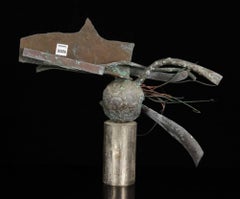
In the manner of Julio Gonzalez, mixed metal sculpture. Neo-Dada Abstract Sculpture: Assemblages Abstract sculpture followed a slightly different course. Rather than focusing on no...

Category

20th Century Abstract Expressionist Abstract Sculptures

Materials

Bronze, Copper

Fernand Leger, Acrobats and Musicians, from Derriere le Miroir, 1960 (after)

Fernand Leger, Acrobats and Musicians, from Derriere le Miroir, 1960 (after)

By Fernand Léger

Located in Southampton, NY

This exquisite lithograph after Fernand Leger (1881–1955), titled Acrobates et musiciens (Acrobats and Musicians), originates from the 1960 folio Derriere le Miroir, No. 119, Poetes, peintres, sculpteurs (Poets, Painters, Sculptors), published by Maeght Editeur, Paris, under the direction of Aime Maeght, and printed by Mourlot Freres, Paris. Acrobates et musiciens exemplifies Leger’s dynamic integration of human movement, geometric rhythm, and vibrant color—hallmarks of his post-Cubist visual language. The composition celebrates modern vitality and the harmony of mechanized and organic forms, capturing the artist’s enduring fascination with energy, structure, and the human figure in motion. Executed on velin paper, this lithograph measures 15 x 22 inches (38.1 x 55.9 cm), with centerfold, as issued. Signed in the plate, as issued. The edition reflects the exceptional quality and craftsmanship of the Maeght and Mourlot collaborations, translating Leger’s bold visual vocabulary into a masterful graphic work. Artwork Details: Artist: After Fernand Leger (1881–1955) Title: Acrobates et musiciens (Acrobats and Musicians), from Derriere le Miroir, No. 119, Poetes, peintres, sculpteurs (Poets, Painters, Sculptors), 1960 Medium: Lithograph on velin paper Dimensions: 15 x 22 inches (38.1 x 55.9 cm), with centerfold, as issued Inscription: Signed in the plate, as issued Date: 1960 Publisher: Maeght Editeur, Paris Printer: Mourlot Freres, Paris Catalogue raisonne reference: Leger, Fernand, and Lawrence Saphire. Fernand Leger: The Complete Graphic Work. Blue Moon Press, 1978, illustration 270 Condition: Well preserved, consistent with age and medium Provenance: From the 1960 folio Derriere le Miroir, No. 119, Poetes, peintres, sculpteurs (Poets, Painters, Sculptors), published by Maeght Editeur, Paris About the Publication: Derriere le Miroir (translated as "Behind the Mirror") was an iconic French art periodical published from 1946 to 1982 by Maeght Editeur, one of the most influential art publishers of the 20th century. Founded by Aime Maeght in Paris, the publication was conceived as a visual and literary collaboration between leading modern artists, poets, and critics. Each issue functioned as both an exhibition catalogue and a work of art in itself—featuring original lithographs printed directly from the artists' stones or plates, alongside essays, poems, and critical commentary. Over the course of 36 years, Derriere le Miroir produced more than 250 issues and showcased an extraordinary roster of artists including Henri Matisse, Marc Chagall, Joan Miro, Georges Braque, Alexander Calder, Fernand Leger, Pierre Bonnard, Alberto Giacometti, Eduardo Chillida, Ellsworth Kelly, Francis Bacon, Paul Rebeyrolle, Claude Garache, Antoni Tapies, Bram van Velde, Pierre Alechinsky, Pol Bury, Shusaku Arakawa, and Gerard Titus-Carmel. Printed in the ateliers of Mourlot, Arte, and Imprimerie Moderne du Lion, the periodical set new standards for quality in color lithography, combining fine art printing with elegant typography and poetic text. Beyond its visual brilliance, Derriere le Miroir also became a cultural chronicle of postwar European modernism. Each issue coincided with exhibitions held at Galerie Maeght, providing a collectible and widely accessible record of groundbreaking shows. Its integration of image, text, and philosophy created a dialogue between art and literature that elevated the modern art book to new aesthetic heights. Today, Derriere le Miroir remains one of the most sought-after and historically significant art publications, prized by collectors and scholars alike for its craftsmanship, influence, and its role in defining the visual language of 20th-century modernism. The Maeght Foundation in Saint-Paul-de-Vence continues to honor this legacy through exhibitions and archival preservation of the series, affirming Derriere le Miroir's enduring place in the history of modern art and fine art publishing. About the Artist: Fernand Leger (1881–1955) was a French painter, sculptor, and filmmaker whose bold, mechanized aesthetic made him one of the most influential figures of modern art. A pioneer of Cubism alongside Pablo Picasso and Georges Braque, Leger developed a distinctive style that celebrated modern life through rhythmic forms, tubular figures, and vibrant color contrasts. His compositions combined industrial precision with human warmth, reflecting both the dynamism and optimism of the 20th century. Influenced by and in dialogue with leading artists such as Henri Matisse, Alexander Calder, Marc Chagall, Alberto Giacometti, Salvador Dali, Joan Miro, Wassily Kandinsky, Marcel Duchamp, and Man Ray, Leger bridged the gap between Cubism, abstraction, and the rise of modern design. His work extended into murals, sculpture, and film, uniting fine art with architecture and everyday life. Represented in major museums worldwide—including MoMA, the Guggenheim, the Centre Pompidou, and the Tate—Leger’s art continues to captivate collectors for its clarity, structure, and vitality. The highest price ever paid for a Fernand Leger artwork is approximately $70 million USD, achieved in 2012 at Christie's New York for Contraste de formes (1913). Fernand Leger Acrobates et musiciens, Leger Derriere le Miroir, Leger Maeght Editeur Paris, Leger Mourlot...

Category

1960s Cubist Figurative Prints
Materials

Lithograph

contemporary abstract colorful acrylic painting impasto textured stripes signed

contemporary abstract colorful acrylic painting impasto textured stripes signed

By Daniel Klewer

Located in Milwaukee, WI

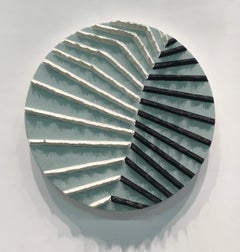
'Rhino Rib' is an excellent example of the paintings of Daniel Klewer, coming from his series 'Linear Tactility.' The paintings in this series all share a consistent, linearly divide...

Category

2010s Contemporary Abstract Paintings

Materials

Canvas, Acrylic

Alexander Calder lithograph 1970s (Calder prints)

Alexander Calder lithograph 1970s (Calder prints)

By Alexander Calder

Located in NEW YORK, NY

Alexander Calder Lithograph c. 1973 from Derrière le miroir: Lithograph in colors; 15 x 11 inches. Very good overall vintage condition; well-preseved. Unsigned from an edition of un...

Category

1970s Surrealist Prints and Multiples
Materials

Lithograph

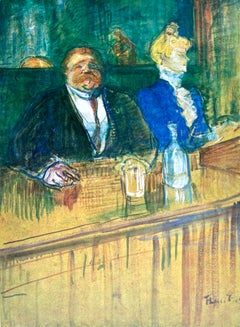
Henri de Toulouse-Lautrec, At the Cafe, from Derriere le Miroir, 1966 (after)

Henri de Toulouse-Lautrec, At the Cafe, from Derriere le Miroir, 1966 (after)

By Henri de Toulouse-Lautrec

Located in Southampton, NY

This exquisite lithograph after Henri de Toulouse-Lautrec (1864–1901), titled Au Cafe, Le consommeteur et la cassiere chlorotique (At the Cafe, The Customer and the Anemic Cashier), ...

Category

1960s Post-Impressionist Figurative Prints
Materials

Lithograph

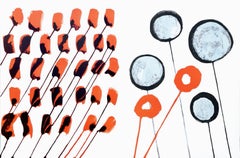
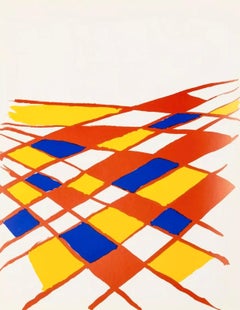
Alexander Calder, Untitled, from Derriere le miroir, 1966

Alexander Calder, Untitled, from Derriere le miroir, 1966

By Alexander Calder

Located in Southampton, NY

This exquisite lithograph by Alexander Calder (1898–1976), titled Sans titre (Untitled), from the folio Derriere le miroir, No. 156, originates from the 1966 edition published by Mae...

Category

1960s Modern Abstract Prints
Materials

Lithograph

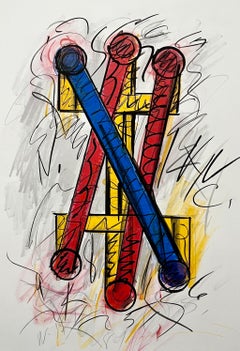
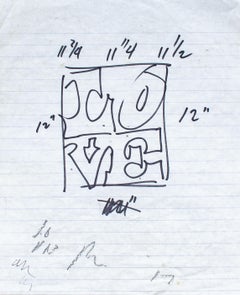
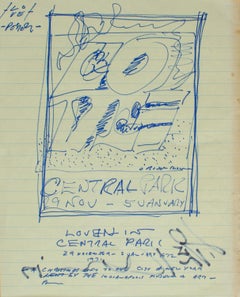
"Love Stacked" Robert Indiana, Drawing, Pop Art, Preparatory Drawing

"Love Stacked" Robert Indiana, Drawing, Pop Art, Preparatory Drawing

By Robert Indiana

Located in New York, NY

Robert Indiana Love Stacked , 2014 Signed lower left, dated lower right Artist's marker on ruled paper 10 x 8 inches Provenance Gifted by the artist, Vinalhaven, Maine Private colle...

Category

2010s Pop Art Abstract Drawings and Watercolors

Materials

Paper, Permanent Marker

Georges Braque, The Studio, from Derriere le Miroir, 1964 (after)

Georges Braque, The Studio, from Derriere le Miroir, 1964 (after)

By Georges Braque

Located in Southampton, NY

This exquisite lithograph after Georges Braque (1882–1963), titled L’Atelier (The Studio), originates from the 1964 folio Derriere le Miroir, Nos. 144–145–146, L’Hommage a Georges Br...

Category

1960s Cubist Abstract Prints
Materials
Lithograph

Eduardo Chillida, Untitled, from Derriere le Miroir, 1982

Eduardo Chillida, Untitled, from Derriere le Miroir, 1982

By Eduardo Chillida

Located in Southampton, NY

This exquisite lithograph by Eduardo Chillida (1924–2002), titled Sans titre (Untitled), originates from the historic 1982 folio Derriere le Miroir, No. 250, Hommage a Aime et Marguerite Maeght (Tribute to Aime and Marguerite Maeght). Published by Maeght Editeur, Paris, under the direction of Aime Maeght, and printed by Imprimerie Moderne du Lion, Paris, this composition embodies Chillida’s exploration of form, balance, and spatial tension. In Sans titre, the artist distills his sculptural sensibility into a two-dimensional plane, using the language of gesture and contrast to evoke mass, gravity, and void. The work exemplifies Chillida’s poetic approach to abstraction, where line and density coexist in perfect equilibrium. Executed on velin paper, this lithograph measures 15 x 11 inches (38.1 x 27.9 cm). As issued, it is signed in the plate and unnumbered, consistent with the authorized publication format. The edition captures Chillida’s mastery of minimal means to achieve monumental expression, extending the spatial dialogue that defines his sculpture into the medium of print. Artwork Details: Artist: Eduardo Chillida (1924–2002) Title: Sans titre (Untitled), from Derriere le Miroir, No. 250, Hommage a Aime et Marguerite Maeght (Tribute to Aime and Marguerite Maeght), 1982 Medium: Lithograph on velin paper Dimensions: 15 x 11 inches (38.1 x 27.9 cm) Inscription: Signed in the plate and unnumbered, as issued Date: 1982 Publisher: Maeght Editeur, Paris Printer: Imprimerie Moderne du Lion, Paris Condition: Well preserved, consistent with age and medium Provenance: From the 1982 folio Derriere le Miroir, No. 250, published by Maeght Editeur, Paris Notes: Excerpted from the folio (translated from French), This special issue of Derriere le Miroir was designed and defined by Aime Maeght in the fall of 1980. He envisioned its publication as a celebration with which artists and writers published since 1946 were to be associated. He also chose Francois Chapon, president of the Reverdy Committee, to write the presentation. This Derriere le Miroir number 250 took the form, after its disappearance on September 5, 1981, of a tribute to Aime Maeght and his wife Marguerite Maeght who died four years earlier. 24 artists agreed to create an original graphic work for this issue which includes the general table of all issues as well as excerpts from texts by 32 writers. Finished printing on June 2, 1982 on the presses of the l'Imprimerie moderne du Lion in Paris. CL examples were printed on velin d'Arches, numbered from I to CL, and some non-commercial examples constituting the original edition. About the Publication: Derriere le Miroir (translated as "Behind the Mirror") was an iconic French art periodical published from 1946 to 1982 by Maeght Editeur, one of the most influential art publishers of the 20th century. Founded by Aime Maeght in Paris, the publication was conceived as a visual and literary collaboration between leading modern artists, poets, and critics. Each issue functioned as both an exhibition catalogue and a work of art in itself—featuring original lithographs printed directly from the artists' stones or plates, alongside essays, poems, and critical commentary. Over the course of 36 years, Derriere le Miroir produced more than 250 issues and showcased an extraordinary roster of artists including Henri Matisse, Marc Chagall, Joan Miro, Georges Braque, Alexander Calder, Fernand Leger, Pierre Bonnard, Alberto Giacometti, Eduardo Chillida, Ellsworth Kelly, Francis Bacon, Paul Rebeyrolle, Claude Garache, Antoni Tapies, Bram van Velde, Pierre Alechinsky, Pol Bury, Shusaku Arakawa, and Gerard Titus-Carmel. Printed in the ateliers of Mourlot, Arte, and Imprimerie Moderne du Lion, the periodical set new standards for quality in color lithography, combining fine art printing with elegant typography and poetic text. Beyond its visual brilliance, Derriere le Miroir also became a cultural chronicle of postwar European modernism. Each issue coincided with exhibitions held at Galerie Maeght, providing a collectible and widely accessible record of groundbreaking shows. Its integration of image, text, and philosophy created a dialogue between art and literature that elevated the modern art book to new aesthetic heights. Today, Derriere le Miroir remains one of the most sought-after and historically significant art publications, prized by collectors and scholars alike for its craftsmanship, influence, and its role in defining the visual language of 20th-century modernism. The Maeght Foundation in Saint-Paul-de-Vence continues to honor this legacy through exhibitions and archival preservation of the series, affirming Derriere le Miroir's enduring place in the history of modern art and fine art publishing. About the Artist: Eduardo Chillida (1924–2002) was a Spanish Basque sculptor and printmaker internationally celebrated for his monumental abstract works that explore the interplay between form, space, and material. Renowned for his mastery of iron, steel, stone, and concrete, Chillida created sculptural compositions that evoke both architectural strength and poetic balance, reflecting his lifelong dialogue between the physical and the spiritual. Emerging in postwar Europe, his art stands alongside that of the great modern masters—Pablo Picasso, Henri Matisse, Alexander Calder, Marc Chagall, Salvador Dali, Joan Miro, Georges Braque, Wassily Kandinsky, Marcel Duchamp, and Man Ray—whose revolutionary approaches to form and perception shaped 20th-century art. Chillida’s work embodies a profound sense of harmony, rooted in the landscapes and philosophies of his native Basque Country, while maintaining a universal resonance. Exhibited internationally and collected by major institutions including MoMA, the Guggenheim, the Tate, and the Centre Pompidou, his sculptures and works on paper continue to command global acclaim. The highest price ever paid for an Eduardo Chillida artwork is approximately $4.1 million USD, achieved in 2022 at Christie’s Paris for Buscando la Luz IV (2001). Eduardo Chillida Sans titre, Eduardo Chillida lithograph, Chillida Derriere le Miroir, Chillida Maeght...

Category

1980s Modern Abstract Prints

Materials

Lithograph

Untitled, from The Geldzahler Portfolio

Untitled, from The Geldzahler Portfolio

By Ellsworth Kelly

Located in London, GB

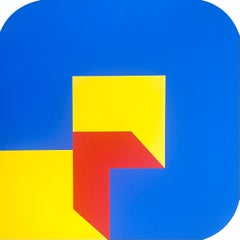
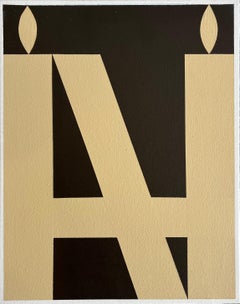
Lithograph in colours, 1997, on Rives BFK paper, signed in pencil, numbered from the edition of 75 (there were also 15 artist’s proofs), printed by Gemini G.E.L. LLC, published by Th...

Category

1990s Abstract Geometric Abstract Prints

Materials

Lithograph

Minimalist Geometric Abstract Painting Red Blue Black Mediterranean oil canvas

Minimalist Geometric Abstract Painting Red Blue Black Mediterranean oil canvas

Located in Sitges, Barcelona

Minimalist Geometric Abstract Painting Red Blue Black Mediterranean 80 cm Artist: Antonio Pérez Portabella (Barcelona, 1944) Medium: Acrylic on canvas Date: 2005 (inscribed on revers...

Category

Early 2000s Abstract Geometric Abstract Paintings

Materials

Oil

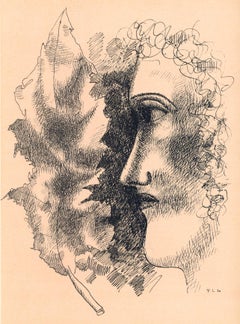
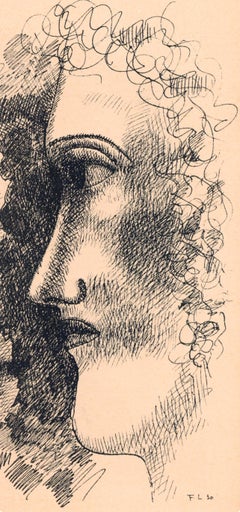
Fernand Leger, Head and Leaf, from Verve, Revue Artistique, 1939

Fernand Leger, Head and Leaf, from Verve, Revue Artistique, 1939

By Fernand Léger

Located in Southampton, NY

This exquisite lithograph by Fernand Leger (1881–1955), titled Tete et Feuille (Head and Leaf), from Verve, Revue Artistique et Litteraire, Vol. II, No. 5–6, originates from the 1939 issue published by Editions de la revue Verve, Paris, under the direction of Teriade, Editeur, Paris, and printed by Mourlot Freres, Paris, 1939. This striking composition epitomizes Leger’s distinct synthesis of mechanical precision and organic vitality. Tete et Feuille demonstrates his fascination with the interplay between geometry and the human figure—translating natural forms into bold, dynamic arrangements of line and color. The juxtaposition of the stylized head and leaf form reveals Leger’s mastery in uniting abstraction with humanism, a hallmark of his mature modernist vision. Through rhythmic design and rich tonal contrast, the work captures the harmony between nature and the machine age that defined much of Leger’s career. Executed as a lithograph on velin du Marais paper, this work measures 14 x 10.5 inches (35.56 x 26.67 cm). Signed in the plate and unnumbered as issued. The edition reflects the exceptional quality of the Mourlot Freres atelier, renowned for its collaborations with the foremost modern masters of the 20th century. Artwork Details: Artist: Fernand Leger (1881–1955) Title: Tete et Feuille (Head and Leaf), from Verve, Revue Artistique et Litteraire, Vol. II, No. 5–6, 1939 Medium: Lithograph on velin du Marais paper Dimensions: 14 x 10.5 inches (35.56 x 26.67 cm) Inscription: Signed in the plate and unnumbered as issued Date: 1939 Publisher: Editions de la revue Verve, Paris, under the direction of Teriade, Editeur, Paris Printer: Mourlot Freres, Paris Condition: Well preserved, consistent with age and medium Provenance: From Verve, Revue Artistique et Litteraire, Vol. II, No. 5–6, published by Editions de la revue Verve, Paris, 1939 About the Publication: Verve, Revue Artistique et Litteraire was one of the most influential art periodicals of the 20th century, founded in Paris in 1937 by the visionary Greek-born publisher Teriade (Stratis Eleftheriades). Conceived as a union of art and literature, Verve featured original lithographs and writings by the foremost artists and thinkers of its time, including Henri Matisse, Pablo Picasso, Marc Chagall, Georges Braque, Joan Miro, and Fernand Leger. Each issue represented a collaboration between artists, poets, and master printers, notably Mourlot Freres, whose exceptional craftsmanship brought color lithography to new aesthetic heights. The 1939 double issue, Vol. II, No. 5–6, is among the most distinguished editions, reflecting both the intellectual vigor and artistic experimentation that defined the pre-war Parisian avant-garde. About the Artist: Fernand Leger (1881–1955) was a visionary French painter, sculptor, designer, and filmmaker whose groundbreaking fusion of modern industry, vivid color, and geometric form transformed the course of 20th-century art. Born in Argentan, Normandy, Leger began as an architectural draftsman before studying at the Academie Julian and the Ecole des Beaux-Arts in Paris, where he absorbed the lessons of Paul Cezanne’s structural rigor and the revolutionary ideas of Cubism. Alongside Pablo Picasso and Georges Braque, he became one of the leading innovators of the avant-garde, yet his work stood apart through its embrace of mechanical rhythm, bold contrasts, and industrial modernity—earning him the title “the painter of the machine age.” His art celebrated the beauty of technology, urban life, and the human form rendered in dynamic, interlocking cylinders and planes, evoking the pulse of the modern world. Immersed in the vibrant Parisian art scene, Leger worked in dialogue with peers and contemporaries such as Alexander Calder, Alberto Giacometti, Salvador Dali, Joan Miro, Wassily Kandinsky, Marcel Duchamp, and Man Ray, all of whom shared his commitment to innovation and the reimagining of artistic expression. Beyond painting, Leger’s creative reach extended into film, design, and monumental public art—his 1924 collaboration on Ballet Mecanique with Dudley Murphy and Man Ray remains a landmark of avant-garde cinema. His later works evolved toward greater clarity and monumentality, celebrating the unity of form, color, and humanity through large-scale murals and mosaics that bridged fine art and architecture. Leger’s synthesis of Cubism, Futurism, and abstraction paved the way for movements such as Pop Art and influenced generations of artists including Roy Lichtenstein, Ellsworth Kelly, Robert Indiana, and Alexander Calder, who admired his fusion of structure, energy, and optimism. Today, his works are prized by major museums and collectors worldwide for their bold visual power and enduring modernity. His highest auction record was achieved by La femme en rouge et vert (1914), which sold for $39,241,000 at Sotheby’s, New York, on May 7, 2008. Fernand Leger Tete et Feuille, Leger Verve, Leger Mourlot...

Category

1930s Fauvist Figurative Prints
Materials

Lithograph

Meditation: Blue, Newburgh, NY, 2020

Meditation: Blue, Newburgh, NY, 2020

By Erica Hauser

Located in Hudson, NY

ABOUT Erica Hauser is a Newburgh, NY based artist and has a BFA from the School of Visual Arts (2002). She received a 2011 NYFA grant, and has attended artist residencies in New Mexi...

Category

2010s Contemporary Abstract Paintings

Materials

Canvas, Acrylic

Georges Braque, Costume Design, Les Facheux, from Views of Paris, 1963

Georges Braque, Costume Design, Les Facheux, from Views of Paris, 1963

By Georges Braque

Located in Southampton, NY

This exquisite lithograph by Georges Braque (1882–1963), titled Conception de costumes, Les Facheux (Costume Design, Les Facheux), from Regards Sur Paris (Views of Paris), originates...

Category

1960s Cubist Abstract Prints

Materials

Lithograph

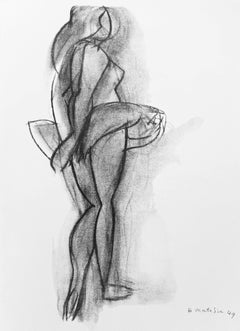
Henri Matisse, Ballerina, from Derriere le Miroir, 1952 (after)

Henri Matisse, Ballerina, from Derriere le Miroir, 1952 (after)

By Henri Matisse

Located in Southampton, NY

This exquisite lithograph after Henri Matisse (1869–1954), titled Ballerine (Ballerina), originates from the 1952 folio Derriere le Miroir, No. 46–47, published by Maeght Editeur, Pa...

Category

1950s Modern Figurative Prints
Materials

Lithograph

Mixed Media Original ink Pastel Drawing and Painting Nancy Chunn Washington Post

Mixed Media Original ink Pastel Drawing and Painting Nancy Chunn Washington Post

Located in Surfside, FL

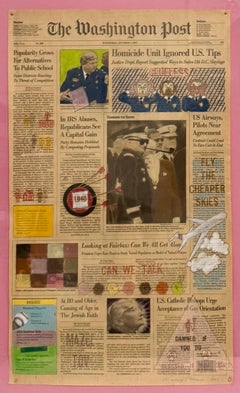
NANCY CHUNN (American, born 1941) Untitled mixed media work Ink and pastel on newspaper De-acidified artistically rendered edition of Washington Post, October 23, 1997, various headlines and illustrations Dimensions Framed, 31 in. x 22 in. Sheet 23 X 14 With some whimsical illustrations and a stencilled Mazel Tov text Nancy Chunn is an American artist (born 1941) based in New York, Known for her commitment to geopolitical issues, Chunn’s work includes a diverse range of paintings. Nancy Chunn was born in Los Angeles, California and received her Bachelor of Fine Arts in 1969, from the California Institute of the Arts, Santa Clarita, California. She began her career in Southern California before moving to New York in the late 1970s, where she currently lives and works. Chunn has exhibited internationally and has been represented by Ronald Feldman Fine Arts in New York since 1985. Chunn currently teaches at the School of Visual Arts in New York, and taught a master painting class at Otis College of Art and Design in Los Angeles in 2007. Chunn’s paintings commonly expose the political arena and portray the power of the media to define and control public opinion. Her work is mostly painting focused on narrative, cultural references and social problems, history, and symbolism both in the global community. She often uses the news, and famously newspapers to draw inspiration and information, adding her own commentary to these sources. The work she produces is colorful, cartoonish, and laced with humorously dark commentary. A self-proclaimed “political junkie,” she achieved critical success with her early map like paintings of tyrannized nations and has continued her commitment to documenting world events and the repeating cycle of history in the paintings she has produced since the early 1980s. She is largely recognized for the yearlong Front Pages project, where she applied images and text to provide commentary on every cover page of The New York Times from January 1 to December 31, 1996. In 1997, Rizzoli produced a hardcover book illustrating each of the project’s works. Chunn was a 2009 Guggenheim Fellow. She was named Honoree of the fall 2007 Jennifer Howard Coleman Distinguished Lectureship and Residency at Otis College of Art and Design. In 2005, Chunn received an Anonymous Was A Woman Award. She has also twice received a Fellowship Award in Painting from the National Endowment for the Arts, namely in 1985 and 1995. Public collections City of Chicago, Chicago, IL Ms. Foundation for Women, New York, NY Chicago Museum of Contemporary Art, Chicago, IL The New York Times, New York, NY The Progressive Corporation, Cleveland, OH The Prudential Insurance Company of America, Newark, NJ Commissions Public School 125, Queens, NY permanent installation painting, commissioned by the City of New York, 1995 Chicago Library Uptown Branch, Chicago, IL, permanent installation painting, commissioned by the City of Chicago, 1993-1995. Select Exhibitions Include 2017 The Times The FLAG Art Foundation Chelsea New York. The exhibition uses The New York Times as its point of departure. Artists included: Carlos Rolón, Ellsworth Kelly, Felix González-Torres, Fred Tomaselli, Nancy Chunn, On Kawara, Richard Prince, Rirkrit Tiravanija, Robert Gober, Suzanne Caporael. 2009 Black and White Works Ronald Feldman Fine Arts Soho NYC Artists included: Andy Warhol, Bruce Pearson, Buckminster Fuller, Chris Burden, Eleanor Antin, Hannah Wilke, Ida Applebroog, Joseph Beuys, Leon Golub, Les Levine, Nancy Chunn, Todd Siler, Vitaly Komar & Alexander Melamid 1995 Strung Into the Apollonian Dream... took place at Feature Inc. in New York, New York from January 20 - February 24, 1995. Artists included Michael Banicki, Nancy Chunn, Tom Friedman, Felix Gonzalez-Torres, Jenny Holzer, Peter Huttinger, Mike Kelley, Louise Lawler, Sherrie Levine, Allan McCollum, David Moreno, Hirsch Perlman, Raymond Pettibon, Adrian Piper, Richard Prince, David Robbins, Rene Santos...

Category

1990s Contemporary Figurative Paintings

Materials

Pastel, Ink, Mixed Media

Hans Jean Arp, Constellations, from XXe siecle, 1938

Hans Jean Arp, Constellations, from XXe siecle, 1938

By Hans Jean Arp

Located in Southampton, NY

This exquisite woodcut by Hans Jean Arp (1886–1966), titled Constellations, from the album XXe siecle, Chroniques du jour, 13 rue Valette (5e), Directeur G. di San Lazzaro, Sommaire ...

Category

1930s Modern Abstract Prints
Materials
Woodcut