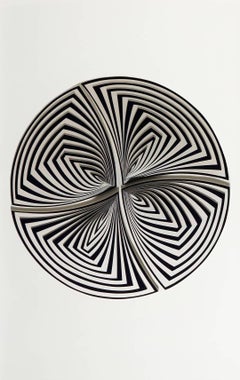
to
3
20
13
20
22
21
Overall Width
to
Overall Height
to
20
76
2
1
2
2
2
2
42
36
5
4
2
2
1
50
29
17
7
5
4
4
3
2
2
2
2
2
1
1
1
1
1
1
1
1
1
1
85
52
43
40
33
33
28
8
5
4
21
31
88
8
"The Frank Lloyd Wright House", Oil Landscape Painting by Richard Rosenblatt

"The Frank Lloyd Wright House", Oil Landscape Painting by Richard Rosenblatt

By Richard Rosenblatt

Located in New York, NY

"The Frank Lloyd Wright House, Spring Green, Wisconsin" by Richard Rosenblatt Oil on canvas Architecture, House, Home, Building, Mid-Century Modern...

Category

21st Century and Contemporary Impressionist Landscape Paintings

Materials

Paint, Oil, Board, Illustration Board, Cardboard

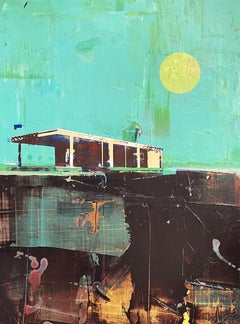
Cabin with Turquoise Sky - Textured painting of Frank Lloyd Wright style house

Cabin with Turquoise Sky - Textured painting of Frank Lloyd Wright style house

Located in Dallas, TX

Dan Parry-Jones – Cabin with Turquoise Sky Mixed Media on Panel 38.5 x 30.5 x 1.5 inches White frame included In Cabin with Turquoise Sky, British contemporary artist Dan Parry-Jon...

Category

2010s Contemporary Landscape Paintings

Materials

Mixed Media, Acrylic, Board

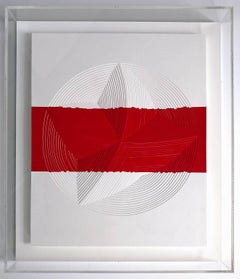
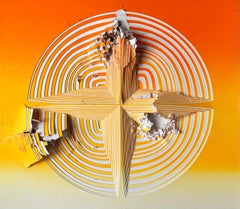
Freehand Cut with Surgical Scalpel on 2 ply Museum Board: Red & White Strip-Out'

Freehand Cut with Surgical Scalpel on 2 ply Museum Board: Red & White Strip-Out'

By Elizabeth Gregory-Gruen

Located in New York, NY

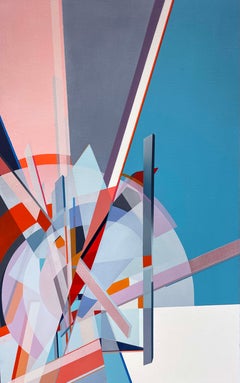
“CUT WORK” is an evolving examination of emotion experienced through the inspired meeting of blade and paper. Beginning with the featureless plane of a blank paper canvas and a surge...

Category

2010s Contemporary Abstract Paintings

Materials

Gouache, Plexiglass, Adhesive, Board

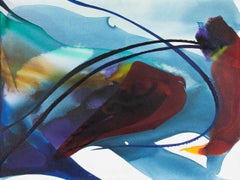
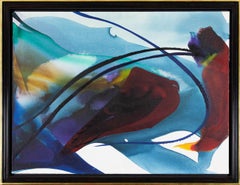
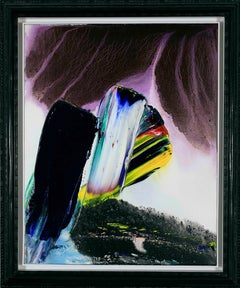
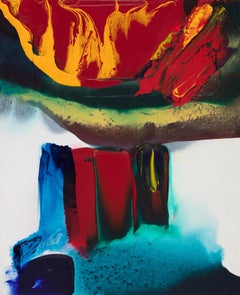
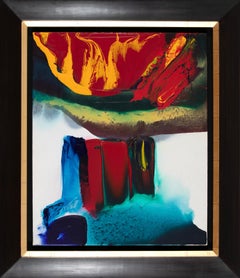
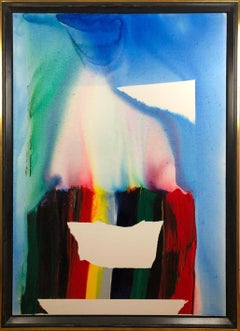
Phenomena Quoth by Paul Jenkins - Abstract Expressionist painting, 1963-64

Phenomena Quoth by Paul Jenkins - Abstract Expressionist painting, 1963-64

By Paul Jenkins

Located in London, GB

Phenomena Quoth by Paul Jenkins (1923-2012) Acrylic on canvas 76 x 100 cm (29 ⁷/₈ x 39 ³/₈ inches) Signed lower center, Paul Jenkins Signed, titled and dated on the reverse Executed in 1963-64 Provenance Kenmore Galleries, Philadelphia Dr. Theodore A. Feinstein collection Sotheby's New York, 24th February 1995 Crozier Fine Arts, New York Private collection, New York Artist biography Born at Kansas City in Missouri (USA), the multi-media artist, poet and playwright Paul Jenkins studied at the Kansas City Art Institute and the Art Students League in New York City. After his discharge from military service at the end of February 1946, he briefly studied playwriting with dramatist George McCalmon at the Carnegie Institute of Technology in Pittsburgh. Thereafter, Jenkins spent four years studying with Japanese American artist Yasuo Kuniyoshi in New York City. His first solo exhibitions were held at Studio Paul Facchetti in Paris in 1954 and the Martha Graham Gallery in New York City in 1956. Over the past thirty years, numerous retrospectives have been curated across the globe and Jenkins’ work can found in national collections from Europe and the United States to Israel, Australia and Japan. The diversity of his work springs from Jenkins’ wealth of eclectic influences. Some of his earliest works included what he called "interior landscapes" influenced by ancient natural forms like the caves he visited in the Ozark Mountains in his native-Missouri. Frequent student visits to the Frick Collection in New York fostered a love of the great masters: Bellini, Holbein, Vermeer, Rembrandt, de la Tour, Turner and Goya. In compliment, lingering student visits to the renowned Eastern collection of the Nelson-Atkins Museum of Art in Kansas City evoked powerful sympathy for a monumental Chinese fresco of Buddha, polychrome sculptures of the enlightened Bodhisattva, the Buddhist goddess of mercy Kuan-Yin, Indian bronzes of Hindu god Shiva, and statues of meditative Buddhist lohans. Serving in the US Naval Air Corps during the Second World War, Jenkins painted watercolours of Japanese Kabuki dancers and read the ancient Chinese poetic teachings of the I Ching and Lao Tse Tung’s Tao Te Ching...

Category

1960s Abstract Expressionist Abstract Paintings

Materials

Canvas, Acrylic

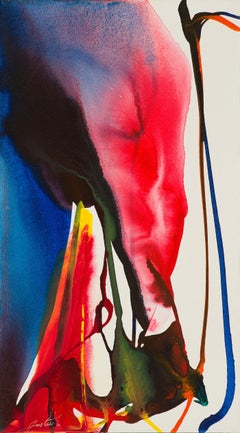
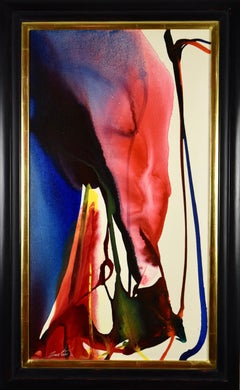
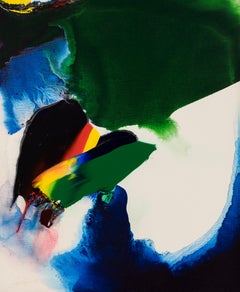
Phenomena High Born by Paul Jenkins - Abstract painting

Phenomena High Born by Paul Jenkins - Abstract painting

By Paul Jenkins

Located in London, GB

*PLEASE NOTE UK BUYERS WILL ONLY PAY 5% VAT ON THIS PURCHASE. Once an order is placed we will arrange the VAT of 20% to be reduced to 5% Phenomena High Born by Paul Jenkins (1923-2012) Acrylic on canvas 91.44 x 50.8 cm (36 x 20 inches) Signed lower left Jenkins Signed, dated and titled on the reverse Executed in 1964 which makes this a very early work and so more valuable Biography Born at Kansas City in Missouri (USA), the multi-media artist, poet and playwright Paul Jenkins studied at the Kansas City Art Institute and the Art Students League in New York City. After his discharge from military service at the end of February 1946, he briefly studied playwriting with dramatist George McCalmon at the Carnegie Institute of Technology in Pittsburgh. Thereafter, Jenkins spent four years studying with Japanese American artist Yasuo Kuniyoshi in New York City. His first solo exhibitions were held at Studio Paul Facchetti in Paris in 1954 and the Martha Graham Gallery in New York City in 1956. Over the past thirty years, numerous retrospectives have been curated across the globe and Jenkins’ work can found in national collections from Europe and the United States to Israel, Australia and Japan. The diversity of his work springs from Jenkins’ wealth of eclectic influences. Some of his earliest works included what he called "interior landscapes" influenced by ancient natural forms like the caves he visited in the Ozark Mountains in his native-Missouri. Frequent student visits to the Frick Collection in New York fostered a love of the great masters: Bellini, Holbein, Vermeer, Rembrandt, de la Tour, Turner and Goya. In compliment, lingering student visits to the renowned Eastern collection of the Nelson-Atkins Museum of Art in Kansas City evoked powerful sympathy for a monumental Chinese fresco...

Category

1960s Abstract Expressionist Abstract Paintings

Materials

Canvas, Acrylic

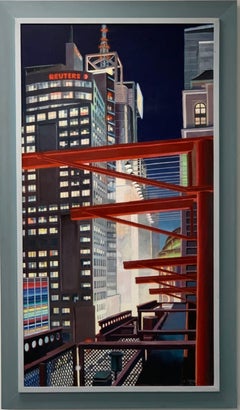
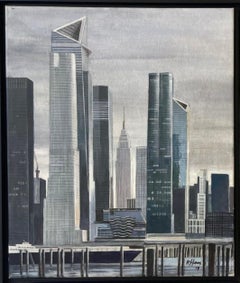
Richard Haas - 42nd Street at Night Unique Acrylic unique painting Signed Framed

Richard Haas - 42nd Street at Night Unique Acrylic unique painting Signed Framed

By Richard Haas

Located in New York, NY

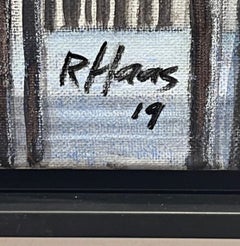
Richard Haas 42nd Street at Night from the Multiplex Cinema Roof, 2008 Acrylic on canvas laid to board Hand signed and dated 2008 on the front Frame included: elegantly framed in art...

Category

Early 2000s Realist Figurative Paintings

Materials

Canvas, Acrylic

Phenomenon East of the River, Acrylic on Canvas Painting by Paul Jenkins

Phenomenon East of the River, Acrylic on Canvas Painting by Paul Jenkins

By Paul Jenkins

Located in London, GB

*PLEASE NOTE UK BUYERS WILL ONLY PAY 5% VAT ON THIS PURCHASE. Once an order is placed we will arrange the VAT of 20% to be reduced to 5% Phenomenon East of the River by Paul Jenkins (1923 - 2012) Acrylic on canvas 97.2 x 130.2 cm (38 ¹/₄ x 51 ¹/₄ inches) Signed lower right, Paul Jenkins Signed, titled and dated 1993 on the reverse Provenance Private collection, New York, acquired directly from the artist Artist's Biography Born at Kansas City in Missouri (USA), the multi-media artist, poet and playwright Paul Jenkins studied at the Kansas City Art Institute and the Art Students League in New York City. After his discharge from military service at the end of February 1946, he briefly studied playwriting with dramatist George McCalmon at the Carnegie Institute of Technology in Pittsburgh. Thereafter, Jenkins spent four years studying with Japanese American artist Yasuo Kuniyoshi in New York City. His first solo exhibitions were held at Studio Paul Facchetti in Paris in 1954 and the Martha Graham Gallery in New York City in 1956. Over the past thirty years, numerous retrospectives have been curated across the globe and Jenkins’ work can found in national collections from Europe and the United States to Israel, Australia and Japan. The diversity of his work springs from Jenkins’ wealth of eclectic influences. Some of his earliest works included what he called "interior landscapes" influenced by ancient natural forms like the caves he visited in the Ozark Mountains in his native-Missouri. Frequent student visits to the Frick Collection in New York fostered a love of the great masters: Bellini, Holbein, Vermeer, Rembrandt, de la Tour, Turner and Goya. In compliment, lingering student visits to the renowned Eastern collection of the Nelson-Atkins Museum of Art in Kansas City evoked powerful sympathy for a monumental Chinese fresco...

Category

1990s Abstract Abstract Paintings

Materials

Canvas, Acrylic

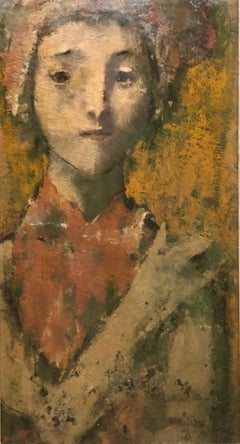
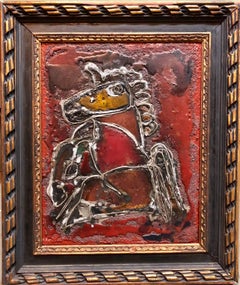
Modernist Encaustic Painting Portrait Boston Expressionist

Modernist Encaustic Painting Portrait Boston Expressionist

By David Aronson

Located in Surfside, FL

Bears old label verso from Raydon Gallery in New York city. Aronson, David 1923- David Aronson, son of a rabbi, was born in Lithuania in 1923 and immigrated to America at the age of ...

Category

20th Century Expressionist Figurative Paintings

Materials

Encaustic

Phenomena Celtic Fire Torc by Paul Jenkins - Abstract painting

Phenomena Celtic Fire Torc by Paul Jenkins - Abstract painting

By Paul Jenkins

Located in London, GB

Phenomena Celtic Fire Torc by Paul Jenkins (1923-2012) Acrylic on canvas 76 x 61 cm (29⁷/₈ x 24 inches) Signed lower left Paul Jenkins Signed, dated and titled on the reverse Executed in 1995 Provenance Private collection, Germany Biography Born at Kansas City in Missouri (USA), the multi-media artist, poet and playwright Paul Jenkins studied at the Kansas City Art Institute and the Art Students League in New York City. After his discharge from military service at the end of February 1946, he briefly studied playwriting with dramatist George McCalmon at the Carnegie Institute of Technology in Pittsburgh. Thereafter, Jenkins spent four years studying with Japanese American artist Yasuo Kuniyoshi in New York City. His first solo exhibitions were held at Studio Paul Facchetti in Paris in 1954 and the Martha Graham Gallery in New York City in 1956. Over the past thirty years, numerous retrospectives have been curated across the globe and Jenkins’ work can found in national collections from Europe and the United States to Israel, Australia and Japan. The diversity of his work springs from Jenkins’ wealth of eclectic influences. Some of his earliest works included what he called "interior landscapes" influenced by ancient natural forms like the caves he visited in the Ozark Mountains in his native-Missouri. Frequent student visits to the Frick Collection in New York fostered a love of the great masters: Bellini, Holbein, Vermeer, Rembrandt, de la Tour, Turner and Goya. In compliment, lingering student visits to the renowned Eastern collection of the Nelson-Atkins Museum of Art in Kansas City evoked powerful sympathy for a monumental Chinese fresco...

Category

1990s Abstract Expressionist Abstract Paintings

Materials

Canvas, Acrylic

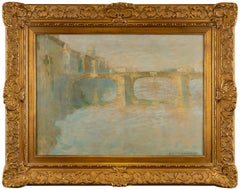
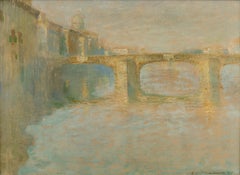
Venice
Venice

Venice

By William Penhallow Henderson

Located in Sheffield, MA

William Penhallow Henderson American, 1877–1943 Venice Oil / Canvas 20 by 30 in, w/ frame 29 by 39 in Signed lower left W.P. Henderson & dated 1902 Provenance: Private Collecti...

Category

Early 20th Century Impressionist Landscape Paintings

Materials

Canvas, Oil

Robert Natkin - unique early painting on historic Wells Street Gall. card Framed

Robert Natkin - unique early painting on historic Wells Street Gall. card Framed

By Robert Natkin

Located in New York, NY

Unique historic work Hand signed and dated on the front An exceptionally early gouache from 1957, executed on the verso of a Wells Street Gallery invitation card - one of the first c...

Category

1950s Abstract Expressionist Abstract Drawings and Watercolors

Materials

Watercolor, Gouache

Phenomena Spectrum Guardian by Paul Jenkins, Abstract Expressionist artist

Phenomena Spectrum Guardian by Paul Jenkins, Abstract Expressionist artist

By Paul Jenkins

Located in London, GB

Phenomena Spectrum Guardian by Paul Jenkins (1923 - 2012) Acrylic on canvas 76 x 101.5 cm (29 ⁷/₈ x 40 inches) Signed lower middle Paul Jenkins Executed in 1970 Provenance: Gallerie Iris Wazzau, Davos, Switzerland Private collection, Cologne, Germany Artist biography: Born at Kansas City in Missouri (USA), the multi-media artist, poet and playwright Paul Jenkins studied at the Kansas City Art Institute and the Art Students League in New York City. After his discharge from military service at the end of February 1946, he briefly studied playwriting with dramatist George McCalmon at the Carnegie Institute of Technology in Pittsburgh. Thereafter, Jenkins spent four years studying with Japanese American artist Yasuo Kuniyoshi in New York City. His first solo exhibitions were held at Studio Paul Facchetti in Paris in 1954 and the Martha Graham Gallery in New York City in 1956. Over the past thirty years, numerous retrospectives have been curated across the globe and Jenkins’ work can found in national collections from Europe and the United States to Israel, Australia and Japan. The diversity of his work springs from Jenkins’ wealth of eclectic influences. Some of his earliest works included what he called "interior landscapes" influenced by ancient natural forms like the caves he visited in the Ozark Mountains in his native-Missouri. Frequent student visits to the Frick Collection in New York fostered a love of the great masters: Bellini, Holbein, Vermeer, Rembrandt, de la Tour, Turner and Goya. In compliment, lingering student visits to the renowned Eastern collection of the Nelson-Atkins Museum of Art in Kansas City evoked powerful sympathy for a monumental Chinese fresco...

Category

1970s Abstract Expressionist Abstract Paintings

Materials

Acrylic, Canvas

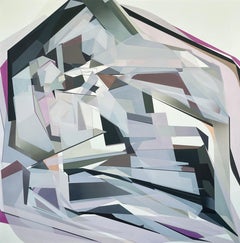
Paired
Paired

Paired

By Marna Shopoff

Located in New Orleans, LA

MARNA SHOPOFF is an Indianapolis-based visual artist with an emphasis on abstract painting and intuitive drawing. She received her Bachelor of Fine Arts degree and Master of Fine Ar...

Category

21st Century and Contemporary Contemporary Abstract Paintings

Materials

Canvas, Oil

"Triple Elvis" Denied Andy Warhol Silver Black Pop Art Painting by Charles Lutz

"Triple Elvis" Denied Andy Warhol Silver Black Pop Art Painting by Charles Lutz

By Charles Lutz

Located in Brooklyn, NY

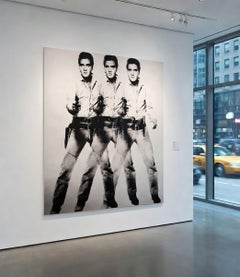
"Triple Elvis" (Denied) Silkscreen Painting by Charles Lutz Silkscreen and silver enamel paint on canvas with Artist's Denied stamp of the Andy Warhol Art Authentication Board. 82 x 72" inches 2010 This important example was shown alongside works by Warhol in a two-person show "Warhol Revisited (Charles Lutz / Andy Warhol)" at UAB Abroms-Engel Institute for the Visual Arts in 2024. Lutz's 2007 ''Warhol Denied'' series gained international attention by calling into question the importance of originality or lack thereof in the work of Andy Warhol. The authentication/denial process of the [[Andy Warhol Art Authentication Board]] was used to create value by submitting recreations of Warhol works for judgment with the full intention for the works to be formally marked "DENIED". The final product of the conceptual project being "officially denied" "Warhol" paintings authored by Lutz. Based on the full-length Elvis Presley paintings by Pop Artist Andy Warhol in 1964, this is likely one of his most iconic images, next to Campbell's Soup Cans and portraits of Jackie Kennedy, Marilyn Monroe, Liz Taylor, and Marlon Brando. This is the rarest of the Elvis works from the series, as Lutz sourced a vintage roll of 1960's primed artist linen which was used for this one Elvis. The silkscreen, like Warhol's embraced imperfections, like the slight double image printing of the Elvis image. Lutz received his BFA in Painting and Art History from Pratt Institute and studied Human Dissection and Anatomy at Columbia University, New York. Lutz's work deals with perceptions and value structures, specifically the idea of the transference of values. Lutz's most recently presented an installation of new sculptures dealing with consumerism at Frank Lloyd Wright's Fallingwater House in 2022. Lutz's 2007 Warhol Denied series received international attention calling into question the importance of originality in a work of art. The valuation process (authentication or denial) of the Andy Warhol Art Authentication Board was used by the artist to create value by submitting recreations of Warhol works for judgment, with the full intention for the works to be formally marked "DENIED" of their authenticity. The final product of this conceptual project is "Officially DENIED" "Warhol" paintings authored by Lutz. Later in 2013, Lutz went on to do one of his largest public installations to date. At the 100th Anniversary of Marcel Duchamp's groundbreaking and controversial Armory Show, Lutz was asked by the curator of Armory Focus: USA and former Director of The Andy Warhol Museum, Eric Shiner to create a site-specific installation representing the US. The installation "Babel" (based on Pieter Bruegel's famous painting) consisted of 1500 cardboard replicas of Warhol's Brillo Box (Stockholm Type) stacked 20 ft tall. All 1500 boxes were then given to the public freely, debasing the Brillo Box as an art commodity by removing its value, in addition to debasing its willing consumers. Elvis was "the greatest cultural force in the Twentieth Century. He introduced the beat to everything, and he changed everything - music, language, clothes, it's a whole new social revolution." Leonard Bernstein in: Exh. Cat., Boston, The Institute of Contemporary Art and traveling, Elvis + Marilyn 2 x Immortal, 1994-97, p. 9. Andy Warhol "quite simply changed how we all see the world around us." Kynaston McShine in: Exh. Cat., New York, Museum of Modern Art (and traveling), Andy Warhol: Retrospective, 1996, p. 13. In the summer of 1963 Elvis Presley was just twenty-eight years old but already a legend of his time. During the preceding seven years - since Heartbreak Hotel became the biggest-selling record of 1956 - he had recorded seventeen number-one singles and seven number-one albums; starred in eleven films, countless national TV appearances, tours, and live performances; earned tens of millions of dollars; and was instantly recognized across the globe. The undisputed King of Rock and Roll, Elvis was the biggest star alive: a cultural phenomenon of mythic proportions apparently no longer confined to the man alone. As the eminent composer Leonard Bernstein put it, Elvis was "the greatest cultural force in the Twentieth Century. He introduced the beat to everything, and he changed everything - music, language, clothes, it's a whole new social revolution." (Exh. Cat., Boston, The Institute of Contemporary Art (and traveling), Elvis + Marilyn 2 x Immortal, 1994, p. 9). In the summer of 1963 Andy Warhol was thirty-four years old and transforming the parameters of visual culture in America. The focus of his signature silkscreen was leveled at subjects he brilliantly perceived as the most important concerns of day to day contemporary life. By appropriating the visual vernacular of consumer culture and multiplying readymade images gleaned from newspapers, magazines and advertising, he turned a mirror onto the contradictions behind quotidian existence. Above all else he was obsessed with themes of celebrity and death, executing intensely multifaceted and complex works in series that continue to resound with universal relevance. His unprecedented practice re-presented how society viewed itself, simultaneously reinforcing and radically undermining the collective psychology of popular culture. He epitomized the tide of change that swept through the 1960s and, as Kynaston McShine has concisely stated, "He quite simply changed how we all see the world around us." (Exh. Cat., New York, Museum of Modern Art (and traveling), Andy Warhol: Retrospective, 1996, p. 13). Thus in the summer of 1963 there could not have been a more perfect alignment of artist and subject than Warhol and Elvis. Perhaps the most famous depiction of the biggest superstar by the original superstar artist, Double Elvis is a historic paradigm of Pop Art from a breath-taking moment in Art History. With devastating immediacy and efficiency, Warhol's canvas seduces our view with a stunning aesthetic and confronts our experience with a sophisticated array of thematic content. Not only is there all of Elvis, man and legend, but we are also presented with the specter of death, staring at us down the barrel of a gun; and the lone cowboy, confronting the great frontier and the American dream. The spray painted silver screen denotes the glamour and glory of cinema, the artificiality of fantasy, and the idea of a mirror that reveals our own reality back to us. At the same time, Warhol's replication of Elvis' image as a double stands as metaphor for the means and effects of mass-media and its inherent potential to manipulate and condition. These thematic strata function in simultaneous concert to deliver a work of phenomenal conceptual brilliance. The portrait of a man, the portrait of a country, and the portrait of a time, Double Elvis is an indisputable icon for our age. The source image was a publicity still for the movie Flaming Star, starring Presley as the character Pacer Burton and directed by Don Siegel in 1960. The film was originally intended as a vehicle for Marlon Brando and produced by David Weisbart, who had made James Dean's Rebel Without a Cause in 1955. It was the first of two Twentieth Century Fox productions Presley was contracted to by his manager Colonel Tom Parker, determined to make the singer a movie star. For the compulsive movie-fan Warhol, the sheer power of Elvis wielding a revolver as the reluctant gunslinger presented the zenith of subject matter: ultimate celebrity invested with the ultimate power to issue death. Warhol's Elvis is physically larger than life and wears the expression that catapulted him into a million hearts: inexplicably and all at once fearful and resolute; vulnerable and predatory; innocent and explicit. It is the look of David Halberstam's observation that "Elvis Presley was an American original, the rebel as mother's boy, alternately sweet and sullen, ready on demand to be either respectable or rebellious." (Exh. Cat., Boston, Op. Cit.). Indeed, amidst Warhol's art there is only one other subject whose character so ethereally defies categorization and who so acutely conflated total fame with the inevitability of mortality. In Warhol's work, only Elvis and Marilyn harness a pictorial magnetism of mythic proportions. With Marilyn Monroe, whom Warhol depicted immediately after her premature death in August 1962, he discovered a memento mori to unite the obsessions driving his career: glamour, beauty, fame, and death. As a star of the silver screen and the definitive international sex symbol, Marilyn epitomized the unattainable essence of superstardom that Warhol craved. Just as there was no question in 1963, there remains still none today that the male equivalent to Marilyn is Elvis. However, despite his famous 1968 adage, "If you want to know all about Andy Warhol, just look at the surface of my paintings" Warhol's fascination held purpose far beyond mere idolization. As Rainer Crone explained in 1970, Warhol was interested in movie stars above all else because they were "people who could justifiably be seen as the nearest thing to representatives of mass culture." (Rainer Crone, Andy Warhol, New York, 1970, p. 22). Warhol was singularly drawn to the idols of Elvis and Marilyn, as he was to Marlon Brando and Liz Taylor, because he implicitly understood the concurrence between the projection of their image and the projection of their brand. Some years after the present work he wrote, "In the early days of film, fans used to idolize a whole star - they would take one star and love everything about that star...So you should always have a product that's not just 'you.' An actress should count up her plays and movies and a model should count up her photographs and a writer should count up his words and an artist should count up his pictures so you always know exactly what you're worth, and you don't get stuck thinking your product is you and your fame, and your aura." (Andy Warhol, The Philosophy of Andy Warhol (From A to B and Back Again), San Diego, New York and London, 1977, p. 86). The film stars of the late 1950s and early 1960s that most obsessed Warhol embodied tectonic shifts in wider cultural and societal values. In 1971 John Coplans argued that Warhol was transfixed by the subject of Elvis, and to a lesser degree by Marlon Brando and James Dean, because they were "authentically creative, and not merely products of Hollywood's fantasy or commercialism. All three had originative lives, and therefore are strong personalities; all three raised - at one level or another - important questions as to the quality of life in America and the nature of its freedoms. Implicit in their attitude is a condemnation of society and its ways; they project an image of the necessity for the individual to search for his own future, not passively, but aggressively, with commitment and passion." (John Coplans, "Andy Warhol and Elvis Presley," Studio International, vol. 181, no. 930, February 1971, pp. 51-52). However, while Warhol unquestionably adored these idols as transformative heralds, the suggestion that his paintings of Elvis...

Category

21st Century and Contemporary Pop Art Figurative Paintings

Materials

Enamel

Imagine

Imagine

By Marna Shopoff

Located in New Orleans, LA

MARNA SHOPOFF is an Indianapolis-based visual artist with an emphasis on abstract painting and intuitive drawing. She received her Bachelor of Fine Arts degree and Master of Fine Ar...

Category

21st Century and Contemporary Contemporary Abstract Paintings

Materials

Canvas, Ink, Oil

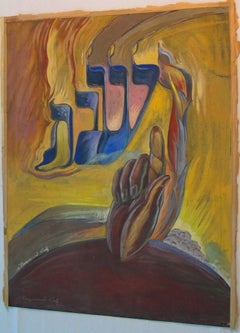
Mixed Media Sculptural Painting "Unicorn" Chicago Jewish Modernist

Mixed Media Sculptural Painting "Unicorn" Chicago Jewish Modernist

By Alexander Raymond Katz

Located in Surfside, FL

Genre: Modern Subject: Abstract Medium: Mixed Media Surface: Board Dimensions: 28.75 X 24 (size includes frame. signed with initials and bearing a label verso. Reminiscent of the Ar...

Category

Mid-20th Century Modern Mixed Media

Materials

Mixed Media

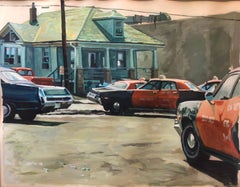
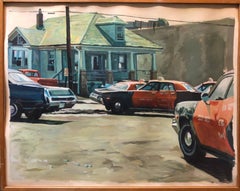
1980s Vintage American Street Scene Painting, Landscape with Taxi Cabs

1980s Vintage American Street Scene Painting, Landscape with Taxi Cabs

By Val Lewton

Located in Surfside, FL

Val Edwin Lewton (May 23, 1937 – April 24, 2015) was a painter and museum exhibition designer. As an artist, he created Realist acrylic paintings and watercolors of urban and suburba...

Category

1980s Photorealist Landscape Paintings

Materials

Acrylic, Archival Paper

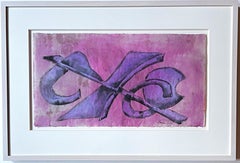
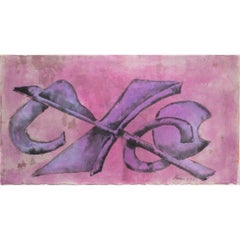
Herbert Ferber - Abstract Expressionist sculptural watercolor, Signed, Framed

Herbert Ferber - Abstract Expressionist sculptural watercolor, Signed, Framed

By Herbert Ferber

Located in New York, NY

Watercolor on paper by renowned sculptor Signed and dated 1974 on the front Provenance: Private collection of composer and art dealer Robert Aichele. This work has been elegantly fra...

Category

1970s Abstract Expressionist Abstract Drawings and Watercolors

Materials

Watercolor

Duck, Duck!---Geese! - Farm Children looking at Geese

Duck, Duck!---Geese! - Farm Children looking at Geese

By Maginel Wright Enright Barney

Located in Miami, FL

signed in orange along lower right of image Illustration for Women's World magazine, published October, 1937 Condition is good. 4.5 inch, unobtrusive vertical crease running from top down into center of image Maginel Wright Enright Barney was the sister of architect Frank Lloyd Wright and the illustrator of several children''s books, including those of L. Frank Baum...

Category

1930s Feminist Figurative Drawings and Watercolors

Materials

Watercolor, Gouache, Graphite

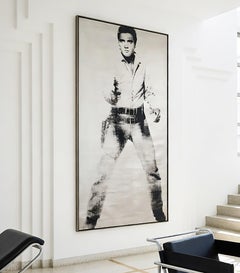
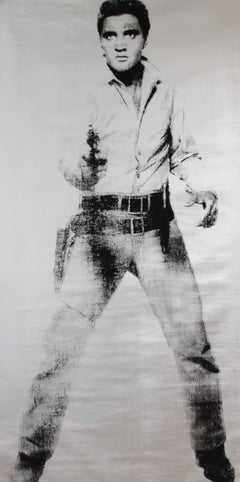
"Elvis", Denied Andy Warhol Silver & Black Pop Art Painting by Charles Lutz

"Elvis", Denied Andy Warhol Silver & Black Pop Art Painting by Charles Lutz

By Charles Lutz

Located in Brooklyn, NY

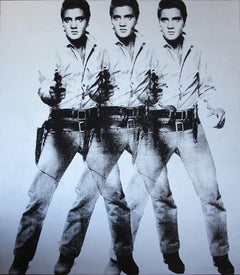
Elvis, Metallic Silver and Black Full Length Silkscreen Painting by Charles Lutz Silkscreen and silver enamel painted on vintage 1960's era linen with Artist's Denied stamp of the Andy Warhol Art Authentication Board. 82" x 40" inches 2010 Lutz's 2007 ''Warhol Denied'' series gained international attention by calling into question the importance of originality or lack thereof in the work of Andy Warhol. The authentication/denial process of the [[Andy Warhol Art Authentication Board]] was used to create value by submitting recreations of Warhol works for judgment with the full intention for the works to be formally marked "DENIED". The final product of the conceptual project being "officially denied" "Warhol" paintings authored by Lutz. Based on the full-length Elvis Presley paintings by Pop Artist Andy Warhol in 1964, this is likely one of his most iconic images, next to Campbell's Soup Cans and portraits of Jackie Kennedy, Marilyn Monroe, Liz Taylor, and Marlon Brando. This is the rarest of the Elvis works from the series, as Lutz sourced a vintage roll of 1960's primed artist linen which was used for this one Elvis. The silkscreen, like Warhol's embraced imperfections, like the slight double image printing of the Elvis image. Lutz received his BFA in Painting and Art History from Pratt Institute and studied Human Dissection and Anatomy at Columbia University, New York. Lutz's work deals with perceptions and value structures, specifically the idea of the transference of values. Lutz's most recently presented an installation of new sculptures dealing with consumerism at Frank Lloyd Wright's Fallingwater House in 2022. Lutz's 2007 Warhol Denied series received international attention calling into question the importance of originality in a work of art. The valuation process (authentication or denial) of the Andy Warhol Art Authentication Board was used by the artist to create value by submitting recreations of Warhol works for judgment, with the full intention for the works to be formally marked "DENIED" of their authenticity. The final product of this conceptual project is "Officially DENIED" "Warhol" paintings authored by Lutz. Later in 2013, Lutz went on to do one of his largest public installations to date. At the 100th Anniversary of Marcel Duchamp's groundbreaking and controversial Armory Show, Lutz was asked by the curator of Armory Focus: USA and former Director of The Andy Warhol Museum, Eric Shiner to create a site-specific installation representing the US. The installation "Babel" (based on Pieter Bruegel's famous painting) consisted of 1500 cardboard replicas of Warhol's Brillo Box (Stockholm Type) stacked 20 ft tall. All 1500 boxes were then given to the public freely, debasing the Brillo Box as an art commodity by removing its value, in addition to debasing its willing consumers. Elvis was "the greatest cultural force in the Twentieth Century. He introduced the beat to everything, and he changed everything - music, language, clothes, it's a whole new social revolution." Leonard Bernstein in: Exh. Cat., Boston, The Institute of Contemporary Art and traveling, Elvis + Marilyn 2 x Immortal, 1994-97, p. 9. Andy Warhol "quite simply changed how we all see the world around us." Kynaston McShine in: Exh. Cat., New York, Museum of Modern Art (and traveling), Andy Warhol: Retrospective, 1996, p. 13. In the summer of 1963 Elvis Presley was just twenty-eight years old but already a legend of his time. During the preceding seven years - since Heartbreak Hotel became the biggest-selling record of 1956 - he had recorded seventeen number-one singles and seven number-one albums; starred in eleven films, countless national TV appearances, tours, and live performances; earned tens of millions of dollars; and was instantly recognized across the globe. The undisputed King of Rock and Roll, Elvis was the biggest star alive: a cultural phenomenon of mythic proportions apparently no longer confined to the man alone. As the eminent composer Leonard Bernstein put it, Elvis was "the greatest cultural force in the Twentieth Century. He introduced the beat to everything, and he changed everything - music, language, clothes, it's a whole new social revolution." (Exh. Cat., Boston, The Institute of Contemporary Art (and traveling), Elvis + Marilyn 2 x Immortal, 1994, p. 9). In the summer of 1963 Andy Warhol was thirty-four years old and transforming the parameters of visual culture in America. The focus of his signature silkscreen was leveled at subjects he brilliantly perceived as the most important concerns of day to day contemporary life. By appropriating the visual vernacular of consumer culture and multiplying readymade images gleaned from newspapers, magazines and advertising, he turned a mirror onto the contradictions behind quotidian existence. Above all else he was obsessed with themes of celebrity and death, executing intensely multifaceted and complex works in series that continue to resound with universal relevance. His unprecedented practice re-presented how society viewed itself, simultaneously reinforcing and radically undermining the collective psychology of popular culture. He epitomized the tide of change that swept through the 1960s and, as Kynaston McShine has concisely stated, "He quite simply changed how we all see the world around us." (Exh. Cat., New York, Museum of Modern Art (and traveling), Andy Warhol: Retrospective, 1996, p. 13). Thus in the summer of 1963 there could not have been a more perfect alignment of artist and subject than Warhol and Elvis. Perhaps the most famous depiction of the biggest superstar by the original superstar artist, Double Elvis is a historic paradigm of Pop Art from a breath-taking moment in Art History. With devastating immediacy and efficiency, Warhol's canvas seduces our view with a stunning aesthetic and confronts our experience with a sophisticated array of thematic content. Not only is there all of Elvis, man and legend, but we are also presented with the specter of death, staring at us down the barrel of a gun; and the lone cowboy, confronting the great frontier and the American dream. The spray painted silver screen denotes the glamour and glory of cinema, the artificiality of fantasy, and the idea of a mirror that reveals our own reality back to us. At the same time, Warhol's replication of Elvis' image as a double stands as metaphor for the means and effects of mass-media and its inherent potential to manipulate and condition. These thematic strata function in simultaneous concert to deliver a work of phenomenal conceptual brilliance. The portrait of a man, the portrait of a country, and the portrait of a time, Double Elvis is an indisputable icon for our age. The source image was a publicity still for the movie Flaming Star, starring Presley as the character Pacer Burton and directed by Don Siegel in 1960. The film was originally intended as a vehicle for Marlon Brando and produced by David Weisbart, who had made James Dean's Rebel Without a Cause in 1955. It was the first of two Twentieth Century Fox productions Presley was contracted to by his manager Colonel Tom Parker, determined to make the singer a movie star. For the compulsive movie-fan Warhol, the sheer power of Elvis wielding a revolver as the reluctant gunslinger presented the zenith of subject matter: ultimate celebrity invested with the ultimate power to issue death. Warhol's Elvis is physically larger than life and wears the expression that catapulted him into a million hearts: inexplicably and all at once fearful and resolute; vulnerable and predatory; innocent and explicit. It is the look of David Halberstam's observation that "Elvis Presley was an American original, the rebel as mother's boy, alternately sweet and sullen, ready on demand to be either respectable or rebellious." (Exh. Cat., Boston, Op. Cit.). Indeed, amidst Warhol's art there is only one other subject whose character so ethereally defies categorization and who so acutely conflated total fame with the inevitability of mortality. In Warhol's work, only Elvis and Marilyn harness a pictorial magnetism of mythic proportions. With Marilyn Monroe, whom Warhol depicted immediately after her premature death in August 1962, he discovered a memento mori to unite the obsessions driving his career: glamour, beauty, fame, and death. As a star of the silver screen and the definitive international sex symbol, Marilyn epitomized the unattainable essence of superstardom that Warhol craved. Just as there was no question in 1963, there remains still none today that the male equivalent to Marilyn is Elvis. However, despite his famous 1968 adage, "If you want to know all about Andy Warhol, just look at the surface of my paintings" Warhol's fascination held purpose far beyond mere idolization. As Rainer Crone explained in 1970, Warhol was interested in movie stars above all else because they were "people who could justifiably be seen as the nearest thing to representatives of mass culture." (Rainer Crone, Andy Warhol, New York, 1970, p. 22). Warhol was singularly drawn to the idols of Elvis and Marilyn, as he was to Marlon Brando and Liz Taylor, because he implicitly understood the concurrence between the projection of their image and the projection of their brand. Some years after the present work he wrote, "In the early days of film, fans used to idolize a whole star - they would take one star and love everything about that star...So you should always have a product that's not just 'you.' An actress should count up her plays and movies and a model should count up her photographs and a writer should count up his words and an artist should count up his pictures so you always know exactly what you're worth, and you don't get stuck thinking your product is you and your fame, and your aura." (Andy Warhol, The Philosophy of Andy Warhol (From A to B and Back Again), San Diego, New York and London, 1977, p. 86). The film stars of the late 1950s and early 1960s that most obsessed Warhol embodied tectonic shifts in wider cultural and societal values. In 1971 John Coplans argued that Warhol was transfixed by the subject of Elvis, and to a lesser degree by Marlon Brando and James Dean, because they were "authentically creative, and not merely products of Hollywood's fantasy or commercialism. All three had originative lives, and therefore are strong personalities; all three raised - at one level or another - important questions as to the quality of life in America and the nature of its freedoms. Implicit in their attitude is a condemnation of society and its ways; they project an image of the necessity for the individual to search for his own future, not passively, but aggressively, with commitment and passion." (John Coplans, "Andy Warhol and Elvis Presley," Studio International, vol. 181, no. 930, February 1971, pp. 51-52). However, while Warhol unquestionably adored these idols as transformative heralds, the suggestion that his paintings of Elvis are uncritical of a generated public image issued for mass consumption fails to appreciate the acuity of his specific re-presentation of the King. As with Marilyn, Liz and Marlon, Warhol instinctively understood the Elvis brand as an industrialized construct, designed for mass consumption like a Coca-Cola bottle or Campbell's Soup Can, and radically revealed it as a precisely composed non-reality. Of course Elvis offered Warhol the biggest brand of all, and he accentuates this by choosing a manifestly contrived version of Elvis-the-film-star, rather than the raw genius of Elvis as performing Rock n' Roll pioneer. A few months prior to the present work he had silkscreened Elvis' brooding visage in a small cycle of works based on a simple headshot, including Red Elvis, but the absence of context in these works minimizes the critical potency that is so present in Double Elvis. With Double Elvis we are confronted by a figure so familiar to us, yet playing a role relating to violence and death that is entirely at odds with the associations entrenched with the singer's renowned love songs. Although we may think this version of Elvis makes sense, it is the overwhelming power of the totemic cipher of the Elvis legend that means we might not even question why he is pointing a gun rather than a guitar. Thus Warhol interrogates the limits of the popular visual vernacular, posing vital questions of collective perception and cognition in contemporary society. The notion that this self-determinedly iconic painting shows an artificial paradigm is compounded by Warhol's enlistment of a reflective metallic surface, a treatment he reserved for his most important portraits of Elvis, Marilyn, Marlon and Liz. Here the synthetic chemical silver paint becomes allegory for the manufacture of the Elvis product, and directly anticipates the artist's 1968 statement: "Everything is sort of artificial. I don't know where the artificial stops and the real starts. The artificial fascinates me, the bright and shiny..." (Artist quoted in Exh. Cat., Stockholm, Moderna Museet and traveling, Andy Warhol, 1968, n.p.). At the same time, the shiny silver paint of Double Elvis unquestionably denotes the glamour of the silver screen and the attractive fantasies of cinema. At exactly this time in the summer of 1963 Warhol bought his first movie camera and produced his first films such as Sleep, Kiss and Tarzan and Jane Regained. Although the absence of plot or narrative convention in these movies was a purposely anti-Hollywood gesture, the unattainability of classic movie stardom still held profound allure and resonance for Warhol. He remained a celebrity and film fanatic, and it was exactly this addiction that so qualifies his sensational critique of the industry machinations behind the stars he adored. Double Elvis was executed less than eighteen months after he had created 32 Campbell's Soup Cans for his immortal show at the Ferus Gallery, Los Angeles in July and August 1962, and which is famously housed in the Museum of Modern Art, New York. In the intervening period he had produced the series Dollar Bills, Coca-Cola Bottles, Suicides, Disasters, and Silver Electric Chairs, all in addition to the portrait cycles of Marilyn and Liz. This explosive outpouring of astonishing artistic invention stands as definitive testament to Warhol's aptitude to seize the most potent images of his time. He recognized that not only the product itself, but also the means of consumption - in this case society's abandoned deification of Elvis - was symptomatic of a new mode of existence. As Heiner Bastian has precisely summated: "the aura of utterly affirmative idolization already stands as a stereotype of a 'consumer-goods style' expression of an American way of life and of the mass-media culture of a nation." (Exh. Cat., Berlin, Neue Nationalgalerie (and traveling), Andy Warhol: Retrospective, 2001, p. 28). For Warhol, the act of image replication and multiplication anaesthetized the effect of the subject, and while he had undermined the potency of wealth in 200 One Dollar Bills, and cheated the terror of death by electric chair in Silver Disaster # 6, the proliferation of Elvis here emasculates a prefabricated version of character authenticity. Here the cinematic quality of variety within unity is apparent in the degrees to which Presley's arm and gun become less visible to the left of the canvas. The sense of movement is further enhanced by a sense of receding depth as the viewer is presented with the ghost like repetition of the figure in the left of the canvas, a 'jump effect' in the screening process that would be replicated in the multiple Elvis paintings. The seriality of the image heightens the sense of a moving image, displayed for us like the unwinding of a reel of film. Elvis was central to Warhol's legendary solo exhibition organized by Irving Blum at the Ferus Gallery in the Fall of 1963 - the show having been conceived around the Elvis paintings since at least May of that year. A well-known installation photograph shows the present work prominently presented among the constant reel of canvases, designed to fill the space as a filmic diorama. While the Elvis canvases...

Category

21st Century and Contemporary Pop Art Figurative Paintings
Materials

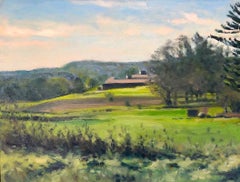
Enamel

Phenomena Entreat the Caves by Paul Jenkins - Abstract Expressionist painting

Phenomena Entreat the Caves by Paul Jenkins - Abstract Expressionist painting

By Paul Jenkins

Located in London, GB

Phenomena Entreat the Caves by Paul Jenkins (1923-2012) Acrylic on canvas 61 x 50 cm (24 x 19 ³/₄ inches) Signed lower left, Paul Jenkins Executed in 1998-2001 Provenance: Private collection, Italy Literature: Prato, Galleria Open Art, Paul Jenkins, 12 November 2005 - 31 January 2006, p. 61 (illustrated) Artist biography: Born at Kansas City in Missouri (USA), the multi-media artist, poet and playwright Paul Jenkins studied at the Kansas City Art Institute and the Art Students League in New York City. After his discharge from military service at the end of February 1946, he briefly studied playwriting with dramatist George McCalmon at the Carnegie Institute of Technology in Pittsburgh. Thereafter, Jenkins spent four years studying with Japanese American artist Yasuo Kuniyoshi in New York City. His first solo exhibitions were held at Studio Paul Facchetti in Paris in 1954 and the Martha Graham Gallery in New York City in 1956. Over the past thirty years, numerous retrospectives have been curated across the globe and Jenkins’ work can found in national collections from Europe and the United States to Israel, Australia and Japan. The diversity of his work springs from Jenkins’ wealth of eclectic influences. Some of his earliest works included what he called "interior landscapes" influenced by ancient natural forms like the caves he visited in the Ozark Mountains in his native-Missouri. Frequent student visits to the Frick Collection in New York fostered a love of the great masters: Bellini, Holbein, Vermeer, Rembrandt, de la Tour, Turner and Goya. In compliment, lingering student visits to the renowned Eastern collection of the Nelson-Atkins Museum of Art in Kansas City evoked powerful sympathy for a monumental Chinese fresco...

Category

Late 20th Century Abstract Expressionist Abstract Paintings

Materials

Canvas, Acrylic

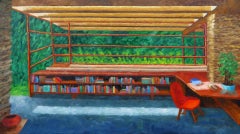
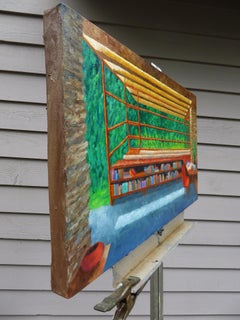
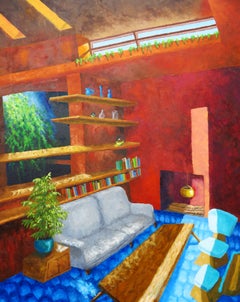
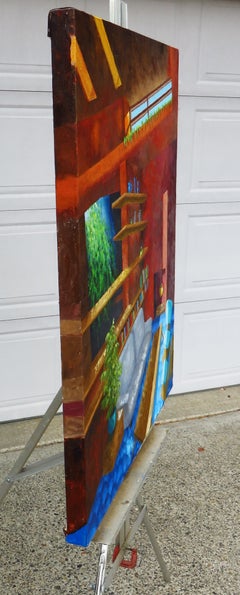
Horizontality, Oil Painting

Horizontality, Oil Painting

By Mitchell Freifeld

Located in San Francisco, CA

Artist Comments
A quiet, serene, and intimate space invites moments of study or quiet reflection beneath the light streaming through the skylights. Treasured volumes line the b...

Category

21st Century and Contemporary Contemporary Interior Paintings

Materials

Oil

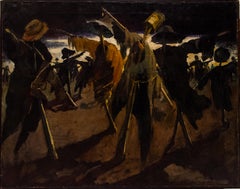
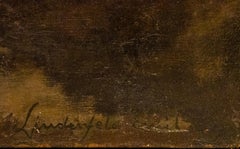
Congress of Scarecrows

Congress of Scarecrows

Located in New York, NY

Emil Lindenfeld (Hungarian-American, 1905-1986) Spaventa Passeri al Congresso (Congress of Scare Crows), 20th century Oil on canvas 53 1/4 x 41 in. Sig...

Category

Early 20th Century Modern Landscape Paintings

Materials

Canvas, Oil

Cut Work, Metal Large Wall Abstract Sculpture: 'Silver Metal-In'

Cut Work, Metal Large Wall Abstract Sculpture: 'Silver Metal-In'

By Elizabeth Gregory-Gruen

Located in New York, NY

“CUT WORK” is an evolving examination of emotion experienced through the inspired meeting of blade and paper. Beginning with the featureless plane of a blank paper canvas and a surge...

Category

2010s Contemporary Abstract Paintings

Materials

Metal

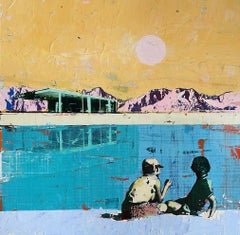
Across the Pool - Painting of two children next to swimming pool and mountains

Across the Pool - Painting of two children next to swimming pool and mountains

Located in Dallas, TX

"Across the Pool" by Dan Parry Jones. Comes with a custom white wooden frame. Two young children sit at the edge of a tranquil pool, basking under the radiant glow of a full sun as i...

Category

2010s Contemporary Figurative Paintings

Materials

Mixed Media, Acrylic, Board

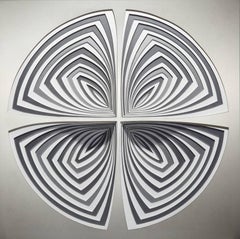
Abstract Metal Wall Sculpture: '4 Piece Circle-In #2'

Abstract Metal Wall Sculpture: '4 Piece Circle-In #2'

By Elizabeth Gregory-Gruen

Located in New York, NY

“CUT WORK” is an evolving examination of emotion experienced through the inspired meeting of blade and paper. Beginning with the featureless plane of a blank paper canvas and a surge...

Category

2010s Contemporary Abstract Paintings

Materials

Metal, Aluminum

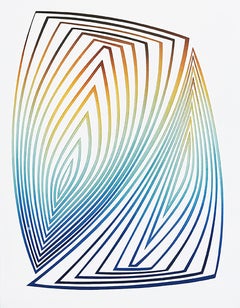
Freehand Cut with Surgical Scalpel on 2 ply Museum Board: 'Blue Yellow Stripe-In

Freehand Cut with Surgical Scalpel on 2 ply Museum Board: 'Blue Yellow Stripe-In

By Elizabeth Gregory-Gruen

Located in New York, NY

“CUT WORK” is an evolving examination of emotion experienced through the inspired meeting of blade and paper. Beginning with the featureless plane of a blank paper canvas and a surge...

Category

2010s Contemporary Abstract Paintings

Materials

Plexiglass, Gouache, Adhesive

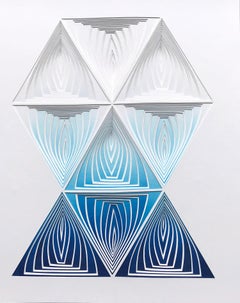
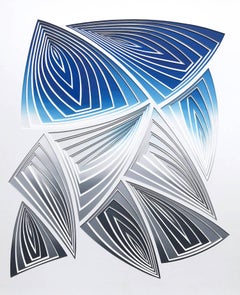
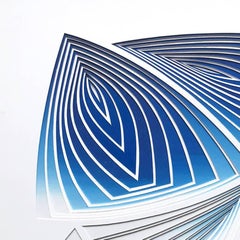
Freehand Cut with Surgical Scalpel, Silk-Screened: 'Blue Blend Triangle '

Freehand Cut with Surgical Scalpel, Silk-Screened: 'Blue Blend Triangle '

By Elizabeth Gregory-Gruen

Located in New York, NY

“CUT WORK” is an evolving examination of emotion experienced through the inspired meeting of blade and paper. Beginning with the featureless plane of a blank paper canvas and a surge...

Category

2010s Contemporary Abstract Paintings

Materials

Plexiglass, Adhesive, Acrylic, Board

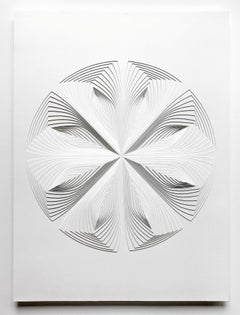
Free Hand Cut Work on 2 ply museum board: 'Multi-Circle Reflection'

Free Hand Cut Work on 2 ply museum board: 'Multi-Circle Reflection'

By Elizabeth Gregory-Gruen

Located in New York, NY

“CUT WORK” is an evolving examination of emotion experienced through the inspired meeting of blade and paper. Beginning with the featureless plane of a blank paper canvas and a surge...

Category

2010s Contemporary Abstract Paintings

Materials

Plexiglass, Board

Amaranth and Blue

Amaranth and Blue

By Marna Shopoff

Located in New Orleans, LA

MARNA SHOPOFF is an Indianapolis-based visual artist with an emphasis on abstract painting and intuitive drawing. She received her Bachelor of Fine Arts degree and Master of Fine Ar...

Category

21st Century and Contemporary Abstract Geometric Abstract Paintings

Materials

Canvas, Oil

Freehand Cut with Surgical Scalpel on 2 ply Museum: Black & White Abstract - In

Freehand Cut with Surgical Scalpel on 2 ply Museum: Black & White Abstract - In

By Elizabeth Gregory-Gruen

Located in New York, NY

“CUT WORK” is an evolving examination of emotion experienced through the inspired meeting of blade and paper. Beginning with the featureless plane of a blank paper canvas and a surge...

Category

2010s Contemporary Abstract Paintings

Materials

Board, Plexiglass, Adhesive

Cut Work, Freehand Cut with Surgical Scalpel, Silk-Screened: 'Soft Fade 2-In'

Cut Work, Freehand Cut with Surgical Scalpel, Silk-Screened: 'Soft Fade 2-In'

By Elizabeth Gregory-Gruen

Located in New York, NY

“CUT WORK” is an evolving examination of emotion experienced through the inspired meeting of blade and paper. Beginning with the featureless plane of a blank paper canvas and a surge...

Category

2010s Contemporary Abstract Paintings

Materials

Plexiglass, Adhesive, Acrylic, Board

Freehand Cut with Surgical Scalpel, Silk Screened: 'All Over Blend'

Freehand Cut with Surgical Scalpel, Silk Screened: 'All Over Blend'

By Elizabeth Gregory-Gruen

Located in New York, NY

“CUT WORK” is an evolving examination of emotion experienced through the inspired meeting of blade and paper. Beginning with the featureless plane of a blank paper canvas and a surge...

Category

2010s Contemporary Abstract Paintings

Materials

Board, Plexiglass, Adhesive, Acrylic

Crystal Ball, Oil Painting

Crystal Ball, Oil Painting

By Mitchell Freifeld

Located in San Francisco, CA

Artist Comments
A softly lit mid-century interior invites quiet contemplation, with a crystal ball resting on a shelf as an intriguing focal point. The intimate space feels bot...

Category

21st Century and Contemporary Contemporary Interior Paintings

Materials

Oil

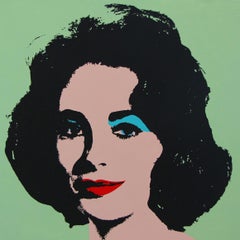
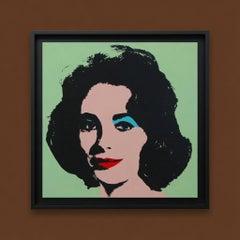
Elizabeth Taylor Denied Andy Warhol Mint Liz Painting Charles Lutz Pop Art

Elizabeth Taylor Denied Andy Warhol Mint Liz Painting Charles Lutz Pop Art

By Charles Lutz

Located in Brooklyn, NY

Denied Warhol Mint Green Liz Painting on canvas by Charles Lutz Silkscreen and acrylic paint on canvas with the artist's Denied stamp of the Andy Warhol Art Authentication Board. 40...

Category

21st Century and Contemporary Pop Art Paintings

Materials

Linen, Acrylic

Chatoyance

Chatoyance

By Marna Shopoff

Located in New Orleans, LA

MARNA SHOPOFF is an Indianapolis-based visual artist with an emphasis on abstract painting and intuitive drawing. She received her Bachelor of Fine Arts degree and Master of Fine Ar...

Category

21st Century and Contemporary Abstract Geometric Abstract Paintings

Materials

Canvas, Oil

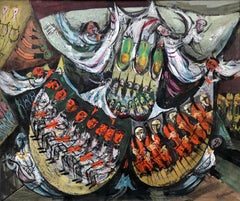
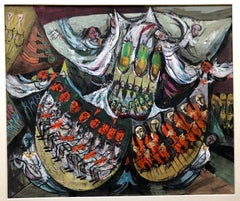
Modernist Orchestra Musical Gouache Painting Boston Expressionist

Modernist Orchestra Musical Gouache Painting Boston Expressionist

By David Aronson

Located in Surfside, FL

Very vibrant, dynamic orchestra scene reminiscent of the work of Mopp (Max Oppenheim) David Aronson, (1923-2015) son of a rabbi, was born in Lithuania in 1923 and immigrated to Amer...

Category

20th Century Expressionist Figurative Paintings
Materials

Gouache, Board

Phenomena like Byron by PAUL JENKINS - Abstract Expressionist, colour

Phenomena like Byron by PAUL JENKINS - Abstract Expressionist, colour

By Paul Jenkins

Located in London, GB

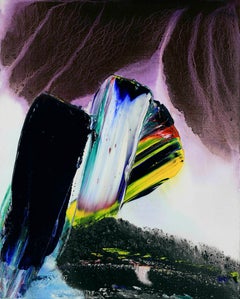
Phenomena like Byron by PAUL JENKINS (1923-2012) Acrylic on canvas 74 x 60 cm (29¹/₈ x 23⁵/₈ inches) Signed lower left, Paul Jenkins Signed, titled and dated on the reverse and on the stretcher Executed in 1990, Saint Paul Provenance Waterhouse & Dodd Fine Art, London/New York Private collection, Europe, acquired from the above in 2012 Private collection, Austria Artist biography Born in Kansas City, the multi-media artist, poet and playwright Paul Jenkins began his studies at Kansas City Art Institute and the Art Students League in New York City. After his discharge from military service at the end of February 1946, he briefly studied playwriting with dramatist George McCalmon at the Carnegie Institute of Technology in Pittsburgh. Thereafter, Jenkins spent four years studying with Japanese American artist Yasuo Kuniyoshi in New York City. His first solo exhibitions were held at Studio Paul Facchetti in Paris in 1954 and the Martha Graham Gallery in New York City in 1956. Over the past thirty years, numerous retrospectives have been curated across the globe and Jenkins’ work can found in national collections from Europe and the United States to Israel, Australia and Japan. The diversity of Jenkins’ work springs from a wealth of eclectic influences. Some of his earliest works included what he called "interior landscapes", influenced by ancient natural forms. Frequent student visits to the Frick Collection in New York fostered a love of the great masters, and lingering student visits to the renowned Eastern collection of the Nelson-Atkins Museum of Art in Kansas City evoked powerful sympathy for a monumental Chinese fresco...

Category

20th Century Abstract Expressionist Paintings
Materials

Canvas, Acrylic

Sheltered
Sheltered

Sheltered

By Marna Shopoff

Located in New Orleans, LA

MARNA SHOPOFF is an Indianapolis-based visual artist with an emphasis on abstract painting and intuitive drawing. She received her Bachelor of Fine Arts degree and Master of Fine Ar...

Category

21st Century and Contemporary Contemporary Abstract Paintings
Materials

Linen, Oil

Doubled

Doubled

By Marna Shopoff

Located in New Orleans, LA

MARNA SHOPOFF is an Indianapolis-based visual artist with an emphasis on abstract painting and intuitive drawing. She received her Bachelor of Fine Arts degree and Master of Fine Ar...

Category

21st Century and Contemporary Abstract Geometric Abstract Paintings
Materials

Canvas, Oil

Borrowing

Borrowing

By Marna Shopoff

Located in New Orleans, LA

MARNA SHOPOFF is an Indianapolis-based visual artist with an emphasis on abstract painting and intuitive drawing. She received her Bachelor of Fine Arts degree and Master of Fine Ar...

Category

21st Century and Contemporary Abstract Geometric Abstract Paintings
Materials

Canvas, Ink, Oil, Pastel, Acrylic

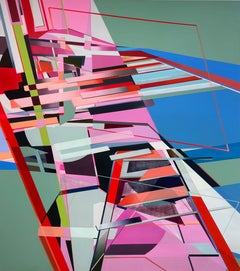
Cornered

Cornered

By Marna Shopoff

Located in New Orleans, LA

MARNA SHOPOFF is an Indianapolis-based visual artist with an emphasis on abstract painting and intuitive drawing. She received her Bachelor of Fine Arts degree and Master of Fine Ar...

Category

21st Century and Contemporary Abstract Geometric Abstract Paintings
Materials

Canvas, Oil

Suspended
Suspended

Suspended

By Marna Shopoff

Located in New Orleans, LA

MARNA SHOPOFF is an Indianapolis-based visual artist with an emphasis on abstract painting and intuitive drawing. She received her Bachelor of Fine Arts degree and Master of Fine Ar...

Category

21st Century and Contemporary Contemporary Abstract Paintings
Materials

Canvas, Oil

Paper Emporium
Paper Emporium

Paper Emporium

By Marna Shopoff

Located in New Orleans, LA

MARNA SHOPOFF is an Indianapolis-based visual artist with an emphasis on abstract painting and intuitive drawing. She received her Bachelor of Fine Arts degree and Master of Fine Ar...

Category

21st Century and Contemporary Contemporary Abstract Paintings
Materials

Canvas, Oil

Freehand Cut with Surgical Scalpel, Silk-Screened: 'Autumn_Allover_Out'

Freehand Cut with Surgical Scalpel, Silk-Screened: 'Autumn_Allover_Out'

By Elizabeth Gregory-Gruen

Located in New York, NY

“CUT WORK” is an evolving examination of emotion experienced through the inspired meeting of blade and paper. Beginning with the featureless plane of a blank paper canvas and a surge...

Category

2010s Contemporary Abstract Paintings
Materials

Plexiglass, Adhesive, Acrylic, Board

Cut Work, Freehand Cut with Surgical Scalpel, Silk-Screened: 'Autumn Fade 1-In'

Cut Work, Freehand Cut with Surgical Scalpel, Silk-Screened: 'Autumn Fade 1-In'

By Elizabeth Gregory-Gruen

Located in New York, NY

“CUT WORK” is an evolving examination of emotion experienced through the inspired meeting of blade and paper. Beginning with the featureless plane of a blank paper canvas and a surge...

Category

2010s Contemporary Abstract Paintings
Materials
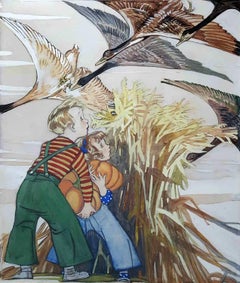
Plexiglass, Adhesive, Acrylic, Board

Cut Work, Freehand Cut with Surgical Scalpel, Silk-Screened: 'Autumn Fade 1-Out'

Cut Work, Freehand Cut with Surgical Scalpel, Silk-Screened: 'Autumn Fade 1-Out'

By Elizabeth Gregory-Gruen

Located in New York, NY

“CUT WORK” is an evolving examination of emotion experienced through the inspired meeting of blade and paper. Beginning with the featureless plane of a blank paper canvas and a surge...

Category

2010s Contemporary Abstract Paintings
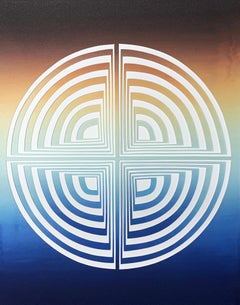
Materials

Plexiglass, Adhesive, Acrylic, Board

Cut Work, Freehand Cut with Surgical Scalpel, Silk-Screened: 'Autumn Fade 2-In'

Cut Work, Freehand Cut with Surgical Scalpel, Silk-Screened: 'Autumn Fade 2-In'

By Elizabeth Gregory-Gruen

Located in New York, NY

“CUT WORK” is an evolving examination of emotion experienced through the inspired meeting of blade and paper. Beginning with the featureless plane of a blank paper canvas and a surge...

Category

2010s Contemporary Abstract Paintings
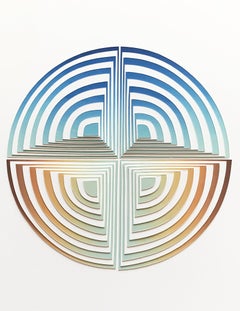
Materials

Plexiglass, Adhesive, Acrylic, Board

Freehand Cut with Surgical Scalpel, Silk-Screened: 'Autumn_Allover_In'

Freehand Cut with Surgical Scalpel, Silk-Screened: 'Autumn_Allover_In'

By Elizabeth Gregory-Gruen

Located in New York, NY

“CUT WORK” is an evolving examination of emotion experienced through the inspired meeting of blade and paper. Beginning with the featureless plane of a blank paper canvas and a surge...

Category

2010s Contemporary Abstract Paintings
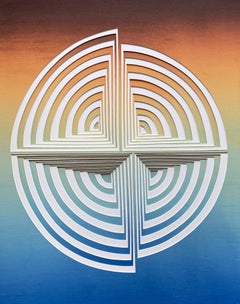
Materials

Plexiglass, Adhesive, Acrylic, Board

Cut Work, Freehand Cut with Surgical Scalpel, Silk-Screened: 'Autumn Fade 2-Out'

Cut Work, Freehand Cut with Surgical Scalpel, Silk-Screened: 'Autumn Fade 2-Out'

By Elizabeth Gregory-Gruen

Located in New York, NY

“CUT WORK” is an evolving examination of emotion experienced through the inspired meeting of blade and paper. Beginning with the featureless plane of a blank paper canvas and a surge...

Category

2010s Contemporary Abstract Paintings
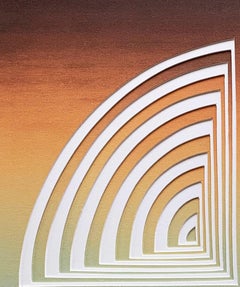
Materials

Plexiglass, Adhesive, Acrylic, Board

Freehand Cut with Surgical Scalpel, Silk-Screened: 'Autumn_Allover_Out'

Freehand Cut with Surgical Scalpel, Silk-Screened: 'Autumn_Allover_Out'

By Elizabeth Gregory-Gruen

Located in New York, NY

“CUT WORK” is an evolving examination of emotion experienced through the inspired meeting of blade and paper. Beginning with the featureless plane of a blank paper canvas and a surge...

Category

2010s Contemporary Abstract Paintings
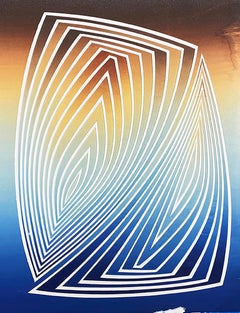
Materials

Plexiglass, Adhesive, Acrylic, Board

Cut Work, Freehand Cut with Surgical Scalpel, Silk-Screened: 'Soft Fade-Out'

Cut Work, Freehand Cut with Surgical Scalpel, Silk-Screened: 'Soft Fade-Out'

By Elizabeth Gregory-Gruen

Located in New York, NY

“CUT WORK” is an evolving examination of emotion experienced through the inspired meeting of blade and paper. Beginning with the featureless plane of a blank paper canvas and a surge...

Category

2010s Contemporary Abstract Paintings
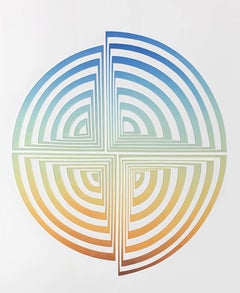
Materials

Plexiglass, Adhesive, Acrylic, Board

Cut 2 ply museum board, abstract wall sculpture: 'Orange & White Gunshot'

Cut 2 ply museum board, abstract wall sculpture: 'Orange & White Gunshot'

By Elizabeth Gregory-Gruen

Located in New York, NY

“CUT WORK” is an evolving examination of emotion experienced through the inspired meeting of blade and paper. Beginning with the featureless plane of a blank paper canvas and a surge...

Category

2010s Contemporary Abstract Paintings
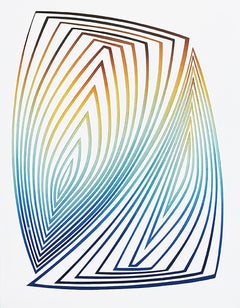
Materials

Plexiglass, Paper, Mixed Media

Cut 2 ply museum board, abstract wall sculpture: Black& White Gunshot

Cut 2 ply museum board, abstract wall sculpture: Black& White Gunshot

By Elizabeth Gregory-Gruen

Located in New York, NY

“CUT WORK” is an evolving examination of emotion experienced through the inspired meeting of blade and paper. Beginning with the featureless plane of a blank paper canvas and a surge...

Category

2010s Contemporary Abstract Paintings

Materials

Plexiglass, Paper

Free Hand Cutwork on 2 ply museum board: 'Four Piece Circle Reflection'

Free Hand Cutwork on 2 ply museum board: 'Four Piece Circle Reflection'

By Elizabeth Gregory-Gruen

Located in New York, NY

“CUT WORK” is an evolving examination of emotion experienced through the inspired meeting of blade and paper. Beginning with the featureless plane of a blank paper canvas and a surge...

Category

2010s Contemporary Abstract Paintings
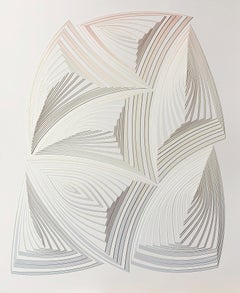
Materials
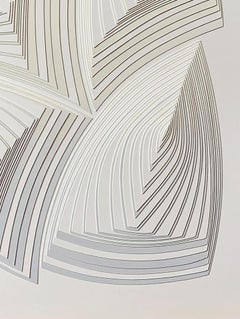
Plexiglass, Board

Freehand Cut with Surgical Scalpel, 2 ply Museum Board: Blue & Yellow Stripe-Out

Freehand Cut with Surgical Scalpel, 2 ply Museum Board: Blue & Yellow Stripe-Out

By Elizabeth Gregory-Gruen

Located in New York, NY

“CUT WORK” is an evolving examination of emotion experienced through the inspired meeting of blade and paper. Beginning with the featureless plane of a blank paper canvas and a surge...

Category

2010s Contemporary Abstract Paintings

Materials

Plexiglass, Gouache, Adhesive

Freehand Cut with Surgical Scalpel on 2 ply Museum Board: 'Cobalt MIrror -In'

Freehand Cut with Surgical Scalpel on 2 ply Museum Board: 'Cobalt MIrror -In'

By Elizabeth Gregory-Gruen

Located in New York, NY

“CUT WORK” is an evolving examination of emotion experienced through the inspired meeting of blade and paper. Beginning with the featureless plane of a blank paper canvas and a surge...

Category

2010s Contemporary Abstract Paintings

Materials

Wood, Gouache, Adhesive, Board