Drypoint Paintings

1 Result
to
1
1
Overall Width
to
Overall Height
to
1
1
1
1
1
1
1
9
2
1
1
1
1
Medium: Drypoint
Artist: Gilbert Shoenbrod
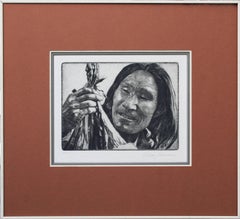
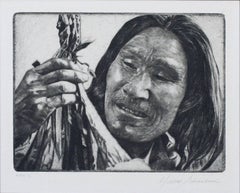
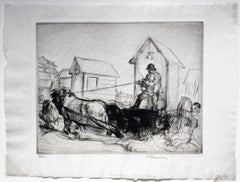
The Hunter, Mid-Century Photo Realist Drypoint Etching Portrait, Limited Edition

The Hunter, Mid-Century Photo Realist Drypoint Etching Portrait, Limited Edition

By Gilbert Schoenbrod

Located in Soquel, CA

An incredible photo-realist drypoint etching of a Native American man by Gilbert Adam Shoenbrod (American, 1903-1996), 1937. Titled "The Hunter", this hyper detailed portrait depicts...

Category

1930s Photorealist Drypoint Paintings

Materials

Drypoint

Related Items
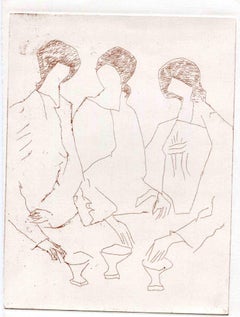
Profile Bust of a Girl - Woman's Head in Profile (Havard)

Profile Bust of a Girl - Woman's Head in Profile (Havard)

By Elie Nadelman

Located in Fairlawn, OH

Profile Bust of a Girl - Woman's Head in Profile (Havard) Drypoint, 1920 Unsigned (as issued) From: The Drypoints of Elie Nadelman, 21 unpublished prints by the sculptor, proof from ...

Category

1920s American Modern Drypoint Paintings
Materials

Drypoint

Cat with Red Claws and a Bird

Cat with Red Claws and a Bird

By Colin Self

Located in New York, NY

Once a peer of David Hockney and Peter Blake during school, Colin Self is an important contemporary British printmaker whose innovative etching techniques and novel use of found mate...

Category

Early 2000s Drypoint Paintings

Materials

Drypoint

Portrait de femme en buste, de profil a gauche, un tres large ruban noir du cou

Portrait de femme en buste, de profil a gauche, un tres large ruban noir du cou

By Paul César Helleu

Located in Fairlawn, OH

Portrait de femme en buste, de profil a gauche, un tres large ruban noir du cou, Mme Marthe Letellier Drypoint, 1900-1901 Signed in pencil lower left (see photo) Titled in pencil low...

Category

Early 1900s Impressionist Drypoint Paintings

Materials

Drypoint

Woman's Head (Vrouwekop), Marguerite Adolphine Helfrich

Woman's Head (Vrouwekop), Marguerite Adolphine Helfrich

By Jan Toorop

Located in Fairlawn, OH

Woman's Head (Vrouwekop), Marguerite Adolphine Helfrich Drypoint, 1897 Signed lower right in pencil: J Toorop; by later hand Toorop's model for this print was Marguerite Adolphine H...

Category

1890s Jugendstil Drypoint Paintings

Materials

Drypoint

Crab, Plaice and Prawns

Crab, Plaice and Prawns

By Colin Self

Located in New York, NY

A contemporary of David Hockney and Peter Blake, Colin Self is an important British printmaker whose innovative etching techniques and novel use of found materials have defined his d...

Category

Early 2000s Expressionist Drypoint Paintings

Materials

Drypoint

Indian Friendship Dance

Gene KlossIndian Friendship Dance, 1953

$2,500

H 8.19 in W 11.94 in

Indian Friendship Dance

By Gene Kloss

Located in Fairlawn, OH

Indian Friendship Dance Drypoint, 1953 Signed in pencil lower right, (see photo) Edition 200 Published by The Society of American Graphic Artists, New York An impression is in the collection of SAAM, Washington and RISD Museum, Condition: Excellent Very rich impression with burr and selective whiping of the ink for atmospheric nocturnal effect. Image/Plate size: 8 3/16 x 11 15/16 inches Sheet size: 11 1/8 x 17 inches Reference: Kloss 450 "'Indian Friendship Dance' is an eloquent statement of something which Gene Kloss has both observed and participated in. It is an Indian dance that is thought of as entertainment, rather than ceremony, but it is essentially an idea expressed in action, and an idea that has universal meaning. The young men who dance wear costumes of exquisite workmanship, intricately wrought with beads and feathers and subtle combinations of colors. The dancers are trained from childhood but develop their own steps and exhibit distinctive strength and grace. Singers and a tom-tom accompany the dance and since it usually takes place at night, a campfire is the source of light. The conclusion occurs when all the onlookers, old and young and from many places, join hands with the dancers in a slow revolving movement, while those who can, sing the difficult but meaningful Indian song that flows with the rhythmical dance step and speaks of fellowship, brotherhood, friendship." - An excerpt from a descriptive statement, written by Lynd Ward, and distributed with the drypoint at the time of publication." Courtesy Old Print Shop Born Alice Glasier in Oakland, CA, Kloss grew up amid the worldly bustle of the San Francisco Bay Area. She attended the University of California at Berkeley, graduating with honors in art in 1924. She discovered her talents in intaglio printmaking during a senior-year course in figurative drawing. The professor, Perham Nahl, held up a print from Kloss’ first plate, still damp from the printing process, and announced that she was destined to become a printmaker. In 1925, Gene married Phillips Kloss, a poet and composer who became her creative partner for life. The match was uncanny, for in her own way Gene, too, was a poet and a composer. Like poetry, her artworks capture a moment in time; like music, her compositions sing with aesthetic harmony. Although she was largely self-taught, Kloss was a printmaking virtuoso. On their honeymoon the Klosses traveled east from California, camping along the way. They spent two week is Taos Canyon – with a portable printing press cemented to a rock near their campsite – where Gene learned to appreciate the wealth of artistic subject matter in New Mexico. The landscape, the cultures, and the immense sky left an indelible impression on the couple, who returned every summer until they made Taos their permanent home 20 years later. Throughout her life, Kloss etched more than 625 copper plates, producing editions ranging from five to 250 prints. She pulled every print in every edition herself, manually cranking the wheel of her geared Sturges press until she finally purchased a motorized one when she was in her 70s. Believing that subject matter dictated technique, she employed etching, drypoint, aquatint, mezzotint, roulette, softground, and a variety of experimental approaches, often combining several techniques on the same plate. She also produced both oil and watercolor paintings. Kloss’ artworks are filled with drama. Her prints employ striking contrasts of darkness and light, and her subjects are often illuminated by mysterious light sources. Though she was a devout realist, there is also a devout abstraction on Kloss’ work that adds an almost mythical quality. For six decades Kloss documented the cultures of the region-from images of daily life to those of rarely seen ceremonies. She and her husband shared a profound respect for the land and people, which made them welcome among the Native American and Hispanic communities. Kloss never owned a camera but relied instead on observation and recollection. Her works provide an inside look at the cultures she depicted yet at the same time communicate the awe and freshness of an outsider’s perspective. Although Kloss is best known for her images of Native American and Penitente scenes, she found artistic inspiration wherever she was. During the early years of their marriage, when she and Phil returned to the Bay Area each winter to care for their aging families, she created images of the California coast. And when the Klosses moved to southwestern Colorado in 1965, she etched the mining towns and mountainous landscapes around her. In 1970 the Klosses returned to Taos and built a house north of town. Though her artwork continued to grow in popularity, she remained faithful to Taos’ Gallery A, where she insisted that owner Mary Sanchez keep the prices of her work reasonable regardless of its market value. Kloss continued to etch until 1985, when declining health made printmaking too difficult. From her first exhibition at San Francisco’s exclusive Gump’s in 1937 to her 1972 election to full membership in the National Academy of Design, Kloss experienced a selective fame. She received numerous awards, and though she is not as well known as members of the Taos Society of Artists...

Category

1950s American Realist Drypoint Paintings

Materials

Drypoint

Girl's Head - Woman's Head  (Harvard)

Girl's Head - Woman's Head (Harvard)

By Elie Nadelman

Located in Fairlawn, OH

Girl's Head - Woman's Head (Harvard) Drypoint, 1920 Unsigned (as issued) From: The Drypoints of Elie Nadelman, 21 unpublished prints by the sculptor, proof from the original zinc an...

Category

1920s American Modern Drypoint Paintings
Materials

Drypoint

Large Modernist Paris Street Scene Wine Shop Montmartre Cafe Ladies  Lithograph

Large Modernist Paris Street Scene Wine Shop Montmartre Cafe Ladies Lithograph

By Charles Levier

Located in Surfside, FL

Framed 32 x 26 image 22 x 16 Charles Levier (1920-2004) He was born in 1920 of a French father and American mother in Corsica. He held a fascination with color and form that led him...

Category

Mid-20th Century Modern Drypoint Paintings
Materials

Lithograph

Drypoint paintings for sale on 1stDibs.

Find a wide variety of authentic Drypoint paintings available on 1stDibs. While artists have worked in this medium across a range of time periods, art made with this material during the 21st Century is especially popular. If you’re looking to add paintings created with this material to introduce a provocative pop of color and texture to an otherwise neutral space in your home, the works available on 1stDibs include elements of orange and other colors. There are many well-known artists whose body of work includes ceramic sculptures. Popular artists on 1stDibs associated with pieces like this include Lenore SImon, Gilbert Shoenbrod, and Jean-Baptiste Valadie. Frequently made by artists working in the Abstract, Surrealist, all of these pieces for sale are unique and many will draw the attention of guests in your home. Not every interior allows for large Drypoint paintings, so small editions measuring 0.1 inches across are also available