1850s Paintings

143 Results
to
33
36
32
27
22
26
Overall Width
to
Overall Height
to
2,062
6,565
43,477
122,278
772
722
1,315
1,733
1,701
2,438
3,048
3,579
3,340
3,317
1,046
5
3
1
94
41
7
89
30
16
16
15
14
14
13
11
10
9
9
8
8
7
7
6
5
5
5
143
130
65
63
13
3
2
2
2
2
129
2
77
66
Period: 1850s
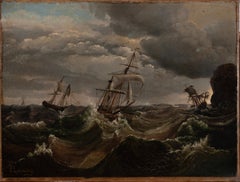
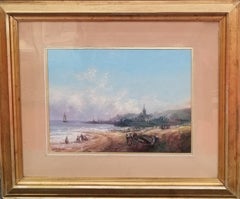
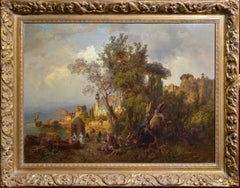
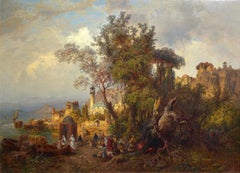
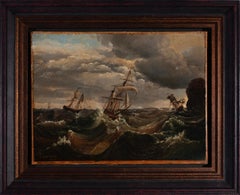
Stormy Seas
Stormy Seas

Stormy Seas

Located in Columbia, MO

Egide Linnig (1821–1860) was a Belgian painter known for his landscape and genre paintings. He was born in Antwerp, Belgium, and studied at the Royal Academy of Fine Arts in Antwerp....

Category

Naturalistic 1850s Paintings

Materials

Canvas, Oil

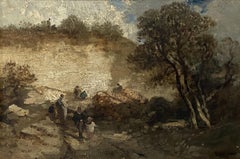
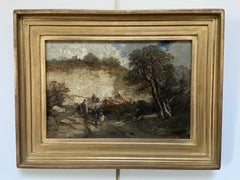
Barbizon School, Fontainebleau landscape with walkers, oil on canvas

Barbizon School, Fontainebleau landscape with walkers, oil on canvas

Located in Paris, FR

Barbizon School, French circa 1850 Fontainebleau landscape with walkers Oil on canvas 21.5 x 31 cm Framed : 32 x 41.5 cm In good condition, some minor lacks of paintings due to a former frame abrasion mainly on the right border and in the lower border (see photographs please) A view of the Forest of Fontainebleau enlivened by strolling figures, most likely depicting the sandstone quarries that drew Barbizon painters and their followers to the site. The handling is brisk and economical, capturing the rugged mineral character of the terrain — rocky outcrops and cliff faces dominating the composition — while the barely sketched silhouettes...

Category

Realist 1850s Paintings

Materials

Oil

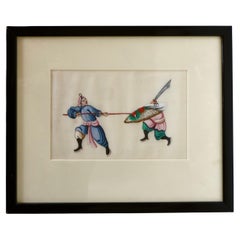
Mid 19th Century Performative Themed Chinese Framed Watercolor On Pith Paper

Mid 19th Century Performative Themed Chinese Framed Watercolor On Pith Paper

Located in Incline Village, NV

This circa 1855 Chinese hand painted pith painting portrays a Chinese tradition of a celebratory warrior dance to display fighting dominance; the two parties being a typical warrior ...

Category

Qing 1850s Paintings

Materials

Watercolor, Rice Paper

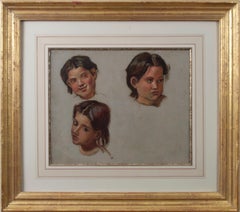
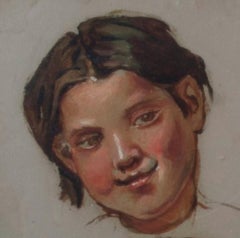
Three Head Portraits of a Young Girl

Three Head Portraits of a Young Girl

Located in Fairlawn, OH

Hippolyte Roques (active 1838-1864) Three Head Portraits of a Young Girl Oil on grey wove paper, c. 1850 Unsigned Provenance: Estate of the artist Shepherd Galle...

Category

Romantic 1850s Paintings

Materials

Oil

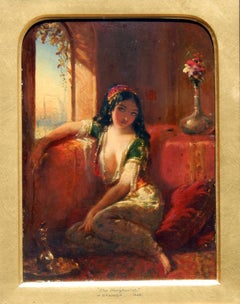
Henry Stanier British Born Artist, Beautiful Orientalist Painting, 1859

Henry Stanier British Born Artist, Beautiful Orientalist Painting, 1859

Located in Phoenix, AZ

Orientalist oil on board by Henry Stanier (1831-1894) in the ornate original frame. Titled “The Narghuileh” and dated 1859. Signed on the verso Stanier and initialed H.S. Titled on ...

Category

1850s Paintings

Materials

Oil, Panel

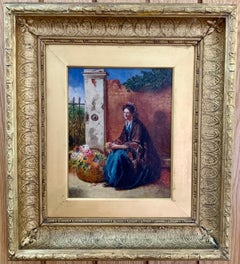
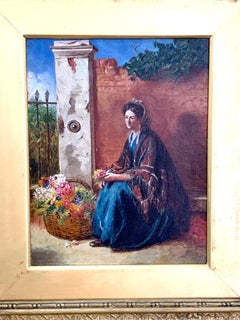
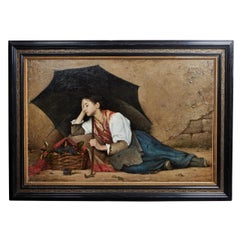
"Violette" Oil on Canvas

"Violette" Oil on Canvas

Located in Los Angeles, CA

A beautifully painted oil on canvas of a flower vendor. Signed illegibly upper right corner. Framed in an ornate ebonized and gilded frame.

Category

Other Art Style 1850s Paintings

Materials

Canvas, Paint

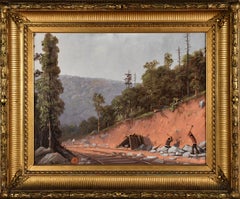
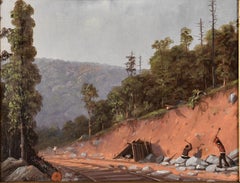
"Building the Allegheny Railroad, Pennsylvania" Alfred Wall, Scalp Level School

"Building the Allegheny Railroad, Pennsylvania" Alfred Wall, Scalp Level School

Located in New York, NY

Alfred S. Wall (American, 1825-1896) Untitled (Building the Railroad), 1859 Oil on canvas 14 1/2 x 18 1/2 inches Signed and dated lower left For Christmas, 2008, the Pittsburgh Post-Gazette featured Alfred Wall's painting, Old Saw Mill from the collection of the Westmoreland Museum of American Art in Greensburg, PA. It was painted in 1851 in the town of Lilly, Pennsylvania in the Allegheny Mountains. The newspaper description stated that "though the saw mill is long gone, it still conveys all the warmth and coziness of this time of year. The article, written by Patricia Lowry, continued: At first glance, Alfred S. Wall's painting of a saw mill in snowy woods triggers nostalgia for the coziness of a log cabin, the smell of a wood-burning fire and the warming of chilled hands and feet beside it. But as sentimental as it seems on the surface, Mr. Wall's painting has a deeper and unexpected context. This is more than a painting about sled-riding children and early industry planted in the middle of virgin forest. Intended or not, this is a painting about conquering the great divide of the Allegheny Mountains. For the third consecutive year, the Post-Gazette features a winter-scene painting on the cover of the Christmas Day newspaper. This year's painting, Old Saw Mill, was selected by co-publisher and editor-in-chief John Robinson Block and executive editor David Shribman during a visit to the Westmoreland Museum of American Art in Greensburg. Mr. Wall, listed as a portrait painter in the 1850 census, was about 26 when he painted Old Saw Mill in 1851. The self-taught artist was born in Mount Pleasant, Westmoreland County, to William and Lucy Wall, who'd emigrated from England around 1820. An artistic sensibility ran in the family: William was a sculptor who carved ornate tombstones here; Alfred's children, A. Bryan and Bessie, were landscape painters, as was Alfred's older brother, William Coventry Wall. For more than a century the Walls formed a prominent art dynasty in Pittsburgh, and Alfred, eventually a partner in the city's most prestigious art gallery, was well known as a painter, dealer and restorer. In Old Saw Mill, two wood cutters, each holding an axe, meet outside the mill; one points in the direction of the forest. On the other side of the stream, one child pulls another down the hillside on a sled. Just behind the hill's slope, the roof of a building appears, perhaps the home of the sawyer. The luminous, late afternoon light comes from the northwest, casting lengthening shadows on the snow under a darkening sky. The saw mill in "Old Saw Mill" likely would have been impossible to track down had Mr. Wall, presumably, not written on the back of the painting: "old saw mill near Jct. 4, Portage RR, Pa." "There was no Junction 4," said Mike Garcia, park ranger at the Allegheny Portage Railroad National Historic Site, about 90 miles east of Pittsburgh near Gallitzen, Cambria County. "But there was an Inclined Plane No. 4 at Lilly, and there was a saw mill there." In fact, there were at least six saw mills at Lilly over the years, said longtime resident Jim Salony, president of the Lilly-Washington Historical Society. But when he saw an image of the painting, Mr. Salony had no trouble coming up with a location. While there are no known photographs of the saw mill, he believes it stood near the intersection of Portage and Washington streets, next to Bear Rock Run. Mr. Salony, retired academic dean at Mount Aloysius College, didn't know exactly when the mill was torn down, but it's been gone since at least the late 1800s. He was pleased to learn of the painting, even though that knowledge came too late for inclusion in a new book about Lilly, The Spirit of a Community, for which he served as primary author and editor. It runs to more than 700 pages. For a little town -- population 869 last year -- Lilly has a lot of history. Nestled in a bowl on the western slope of the Allegheny Mountains about 3 miles south of Cresson, Lilly was first settled in 1806 by Joseph Meyer and his family, who named their 332-acre land patent Dundee. Although the Meyers had left by 1811, other settlers followed, but the community didn't flourish until the 1830s, when the Allegheny Portage Railroad began its 23-year-run through the town. For 200 years the Alleghenies had stood as an impediment to trade and travel between Pittsburgh and the east. A canal from Philadelphia to Pittsburgh would change that and compete with New York's Erie Canal. But a portage railroad would have to be built, on which teams of horses would lead the canal boats over the mountains. Engineer Sylvester Welch began his surveying from the small settlement at Lilly. The railroad would require 10 inclined planes, some quite steep, between Hollidaysburg and Johnstown. To build it, trees had to be cut along a 120-foot-wide right-of-way for 36 miles, along which track and engine houses had to be built. William Brown, who owned the saw mill on Bear Rock Run, built at least one of the engine houses at Inclined Plane No. 4; an 1834 contract also included fencing the dwelling lots at the head and foot of the plane. Lilly is located at what was the foot of Inclined Plane No. 4., giving the community one of its early informal names, Foot of Four. Named in 1883 for Richard Lilly, who'd completed the grist mill there, Lilly had another early name: Hemlock, so dubbed by a Portage Railroad traveler who smelled the bark stripped from the trees at the saw mill. Because there isn't another Allegheny Portage Railroad location like it, where a cut in the mountains opens into a bowl, Mr. Salony thinks it was Lilly that Charles Dickens wrote about following his trip from Harrisburg to Pittsburgh on the Pennsylvania Canal in late March 1842, describing what he saw after emerging from "the bottom of the cut": "It was very pretty while traveling, to look down into a valley full of light and softness, catching glimpses through the tree-tops of scattered cabins; children running to the doors; dogs bursting out to bark, who we could see without hearing; terrified pigs scampering homeward; families sitting out in their rude gardens; cows gazing upward with a stupid indifference; men in their shirt-sleeves looking on at their unfinished houses, planning out to-morrow's work; and we riding onward, high above them, like a whirlwind." To get to Lilly, Mr. Wall may have taken the Pennsylvania Canal from his home in Allegheny City, now the North Side. He'd married young, at 21, to Sarah Carr in 1846, the same year he began his career as an artist. By 1880 they were living in a brick townhouse at 104 (later 814) Arch St., now demolished. Across the river in Pittsburgh he shared a studio at 67 Fourth Ave. with his brother William; they later moved to Burke's Building, today the city's oldest office building at 209-211 Fourth. But often they worked outdoors, sometimes as part of the colony of artists that grew up around painter George Hetzel beginning in the late 1860s at Scalp Level...

Category

Hudson River School 1850s Paintings
Materials

Canvas, Oil

The Ferry boat at Neuville sur Ain near Lyon in France

The Ferry boat at Neuville sur Ain near Lyon in France

By Antoine Ponthus-Cinier

Located in BELEYMAS, FR

Antoine-Claude PONTHUS-CINIER (Lyon, 1812 - Lyon, 1885) The Trailer Ferry at Neuville-sur-Ain Oil on canvas H. 54 cm; W. 81 cm Sale stamp lower left. Provenance: 1885, Studio Sale, No. 18 Ponthus-Cinier belongs to what could be defined as the third (and, so to speak, last) generation of neoclassical or historical landscape artists, born in the 1810s and 1820s, such as Félix Lanoüe, Achille Bénouville, Paul Flandrin, Eugène Ferdinand Buttura, and Alfred de Curzon. More specifically, he is considered the leading and most popular representative of the Lyon School of landscape artists around the mid-19th century. A generous, honest, and pleasant companion, Ponthus-Cinier came from a family of merchants on his mother's side and magistrates on his father's. Destined for commerce by his parents, he preferred the artistic path, and after enrolling at the École des Beaux-Arts in Lyon in 1829 and training in Paris with Paul Delaroche, he exhibited his first works at the Lyon Salon of 1839, before participating in the Paris Salon in 1841. That same year, he received the second Prix de Rome for historical landscapes (won by Buttura in 1837, and Bénouville in 1845), beaten by the Versailles artist Lanoüe. To perfect his skills, Ponthus-Cinier then decided to travel to Italy, alone and at his own expense, for a single stay between 1842 and 1844; He discovered the Ligurian coast, Tuscany, Naples, and, of course, Rome and its surroundings, and executed a considerable number of studies (painted sketches or pen and ink sketches) that he used to compose views of Italy throughout his career. Ponthus-Cinier's main qualities probably lie in "the art of illuminating a canvas," as A. Jouve wrote in the 19th century, and in his sense of perspective, sometimes truly extraordinary; however, he seems, most of the time, a little less brilliant in his figures and in the transcription of details. This unsigned canvas...

Category

French School 1850s Paintings
Materials

Oil, Canvas

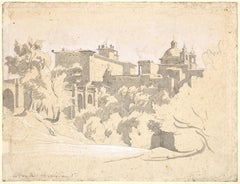
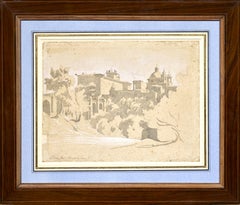
View of Ariccia, a preparatory drawing by Achille Bénouville (1815 - 1891)

View of Ariccia, a preparatory drawing by Achille Bénouville (1815 - 1891)

Located in PARIS, FR

This very modern drawing presents a view of Ariccia, a small town 25 kilometres south-east of Rome. The Palazzo Chigi (in which the film-maker Luchino Visconti would film a large part of The Leopard a century later) and the adjoining church are seen from the bottom of the ravine that surrounds the town. This drawing is a moving testimony to the attraction of the city for artists of the Romantic period, who established in Ariccia a vivid artists' colony. 1. Achille Bénouville...

Category

Romantic 1850s Paintings

Materials

Ink, Gouache, Pencil

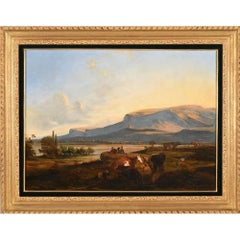
Landscape with Herd
Landscape with Herd

Landscape with Herd

Located in ROUEN, FR

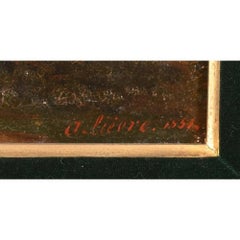
19th-century French School oil on canvas by Auguste-François Lièvre, titled “Landscape with Herd” (Paysage au troupeau). Signed and dated 1854.

Category

French School 1850s Paintings
Materials

Oil

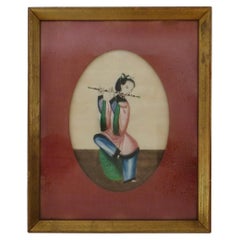
Mid 19thC. Chinese Pith Painting of A Female Flautist Framed; Oval Matte C. 1850

Mid 19thC. Chinese Pith Painting of A Female Flautist Framed; Oval Matte C. 1850

Located in Incline Village, NV

A female flautist is proudly on display in this circa 1850 Chinese watercolor pith painting; as the subject portrays an element of Chinese culture wanting to be expressed and shown t...

Category

Qing 1850s Paintings

Materials

Watercolor, Rice Paper

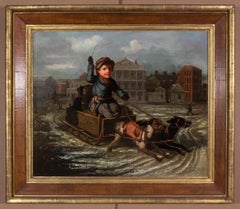
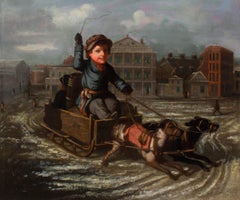
Quirky Dogsled Scene featuring Downtown Detroit in 1853

Quirky Dogsled Scene featuring Downtown Detroit in 1853

Located in Philadelphia, PA

Frederick E. Cohen (American, born England, c. 1818-1858) Boy in a Dog Sled, 1853 Oil on canvas, 25 x 30 inches Framed: 35 x 40 inches (approx.) Signed and inscribed: (on side of sle...

Category

Realist 1850s Paintings

Materials

Canvas, Oil

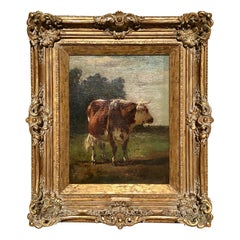
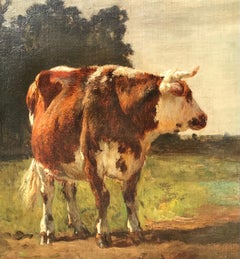
Vache En Prairie
Vache En Prairie

Vache En Prairie

By Constant Troyon

Located in Dallas, TX

Constant Troyon (French, 1810-1865) Vache en prairie Oil on canvas Canvas: 19 x 15 inches (48.3 x 38.1 cm) Framed: 28.75 x 24.75 x 3 Inches Artist's estate stamp lower right: Vente /...

Category

Barbizon School 1850s Paintings
Materials

Canvas, Oil

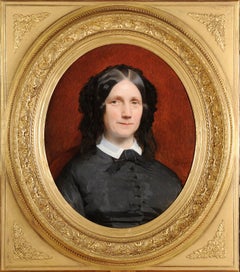
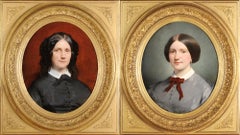
Women portraits from Napoleon III period

Women portraits from Napoleon III period

By Charles Chaplin

Located in BELEYMAS, FR

Charles CHAPLIN (Les Andelys 1825 – Paris, 1891) Portraits of women Pair of oils on rectangular canvases H. 60 cm; L. 50 cm Signed Student of Michel Martin Drolling at the École des...

Category

French School 1850s Paintings
Materials

Canvas, Oil

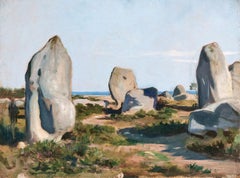
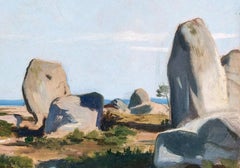
Carnac, the Druidic Stones in Brittany

Carnac, the Druidic Stones in Brittany

Located in BELEYMAS, FR

Guillaume BODINIER. Attributed to (Angers, 1795 - Angers, 1872) Carnac, the Druidic Stones Oil on paper laid down on canvas H. 26 cm ; W. 34.5 cm Unsigned 1850 Related works: severa...

Category

French School 1850s Paintings
Materials
Paper, Oil