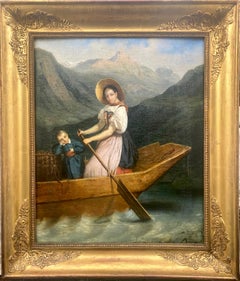
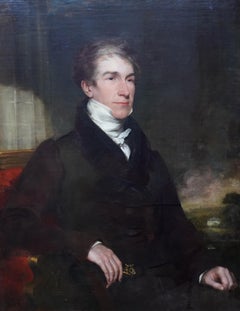
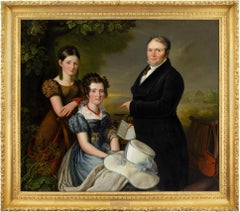
Double portrait of a brother and sister, c. 1830s
By Margaret Sarah Carpenter
Located in Henley-on-Thames, England
Margaret Sarah Carpenter (Salisbury 1793-1872 London)
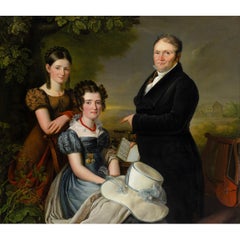
Double portrait of a brother and sister, formerly identified as the Poulett children, c. 1830s
Half-length, within a park landscape
Oil on canvas
Inscribed to the stretcher frame verso, ‘Ms Carpenter’
91.5 x 71.6 cm.; (within frame) 104.2 x 84 cm.
(Unsigned)
Provenance:
Private collection, United Kingdom;
Portobello Road, c. 2014;
Where acquired by a private collector United Kingdom;
By whom sold, Dreweatts, Old Master, British and European Art, 10 February 2026, lot 145;
Where acquired by Haveron Fine Art.
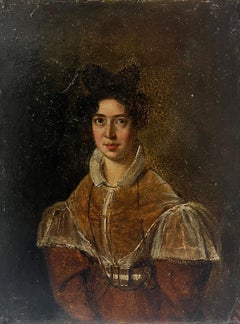
Painted by the most celebrated female artist of her generation, this charming double portrait of a brother and sister belongs to Margaret Sarah Carpenter’s highly productive output of the 1830s, and is characteristic of the accomplished duality of her child portraits. Both endearing and elegant, the siblings are pictured at the cusp of adolescence, and Carpenter navigates this moment of tender transformation with a subtlety no doubt informed by her own motherhood of five children.
The young boy embraces his elder sister with a fraternal warmth, resting his hand on her wrist with a hint of Regency Romanticism. Their cheeks are flushed with the vitality and pictorial sweetness of youth; their lips are delicately coloured; and their eyes gleam with enlivening highlights. Meanwhile, they have graduated to the fashion of young adults: the boy has been ‘breeched’, and wears a double-breasted velvet jacket with a black cravat, while his sister’s fashion is altogether adult, albeit comprising softer materials, with delicate lace trim and pink ribbons. Moreover, their knowing gaze towards the viewer speaks to a primed sensibility, and their standing within a park landscape perhaps foresees the responsibilities of familial inheritance come adulthood. It was this intuitive and measured approach which earned Carpenter a reputation that vastly exceeded those typically afforded to public women of the 19th century. Indeed, she was for a time considered the natural successor to Thomas Lawrence, whom she is rumoured to have briefly studied under.
A typewritten label affixed to the stretcher frame gives the traditional identification of the children as ‘John and Charlotte Poulett / children of / Lt. Gen. Hon. Vere Poulett’. Himself a son of Vere Poulett, 3rd Earl Poulett (1710-1788), the Hon. Vere Poulett (1761-1812) did have a number of children, including John (b. 1789) and Charlotte. However, their birthdates are not fitting with the painting’s date of creation or Carpenter’s own age, and thus leaves the children’s identities uncertain. Indeed, there is no record of any Poulett sitters in a transcript of Carpenter’s sitter book, held in the collection of the National Gallery, London (GB 1082 MSC); however, the record is by no means exhaustive, and does not include some 500 of Carpenter’s other works (particularly her child portraits). It is nonetheless apparent that the siblings’ fashion is belongs to the established classes, and the rural setting presumably suggests a landed family, possibly of noble descent.
Margaret Sarah Carpenter (Salisbury 1793-1872 London)
Carpenter was born in Salisbury to Alexander Geddes, a retired army officer, and Harriet Easton. Carpenter’s early talent was developed under the tuition of Thomas Guest (1754-1818) in Salisbury, where her skill was noticed by the 2nd Earl of Radnor, who allowed her to make copies of the Old Master pictures at Longford Castle. On Lord Radnor’s advice, Carpenter sent pictures for three successive years to the Royal Society of Arts, receiving a public acknowledgement for each as well as gold medals in 1813 and 1814. Aged 21, Carpenter moved to London in 1814 with Radnor’s funding, and established her early practise in his London residence. That same year, she first exhibited at the Royal Academy and British Institution. Her works received high praise in the press, and some pictures were acquired by the Marquess of Strafford, an influential patron of the arts. Her works were heavily influenced by Lawrence and Reynolds, and it is possible that she studied for a year under Lawrence in 1812. Indeed, she later finished Lawrence’s portrait of Mrs Brandling.
Carpenter married William Carpenter in 1817, who later became Keeper of Prints at the British Museum. Together, their five surviving children included artists William, Percy, and Jane Henrietta ‒ a model for some of her mother’s most tender portraits. Carpenter enjoyed a broad professional and social circle, being a close friend of Richard Parkes Bonington, and being reasonably well-acquainted with Constable ‒ who suspected that her incessant work was resulting in physical problems for her, as well as the neglect of her children (Gaze, p. 350). She introduced her sister Harriet to the artist William Collins RA...
Category
English School 1830s Art